Plisio Review: Fees, No-KYC Sign-Up, Custody and Plugins
Plisio charges 0.5% (1.5% with White Label), holds your funds and says it needs no ID. Fees, coins, 19 plugins and gaps, checked 6 Oct 2026.
 Kevin Richards
The Short Answer
- Cost: 0.5% per payment through Plisio's API and plugins, or 1.5% with its White Label checkout. There is no setup or monthly fee. Withdrawals cost the blockchain network fee.
- Who holds the money: Plisio does. Payments land in your Plisio balance and you withdraw them in crypto. There is no bank payout.
- Verification: sign-up needs an email and password, and Plisio's FAQ says: "Our service does not require identification." Its terms still let it suspend accounts and freeze them at a regulator's request.
- Who can't use it: sanctioned people and anyone in a country under US sanctions. Its terms name Cuba, Iran, North Korea, Sudan and Syria. Its homepage lists "Adult" and "High Risk" among the industries it serves.
- Gaps: no Shopify app, no subscription billing, and its WooCommerce plugin on WordPress.org is flagged as untested with the last three major WordPress releases.
- Suits: merchants on WooCommerce, WHMCS, Magento or one of its other supported carts who want a low-fee crypto checkout without ID checks and will withdraw often.
Last checked: 6 October 2026. We read Plisio's pricing, product, integrations, affiliate and security pages, its FAQ, its API documentation and its Terms of Use. We also checked its WooCommerce plugin on WordPress.org, searched the Shopify App Store, and looked at its GitHub account, its domain record and its Trustpilot page. We did not open an account or make a payment, so nothing here is a first-hand checkout, payout or support test.
Affiliate disclosure: Payyd earns a commission if you sign up to Plisio through the links on this page. It does not change what we report here.
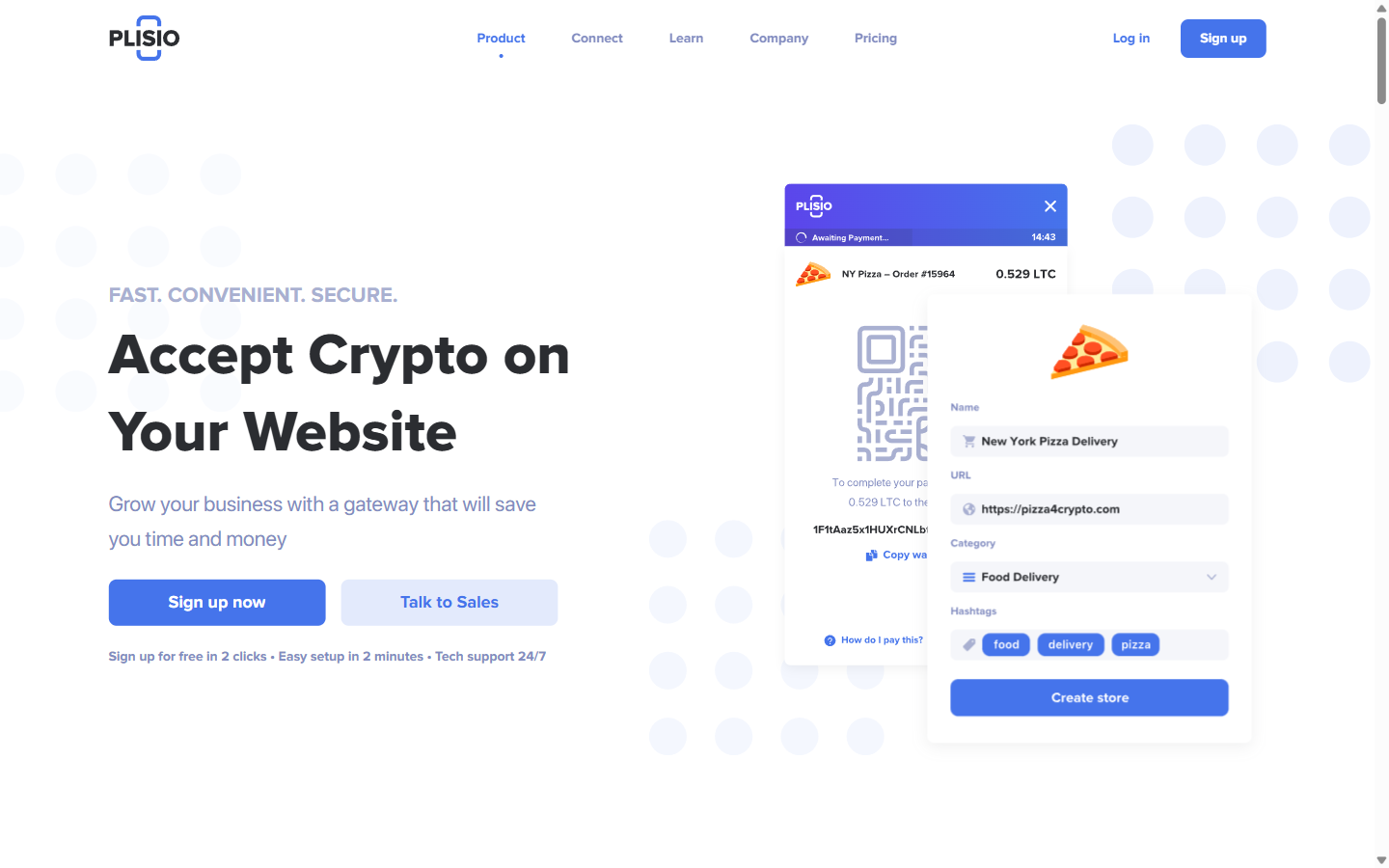
Plisio (plisio.net) is a hosted crypto payment gateway. It combines a merchant wallet with API invoices, plugins for 19 shopping carts and billing systems, an optional White Label checkout, no-code invoices, donation pages and mass payouts. This review covers what it costs, who holds your money, what Plisio asks of you, and where it falls short.
What Plisio Costs
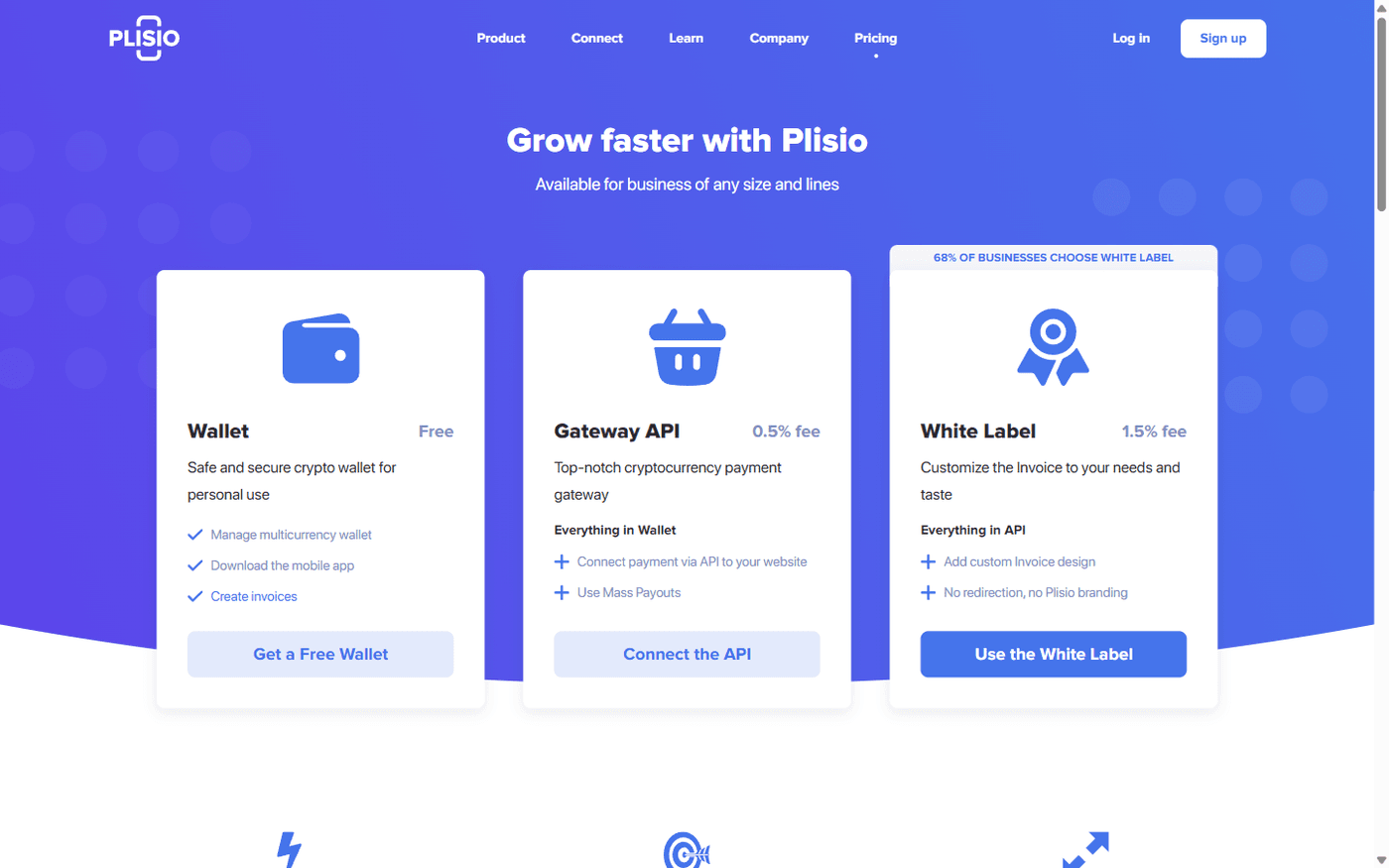
Plisio's pricing page lists three plans. The Wallet is free. Gateway API costs 0.5% per transaction and covers payments through the API and plugins, plus mass payouts. White Label costs 1.5%, which Plisio's FAQ breaks down as "Invoicing - 0.5% + White Label 1%". The homepage adds: "No monthly, setup or hidden fees."
You choose who pays the fee. In the API settings you decide whether you or your customer pays Plisio's commission. If the customer pays, it is added to the invoice total.
ETH and ERC-20 tokens have their own rate. Plisio's FAQ says their fee "is different" but gives no figure. If you expect a lot of ETH, or USDT and USDC on Ethereum, get the rate from support in writing.
Withdrawals cost the network fee. Plisio's withdrawal FAQ describes only network fees, at "Normal" or "Priority" speed. Its fee-estimate API, though, returns both a network fee and a "Plisio commission" for withdrawals and mass payouts, without saying when that commission is above zero. Run the estimate before a large withdrawal.
Token withdrawals need gas in the native coin. Withdrawing USDT on Tron needs a TRX balance, tokens on Ethereum need ETH, and tokens on BNB Smart Chain need BNB.
Enterprise and exchange. Larger merchants can ask support for an Enterprise plan with a "Lower fee" and a personal manager. One of its individually set requirements is "placing the Plisio logo on the Partners block of your website". Plisio also lets you exchange currencies inside your account but publishes no exchange fee or spread. For context, see our crypto gateway fee comparison and the cheapest crypto gateways.
Who Holds the Money
Plisio is custodial. Its pricing page says "Payments received from your customers are sent automatically to your account", meaning your Plisio balance, and you withdraw from there in the dashboard or through the API. Plisio says "90% of funds are stored In cold wallets" and that its employees "do not have access to these funds". Its security page cites no audit or proof of reserves to back that.
The Terms of Use, last updated on 12 March 2019, give Plisio room to act on your balance:
- Plisio "reserves the right to change the limits on deposits, withdrawals, conversions, storage and speed in your account".
- It can freeze an account "in case of a request from state regulatory authorities until further clarification of the circumstances".
- It can suspend or close accounts for inactivity or breaking the terms. You can still withdraw what remains unless a law or court order prevents it.
- After 180 days with no activity, Plisio may move an account's funds to cold storage, and you must contact support to get them back.
- Disputes go to binding arbitration under the rules of net-ARB.com, and the terms say the decision "cannot be appealed".
If you want payments to go straight to your own wallet, see our list of non-custodial crypto gateways.
Verification, Terms and Who Can't Use It
No identity check, by Plisio's own account. Its FAQ answers "Do I need to confirm my identity?" with "No. Our service does not require identification." The homepage says "No proof of identity needed", and the affiliate page says Plisio does "not require documentary verification". To register, you enter an email and password and click the confirmation link that Plisio emails you.
There are caveats. A FAQ answer on Plisio's mass-payouts page says "businesses need to sign up for a Plisio account and verify their identity", which contradicts the FAQ above. The terms list failing to identify yourself, if Plisio believes your account has been hacked, as grounds for suspension. And they let Plisio freeze accounts at a regulator's request.
Excluded countries and people. The terms' export-controls section bars anyone on (or owned or controlled by someone on) US Treasury, US State Department, UN Security Council, EU, HM Treasury or Hong Kong Government sanctions lists, or US Commerce Department restricted lists. It also bars anyone located, organised or resident in a country under US economic sanctions, "including but not limited to Cuba, Iran, North Korea, Sudan, or Syria", and anyone whose local law prohibits using Plisio. Plisio's WooCommerce page claims "There is no country restrictions for our users", which the terms contradict.
Business types. Plisio's homepage lists "High Risk" and "Adult" among the industries it serves, alongside eCommerce, Freelance, Marketplaces, Non-Profit, Games and Crowdfunding. Its terms contain no list of prohibited business types. Its shop settings include a "High-risk business" option that the docs do not explain, so ask Plisio how it affects your account before relying on it. Our guide to crypto payment processors for adult businesses covers the alternatives.
For other gateways that open without ID, see no-KYC payment gateways and our no-KYC gateway guide.
Supported Coins and Networks
Plisio's marketing pages give different counts: "15+" coins on the homepage, "Over 19 Cryptocurrencies and 12 Blockchains" on the affiliate page, and "50+" in the WordPress.org plugin description. Its API documentation is more precise. It lists 28 currency entries on 14 blockchains:
Monero and Zcash support matters if your customers value privacy. See our guide to accepting Monero payments. You choose which currencies your checkout offers in the shop settings.
Minimum amounts. Plisio's FAQ lists a minimum invoice for each coin, including 10 USDT on Ethereum, 3 USDT on Tron, 1 USDT on BNB Smart Chain, 10 USDC on Ethereum, 0.01 ETH and 0.01 XMR. Small orders paid in ERC-20 stablecoins can fall below these minimums.
Fiat pricing, crypto payouts. You can price an invoice in any of 167 fiat currencies, and Plisio converts the price into a crypto amount for the customer to pay. This is what the homepage means by "convert crypto into 160+ world currencies". Plisio's WooCommerce page puts it plainly: "The merchant receives payment in cryptocurrency only."
Plugins, API and the Shopify Gap
Plisio's integrations page lists 19 plugins: WooCommerce, Magento, PrestaShop, OpenCart, WHMCS, BigCommerce, Ecwid, Easy Digital Downloads, Shopware, CS-Cart, X-Cart, Zen Cart, osCommerce, VirtueMart, Blesta, Clientexec, XenForo, Botble and Zender. It also lists libraries for C#, Java, Laravel, Node.js, PHP, Python, Ruby, Android, React and Vue, plus a Telegram bot, all published on Plisio's GitHub account.
The WooCommerce plugin needs testing before you rely on it. On 6 October 2026, Plisio's plugin on WordPress.org ("Accept Cryptocurrencies with Plisio") was at version 2.0.6, last updated on 11 February 2026. It had more than 1,000 active installs and an average of 3.3 out of 5 from three ratings. It was tested up to WordPress 6.5.12, against a current release of 7.1.2, and WordPress.org warned that it "hasn't been tested with the latest 3 major releases of WordPress". That does not mean it is broken, but test it on a staging site first. More options are in our WooCommerce crypto gateway guide and the WooCommerce crypto payment list.
No Shopify app. One answer in Plisio's FAQ ("What is Plisio?") names Shopify among its integrations. But there is no Shopify plugin on its integrations page, apps.shopify.com/plisio returns Shopify's "page doesn't exist" error, and a Shopify App Store search for "plisio" on 6 October 2026 returned no Plisio app. If you sell on Shopify, see our guide to Shopify crypto payment gateways.
The API. Plisio's REST API uses GET requests only, returns JSON and covers invoices, withdrawals, mass withdrawals, transactions, balances, fees and deposits. Invoice updates are posted to a Status URL you set, with a hash for verification. Every call carries your secret key in the query string, so set the Request IP restriction the docs call for. On a store that only takes payments, use the setting that disables withdrawals via API, so a leaked key cannot move your balance.
White Label Checkout
With the standard API, Plisio redirects your customer to an invoice page on plisio.net. White Label keeps the customer on your site. Plisio's pricing page describes it as "No redirection, no Plisio branding", with a custom invoice design. Plisio still processes the payment, and it describes itself as "responsible for all technical operations".
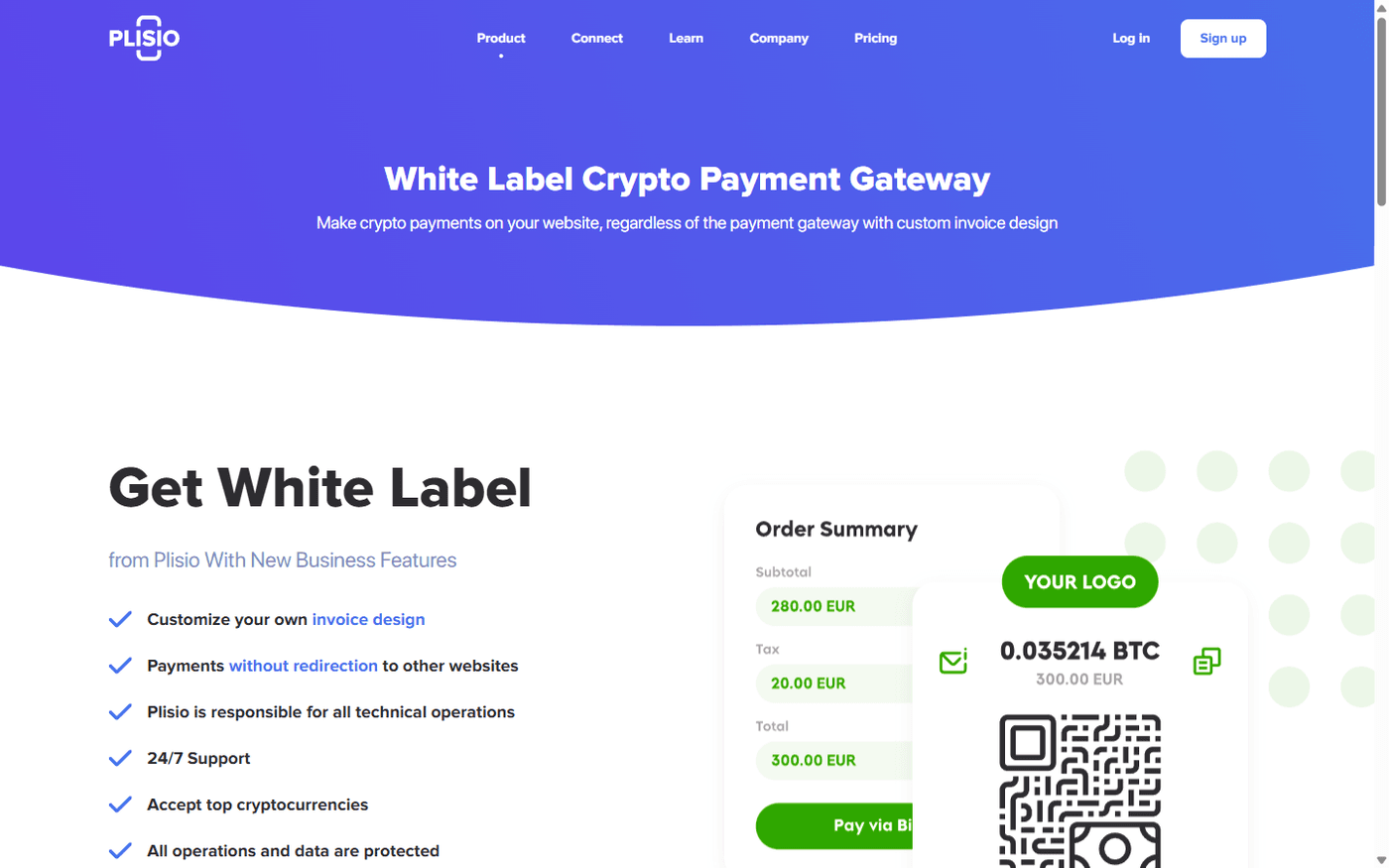
You switch it on under API, then Site Settings. The API then returns the data you need to draw the payment page yourself, including the deposit address, amount, QR code and expiry time. Plisio says its plugins pick up the setting automatically, with the design in the plugin's "invoice" or "plisio_invoice" files. For a custom build, Plisio publishes invoice templates on GitHub.
The catch is the price. White Label triples the per-transaction fee from 0.5% to 1.5%. On $20,000 a month of sales, that is $300 in Plisio fees instead of $100. Decide whether keeping customers on your own domain is worth the extra $200.
Invoices, Donations and Mass Payouts
Invoices without code. Plisio's wallet can create an invoice without a website or API. You pick a coin, click "Create invoice", enter the payer's name, the amount and the cryptocurrencies you will accept, and then share the link or QR code. The homepage says invoices can be sent "via e-mail, SMS and messengers". See our crypto invoicing list for alternatives.
Invoice settings. You set how long an invoice stays open and an underpayment tolerance from 0.01% to 99%, so a slightly short payment still counts. Overpayments show as, for example, "Completed 200%". Plisio also offers a donation button, link, QR code and customisable donation page.
Mass payouts. Plisio's homepage says you can "Pool together up to 1000 transactions", "Import your data from file (.xls)", and send with "No limits for payout amount". Through the API, a mass withdrawal sends one currency to a list of addresses and amounts, at Normal or Priority fee speed. Plisio claims pooling saves "80% on fees" by combining transfers into one blockchain transaction, and it publishes no separate percentage fee for payouts. Compare options in our crypto mass payouts list.
Affiliate Program
Plisio's affiliate page says you can "earn 10% of profits from exchanges and 25% from transaction fees" on businesses you refer, with "unlimited earning potential". You copy your link from the affiliate section of your account. For example, a referred merchant that processes $10,000 through the API at 0.5% pays Plisio $50, and 25% of that is $12.50. The page's earnings calculator shows results in USDT. The page does not say how long commissions last, how often they are paid, or whether there is a minimum payout. Payyd is a Plisio affiliate (see the disclosure above). Other programs are compared in crypto gateways with affiliate programs.
Who Runs Plisio, and Its Track Record
Company. Plisio's footer reads "© 2026 Plisio, Inc.", but its website and terms give no registered address, company number, jurisdiction, regulator or licence. The terms are dated 12 March 2019. The plisio.net domain was registered on 16 January 2019, and Plisio's GitHub account dates from April 2019. It hosts 37 public repositories of plugins and SDKs. Its WooCommerce plugin has been on WordPress.org since January 2020.
Registry. Plisio's Trustpilot profile, which the company has claimed, gives its location as the United Kingdom.
Reviews. On 6 October 2026, Plisio's Trustpilot page showed a TrustScore of 2.9 from 406 reviews. Of those, 54% were five-star and 37% one-star, and Trustpilot noted that the company "hasn't replied to negative reviews".
Plisio has run since 2019 and keeps its plugins and documentation online. But it holds your funds, gives no company details beyond a name, and has a polarised review record. Keep balances small.
Pros and Cons
Pros
- 0.5% per payment via API and plugins, with no setup or monthly fee
- No identity verification to sign up, according to Plisio
- 19 plugins, plus seven server-side libraries and React, Vue and Android SDKs
- Monero, Zcash, TON, Solana and Base, with USDT on five networks
- Mass payouts of up to 1,000 transfers from a file or the API
- Invoices and donation pages with no integration needed
- Options to restrict API access by IP and to disable API withdrawals
Cons
- White Label raises the fee to 1.5%
- Custodial; the terms allow limit changes and freezes at a regulator's request
- No Shopify app, no subscriptions, no fiat settlement and no POS
- WooCommerce plugin is flagged as untested with the last three major WordPress releases
- Token withdrawals need a native-coin balance (ETH, TRX, BNB) for network fees
- ETH and ERC-20 fee not published
- No address, company number or licence, and terms last updated in 2019
- Its own pages contradict each other on custody, identity checks and country restrictions
Who Plisio Suits
Plisio suits a merchant outside the sanctioned countries who runs WooCommerce, WHMCS, Magento, PrestaShop or one of its other supported platforms. It fits if you want a crypto checkout at 0.5%, without submitting ID, and are comfortable with a custodial balance that you empty regularly. Its no-code invoices and mass payouts also make it practical for freelancers and businesses that pay contractors in crypto, and its Monero and Zcash support suits privacy-minded customers.
Look elsewhere if you sell on Shopify, need subscription billing (see also our guide to recurring crypto payments), need payouts to a bank in fiat, want a point-of-sale terminal (Plisio's product menu lists none), or want funds to land in your own wallet. And price in White Label before choosing Plisio for it: at 1.5%, it costs three times the standard rate.
Alternatives
We checked these on 6 October 2026 against each provider's own pages:
- ATLOS: 1% on all transactions, per its pricing page. Its FAQ says "ATLOS does not hold merchant's funds" and that it supports recurring payments. It also lists a Shopify integration.
- Paymento: 0.5% per transaction, plus $0.20 per transaction if you use its Embedded Wallet. With Bring Your Own Wallet, funds land directly in a wallet you control, and Paymento says it "never holds your funds".
- BTCPay Server: free, open-source software you host yourself or run on a shared server, with 0% processing fees. Its site says funds "arrive directly to your connected wallet", and Shopify is among its listed integrations. You handle setup and maintenance.
- NOWPayments: lists subscriptions and mass payouts among its products, so it covers Plisio's recurring-billing gap. Read our NOWPayments review for its fees and country restrictions.
Compare No-KYC Payment Gateways
See the gateways that open without ID side by side: fees, custody and onboarding conditions.
Compare No-KYC Gateways →Frequently Asked Questions
Is Plisio legit?
Plisio is a working gateway with a domain dating from January 2019, 19 plugins and public API documentation. But its website gives no company address, registration number or licence, it holds your funds, and on 6 October 2026 its Trustpilot score was 2.9 out of 5 from 406 reviews. Start small and withdraw regularly.
How much does Plisio charge?
0.5% per transaction through the API and plugins, or 1.5% with White Label, with no setup or monthly fee. Withdrawals and mass payouts cost the blockchain network fee. ETH and ERC-20 token payments have a different rate that Plisio does not publish.
Does Plisio require KYC?
Plisio says no. Its FAQ answers "Do I need to confirm my identity?" with "No. Our service does not require identification", and sign-up needs only an email and password. One answer on its mass-payouts page says businesses must verify their identity, and its terms let it suspend accounts or freeze them at a regulator's request.
Is Plisio custodial?
Yes. Customer payments are credited to your Plisio balance and you withdraw them to your own wallet. Withdrawing a token such as USDT also needs a balance of that network's native coin, such as TRX on Tron, to pay the network fee.
Does Plisio work with Shopify?
Not through an app. Plisio's integrations page lists no Shopify plugin, apps.shopify.com/plisio does not exist, and a Shopify App Store search for "plisio" on 6 October 2026 returned no Plisio app.
Who can't use Plisio?
Its terms bar people on US, UN, EU, UK and Hong Kong sanctions lists, and anyone located in or resident in a country under US economic sanctions, naming Cuba, Iran, North Korea, Sudan and Syria. You also may not use it where your local law prohibits it.
How does the Plisio affiliate program work?
Plisio pays affiliates 25% of the fees it earns on referred merchants' transactions and 10% of its profit on their exchanges, with no cap on referrals. Its page does not state how long commissions last or how and when they are paid.
Sources
All pages were checked on 6 October 2026.
- Plisio homepage
- Plisio pricing
- Plisio White Label
- Plisio Mass Payouts
- Plisio Crypto Invoices
- Plisio Donations
- Plisio integrations (plugins and libraries)
- Plisio WooCommerce page
- Plisio Affiliate Program
- Plisio Security
- Plisio FAQ: Do I need to confirm my identity?
- Plisio FAQ: How to register?
- Plisio FAQ: Does the fee amount change with White Label?
- Plisio FAQ: Enterprise plan
- Plisio FAQ: Is there a fee for sending or withdrawing funds?
- Plisio FAQ: How to send tokens and pay the fee
- Plisio FAQ: Are my funds safe?
- Plisio FAQ: Minimum amounts
- Plisio FAQ: How to enable White Label?
- Plisio FAQ: Customising the White Label invoice
- Plisio FAQ: How to create an invoice without the API
- Plisio FAQ: Transaction statuses and mass payouts
- Plisio FAQ: What is Plisio?
- Plisio API docs: Introduction
- Plisio API docs: Setting shop
- Plisio API docs: Create an invoice
- Plisio API docs: Withdrawal / Mass withdrawal
- Plisio API docs: Plisio fee
- Plisio API docs: Supported cryptocurrencies
- Plisio API docs: Supported fiat currencies
- Plisio Terms of Use (last updated 12 March 2019)
- Plisio WooCommerce plugin on WordPress.org
- WordPress.org current release (version check)
- Shopify App Store search for "plisio"
- apps.shopify.com/plisio (page does not exist)
- Plisio on GitHub
- RDAP domain record for plisio.net
- Plisio on Trustpilot
- ATLOS pricing
- ATLOS FAQ
- Paymento fees and pricing
- BTCPay Server
- NOWPayments pricing