Solana Pay Review: Free Protocol, Paid Shopify App
Solana Pay is a free, open protocol: funds go wallet to wallet with no KYC, but you build the checkout. Its Shopify app is MoonPay's, with KYB and a fee.
 Jennifer McNally
Key Takeaways
- Not a company you sign up with: Solana Pay is "a standard protocol and set of reference implementations". It has no account, no merchant agreement and no KYC of its own.
- Cost: no protocol fee. Each Solana transaction pays a network fee in SOL, which Solana Pay's docs put at "on average $0.0005". Apps built on Solana Pay can add their own fee.
- You hold the money. Payments go on-chain from the customer's wallet to yours, with no payment provider in between to hold or freeze them. Nobody can reverse them either: a refund is a new payment you send.
- You are paid in SOL or SPL tokens such as USDC, on Solana only. There is no fiat settlement; converting to your own currency is up to you.
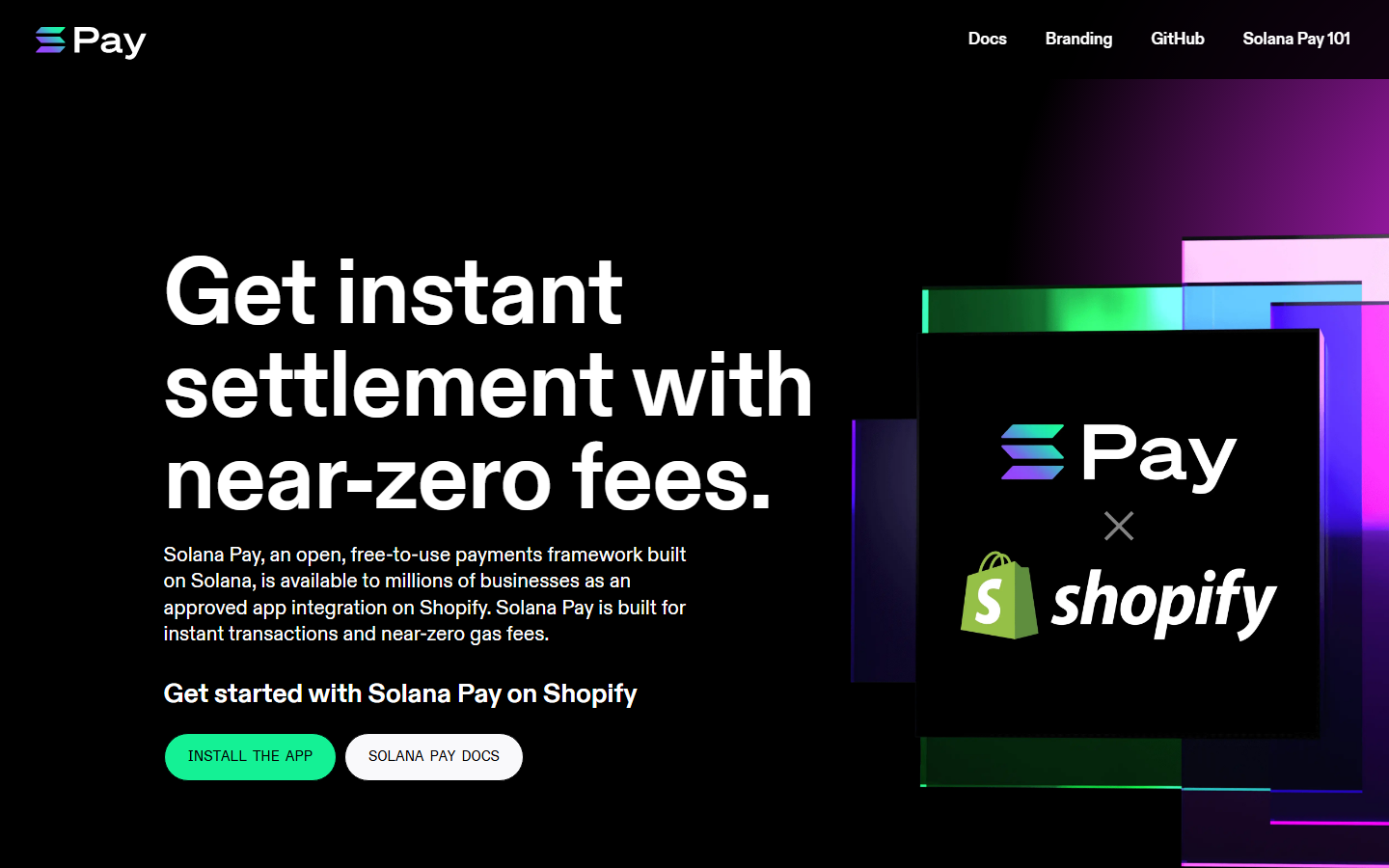
- Shopify: the "Solana Pay" app is built and run by MoonPay (formerly Helio). It is live in the App Store, but it requires business verification (KYB), lists a 1% fee per transaction and has a 2.0 rating from six reviews. An older listing is marked "not currently available".
- Suits developers and Solana-native businesses that can build and check their own checkout. Doesn't suit merchants who want a ready-made multi-chain checkout, bank payouts or a support desk; they need a hosted gateway.
Table of Contents
- Solana Pay at a Glance
- What Solana Pay Is, and What It Is Not
- Transfer Requests vs Transaction Requests
- Supported Tokens and Wallets
- What It Costs
- What a Merchant Must Build or Install
- Solana Pay on Shopify: the Real State of the App
- Network Reliability
- Solana Pay or a Hosted Gateway?
- Pros, Cons and Verdict
- FAQ
- Sources
Solana Pay at a Glance
| Question | Solana Pay (6 October 2026) |
|---|---|
| What is it? | An open payment standard (a solana: URL format), a JavaScript SDK and example apps, published on the Solana Foundation's GitHub |
| Protocol fee | None |
| Network fee | Paid in SOL: a base fee of 5,000 lamports (0.000005 SOL) per signature, plus an optional priority fee. The docs give an average of $0.0005 |
| Who holds the money | You. Payments go straight to your wallet address |
| KYC / KYB | None from Solana Pay, because there is no account. MoonPay's Shopify app requires KYB |
| What you can accept | SOL and any SPL token, such as USDC or USDT, on the Solana network only |
| Fiat settlement | No. You convert tokens yourself |
| Refunds and chargebacks | None built in. Payments are final, and a refund is a new transfer from your wallet |
| Payment detection | Your own code finds each payment on-chain by a reference key and checks the amount and recipient |
| Ways to use it | @solana/pay SDK (MIT licence, v1.0 since May 2026), a point-of-sale example app, MoonPay's Shopify app, a third-party WooCommerce plugin |
What Solana Pay Is, and What It Is Not
Solana Pay's documentation describes it as "a standard protocol and set of reference implementations that enable developers to incorporate decentralized payments into their apps and services." Its homepage calls it "an open, free-to-use payments framework built on Solana". In practice it is a URL format that Solana wallets understand, the @solana/pay JavaScript library and some example apps.
There is no company to sign up with. The website's terms name Solana Technology Services LLC as the site's operator and say it does "not store or have access to or control over any tokens, private keys, passwords, accounts or other property of the User". If you would rather have a provider run the checkout for you, see our gateway comparison.
For a merchant, that has five consequences:
- No custody. The customer's wallet sends funds to your address, and nothing sits in between that could hold or freeze them. Solana Pay's own explainer says "there are no intermediaries holding assets on your behalf".
- No KYC from Solana Pay. There is no account to verify, and the same explainer notes that "You don't need an ID or bank account to create a wallet." Your own tax and legal obligations still apply, and Shopify tells merchants to check that crypto is an acceptable form of payment in their region. Products built on Solana Pay can verify you: MoonPay's Shopify app does.
- No fiat settlement. You receive tokens. Getting dollars or euros into a bank account means selling them through an exchange or a service that does it for you.
- No refunds or chargebacks. A confirmed payment is final; to refund, you send a new payment back. Escrow-style refunds are possible, but you would build them. Our guide to crypto refunds for merchants covers the practical side.
- No dashboard, invoices or support desk. You rely on your own code, or on whoever made the app you install.
Transfer Requests vs Transaction Requests
The specification defines two kinds of payment request. Both can be shown as a QR code, link or button, and both are signed in the customer's own wallet.
Transfer requests
A transfer request is a URL in the form solana:<recipient>?amount=<amount>&spl-token=<mint>&reference=<reference>, with optional label, message and memo fields. The specification calls it "a non-interactive request for a SOL or SPL Token transfer": the wallet reads the URL and builds the transaction itself. For a token payment, the spl-token field names the token, and the wallet pays your token account for it.
The reference field is a unique key the wallet attaches to the transaction, so your system can find the payment for each order on-chain. Memos are public: the specification says they "should not include private or sensitive information".
Transaction requests
A transaction request is solana: followed by an HTTPS link to your server. The wallet sends your server the customer's address, and your server replies with a transaction for the customer to sign. Because you build it, it can do more than move money. The docs' examples include sending loyalty tokens or minting an NFT in the same transaction, paying the network fee so the customer needs no SOL, and declining to respond so only approved customers can pay.
| Transfer request | Transaction request | |
|---|---|---|
| Who builds the transaction | The customer's wallet, from the URL | Your server, on demand |
| What it can do | Send SOL or one SPL token to you | Any Solana transaction: payment plus loyalty tokens, NFTs or discounts |
| Network fee paid by | The customer, who needs some SOL | The customer, or you if you choose to pay it |
| Server needed when the customer pays | No, though you still verify the payment | Yes, an HTTPS endpoint that answers the wallet |
| Best for | Simple QR codes and payment links | Custom checkouts, loyalty schemes, customers without SOL |
Confirming that you have been paid
Solana Pay does not notify you; your system checks the blockchain. The merchant guide's flow: your server stores a unique reference with each order's expected amount, finds the transaction carrying it, and validates the recipient and amount before you release the goods. Skipping validation lets a different transaction, or a tampered front end, pass as payment.
Speed depends on how sure you need to be. The docs say Solana "confirms transactions in less than a second", and the SDK looks for payments at the "confirmed" level by default. The guide adds that this "can, on rare occasions, result in a transaction that is not fully complete", and that waiting for "finalized" is safer but slower. For high-value orders, wait for finality.
Supported Tokens and Wallets
- SOL and any SPL token. The specification covers native SOL and SPL token transfers, and its own example requests 0.01 USDC using the token address that Circle lists for USDC on Solana. Tether lists Solana as a supported network for USDT.
- Newer tokens: the v1 SDK's transfer code switches to Solana's Token-2022 program when a token was issued under it.
- Solana only. Solana Pay cannot take Bitcoin, Ethereum or tokens on other chains. MoonPay's Shopify app adds other chains through its own platform, not through the Solana Pay protocol.
- A token account to receive tokens. The docs say a SOL address costs nothing, but receiving USDC or another token needs a token account, "which may require a small amount of SOL".
- Stablecoins avoid SOL's price swings. Price your goods in USDC and you receive that USDC amount.
The docs list eight supporting wallets: Phantom, Solflare, Glow, Decaf, Espresso Cash, Ottr and Ultimate on iOS and Android, and TipLink on the web. That page carries a 2023 copyright notice, so test with the wallets your customers actually use.
What It Costs
Solana Pay itself costs nothing. Costs come from the network, from any app you add, and from running your own checkout.
- Network fee. Solana's documentation says every transaction requires a fee paid in SOL: a base fee of 5,000 lamports per signature, plus an optional priority fee that raises the chance of a transaction being scheduled ahead of others. A lamport is 0.000000001 SOL, so a single-signature payment has a base fee of 0.000005 SOL. The fee is charged even if the transaction fails. Solana Pay's docs put the average cost at $0.0005; the dollar figure moves with the SOL price.
- Who pays it. In a transfer request, the customer's wallet pays. In a transaction request, you can choose to pay it.
- Token accounts. A small amount of SOL may be needed to create the account that receives USDC or another token.
- Your own build. Development time, hosting, and an RPC connection to the Solana network to find and validate payments.
Products built on Solana Pay add their own charges:
| Route | Fee on top of the network fee | Verification |
|---|---|---|
Your own integration with @solana/pay | None | None |
| MoonPay's Solana Pay app for Shopify | 1% per transaction (App Store listing); MoonPay's fee page says 2% standard. Swaps 0.25%, bank payouts 0.50%. Shopify's third-party transaction fee may apply | KYB |
| WC Solana Pay (third-party WooCommerce plugin) | 0.5% per transaction | None stated on its WordPress.org listing |
What a Merchant Must Build or Install
There are four ways to start taking Solana Pay payments, from most work to least.
1. Build with the SDK
@solana/pay creates payment URLs and QR codes and finds and validates payments. Version 1.0 reached npm on 5 May 2026; it is MIT-licensed and needs Node.js 20 or later.
2. Run the point-of-sale example
An open-source web app for in-person QR payments. Its README presents it as an example to use as a reference or run yourself, not a supported product.
3. Install the Shopify app
MoonPay's app adds Solana Pay to Shopify checkout after KYB, for a per-transaction fee. Details below.
4. Use a WooCommerce plugin
No official plugin exists. WC Solana Pay, by third-party developer aztemi (60+ active installs, updated 17 September 2026), charges 0.5% per transaction.
Building it yourself
A minimal online integration follows the docs' recommended flow:
- When a customer checks out, your server creates a unique reference and stores it with the order and the expected amount.
- The checkout page shows a transfer request as a QR code or a wallet button, or a transaction request link if you need more control.
- Your server watches for a transaction carrying that reference. The v1 SDK can poll (
findReference) or subscribe (watchReference). - Your server checks the recipient and amount with
validateTransfer, then marks the order paid. - Refunds, accounting and conversion to fiat are then up to you.
Expect some housekeeping. The documentation site lags the code: it still shows the v0.2.5 API, examples for the older @solana/web3.js library and an Apache 2.0 licence, while the v1 package is MIT-licensed and its README has a migration guide. The GitHub address in the docs, solana-labs/solana-pay, now redirects to solana-foundation/pay, whose front page promotes pay.sh, a command-line tool for "agentic" payments (x402 and MPP). The Solana Pay SDK sits in its typescript/packages/solana-pay folder; it was last changed on 1 October 2026, and the latest npm release is 1.0.26 from 31 July 2026. For a wider view, see our crypto payment API guide.
Solana Pay on Shopify: the Real State of the App
Shopify's cryptocurrency help page still lists Solana Pay as a payment method merchants can activate, supporting "United States Dollar Coin (USDC) among other currencies" with NFT gating and discounts. Its setup-instructions link (docs.hel.io/product-guides/solana-pay-shopify-plugin) returned a 404 error on 6 October 2026; the current guide is at docs.hel.io/docs/solana-pay-shopify-plugin.
The App Store has two listings, which explains the conflicting reports about whether the app still exists:
- apps.shopify.com/solana-pay says: "This app is not currently available on the Shopify App Store. If you have support questions, contact Helio Fintech Ltd directly."
- apps.shopify.com/solana-pay-helio is live, with an Install button. The developer is Helio Fintech Ltd, and the app was launched on 7 June 2024. Its pricing reads "Free to install" and "1% fee per transaction". This is the listing that solanapay.com's "Install the app" button opens.
Who runs it, and how it differs from the protocol
MoonPay Commerce's FAQ says "MoonPay is the developer and operator of the official Solana Pay plugin for Shopify"; Helio became MoonPay Commerce after MoonPay bought it in 2025. The app is MoonPay's checkout under the Solana Pay name, and it differs from the bare protocol:
- KYB is required. Setup includes "Complete the KYB process (real-time, up to 48 hours)", and you enter a Solana wallet that is not linked to another MoonPay Commerce account.
- USDC by default. "Payments settle in USDC by default." Swaps are switched on automatically, so customers can pay with any Solana token while you receive USDC.
- More than Solana. You can enable Bitcoin, Ethereum, Polygon and Base, each paid to a wallet you link for that chain.
- Optional bank payouts. The guide says to contact the team for automatic conversion of USDC to your bank via Iron.xyz.
- Refunds. You start the refund in Shopify, approve it in the app and sign it with a Solana wallet. Payments made on other chains must be refunded manually from your own wallet.
- Custody. MoonPay says it "does not custody funds" and that payments go peer-to-peer from buyer to merchant.
Fees do not match across MoonPay's own pages. The App Store listing says 1% per transaction. MoonPay Commerce's fee page lists a 2% standard fee, or 1% for holders of a HelioX Pass NFT, plus 0.25% for swaps and 0.50% for automatic conversion to fiat. It also says high-risk platforms pay at least 2%. Shopify adds that third-party gateways can incur its third-party transaction fee, depending on your plan. Confirm your rate before you switch the app on.
Reviews: on 6 October 2026 the listing showed a 2.0 rating from six reviews: four 5-star reviews from 2024 and early 2025, and two 1-star reviews dated 28 December 2025 and 3 February 2026, each saying the app was not working for that store.
If what you want on Shopify is stablecoin payments rather than Solana in particular, Shopify Payments now accepts USDC itself in eligible regions, and may ask you to verify your identity first. Its help page lists Base, Ethereum, Optimism, Polygon and Arbitrum, not Solana. Our Shopify crypto payment gateway guide compares the options.
Network Reliability
Solana Pay works only while Solana does. Solana's status page records a mainnet outage on 6 February 2024: block production stopped at about 09:53 UTC and resumed at 14:57 UTC, roughly five hours later, after a cluster restart. A February 2023 incident also needed a coordinated restart. The page lists no incidents since February 2024 and showed all systems operational on 6 October 2026. If your checkout accepts only Solana, an outage stops all payments. A gateway that takes several chains can keep accepting others.
Solana Pay or a Hosted Gateway?
| Solana Pay (your own build) | Hosted gateway | |
|---|---|---|
| Fee | Network fee only | Usually a percentage per payment, plus network fees |
| Custody | Always your wallet | Your wallet (non-custodial) or the provider's account (custodial) |
| Verification | None | From none to full business verification |
| Chains | Solana only | Usually several, often including Solana |
| Checkout, plugins, dashboard | You build them | Provided |
| Fiat to your bank | No | Offered by some, after full verification |
Solana Pay suits you if you have developers, your customers already hold SOL or USDC in Solana wallets, and you want payments in your own wallet with no account anyone can freeze. It also fits when the payment is part of something bigger, such as loyalty tokens or NFTs at checkout.
A hosted gateway suits you better if:
- You want your own wallet without building anything. Hosted non-custodial gateways pay straight to your wallet and supply the checkout and plugins. ATLOS, for example, charges 1%, requires no KYC and accepts Solana alongside other chains. Compare the options in non-custodial crypto gateways and no-KYC payment gateways.
- You need dollars or euros in a bank account. See gateways with fiat settlement; all of them verify your business in full.
- You sell on WooCommerce. See WooCommerce crypto payment plugins.
- You sell in person. See crypto POS terminals.
- You bill monthly. Solana Pay has no recurring billing; see crypto subscription billing.
- You want zero fees on Bitcoin. BTCPay Server is free, open-source and self-hosted, with Lightning Network support. It is the closest Bitcoin equivalent to Solana Pay's no-middleman model; see open-source crypto gateways.
- Price is your main concern. See the cheapest crypto gateways.
Pros, Cons and Verdict
Pros
- No protocol fee; the docs put the average network cost at $0.0005
- Payments land in your own wallet, with no account to freeze
- No sign-up or KYC for the protocol itself
- SOL and any SPL token, including USDC and USDT
- Transaction requests can add loyalty tokens or NFTs, or cover the customer's fee
- MIT-licensed SDK, still being updated in 2026
Cons
- Solana only
- You build and secure the checkout, payment checks and refunds
- No fiat settlement, dashboard, invoicing, subscriptions or support
- Customers need a Solana wallet, and SOL for fees on transfer requests
- Documentation site lags the v1 SDK
- The Shopify app is a separate MoonPay product with KYB, a fee and poor recent reviews
Bottom Line
Solana Pay is a free, open payment standard, not a gateway. If you can build on it, you get payments in SOL or USDC straight into your own wallet for a network fee measured in fractions of a cent, with no account, no KYC and no payment provider able to freeze your balance. In exchange you build the checkout, check every payment on-chain, handle refunds and convert to fiat yourself, on one blockchain. On Shopify, "Solana Pay" means MoonPay's app, which requires KYB and charges 1% per transaction according to its App Store listing, or 2% according to MoonPay's standard fee page. Merchants who want a ready-made checkout across several chains should start with a hosted non-custodial gateway instead.
Compare non-custodial gateways →FAQ
Is Solana Pay free?
The protocol charges nothing. Each transaction pays a Solana network fee in SOL, which Solana Pay's docs put at $0.0005 on average. Apps built on it can add a fee: MoonPay's Shopify app lists 1% per transaction and the WC Solana Pay plugin 0.5%.
Does Solana Pay require KYC?
Not the protocol: there is no account to verify. Your own legal obligations still apply, and MoonPay's Solana Pay app for Shopify requires business verification (KYB).
Is the Solana Pay Shopify app still available?
Yes, on 6 October 2026, at apps.shopify.com/solana-pay-helio (Helio Fintech Ltd, now MoonPay Commerce): free to install, 1% per transaction, KYB required, rated 2.0 from six reviews. An older listing, apps.shopify.com/solana-pay, says the app is not currently available.
Can I accept USDC with Solana Pay?
Yes. USDC on Solana is an SPL token, and the specification's own example requests 0.01 USDC. You need a USDC token account, which may cost a little SOL to create. USDC on other chains, such as Ethereum or Base, cannot be received this way.
What is the difference between a transfer request and a transaction request?
A transfer request is a URL telling the wallet to send SOL or a token to your address; the wallet builds the transaction. A transaction request points the wallet to your server, which returns a transaction to sign, allowing extras such as loyalty tokens or paying the customer's fee.
Does Solana Pay work with WooCommerce?
There is no official plugin. The third-party WC Solana Pay plugin on WordPress.org charges 0.5% per transaction. Otherwise, build with the SDK or use a multi-chain gateway's WooCommerce plugin.
Sources
Primary sources checked on 6 October 2026:
- Solana Pay: homepage
- Solana Pay: Solana Pay 101
- Solana Pay: terms of service (Solana Technology Services LLC)
- Solana Pay docs: introduction and supporting wallets
- Solana Pay docs: specification
- Solana Pay docs: overview
- Solana Pay docs: create a transfer request
- Solana Pay docs: transaction request overview
- Solana Pay docs: create a transaction request
- Solana Pay docs: API reference (v0.2.5)
- GitHub: solana-foundation/pay (formerly solana-labs/solana-pay)
- GitHub: Solana Pay SDK, docs and examples
- GitHub: SDK transfer code (Token-2022 handling)
- GitHub: point-of-sale example
- npm: @solana/pay (v1.0 on 5 May 2026; 1.0.26 on 31 July 2026)
- Solana docs: fees
- Solana docs: fee structure
- Solana docs: terminology (lamport)
- Solana status: incident history
- Circle: USDC contract addresses
- Tether: supported protocols
- Shopify Help Center: cryptocurrency
- Shopify Help Center: USD Coin (USDC)
- Shopify App Store: Solana Pay (not currently available)
- Shopify App Store: Solana Pay by Helio Fintech Ltd (live listing)
- Shopify App Store: Solana Pay reviews
- MoonPay Commerce docs: Solana Pay Shopify plugin
- MoonPay Commerce docs: old setup link from Shopify's help page (404)
- MoonPay Commerce docs: fees
- MoonPay Commerce docs: FAQ
- MoonPay Commerce docs: security
- WordPress.org: WC Solana Pay
- ATLOS: pricing
- ATLOS: homepage
- BTCPay Server: homepage
- BTCPay Server docs: Lightning Network