B2BinPay Review: Fees, KYB, Custody and Licensing
B2BinPay charges 0.25%–0.50% by volume, requires KYB before live payments and holds funds in pooled wallets. Fees, licences and limits checked.
 Brian Ormond
Key Takeaways
- Published, tiered fees: 0.40% (coins) and 0.50% (stablecoins and tokens) below $1 million a month, falling to 0.25% and 0.35% above $5 million. Every chain has a minimum fee, such as $3 on TRON.
- KYB is mandatory. You get a sandbox at sign-up, but no live payments until your company is approved. A one-time onboarding fee may apply.
- Custodial: merchant wallet assets are pooled "on an omnibus basis".
- Licensed in El Salvador (confirmed on both regulators' registers) and, by its own account, Mauritius.
- Not marketed to the US, UK or EU, and no maintained shop plugins.
Last checked: 6 October 2026. We read B2BinPay's fee pages, Terms and Conditions (last updated 26 June 2026), AML and KYC policy, product and industry pages, the B2BINPAY DeFi page, and its developer documentation on KYB, wallets, deposits, payouts, bank withdrawals and supported currencies. We checked El Salvador's CNAD register and the Central Reserve Bank's register of bitcoin service providers, the WordPress.org plugin directory and B2BinPay's GitHub account. The Mauritius FSC register blocked automated access. We did not open a merchant account, so nothing here is a first-hand onboarding, checkout or payout result.
Affiliate disclosure: Payyd earns a commission if you sign up to B2BinPay through some links on this page. That does not change the fees, limits or caveats reported here.
B2BinPay at a Glance
What B2BinPay Is
B2BinPay is a custodial crypto payment platform for businesses. It covers payment processing (invoices, a hosted payment page and a payment button), wallet-as-a-service, swaps, staking, custody and a white-label gateway. Its homepage names Arthur Azizov as CEO and founder. The same page claims $5.1 billion in incoming transactions, 6.7 million transactions and 983 business customers "by 2025". We have no way to check those figures.
The website footer names two operating companies. B2BINPAY El Salvador S.A. de C.V. is the party to the Terms and Conditions, which are governed by Salvadoran law. B2BINPAY Mauritius Ltd holds the Mauritius licence. A third company runs the separate non-custodial DeFi app, covered below.
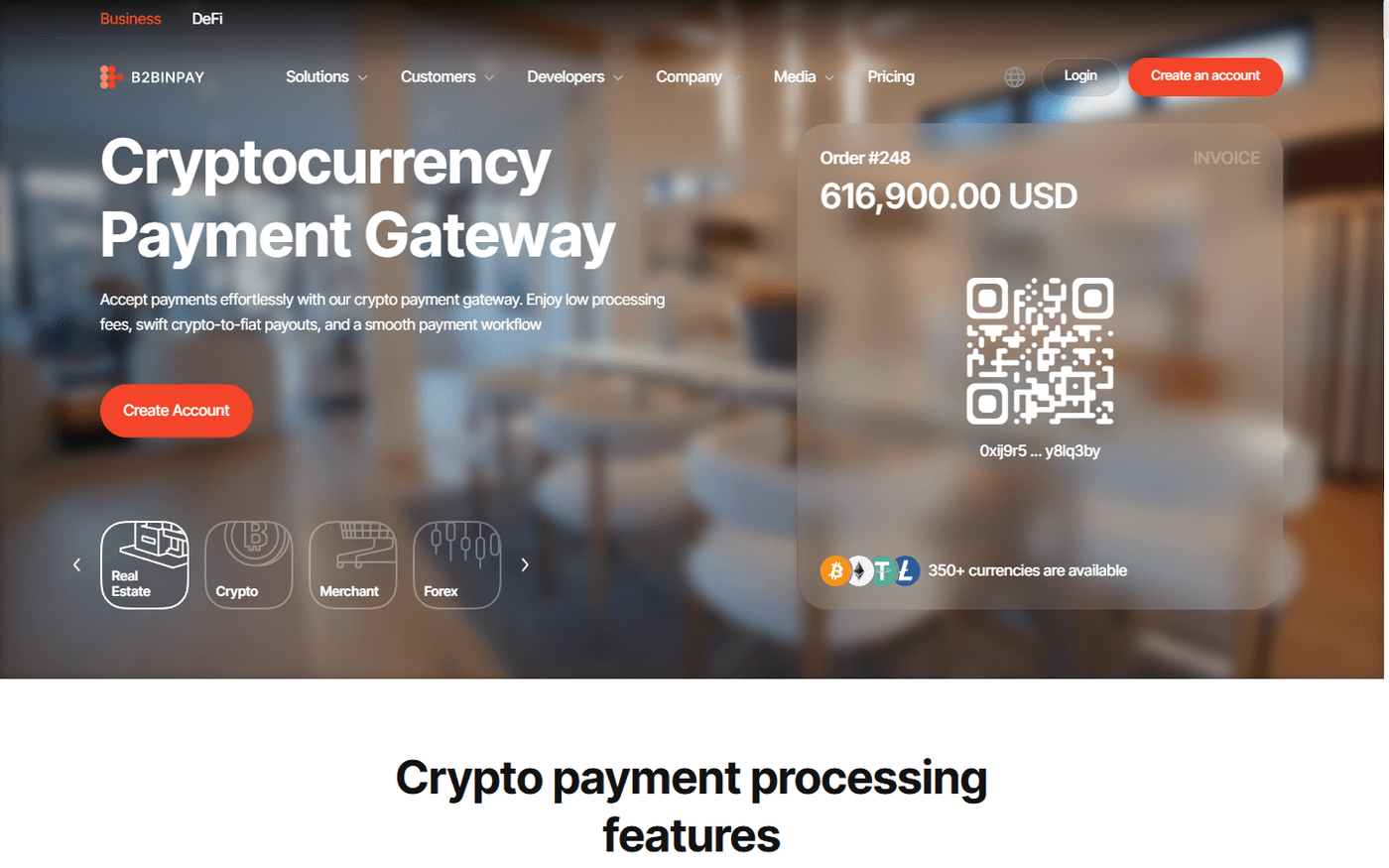
B2BinPay's homepage. The "350+ currencies" figure is B2BinPay's own claim. Its currency reference flags 53 assets as available for merchant payment wallets (see Coins, Networks and Settlement).
Fees
B2BinPay publishes its rates. Merchant wallets are charged on incoming payments. The rate depends on whether the payer sends a coin (BTC, ETH, TRX and so on) or a stablecoin or token (such as USDT or USDC), and on your volume that month.
How the tiers work. Volume is all deposits in US dollars at on-chain confirmation, reset monthly. Once you cross a threshold, the lower rate applies for the rest of that month, and earlier commissions are not recalculated. So the first $1 million each month always pays 0.40% or 0.50%. The old version of this review said fees started "from 0.4%". In fact that is the highest coin rate, and stablecoins start at 0.50%.
Minimum fee per blockchain
The fee page also lists a minimum commission for each blockchain:
This matters for small tickets. Assuming the minimum applies per payment (the page does not say otherwise), a 100 USDT payment on TRON costs $3 (3%). The 0.50% rate only exceeds the TRON minimum above $600. The same 100 USDT on Polygon, BNB Smart Chain or Solana pays $0.50. If your customers send small USDT payments, steer them away from TRON.
Fiat deposits and bank withdrawals
A €5,000 SEPA withdrawal costs €30, and a $10,000 SWIFT withdrawal costs $95. Fiat deposits are accepted only by corporate bank wire. TRON payouts are listed at $2, labelled as the blockchain fee. Conversion and swap fees are not published. The swaps page says they are shown before you confirm.
Other charges in the Terms
- Onboarding fee: a one-time setup fee "may" be required. It covers compliance checks, account configuration and activation, and the amount is disclosed during onboarding. It is non-refundable once your account is activated. If you pay but do not complete KYC, or onboarding runs past 14 banking days, the Terms say you may get 50% back.
- Dormant-account fee: an account becomes dormant after six months with no activity you initiate. B2BinPay can then restrict it and charge an administrative fee. The Terms point to the fees section of the website for the amount, but we found no figure there.
- Payment Review returns: if a payment is held for an AML review and sent back, B2BinPay can deduct its processing costs plus USD 50 to 100 per returned transaction.
- Wrong-network or unsupported deposits: recovery is optional, and if B2BinPay attempts it the fee is at least USD 200 per transaction.
- Enterprise wallets: segregated on-chain wallets can carry gas costs, and ETH, XRP, XLM and BNB wallets need an activation fee.
The homepage says there is no rolling reserve. If you use B2BinPay as wallet infrastructure rather than a checkout, pricing flips: incoming transfers are free and outgoing transfers cost 0.025% to 0.05%.
KYB and Onboarding
Sign-up is self-service. You register with a name, email address, phone number, password and 2FA, and you get immediate access to the sandbox. B2BinPay's documentation is explicit that "KYB verification is mandatory" for the production environment. Until your company is approved, you can only test.
KYB runs through Sumsub, and only the account Owner can start it. You enter the legal entity name, country of incorporation, business type and where the ultimate beneficial owner lives. Then you follow Sumsub's document flow. The documentation lists the statuses (In progress, Pending, Action required, Approved, Declined) and says verification must be renewed periodically. We found no published review time, so the "3 to 5 business days" claimed in the old version of this review has been removed.
The AML and KYC policy adds that anonymous accounts are not permitted, that clients complete questionnaires and liveness checks, and that each client registers a single bank account for all fiat deposits and withdrawals. The Terms' eligibility rules start with being a legal entity in good standing, and they make you responsible for running KYC on your own end users where the law or B2BinPay requires it.
For a broader look at testing environments, see our crypto payment gateway sandbox guide.
Who Holds the Money
B2BinPay does. Its website risk disclaimer says it "acts as a custodian", and the Terms describe three wallet types:
- Merchant wallets, used for payment processing, are virtual balances. Your assets are held "on an omnibus basis", pooled rather than allocated to you on-chain. A fresh deposit address is generated for each payment. Merchant wallets can be denominated in a crypto or a fiat currency, and incoming payments are converted automatically into the wallet's currency.
- Enterprise wallets use segregated on-chain addresses in a single crypto asset, with no conversion. They are still accounts on B2BinPay's platform. The Terms let B2BinPay move Enterprise wallet assets into omnibus custody if an account becomes dormant.
- Custody wallets are for storage. Withdrawals are deliberately slower and can require video verification.
Under the Terms, wallets are not bank accounts and have no deposit insurance. Your digital assets are said not to be B2BinPay's property or available to its creditors, though the Terms warn that a court could decide otherwise in an insolvency. You accept that omnibus arrangements may involve commingling and that recovery in an insolvency "may be uncertain". Fiat balances sit with partner banks and electronic money institutions, segregated from B2BinPay's own funds. Liability is capped at the fees you paid in the previous three months. Confusingly, the liability section says B2BinPay does not act as a custodian "on your behalf".
The custody page says B2BinPay buys insurance against asset loss, but we found no insurer or policy details. If you want funds that never sit with a third party, see non-custodial gateways or the DeFi app below.
Licensing and Where It Operates
The Terms you sign are with the El Salvador company, under Salvadoran law and courts. Complaints can go to El Salvador's financial supervisor, the SSF, or to CNAD.
Who it does not market to. The site footer says the El Salvador company does not market, promote or actively offer its services in the US, UK or EU. It serves customers there only when they fall within an exemption under the local financial promotion rules. If you are a US or EU business looking for a provider that is licensed or registered at home, start with our guides to US crypto payment gateways and European crypto payment gateways.
Countries it refuses. B2BinPay does not serve residents or companies from Afghanistan, the Central African Republic, Cuba, Eritrea, Iran, North Korea, Libya, Myanmar, Russia, Somalia, South Sudan, Sudan, Syria, Venezuela or Yemen, or from the Crimea, Donetsk, Luhansk, Kherson and Zaporizhzhia regions of Ukraine. It may restrict other jurisdictions after a risk assessment.
Coins, Networks and Settlement
B2BinPay's currency reference lists about 520 assets. Most are tokens that are only available for Enterprise (wallet-infrastructure) wallets. For payment processing, the column that matters is "Available for Merchants", and on 6 October 2026 it flagged 53 assets across 18 networks:
- Coins: BTC, ETH, LTC, BCH, XRP, ADA, DOGE, XLM, ALGO, TRX, SOL, TON, BNB (BNB Smart Chain), AVAX and POL, plus ETH on Arbitrum and Base.
- USDT: Ethereum, TRON, BNB Smart Chain, Solana, Polygon, Arbitrum, Avalanche, Optimism and TON.
- USDC: Ethereum, BNB Smart Chain, Solana, Polygon, Arbitrum, Avalanche, Optimism, Base and Algorand.
- Other tokens, including PayPal USD (PYUSD), LINK, UNI, AAVE and WBTC on Ethereum.
The homepage's "350+ currencies" (and this review's old "300+") describes the wider platform, not what your checkout can accept.
Settlement. Crypto is credited immediately, and fiat settles T+1, according to the fee page. Published bank withdrawals cover EUR (SEPA or SWIFT) and USD (SWIFT). The off-ramp page also mentions GBP and other currencies, but they are not in the fee schedule, so confirm them first. B2BinPay's finance team confirms each bank withdrawal. You can also set a regular withdrawal that triggers when a fiat wallet reaches a chosen balance. We found no support for the old review's "daily, weekly or custom" schedules.
Payment pages. Each deposit gets an automatically generated payment page, and the exchange rate on it is frozen for 15 minutes. For Merchant wallets you can set an expiry time and an amount tolerance (a "delta") to absorb rate movements.
Our fiat settlement comparison lists other gateways that pay out to a bank.
Integration, Plugins and Payouts
- API. A REST API covers wallets, deposits, payouts, transfers and rates. The older v2 API is marked deprecated. B2BinPay's pages describe the path: sign up, take API keys, test in the sandbox, then go live.
- No maintained plugins. The e-commerce page promises "ready-made plugins", but the only one we found is "B2BinPay Payments for WooCommerce" on WordPress.org. It is version 1.0.2, last updated on 28 October 2019, tested up to WordPress 5.3, with 10+ active installs. B2BinPay's PHP API client on GitHub is archived, with its last code push in November 2022. If you need a working plugin, see our WooCommerce crypto payment picks.
- Payment button: a configurable button you embed with a code snippet.
- Payouts one at a time. The payout API only has single-payout endpoints (create, validate, calculate fee), which you can automate. We found no batch or CSV mass payouts, and "crypto payrolls" sits on the white-label roadmap. See gateways with mass payouts.
- Subscriptions unconfirmed. The payment-button FAQ mentions a recurring button, but the API documentation does not support recurring billing.
- Compliance tooling: an optional extra AML check, Travel Rule data for deposits and payouts, IP whitelisting, withdrawal thresholds and user roles.
- White label. A branded gateway where you earn from your own processing fees and conversion markups. Pricing is not published (you book a demo).
The platform is actively maintained. The most recent product update listed on its site is version 26.3.1, dated 18 September 2026.
B2BINPAY DeFi: The Separate Non-Custodial App
B2BINPAY DeFi is a different product run by a different company, Global Enterprise Software Fintech Solutions Ltd of Antigua and Barbuda. The website says it never holds your funds or keys. On that basis it says it is not subject to licensing anywhere, so the El Salvador and Mauritius licences above do not cover it.
- How it works: you connect your own wallet and deploy a multisig smart-contract account. Then you create invoices with their own deposit addresses, collect funds from them singly or in batches, and approve payouts once enough signers have signed.
- Networks: Ethereum, BNB Smart Chain, Polygon, Avalanche, Arbitrum, Optimism, Base and TRON. TRON needs a separate wallet connection.
- Pricing: the interface is free to use, with basic rate limits. API usage is charged per request, with pricing that "starts at $10", and new users get free test credits. Network fees are paid from your own wallet.
- Verification: the quick-start guide describes connecting a wallet and creating an account, with no KYB step. The site does not state its KYC policy, so ask before relying on that.
- Code: B2BinPay's GitHub account has smart-contract repositories (Solidity, plus a TRON version) and a Node.js DeFi SDK, all updated in August and September 2026. The DeFi page describes its contracts as audited. We did not review an audit report.
We found no fiat settlement in the DeFi app. It is the closer fit if you want B2BinPay's tooling without handing over custody.
Adult and Other High-Risk Businesses
B2BinPay openly targets high-risk sectors. Its menu has pages for gambling, online games and adult platforms, and its industry list also names Forex and CFD brokers. The adult page calls B2BinPay a crypto payments processor for adult platforms and quotes fees of 0.25% to 0.50%. It describes auto-conversion, fiat withdrawal and custody as part of the offer.
Three things to weigh. First, the adult page talks about "anonymous transactions for your users", but your business still has to pass KYB. The Terms also require you to run KYC on end users where the law or B2BinPay demands it. Second, the Terms' prohibited activities list does not ban legal adult content or gambling outright. It bans illegal and fraudulent activity, money laundering, mixers, sanctioned parties, and trade in narcotics, weapons, human trafficking and child exploitation. Third, B2BinPay can hold payments for AML review for as long as it considers necessary, and charge fees when it returns them.
For comparisons, read our guides to crypto payment processors for adult sites and crypto payment gateways for gaming.
Pros and Cons
Pros
- Published, volume-tiered rates from 0.50% down to 0.25%, with no B2BinPay charge on crypto payouts
- Authorised in El Salvador by CNAD and listed on the BCR register, both confirmed on the regulators' own registers
- T+1 fiat settlement with published SEPA and SWIFT withdrawal fees, plus automatic withdrawals at a balance threshold
- USDT and USDC on nine networks each, including cheap-minimum chains such as Polygon, BNB Smart Chain and Solana
- Instant sandbox access, a hosted payment page with a 15-minute rate lock, and a white-label option
- A separate non-custodial DeFi app with multisig payouts and a free interface
Cons
- KYB is mandatory, and a one-time onboarding fee may apply whose amount is not published
- Custodial: merchant balances are pooled, with no deposit insurance
- A $3 minimum fee on TRON makes small USDT-TRC20 payments expensive
- Bank withdrawals need at least 5,000 EUR or USD
- No maintained e-commerce plugins, no batch payouts and no documented subscriptions
- Does not market to US, UK or EU businesses
- Conversion fees and the dormant-account fee are not published
Who It Suits and Alternatives
It suits brokers, iGaming, gaming, adult and other high-volume businesses outside the US, UK and EU. You need developers to integrate the API, a company that can pass KYB, and an appetite for published pricing that falls with volume. EUR or USD bank settlement is available in withdrawals of at least 5,000.
It does not suit a small shop that wants a plugin, businesses taking mostly small USDT payments on TRON, anyone needing mass payouts or subscriptions, or anyone unwilling to hand over custody (outside the DeFi app).
Alternatives worth comparing:
- CoinsPaid (review): also custodial and KYB-based, but with mass payouts and a WooCommerce plugin updated in September 2026.
- NOWPayments (review): plugin-based, with a WooCommerce plugin updated in August 2026 and mass payouts.
- BTCPay Server (review): free, open-source and self-hosted, so no one else holds your funds.
- BVNK (review): another sales-led option for stablecoin payments with fiat settlement.
Test B2BinPay's API in its sandbox before you start KYB
Visit B2BinPay →Frequently Asked Questions
How much does B2BinPay charge?
Incoming payments cost 0.40% for coins and 0.50% for stablecoins and tokens up to $1 million a month, falling by tier to 0.25% and 0.35% above $5 million. Each blockchain has a minimum fee, up to $3 on TRON. Crypto payouts carry no B2BinPay fee. SEPA withdrawals cost 0.5% + €5, and SWIFT withdrawals 0.6% + €35 or $35.
Does B2BinPay require KYC?
Yes. Business verification (KYB, through Sumsub) is mandatory before you can use the production environment. Until then you only have the sandbox, and verification is renewed periodically.
Is B2BinPay custodial?
Yes. It holds merchant wallet assets on an omnibus (pooled) basis, with no deposit insurance. Only the separate B2BINPAY DeFi app is non-custodial.
Is B2BinPay licensed?
Its El Salvador company is on CNAD's register (PSAD-0064, registered 17 October 2025) and on the Central Reserve Bank's bitcoin service provider register. B2BinPay says its Mauritius company holds FSC licence GB24203002. We could not load the FSC register to confirm that.
Can US, UK or EU businesses use B2BinPay?
B2BinPay says it does not market or actively offer its services in the US, UK or EU, and serves customers there only under a regulatory exemption.
Does B2BinPay have a WooCommerce plugin?
Not a maintained one. The WordPress.org plugin was last updated in October 2019 and tested up to WordPress 5.3. Plan on an API integration or the hosted payment page.
Does B2BinPay accept adult websites?
Yes. It has a dedicated adult platforms page, and its prohibited list bans illegal activity, not legal adult content. You still need to pass KYB.
Sources
- B2BinPay homepage (company claims, legal entities, restricted countries, US/UK/EU notice)
- Fees: crypto payment processing
- Fees: wallet as a service
- Terms and Conditions (last updated 26 June 2026)
- AML and KYC policy
- About us (licence references, product updates)
- Custody
- White label
- Swaps
- Off-ramp
- E-commerce, Payment button and Adult platforms pages
- B2BINPAY DeFi
- Docs: quick start guide
- Docs: KYB
- Docs: currency codes
- Docs: key terms (commissions)
- Docs: wallets
- Docs: deposits
- Docs: payout API methods
- Docs: bank withdrawals
- Docs: B2BINPAY DeFi quick start
- CNAD public register of digital asset service providers
- BCR register of bitcoin service providers
- FSC Mauritius register of licensees (blocked automated access on 6 October 2026)
- B2BinPay press release on its FSC Mauritius licences (13 May 2026)
- WordPress.org: B2BinPay Payments for WooCommerce
- B2BinPay on GitHub
- Alternatives' plugin listings: CoinsPaid (CryptoProcessing), NOWPayments