BlockBee Review: 1% Base Fee, KYC Above $1,000, No Shopify
BlockBee forwards crypto to your wallet for 1%, falling to 0.25% only at $25M in 30 days. KYC above $1,000, no Shopify, strict bans. Checked Oct 2026.
 Kevin Richards
Key Takeaways
- Cost: 1% per payment until your 30-day volume passes $10,000, falling in steps to 0.25% only at $25 million, plus network fees and an unpublished industry risk tier. Payouts cost half the deposit rate.
- Who holds the money: each confirmed payment is forwarded from a BlockBee-generated address to your own wallet, minus the fee. The terms let BlockBee delay forwarding during a review.
- Verification: no KYC up to $1,000 in volume, an ID check up to $500,000 and full KYC beyond, says BlockBee's help centre.
- Banned: adult content, gambling, gaming, donations, alcohol, tobacco, cannabis and more, plus 30 countries and territories, including Russia and Turkey.
- Gaps: no Shopify plugin, no Monero, no fiat payout and no sandbox; payments below a coin's minimum are lost.
- Suits permitted businesses on WooCommerce, Magento, PrestaShop, OpenCart, Odoo or WHMCS that want crypto paid straight to their own wallets.
Affiliate disclosure: Payyd earns a commission from some providers linked on this page. That does not change the fees, limits or caveats reported here.
BlockBee at a Glance
BlockBee is a crypto payment gateway run by Blockbee Inc. of Panama and built on the technology of its sister service, CryptAPI. You take payments through a plugin, hosted checkout, payment link, POS app or the API, and each confirmed payment is forwarded to your wallet minus BlockBee's fee.
| Question | BlockBee (6 October 2026) |
|---|---|
| What it costs | 1% base, falling to 0.25% at $25M in 30-day volume. No setup or monthly fee. Network fees extra |
| Who holds the money | Payments are forwarded automatically to your wallets after confirmation. No merchant balance |
| Verification | None up to $1,000 volume; ID check up to $500,000; full KYC beyond |
| Coins | 105 assets: tokens on 13 networks plus native BTC, BCH, LTC, DOGE, ZEC, ETH and TRX. No Monero |
| Plugins | WooCommerce, Magento, PrestaShop, OpenCart, Odoo, WHMCS. No Shopify |
| Fiat | No fiat payout. Optional crypto-to-crypto swaps, or forwarding to your own Binance account |
| Test mode | None. Test with a small real payment |
| Banned | Adult, gambling, gaming, donations and more; 30 countries and territories, plus Crimea, Donetsk and Luhansk |
| Company | Blockbee Inc., Panama City, Panama |
Fees: What BlockBee Actually Charges
BlockBee's fee help article is clear about where you start:
"Our base fee for all cryptocurrencies is 1%, which can go down to 0.25% based on volumes transacted in the last 30 days. The volume calculation is issued every day at 00:00 UTC."
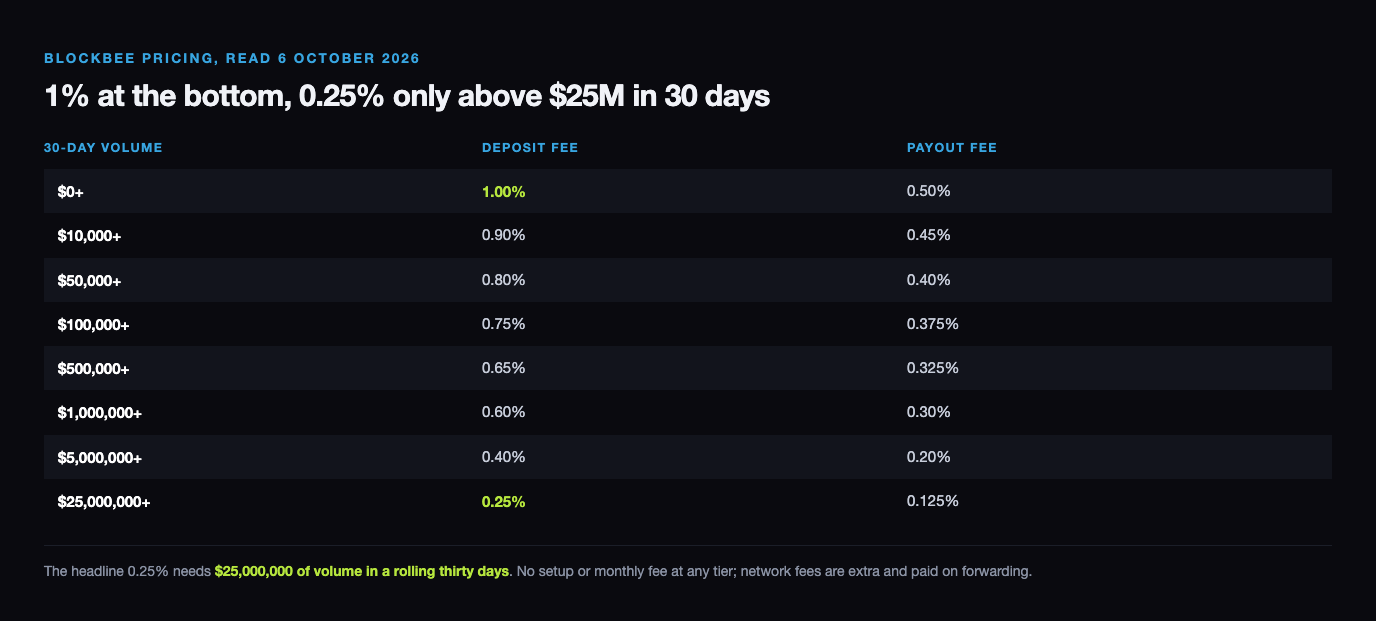
The fees page adds that the rate also depends on "industry risk tier", which BlockBee does not publish. Its calculator counts "deposits and payouts" toward your volume, and the fee is deducted from each payment. There are no setup or monthly fees. The homepage's "as low as 0.25%" is the top tier.
| 30-day volume | Deposit fee | Payout fee |
|---|---|---|
| $0+ | 1.00% | 0.50% |
| $10,000+ | 0.90% | 0.45% |
| $25,000+ | 0.85% | 0.425% |
| $50,000+ | 0.80% | 0.40% |
| $100,000+ | 0.75% | 0.375% |
| $250,000+ | 0.70% | 0.35% |
| $500,000+ | 0.65% | 0.325% |
| $1,000,000+ | 0.60% | 0.30% |
| $2,500,000+ | 0.50% | 0.25% |
| $5,000,000+ | 0.40% | 0.20% |
| $10,000,000+ | 0.30% | 0.15% |
| $25,000,000+ | 0.25% | 0.125% |
Source: tier table on blockbee.io/fees, also returned by BlockBee's public API, 6 October 2026. Payout column: the fees-page calculator shows half the deposit rate. Standard rates, before any risk-tier adjustment.
At these rates a steady $5,000 a month costs $50 (1%), $60,000 costs $480 (0.80%) and $600,000 costs $3,900 (0.65%), before network fees. Because the rate follows the previous 30 days, a new account pays 1% until its volume builds. The site also advertises "0% fees for 7 days!" beside its sign-up buttons, with no published conditions.
Minimum fees. The help article says you pay the larger of the percentage fee and a per-coin minimum. BlockBee's API on 6 October showed a minimum only for Bitcoin and Bitcoin Cash (546 satoshis) and Litecoin (5,460 litoshis), and its API reference says it "currently doesn't charge a minimum fee" beyond those dust limits. At the Bitcoin price BlockBee's API returned that day, 546 satoshis was about $0.47, so Bitcoin payments under roughly $47 pay more than 1%.
Network fees. Merchants "bear the blockchain fees", and by default those fees cover two transfers, "to forward both our fee and your payment". Its optional Prepaid Fees feature, which pays BlockBee's fee from credit, removes one transaction and saves "up to 50%" on blockchain fees, BlockBee says. Checkout and POS settings can pass both fees on to the customer. The network matters more than the tier:
| Asset | Minimum payment | Estimated network fee to forward |
|---|---|---|
| USDT on Tron | 10 USDT | 12.9 TRX (about $4.34) |
| USDT on Ethereum | 2 USDT | 0.00061 ETH (about $1.65) |
| USDC on Base | 3 USDC | 0.000295 ETH (about $0.80) |
| USDT on BNB Smart Chain | 1 USDT | 0.00002 BNB (about $0.02) |
| USDT on Polygon | 0.5 USDT | 0.107 POL (about $0.01) |
| USDT on Solana | 1 USDT | 0.00001 SOL (under $0.01) |
| Bitcoin | 0.00008 BTC (about $6.88) | 0.0000021 BTC (about $0.18) |
| Litecoin | 0.002 LTC (about $0.14) | 0.0000021 LTC (under $0.01) |
Source: BlockBee's public API at 10:12 UTC on 6 October 2026 (the same figures appear on blockbee.io/cryptocurrencies), converted at the prices it returned. BlockBee says estimates "might change significantly".
For comparison with other gateways, see our crypto payment gateway fee comparison and our list of the cheapest crypto gateways.
KYC: What Verification It Requires
BlockBee is not a no-KYC gateway. Its help article "Is KYC Verification Required?" says:
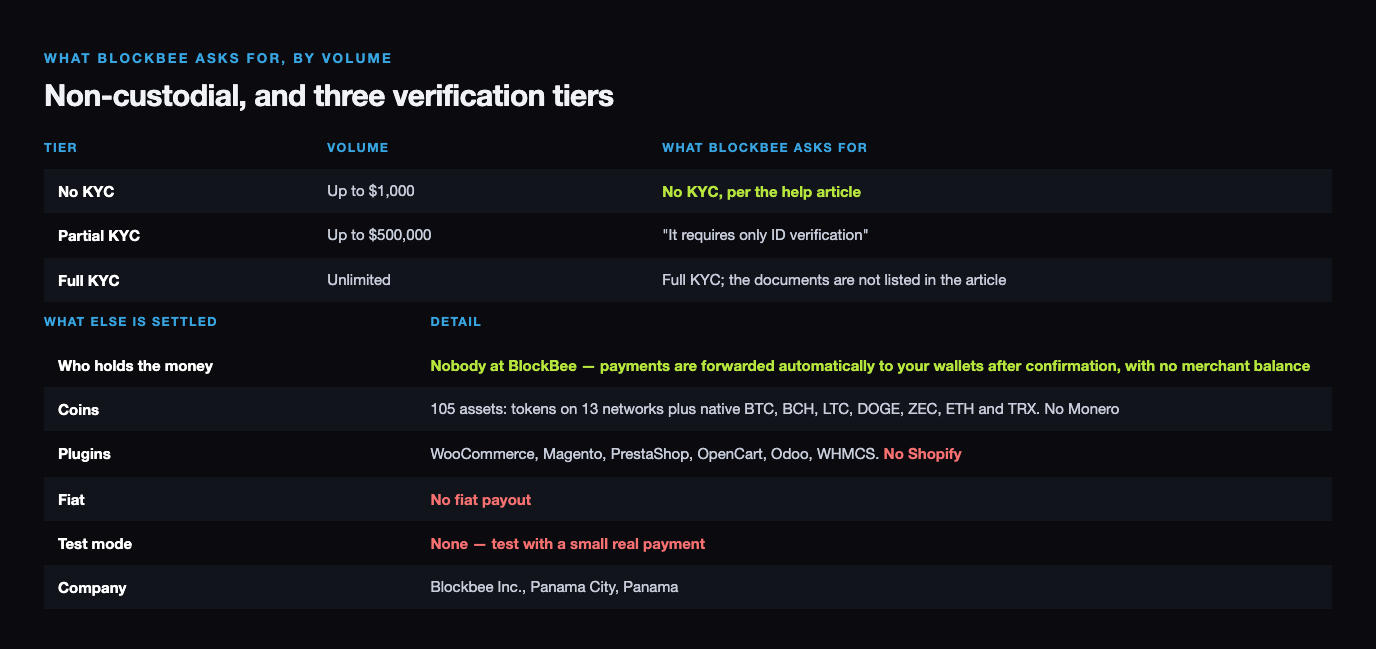
"Yes, KYC verification is required for certain transaction volumes on BlockBee. Specifically, KYC verification is mandatory for transactions exceeding $1000."
| Tier | Volume | What BlockBee asks for |
|---|---|---|
| No KYC | Up to $1,000 | No KYC, per the help article |
| Partial KYC | Up to $500,000 | "It requires only ID verification" |
| Full KYC | Unlimited | Full KYC (documents not listed in the article) |
Source: docs.blockbee.io, "Is KYC Verification Required?", checked 6 October 2026.
Its other documents are stricter. The terms require every user to "undergo a verification procedure" when registering. The privacy policy (effective 10 September 2025) says KYC and KYB procedures "are mandatory during account creation" and may cover ID, proof of address, a selfie and biometrics, or company documents and beneficial owners. The AML policy (effective 7 September 2026) ties checks to "monthly transaction volume" and risk profile. The help article does not say whether the $1,000 is lifetime or monthly.
Plan for an ID check before you take meaningful volume. For gateways that never ask, see our no-KYC crypto payment gateways guide.
Who Holds the Money
BlockBee calls itself "non-custodial". Each payment gets a deposit address that BlockBee generates, and BlockBee forwards what arrives to your wallet. Its transaction-status article defines "Sent" as "received in the system's address and forwarded to the provided address", and its About page says merchants get funds "as soon as a transaction is confirmed by the blockchain".
- No balance to withdraw. Funds go to the addresses you set in the dashboard or pass in the API call.
- Split payments. One payment can be split across up to 20 addresses, but each extra address raises the minimum (two addresses need 1.33 times the normal minimum).
- No refunds through BlockBee. Its terms say it is "unable to cancel, reverse or provide refunds for any transaction". You send refunds yourself.
The caveat
The money passes through an address BlockBee controls, and the terms let it stay there: BlockBee "may suspend or delay the processing or forwarding of a transaction, request additional information or documentation, conduct additional identity verification or due diligence, restrict or suspend access to the Services, or reject the transaction."
Payouts use a separate Self-Custodial Wallet secured by a two-of-three threshold signature scheme: BlockBee holds one encrypted share, and your API Key V2 and Recovery Key are the other two. If you lose both of yours, the funds are "permanently inaccessible".
There is no fiat payout. SwapBee rules can swap an incoming coin into another coin, or you can forward payments to your own Binance account, where BlockBee says its API can place a sell order. See gateways with fiat settlement or non-custodial gateways if either matters.
Supported Coins and Networks
BlockBee listed 105 assets on 6 October 2026, 45 of them stablecoins. Tokens run on 13 networks (BNB Smart Chain, Ethereum, Arbitrum One, Polygon, Avalanche C-Chain, Berachain, Base, Optimism, Linea, Monad, Solana, TON and Tron), alongside native BTC, BCH, LTC, DOGE, ZEC, ETH and TRX. USDT is accepted on ten networks, including Tron, BNB Smart Chain, Polygon and Solana.
- No Monero. XMR is not on the coin list or in the API, although an old line in BlockBee's WooCommerce docs still mentions "Monero and IOTA". See how to accept Monero.
- MATIC is now POL. Polygon upgraded MATIC to POL on 4 September 2024, and BlockBee lists POL.
- TON added 29 September 2026 for GRAM and USDT; BlockBee says Toncoin was renamed Gram (GRAM) in June 2026.
- Lightning is unclear: the coin page lists it, but it has no API ticker and is absent from the docs. Confirm before relying on it.
Compare coverage in our supported currencies guide.
Plugins and Integrations
BlockBee's documentation lists six official plugins. There is no Shopify plugin.
| Platform | Where to get it | Notes (6 October 2026) |
|---|---|---|
| WooCommerce | WordPress.org | Version 1.6.1, updated 6 July 2026, tested up to WordPress 7.0.6. 40+ active installs; 2 ratings averaging 3 out of 5 |
| PrestaShop | GitHub releases | Version 2.0.0 (May 2026) rebuilt on BlockBee's hosted checkout; PrestaShop 8 and 9 |
| OpenCart | GitHub releases | Requires OpenCart 4.0 or later; needs a cron job every minute for rate updates and order timeouts |
| Magento | GitHub releases | Uses the hosted checkout since version 1.1.0; repository last updated March 2025 |
| Odoo | Odoo Apps Store | payment_blockbee module, listed for Odoo 19.0; version 1.4.0 security release in July 2026 |
| WHMCS | GitHub releases (MIT licence) | PHP 7.4+; customers pay invoices on the hosted checkout; no refunds through the gateway |
- Shopify: none. It is not in BlockBee's plugin list, and both docs.blockbee.io/get-started/shopify and apps.shopify.com/blockbee return 404 errors. See our Shopify crypto payment guide.
- Bubble: the homepage lists it and BlockBee announced a plugin in July 2023, but it is missing from the docs plugin list. Treat it as unconfirmed.
- Without a plugin: a hosted checkout with your logo, payment links, a Storefront page, and an API with Node.js, PHP and Python libraries.
Other options: best WooCommerce crypto gateways.
Subscriptions, POS and Payouts
Subscriptions. BlockBee tracks billing cycles and emails customers "when payments are due"; each customer pays every renewal themselves, so nothing is charged automatically. The API sends webhooks on renewal and expiry, and a Telegram Bot handles paid channel subscriptions. See recurring crypto payments.
Point of sale. The POS app runs in a browser at pos.blockbee.io and as an Android app downloaded from BlockBee; iOS is "coming soon". Staff log in with separate POS usernames. More in our crypto POS guide.
Payouts. Mass payouts go from the Self-Custodial Wallet, by API or dashboard, to up to 100 addresses per request, at half the deposit rate plus network fees. A dashboard tutorial lists only Ethereum, BNB Smart Chain, Polygon and Tron, while the API guide uses Bitcoin and Litecoin examples, so check your network. Compare mass payout providers.
No Sandbox, and Small Payments Can Be Lost
BlockBee's e-commerce docs say it plainly:
"BlockBee has no sandbox or test mode. Before going live, place a small real order (for example about $2 in Litecoin) above the coin's minimum transaction amount and confirm it completes in your store."
The same page warns: "Payments below the minimum are ignored and the funds are lost." USDT minimums ranged from 0.5 USDT on Polygon and TON to 10 USDT on Tron on the day we checked, so show the minimum at checkout. Customers paying from an exchange must add its withdrawal fee, because "BlockBee expects the precise amount"; a payment-tolerance setting can accept slightly short payments.
See also our guides to gateway sandboxes and minimum crypto payments.
Banned Businesses and Countries
BlockBee's terms, effective 2 October 2026, list "Prohibited Business Activities" that are banned "regardless of whether they are lawful, licensed, regulated, or otherwise authorized in the jurisdiction in which they operate". The adult ban is explicit:
"Adult content and services: pornography, sexually explicit content or materials, prostitution, escort services, adult live chat, adult streaming, or other adult entertainment services"
The full list also covers:
- gambling, betting, casinos and lotteries
- gaming: video games, online games, in-game purchases and virtual items
- drugs and controlled substances, including cannabis
- alcohol, tobacco, nicotine and vaping products
- pharmaceutical and medicinal products, including over-the-counter medicines
- precious metals and stones
- donations and fundraising, including crowdfunding
- weapons, ammunition, fireworks and hazardous materials
- Ponzi, pyramid and other fraudulent schemes
Some BlockBee pages lag behind: Storefront and Payment Links still mention donations, and the wallet docs suggest payouts for "Gaming Platforms". The terms are what bind you, so get written approval first if you are near these lines. See our guides to crypto payments for adult businesses, gaming and donations.
The terms also exclude sanctioned persons and these countries and regions: Afghanistan, Belarus, Bosnia and Herzegovina, Burundi, the Central African Republic, Congo, the Democratic Republic of the Congo, Eritrea, Guinea-Bissau, Haiti, Iran, Iraq, Lebanon, Libya, Mali, Moldova, Myanmar, Nicaragua, Niger, North Korea, the Palestinian Territories, Russia, Serbia, Somalia, South Sudan, Syria, Turkey, Venezuela, Yemen and Zimbabwe, plus Crimea (including Sevastopol) and the Donetsk and Luhansk regions of Ukraine.
BlockBee and CryptAPI
BlockBee calls CryptAPI its "highly successful predecessor" and says its products "are driven by CryptAPI technology". Blockbee Inc. and CryptAPI Inc. give the same registered office in their terms (Vía España 1280, Edificio Orión, Suite 7D, Panama City), BlockBee's API serves coin logos from api.cryptapi.io, and a May 2026 BlockBee changelog entry says new tokens are "live across all CryptAPI endpoints".
The difference is the account. CryptAPI says "No registration or API Key required"; BlockBee adds an account, KYC, a dashboard, hosted checkout, subscriptions, a POS app and payouts. CryptAPI's published rates are lower at every volume from $5,000 to just under $25 million:
| 30-day volume | BlockBee | CryptAPI |
|---|---|---|
| $0+ | 1.00% | 1.00% |
| $5,000+ | 1.00% | 0.90% |
| $10,000+ | 0.90% | 0.85% |
| $50,000+ | 0.80% | 0.75% |
| $100,000+ | 0.75% | 0.70% |
| $1,000,000+ | 0.60% | 0.50% |
| $10,000,000+ | 0.30% | 0.25% |
| $25,000,000+ | 0.25% | 0.25% |
Source: the tier tables on blockbee.io/fees and cryptapi.io/fees, 6 October 2026.
CryptAPI's terms (effective 7 September 2026) also ban pornography and adult live chat and allow it to delay forwarding during reviews, so it is no way around BlockBee's rules.
Company and Reputation
The operator is Blockbee Inc., registered in Panama. Its About page names three co-founders: Stefano Moretti (CEO), Jorge Batista (CTO) and Ariano Ângelo (Tech Lead). Its WordPress plugin was first listed in October 2022. Its terms, AML policy and privacy policy name no financial licence or regulator. Disputes go to mediation, then binding arbitration.
- BlockBee's own figures: "$100M+ processed by January 2026", "10K+ merchants" and "100+" cryptocurrencies, according to its homepage. We could not verify the first two independently.
- Trustpilot: rated "Great" with 4.1 out of 5 (page checked 6 October 2026).
- WordPress.org: 40+ active installs of the WooCommerce plugin and two ratings averaging 3 out of 5.
Pros, Cons and Verdict
Pros
- Confirmed payments are forwarded to your own wallets, with no balance held at BlockBee
- No setup or monthly fees; volume tiers from 1% down to 0.25%
- Official plugins for WooCommerce, Magento, PrestaShop, OpenCart, Odoo and WHMCS
- 105 assets, including USDT and USDC on many low-fee networks
- Hosted checkout, payment links, subscription reminders, a POS app and a Telegram subscription bot
- Mass payouts to up to 100 addresses from a two-of-three key wallet
Cons
- KYC above $1,000 in volume; the privacy policy says checks start at sign-up
- 1% base fee; 0.25% needs $25M in 30-day volume, and risk tiers are unpublished
- Funds pass through BlockBee addresses, and forwarding can be delayed during reviews
- Bans adult, gambling, gaming, donations and more, plus 30 countries and territories
- No Shopify plugin, no Monero, no fiat payout
- No sandbox; payments below a coin's minimum are lost
Bottom Line
BlockBee suits a legitimate e-commerce, SaaS or hosting business that wants crypto forwarded to its own wallets through a ready-made plugin for WooCommerce, Magento, PrestaShop, OpenCart, Odoo or WHMCS. Expect 1% at first, an ID check once volume passes $1,000, and real network costs on some chains: BlockBee estimated about $4 to forward USDT on Tron when we checked. It is not a no-KYC gateway, has no Shopify plugin, and bans adult, gambling, gaming and donation businesses. Developers who only need the API should also compare CryptAPI. Full specs are on our BlockBee profile.
Visit BlockBee →FAQ
How much does BlockBee charge?
1% per payment at first, falling with 30-day volume to 0.25% at $25 million, plus network fees. An unpublished industry risk tier also applies, and payouts cost half the deposit rate. There are no setup or monthly fees.
Does BlockBee require KYC?
Above $1,000 in volume, yes: ID verification up to $500,000 and full KYC beyond, according to its help article. Its terms and privacy policy describe verification at sign-up.
Is BlockBee custodial?
It keeps no merchant balance and forwards each payment to your wallet, but the funds pass through a BlockBee-generated address first, and its terms allow it to delay forwarding during a review.
Does BlockBee work with Shopify?
No. Its official plugins cover WooCommerce, Magento, PrestaShop, OpenCart, Odoo and WHMCS, and we found no Shopify app.
Can adult or gambling businesses use BlockBee?
No. Its terms (effective 2 October 2026) prohibit adult content, gambling and gaming, even where the business is licensed.
Is BlockBee the same as CryptAPI?
They are sister services that share technology and a registered office in Panama City. CryptAPI needs no account and publishes lower rates; BlockBee adds KYC, a dashboard, hosted checkout, subscriptions, a POS app and payouts.
Sources
Primary sources checked on 6 October 2026:
- BlockBee: fees and fee calculator
- BlockBee help: How much are your transaction fees?
- BlockBee help: How to reduce blockchain fees
- BlockBee help: Prepaid BlockBee Fees
- BlockBee help: payment settings (confirmations, tolerance, surcharges)
- BlockBee API reference: service information
- BlockBee public API: service info (queried 6 October 2026)
- BlockBee API reference: estimate blockchain fees
- BlockBee API reference: create payment address
- BlockBee help: Is KYC verification required?
- BlockBee: terms and conditions (effective 2 October 2026)
- BlockBee: AML policy (effective 7 September 2026)
- BlockBee: privacy policy (effective 10 September 2025)
- BlockBee: homepage
- BlockBee: about
- BlockBee: cryptocurrencies
- BlockBee blog: BlockBee Adds Support for TON (29 September 2026)
- BlockBee blog: Weekly Buzz #12 (24 July 2026)
- BlockBee blog: Introducing BlockBee's Bubble Plugin (5 July 2023)
- BlockBee help: transaction statuses
- BlockBee help: minimums with multiple addresses
- BlockBee help: paying from an exchange
- BlockBee docs: custom payment flow
- BlockBee docs: Self-Custodial Wallet
- BlockBee docs: payouts
- BlockBee help: how to create a payout
- BlockBee: mass payouts
- BlockBee help: SwapBee automation rules
- BlockBee docs: e-commerce plugins
- BlockBee docs: WooCommerce
- BlockBee docs: PrestaShop
- BlockBee docs: OpenCart
- BlockBee docs: Magento
- BlockBee docs: Odoo
- BlockBee docs: WHMCS
- BlockBee docs: changelog
- BlockBee docs: Shopify (404)
- WordPress.org: BlockBee Cryptocurrency Payment Gateway
- Odoo Apps Store: BlockBee Payment Gateway
- GitHub: blockbee-io repositories
- Shopify App Store: apps.shopify.com/blockbee (404)
- BlockBee: subscriptions
- BlockBee docs: subscriptions
- BlockBee: Telegram Bot
- BlockBee: POS
- BlockBee docs: POS
- BlockBee help: POS platforms
- BlockBee: checkout
- BlockBee: payment links
- BlockBee: Storefront
- CryptAPI: homepage
- CryptAPI: about
- CryptAPI: fees
- CryptAPI: terms and conditions (effective 7 September 2026)
- Polygon: MATIC to POL migration is now live (4 September 2024)
- Trustpilot: BlockBee reviews