NexaPay Review 2026: Card-to-Crypto Gateway, Fees and Risks
NexaPay sends card payers to onramps like Transak and Banxa and pays you in USDC. Plans from $79/month, owner unverified. What we checked, 6 Oct 2026.
 Kevin Richards
Key Takeaways
- NexaPay does not process cards itself. Your customer picks a third-party provider such as Transak, Banxa or Stripe and pays on that provider's checkout. The crypto, mostly USDC on Polygon, is then sent to your own wallet.
- It is now a subscription: $79 to $719 a month billed yearly, or $99 to $899 billed monthly. NexaPay's own 0% commission ends on 28 October. After that a platform fee applies, but NexaPay does not publish the rate. Provider fees are always extra.
- No merchant KYC, but the provider may ask your customers to verify their identity.
- We could not identify the company behind it. The site names no legal entity, a search of Estonia's business register found no match, and the domain was registered in November 2025. Scamadviser rates the site 1 out of 100.
- If you try it, stick to the free trial (3 payments of up to $50) and small amounts. Don't pay for a year upfront.
Last checked: 6 October 2026. We read NexaPay's pricing, product, API documentation, terms, refund and legal pages, plus its status page and changelog. We also looked up the domain registration record, searched Estonia's e-Business Register and checked NexaPay's Scamadviser and Trustpilot pages. Finally, we read the customer terms of Banxa and Transak, two of the providers it routes payments through. We did not open a merchant account or make a live payment, so this review contains no first-hand checkout or payout results.
How NexaPay Actually Works
NexaPay (nexapay.one) calls itself a no-KYC fiat-to-crypto payment gateway. In practice it is a checkout layer that passes your customer to a third-party crypto onramp. NexaPay's documentation describes the flow like this:
- You create a payment with a payment link, the WooCommerce plugin or the API. Payouts go to the EVM wallet address saved in your account.
- Your customer chooses a provider on a NexaPay page and pays on that provider's own checkout. Depending on your plan and their region, that could be Transak, Banxa, Stripe, PayPal, Revolut or another provider.
- The provider converts the payment to crypto and sends it to your wallet. NexaPay says the transfer usually starts within 1–2 minutes of the payment confirming.
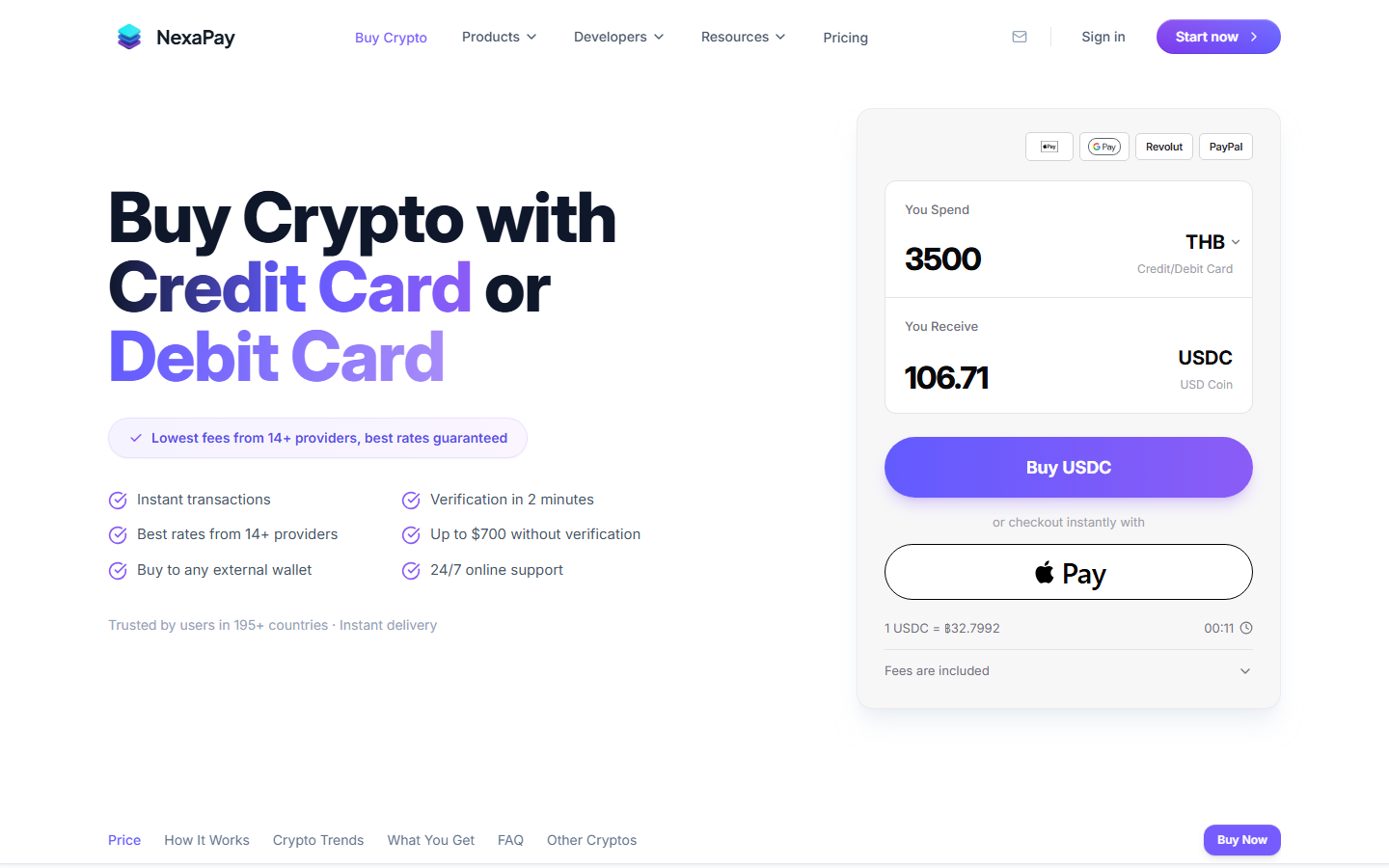
NexaPay's homepage opens with a consumer "buy crypto" widget. The merchant gateway is under Payment gateways. This screenshot is from an earlier version of the site, and the provider count has changed since.
NexaPay's legal pages say plainly that it sells software only. They state it is not a payment processor, acquirer, merchant of record or custodian. Card processing, customer KYC, AML checks, disputes and the wallet infrastructure are all handled by licensed third-party providers. One product page says otherwise: the crypto settlement page claims NexaPay handles "card processing, fraud detection, and authorization." The terms are what you agree to, so treat the legal pages as the accurate description.
NexaPay is also not the only gateway built this way. PayGate.to runs the same provider-checkout model (see Alternatives below). For a broader overview, see our guide to fiat-to-crypto payment gateways.
Pricing and Fees
| Plan | Monthly billing | Yearly billing | Processing cap | Providers |
|---|---|---|---|---|
| Starter | $99/mo | $79/mo ($948/yr) | $10,000/month | 4: Transak, Banxa, Binance Pay, Ramp (Visa and Mastercard) |
| Professional | $249/mo | $199/mo ($2,388/yr) | $75,000/month | 15 live, 2 coming soon; adds Apple Pay and Google Pay |
| Enterprise | $899/mo | $719/mo ($8,628/yr) | Unlimited | Same as Professional; required for high-risk categories |
| White Label | $3,999/mo | — | — | Your own branded gateway with sub-merchants and commissions |
- NexaPay commission: 0% until 28 October. According to the pricing FAQ, "a platform fee applies after the promotion". The rate is not published.
- Provider and network fees: charged on top of the plan. NexaPay does not list these fees, and they vary by provider, amount and region.
- Free trial: 3 live payments of up to $50 each before you choose a plan.
Because the subscription is a fixed amount, what it costs you as a percentage depends on your volume. Take Starter billed yearly at $79 a month. That is 0.79% of a month at its $10,000 cap, but 7.9% of a $1,000 month, before any provider fees.
The previous version of this review, like other coverage from early 2026, described a 1–3% fee and no monthly charge. That no longer matches NexaPay's pricing page.
High-risk merchants: NexaPay only allows iGaming, gambling, adult content, forex and crypto trading on the Enterprise plan. Its terms say that choosing a plan that doesn't match your business category can get your account closed. For these merchants the real entry price is $719 a month, billed yearly.
Payment Methods and Coverage
Which payment methods your customers can use depends on your plan, the provider and the customer's country:
- Starter: Transak, Banxa, Binance Pay and Ramp, with Visa and Mastercard on their checkouts.
- Professional and Enterprise: 15 providers are live. On top of the Starter four, these are Alchemy Pay, Coinbase Pay, Meld, Blockchain.com, Sardine, Topper, Stripe (US and EU customers), PayPal and Cash App (US only), Revolut (EU and UK) and Klarna (Sweden only). Guardarian and Crypto.com are listed as coming soon. Apple Pay and Google Pay are offered on the providers' checkouts.
- Countries: NexaPay's availability page lists 205 countries and territories, some marked as restricted. Each provider can add its own requirements on top.
Settlement: What Lands in Your Wallet
- Asset: mostly USDC on Polygon. The API docs also list USDC on Ethereum, USDT on Polygon or BNB Chain, ETH and POL. The settlement product page adds LINK and UNI on Polygon, and NexaPay's own summary says some payments settle in assets such as ETH or POL. Expect to receive more than one token.
- Wallet: an EVM address (starting 0x). There is no Bitcoin settlement.
- Speed: NexaPay says 1–2 minutes after the payment confirms. We did not test this with a live payment.
- Custody: NexaPay says it never holds funds or private keys. However, its terms say the payment addresses and keys used along the way are run by third-party providers, and that those providers control assets in transit. "Non-custodial" describes NexaPay's part only. A third party controls the funds in transit before they reach you.
- Chargebacks and refunds: card disputes go to the provider, and on-chain payouts are final. The API reference lists no refund endpoint, so you handle refunds yourself. See how merchants handle crypto refunds and crypto chargebacks and disputes.
What "No KYC" Covers, and What It Doesn't
For you as the merchant: you sign up with an email address or a Google account, add a wallet address and answer a few questions about your business category, website and expected volume. NexaPay asks for no business (KYB) documents.
For your customers: NexaPay's pricing FAQ says providers may ask customers to verify their identity, depending on the provider, the transaction and the region. The old claim that customers face no KYC was wrong.
The provider-terms question: Banxa's customer terms (effective 10 March 2026) require buyers to use the service only for themselves. They must also confirm that the destination wallet is exclusively theirs. Transak's terms (updated 21 September 2026) also require buyers to own the wallet, but make an exception for a "Merchant wallet". In a NexaPay checkout, the crypto goes to an address your customer doesn't own. NexaPay doesn't publish its agreements with providers, so we can't tell whether each provider has approved this use. A provider that hasn't could block these payments without warning.
For gateways that collect less data in other ways, see our no-KYC payment gateway rankings and the no-KYC gateway guide.
Integrations
- Payment links from the dashboard, so you don't need a website.
- REST API with three endpoints: create a payment, get a payment and list payments. Requests authenticate with an API key.
- Webhooks for "payment completed" and "session expired", signed with HMAC-SHA256.
- WooCommerce plugin, downloaded from NexaPay's docs and uploaded to WordPress by hand.
- SDKs: Node.js and Python packages installed from nexapay.one. The docs mark PHP and Ruby as "coming soon", although another page claims PHP, Ruby and Go SDKs.
- No test mode. There are only live keys. Creating a session charges nothing until a customer pays.
- Rate limit: the docs allow 60 payment creations per API key per hour. The changelog mentions higher limits, so ask before relying on either figure for a busy store.
- Not available: Shopify ("coming soon"), a payouts API, and recurring billing in the API. The product page advertises subscriptions, but the API reference only covers one-off payments.
Is NexaPay Legit? What We Could and Couldn't Verify
NexaPay may well process real payments, and its Trustpilot reviewers say it works. But before you route your revenue through a checkout, you should know who runs it. For NexaPay the public record is thin and partly contradictory.
| Operator | No company name or registration number on the site, terms or legal pages, only "Tallinn, Estonia". A name search for "NexaPay" in Estonia's e-Business Register returned no company. |
| Domain | nexapay.one was registered on 29 November 2025 through Name.com, with the owner's identity withheld. |
| History and scale claims | The site claims it was founded in 2023, processed its first $100M in 2024, now processes over $1B a year and serves more than 50,000 merchants. It offers no evidence for any of this and names no earlier domain. Its changelog starts at version 2.5.5, dated 25 November 2025. |
| Security claims | PCI DSS Level 1 and SOC 2 Type II are claimed, but no certificate or audit report is published. The legal pages also say NexaPay never handles card payments. |
| Status page | The page itself says it is a "published snapshot" with no live monitoring connected. The latest incident listed is from January 2026. |
| Scamadviser | Trust score 1, labelled "Very Likely Unsafe". Its flags include a hidden owner, a recent registration and an IPQS phishing flag. |
| Trustpilot | 4.7 from 39 reviews on a profile claimed in December 2025. The reviews we saw were dated June to August 2026. Trustpilot warns that the company may be associated with high-risk investments and that its reviews may not be representative. The listed contact country is the United Kingdom, not Estonia. Separately, NexaPay's own structured data claims a 4.9 rating from 184 ratings, with no source given. |
| Regulator warnings | We found none naming NexaPay or nexapay.one. Several unrelated firms with "Nexa" names, such as Nexa-Trader(s), are on the UK FCA's warning list, so don't confuse them. |
The terms are also one-sided, though that is common for software-only gateways. The service is provided "as is". NexaPay can suspend or close your account at any time without notice, liability is excluded as far as the law allows, and disputes go to the courts in Tallinn under Estonian law.
Before you send customers to it
- Run the free trial payments and confirm each payout on a block explorer, checking the amount and token.
- Ask support in writing what the platform fee will be after 28 October, and which company you are contracting with.
- Pay monthly rather than yearly until payouts have been reliable for a while.
- Sweep payouts into a wallet you control and don't reuse elsewhere, and keep your own records of every order.
Pros & Cons
Pros
- No merchant KYC or KYB documents
- Customers pay by card; Apple Pay and Google Pay on higher plans
- Payouts to your own wallet, in minutes according to NexaPay
- Card disputes handled by the provider, not charged back to you
- Payment links, REST API, webhooks and a WooCommerce plugin
- Free trial of 3 payments up to $50
Cons
- No identifiable company; domain from November 2025; Scamadviser score of 1
- $79–$899 monthly plans plus unpublished provider fees, and an unpublished platform fee after 28 October
- High-risk businesses limited to the $719+/month Enterprise plan
- Customers may have to complete the provider's KYC
- Banxa's and Transak's terms require buyers to own the destination wallet
- EVM tokens only, mostly USDC; no BTC
- No test mode, no refund or payouts API, no Shopify
- Security certifications claimed without evidence
Alternatives
Same model, no subscription: NexaPay's setup closely matches PayGate.to: provider checkouts, USDC on Polygon paid to a self-custodial EVM wallet, and occasional payouts in USDT, ETH or POL. Much of the legal wording matches too. PayGate.to needs no account and lists a 1% fee plus provider fees. Like NexaPay, it sends customers through onramps that may verify their identity. We could not find out whether NexaPay is built on PayGate.to. If you want this model, compare the total cost of both before you pay for a subscription.
If your customers already hold crypto: a conventional crypto gateway is cheaper and better documented. For example, BlockBee lists a 1% deposit fee that can fall to 0.25% depending on volume, plus network fees and no monthly fee. See our cheapest crypto gateways and non-custodial gateways rankings, or our gateway fee comparison.
Verdict
Bottom Line
NexaPay addresses a real need: customers pay by card and you receive stablecoins without merchant KYC. It does this by routing payments through third-party onramps, and nobody can tell you which company is behind it. For most merchants the risk is not the technology but the counterparty: there is no one identifiable to pursue if payouts stop. NexaPay now charges a monthly subscription, plus provider fees and an unpublished platform fee after 28 October. If you test it, use the free trial, keep amounts small and check every payout on-chain. Compare it with PayGate.to, which offers the same model without a subscription. If your customers can pay in crypto, a conventional crypto gateway is cheaper and easier to vet.
Sources
- NexaPay pricing (plans, providers, 0% offer, trial)
- NexaPay Instant product page
- NexaPay crypto settlement page
- NexaPay White Label
- NexaPay API documentation
- NexaPay reference summary (llms-full.txt)
- NexaPay Terms of Use (August 2026)
- NexaPay Legal Inquiries notice
- NexaPay legal About Us
- NexaPay Refund Policy
- NexaPay company page
- NexaPay security page
- NexaPay status page
- NexaPay changelog
- NexaPay service availability
- RDAP domain record for nexapay.one
- Estonian e-Business Register
- Scamadviser report for nexapay.one
- Trustpilot page for nexapay.one
- FCA warning: Nexa-Trader(s) (unrelated firm, for name disambiguation)
- Banxa Customer Terms & Conditions (effective 10 March 2026)
- Transak Terms of Service (updated 21 September 2026)
- PayGate.to instant payment gateway and FAQ
- BlockBee fees