PayRam Review: Self-Hosted, 1–5% Fee, Not Open Source
Self-hosted PayRam needs no KYB, but its docs state a 1–5% fee and its code is closed. Fees, coins, plugins and hosting costs, checked Oct 2026.
 Jennifer McNally
Key Takeaways
- Not fee-free: PayRam's docs FAQ (updated 17 September 2026) says it "charges a flat 1%-5% fee on settlement, when funds are withdrawn to the cold wallet". Its blog posts still say 0%, "up to 2.5%" or 0.4% to 0.5%. Get your rate in writing.
- You hold the money. It is software on your own server, and smart contracts sweep payments into a cold wallet only you control. You pay for hosting ($24 a month for the cheapest DigitalOcean server that meets its minimum) and gas.
- No KYC or KYB from PayRam, because there is no PayRam account. Your own legal obligations remain, and card payments run through third-party providers with their own checks.
- Not open source: the gateway is a prebuilt Docker image, and none of PayRam's 20 public GitHub repositories has a licence.
- Stablecoin-first: USDT and USDC on Ethereum, Polygon, Base (USDC) and Tron (USDT), plus BTC, ETH, PYUSD and cbBTC. Solana and BNB Chain only via a bridge that pays you USDC on Base.
- Suits technical teams, including the iGaming, gambling and adult merchants it markets to. Doesn't suit anyone needing a fixed published price, fiat settlement, subscriptions or a one-click Shopify app.
Affiliate disclosure: Payyd earns a commission from some providers linked on this page. That does not change the fees, limits or caveats reported here.
PayRam at a Glance
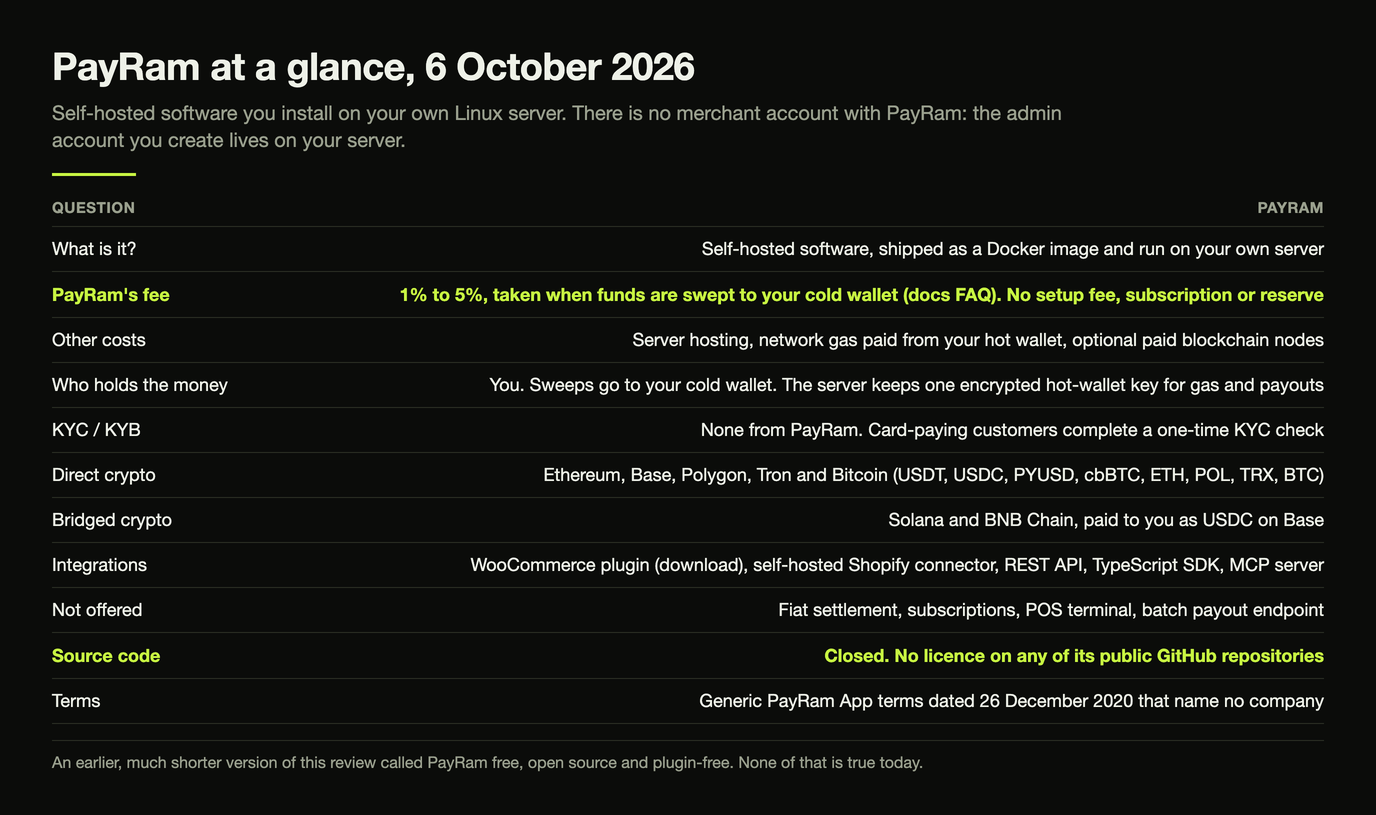
PayRam is crypto payment gateway software you install on your own Linux server with a one-line script or a DigitalOcean 1-Click droplet. It gives you a dashboard, hosted checkout, payment links, a REST API and webhooks. There is no merchant account with PayRam: the admin account you create lives on your server.
| Question | PayRam (6 October 2026) |
|---|---|
| What is it? | Self-hosted software, shipped as a Docker image and run on your own server |
| PayRam's fee | 1% to 5%, taken when funds are swept to your cold wallet (docs FAQ). No setup fee, subscription or reserve |
| Other costs | Server hosting, network gas paid from your hot wallet, optional paid blockchain nodes |
| Who holds the money | You. Sweeps go to your cold wallet. The server keeps one encrypted hot-wallet key for gas and payouts |
| KYC / KYB | None from PayRam. Card-paying customers complete a one-time KYC check |
| Direct crypto | Ethereum, Base, Polygon, Tron and Bitcoin (USDT, USDC, PYUSD, cbBTC, ETH, POL, TRX, BTC) |
| Bridged crypto | Solana and BNB Chain, paid to you as USDC on Base |
| Integrations | WooCommerce plugin (download), self-hosted Shopify connector, REST API, TypeScript SDK, MCP server |
| Not offered | Fiat settlement, subscriptions, POS terminal, batch payout endpoint |
| Source code | Closed. No licence on any of its public GitHub repositories |
| Terms | Generic "PayRam App" terms dated 26 December 2020 that name no company |
Fees: What PayRam Charges
PayRam's documentation gives the most specific statement, and the most recent one with a date on it. Its General FAQ, last updated on 17 September 2026, answers "What fees does PayRam charge?" like this:
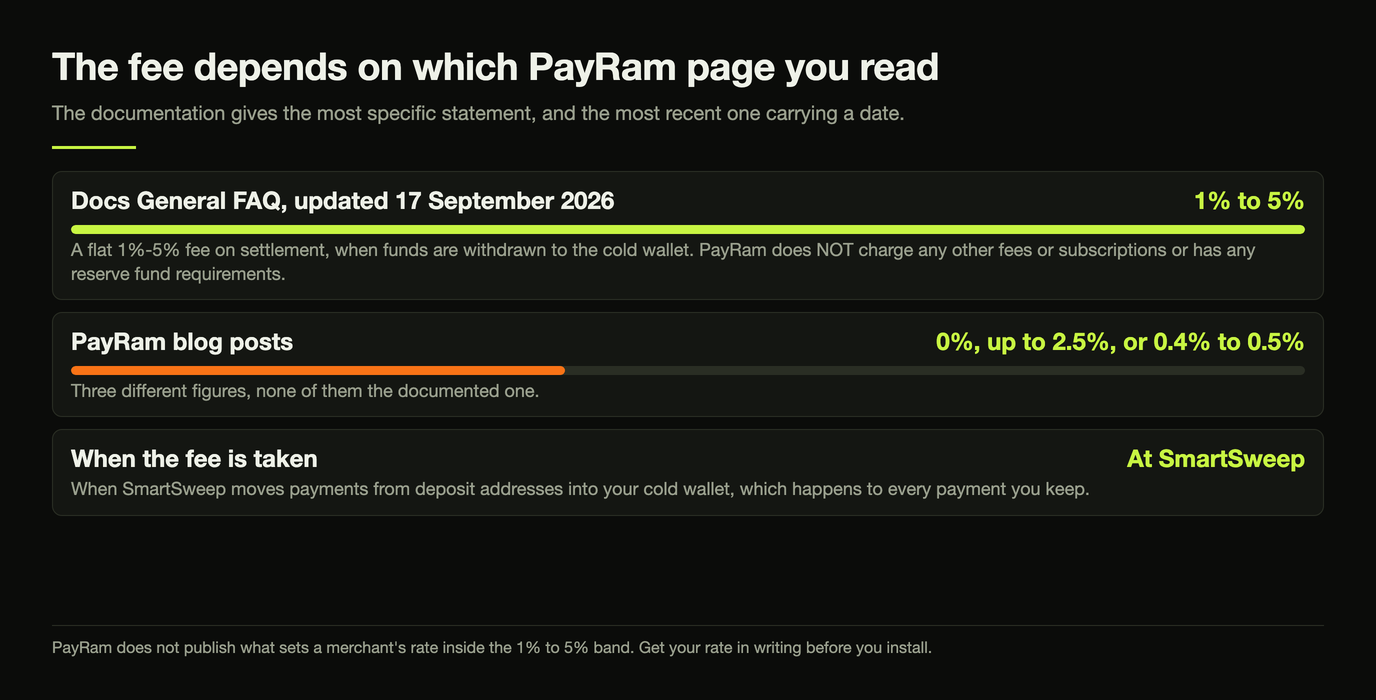
"PayRam charges a flat 1%-5% fee on settlement, when funds are withdrawn to the cold wallet. PayRam does NOT charge any other fees or subscriptions or has any reserve fund requirements."
The fee is taken when SmartSweep moves payments from deposit addresses into your cold wallet, which happens to every payment you keep. PayRam does not publish what sets a merchant's rate within that range; the llms.txt file on its website says "Commercial terms are agreed privately, case by case."
Other PayRam pages say something different:
| PayRam page | Dated | What it says about fees |
|---|---|---|
| Docs, General FAQ | Updated 17 Sep 2026 | A flat 1% to 5% on settlement |
| Blog: "What is PayRam?" | 4 Apr 2026 | "0% core processing fees"; the only costs are hosting and gas |
| Blog: "PayRam vs. BTCPay Server" | 4 Jul 2025 | Service fees for sweeping "can go up to 2.5%"; elsewhere in the same post, "0.4% to 0.5%" |
| Docs, DigitalOcean 1-Click guide | Current | "PayRam itself is free and self-hosted" |
| Affiliate page calculator | Current | Three merchants doing $30,000 a month earn an affiliate $450 a month. That is 0.5% of volume, which at the full 20% share works out to a 2.5% fee |
We use the documentation figure: it is the newest dated statement and the only one that answers the question directly. On $20,000 of swept payments a month, that is $200 at 1% or $1,000 at 5%. ATLOS, a hosted gateway that also pays straight to your wallet without KYC, lists "Only 1% fee for all transactions" and needs no server, so self-hosting is not automatically cheaper. Compare our cheapest crypto gateways.
Costs you carry yourself
- Hosting: see the next section.
- Gas: a hot wallet funded with ETH (EVM chains) and TRX (Tron) pays to deploy deposit-wallet contracts, sweep and send payouts. If it runs dry, sweeps and payouts fail.
- Nodes: PayRam ships with public nodes; for high volume its docs recommend a paid provider such as Infura or Alchemy.
- Card payments: PayRam adds no markup, but the card providers charge their own fees.
Hosting Costs and Server Requirements
PayRam's pages disagree on the minimum server. The Quick Setup guide asks for 2 CPU cores, 4 GB of RAM and a 50 GB SSD on Ubuntu 22.04 or another supported Linux, plus a PostgreSQL database. The docs FAQ recommends 4 cores; the homepage says "2 CPU, 8GB RAM". The DigitalOcean guide says not to go below 2 vCPUs and 4 GB.
On DigitalOcean's price list, the cheapest Basic droplet with 2 vCPUs and 4 GiB costs $24 a month (checked 6 October 2026). PayRam's own pages say a VPS typically costs "$20 to $150 per month". On the DigitalOcean 1-Click, PayRam runs PostgreSQL on the droplet unless you add a managed database, which its guide recommends for production at extra cost.
You also need a domain with HTTPS, SSH access, an SMTP server if you want payouts (approval codes go by email), a cold wallet you control, and time for updates: PayRam shipped Core versions 3.6 through 3.8.2 between August and 24 September 2026, and you install each with its update script. Its FAQ says you can be live "in under an hour"; if you have never run a production server, read our BTCPay Server setup guide for a sense of the work.
Custody: Who Holds the Money
PayRam the company never holds your balance. Each customer pays into a permanent deposit address. Once an address has received a minimum amount ($5 by default), PayRam deploys a smart-wallet contract for it, and SmartSweep moves balances to your cold wallet when a threshold you set is reached: an amount, a number of funded addresses, or a period of time. PayRam's FAQ says: "You maintain exclusive ownership of your private keys at all times."
Four details qualify that:
- The server holds one key. The hot wallet is "the one wallet PayRam keeps a private key for", encrypted at rest, and it pays gas and sends payouts. Keep only working balances in it.
- Bitcoin is different. With no smart contracts, BTC is swept through PayRam's mobile app using your seed phrase, which PayRam says stays on your device.
- Bridged payments pass through a third party: a bridge provider converts them before they reach you as USDC on Base.
- Issuers can still freeze stablecoins. PayRam itself "makes no claim that any token is 'unfreezable'".
There is no PayRam balance to freeze, no rolling reserve and no on-chain chargeback; refunds are sent by you. See also our non-custodial crypto gateways.
Is PayRam Open Source?
No. The earlier version of this review said it was, and that was wrong. PayRam's installer script (in its payram-scripts repository) downloads a prebuilt image, payramapp/payram, from Docker Hub. The gateway's own source code is not in any of PayRam's 20 public GitHub repositories. Those hold the installer, the WooCommerce and Shopify connectors, the MCP server, a Tron library and other tools, and GitHub shows no licence on any of them.
That matters even for the code you can read. GitHub's documentation says that without a licence "the default copyright laws apply", so no one may reproduce, distribute or create derivative works from the code. PayRam calls its Shopify connector "open source", and its white-label page lists "Full source-level control", but no published licence backs either claim. In its own comparison with BTCPay Server, PayRam calls itself "a commercial, business-focused product".
If you need code you can audit and fork, BTCPay Server is MIT-licensed. Our list of open-source crypto gateways has others. PayRam's homepage says its smart contracts were "Audited by QuillAudits" and links to a QuillAudits page titled "Payram Security Audit Report". That page loads its content in the browser, and we could not read the findings, the date or the scope, so we have not verified the audit.
Supported Coins and Networks
PayRam's Supported Networks and Coins page lists three ways a customer can pay. A coin appears at checkout only after you enable it and deploy the deposit wallet for that network.
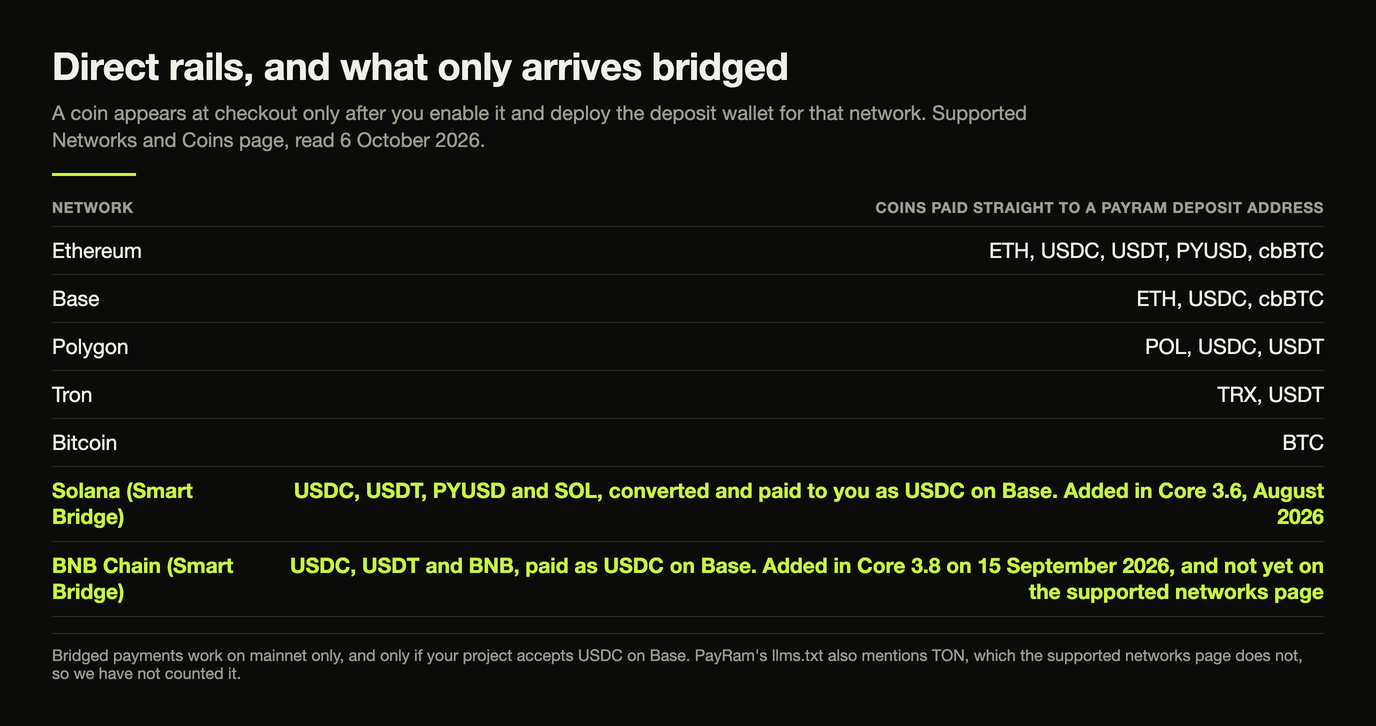
Direct crypto, paid straight to a PayRam deposit address:
| Network | Coins |
|---|---|
| Ethereum | ETH, USDC, USDT, PYUSD, cbBTC |
| Base | ETH, USDC, cbBTC |
| Polygon | POL, USDC, USDT |
| Tron | TRX, USDT |
| Bitcoin | BTC |
Bridged crypto (Smart Bridge), converted by a bridge provider and paid to you as USDC on Base:
- Solana: USDC, USDT, PYUSD and SOL (added in Core 3.6, August 2026).
- BNB Chain: USDC, USDT and BNB (added in Core 3.8 on 15 September 2026, but not yet on the supported networks page).
- Bitcoin and USDT on Tron can also use Smart Bridge since Core 3.7 (3 September 2026), alongside or instead of the direct rails.
Bridged payments work on mainnet only, and only if your project accepts USDC on Base.
Card payments go through PayRam Wallet (you receive USDC or ETH on Base), Changelly (USDC or ETH on Ethereum) or Wert (Ethereum, Base or Polygon).
PayRam's llms.txt also mentions TON, but the supported networks page does not, so we have not counted it. Arbitrum and Optimism, listed in the earlier version of this review, are not documented anywhere. See also our guide to accepting USDT.
WooCommerce, Shopify and the API
WooCommerce
The free plugin is a download from payram.com; a WordPress.org search for "payram" finds nothing. Version 0.2.0 needs WordPress 6.0+, WooCommerce 6.0+ and PHP 7.4+, supports checkout blocks and HPOS, and sends amounts in USD only, so your store currency must be USD (multi-currency is "on the roadmap"). Buyers pay on your gateway's hosted checkout, and orders complete on a signed webhook.
Check the version before you install. On 6 October 2026 the payram.com zip was still 0.2.0, while GitHub has 0.3.0 with a fix merged on 11 August 2026. PayRam's commit notes say the old re-check of each payment "silently found nothing and fell through to trusting" the webhook body, so "a replayed, validly-signed old body could still complete an order". Version 0.2.0 still rejects unsigned webhooks, but install from GitHub or ask PayRam for the current build. Alternatives are in our WooCommerce crypto plugins list.
Shopify
We found no PayRam listing on the Shopify App Store (apps.shopify.com/payram returns a 404). The Shopify connector is an app you host yourself: run it on a server with port 2798 behind HTTPS, install it as a custom app through a Shopify Partner account, and connect it with a project API key. The buyer picks a manual payment method, Shopify places the order unpaid, and the buyer pays from a link on the Thank You page. The connector converts non-USD totals to USD, marks orders paid when funds arrive and refunds overpayments as gift cards.
It is new: PayRam's release notes date it to 4 September 2026 and version 1.1.0 to 18 September, and say earlier builds created a €50 order as a $50 payment. See our Shopify crypto payment guide for alternatives.
API, SDK and AI agents
A REST API covers payments, payouts and webhooks with a project API key. Webhooks are signed with HMAC-SHA256 (X-Payram-Signature), and failed final notifications are retried at gaps growing from 30 minutes to 48 hours. There is a TypeScript SDK, an MCP server for AI agents and a testnet setup. Magento is "on the roadmap".
KYC, Compliance and Who It Targets
PayRam "does not impose mandatory KYC requirements by default": you download the software and nobody approves you. Its no-KYC page adds that this "does not remove the KYC, AML, sanctions, or licensing obligations that apply to your own business".
PayRam markets openly to high-risk sectors. Its docs FAQ names "iGaming, adult services, and gambling"; its WooCommerce page adds "peptides and nutraceuticals, CBD, high-ticket digital goods, marketplaces in sanctioned-adjacent corridors" and says the gateway "reports to no one". Its terms ban no business types and exclude no countries.
Two limits apply to card payments:
- They are not fully permissionless. PayRam's 24 September 2026 release notes say that before you apply to its card onramp provider, the dashboard shows "which business categories they don't approve". Only the crypto rails need no approval at all.
- Customers are verified. Those paying through PayRam Wallet complete a one-time KYC check on their first purchase.
See also our guides to crypto payments for adult businesses, gaming and no-KYC gateways.
Terms, Company and Support
PayRam's Terms and Conditions carry an "Effective Date: 26th December 2020". They are written for "the PayRam App", with a section on camera permissions for QR scanning, and name no legal entity. Governing law is "the laws and regulations of jurisdictions where our website operates, including GDPR (Europe) and CCPA (California)". PayRam "disclaims all liability" for the self-hosted software once it is downloaded, hosted or operated. No countries or business types are excluded.
PayRam's media kit names Siddharth Menon as founder and says he previously co-founded the Indian exchange WazirX. Apple's App Store lists Mojo Nation Ltd as the seller of the PayRam Business iOS app. Neither the website nor the terms say which company sells the gateway or collects its fee, which matters if you ever need to enforce an agreed rate.
Traction figures differ by page (homepage: "100+ merchants"; llms.txt: "400+ active merchants"), and we could not verify either. The docs FAQ promises 24/7 email and chat support for critical issues; PayRam's DigitalOcean listing gives support hours of "Weekdays between 12 PM to 6 PM", with no time zone.
Payouts, Refunds and Operator Mode
- Payouts: USDC and USDT on Ethereum, Base, Polygon and Tron, sent from your hot wallet to OTP-confirmed address-book recipients. Non-admin payouts need admin approval, with optional auto-approve thresholds and daily and hourly limits. It is "one API call per payout", with no batch endpoint documented; see our mass payout gateways.
- Refunds: manual, from the dashboard or API. Underpayments stay "pending"; overpayments can be refunded or credited to a later invoice. See our crypto refunds guide.
- Subscriptions: not included; you would build them on the API yourself.
- Fiat: crypto only. The features page lists a "Crypto-to-Fiat Off-Ramp", but the docs FAQ says fiat off-ramp settlement is "part of the roadmap".
- Operator mode and white label: one installation can serve several merchants with their own wallets, API keys and webhooks. Operators set a markup of up to 15% per chain, split on-chain to their own wallet at each sweep.
Affiliate Program
PayRam's affiliate program pays up to 20% of the fees PayRam earns from merchants you refer. The commission recurs for as long as the merchant is active, subject to an annual rate review, with at least 30 days' notice of any change. It is paid monthly in the crypto or stablecoin the merchant settles in. The minimum payout is $50, and smaller amounts roll over to the next month. There is no approval step, and PayRam says there are no geographic or category restrictions. Because the commission is a share of PayRam's fee, the full 20% works out to between 0.2% and 1% of a referred merchant's swept volume, depending on that merchant's rate. Other programs are compared on our gateways with affiliate programs page.
PayRam vs BTCPay Server
Both run on your own server and pay into your own wallet. The differences that matter most are price, licence and what each one is built for:
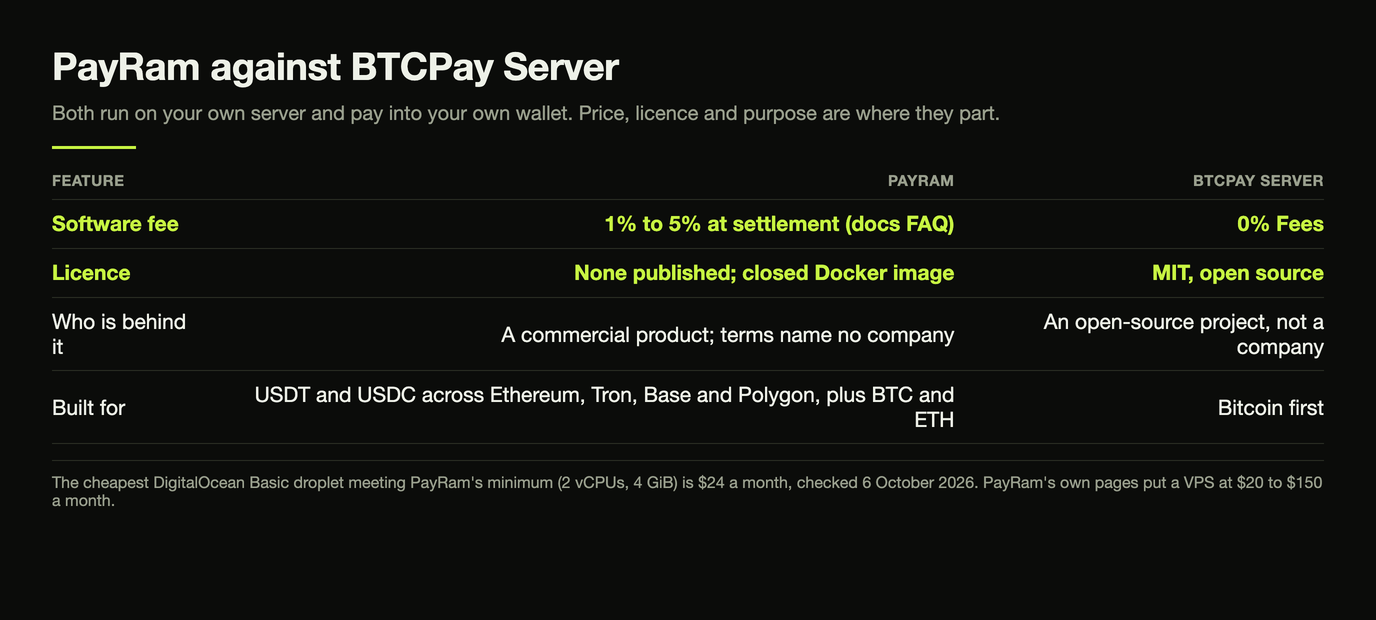
| Feature | PayRam | BTCPay Server |
|---|---|---|
| Software fee | 1% to 5% at settlement (docs FAQ) | "0% Fees" |
| Licence | None published; closed Docker image | MIT, open source |
| Who is behind it | A commercial product; terms name no company | "An open-source project, not a company" |
| Built for | USDT and USDC across Ethereum, Tron, Base and Polygon, plus BTC and ETH | Bitcoin first |
Choose PayRam if most of your customers pay in USDT or USDC, you want card-to-crypto and payout tools in the same install, and you accept a fee you have to negotiate. Choose BTCPay Server if you mainly take Bitcoin, want software you can audit and fork, or refuse to pay a percentage to a software vendor. Our BTCPay Server review has the details.
Pros, Cons and Verdict
Pros
- Payments sweep into a cold wallet only you control
- No PayRam account, KYB or approval to start
- Stablecoins on Ethereum, Base, Polygon and Tron
- WooCommerce plugin, Shopify connector, API, SDK and MCP server
- Payout approvals, card-to-crypto option and operator mode
Cons
- 1% to 5% fee, with conflicting figures on PayRam's own pages
- Closed source with no licence, despite "open source" wording
- You run and pay for the server, nodes and gas
- No fiat settlement, subscriptions, POS or batch payouts
- 2020 terms that name no company
Bottom Line
PayRam's appeal is control: stablecoin payments swept into your own wallet by software on your own server, with no PayRam account for anyone to freeze. It is not the free, open-source gateway it was once described as. Its documentation says it takes 1% to 5% at settlement, the core is a closed Docker image, and the terms behind it name no company. It suits teams that already run servers, take mostly USDT or USDC, and are prepared to negotiate and document their rate. If you want zero fees and auditable code, use BTCPay Server. If you would rather not run infrastructure at all, a hosted non-custodial gateway such as ATLOS may cost less. Full specs are on our PayRam profile.
Visit PayRam →FAQ
How much does PayRam cost?
Its docs FAQ (updated 17 September 2026) says a flat 1% to 5% when funds are swept to your cold wallet, with no other fees, subscriptions or reserves. Older blog posts say 0% or up to 2.5%, so confirm your rate in writing. Hosting and gas are extra.
Is PayRam open source?
No. The gateway is installed as a prebuilt Docker image, its source is not public, and none of PayRam's 20 public GitHub repositories has a licence.
Does PayRam require KYC?
Not from the merchant: there is no PayRam account to verify, though your own legal obligations still apply. Customers paying by card through PayRam Wallet complete a one-time KYC check.
Which coins does PayRam support?
Directly: ETH, USDC, USDT, PYUSD and cbBTC on Ethereum; ETH, USDC and cbBTC on Base; POL, USDC and USDT on Polygon; TRX and USDT on Tron; and BTC. Solana and BNB Chain payments arrive as USDC on Base through Smart Bridge.
Does PayRam work with Shopify and WooCommerce?
Yes, with limits. The WooCommerce plugin is a payram.com download for USD stores only. Shopify uses a connector you host yourself and install as a custom app; customers pay after the order is placed, and there is no App Store listing.
Sources
Primary sources checked on 6 October 2026:
- PayRam docs: General FAQs (last updated 17 September 2026)
- PayRam docs: Fund Management FAQs
- PayRam docs: Supported Networks and Coins
- PayRam docs: What's New
- PayRam: release notes
- PayRam docs: Quick Setup
- PayRam docs: DigitalOcean 1-Click
- PayRam docs: Hot Wallet Setup
- PayRam docs: Node Details Configuration
- PayRam docs: Funds Sweeping
- PayRam docs: SmartSweep
- PayRam docs: Card-to-Crypto Fiat Onramp
- PayRam docs: Payouts
- PayRam docs: Operator Mode
- PayRam docs: Webhook
- PayRam docs: Shopify Plugin
- PayRam: homepage
- PayRam: llms.txt
- PayRam: product features
- PayRam: payouts
- PayRam: integrations
- PayRam: WooCommerce plugin page
- PayRam: WooCommerce plugin download (v0.2.0, downloaded 6 October 2026)
- PayRam: no-KYC gateway page
- PayRam: white label
- PayRam: operator mode
- PayRam: affiliate program
- PayRam: terms and conditions
- PayRam: media kit
- PayRam blog: What is PayRam? (4 April 2026)
- PayRam blog: PayRam vs. BTCPay Server (4 July 2025)
- PayRam on GitHub (20 public repositories, none with a licence)
- PayRam installer script
- GitHub: payram-woocommerce (v0.3.0 and webhook fix commits)
- GitHub: payram-shopify
- Docker Hub: payramapp/payram
- GitHub Docs: Licensing a repository
- WordPress.org plugin search: "payram" (no results)
- ATLOS: pricing
- ATLOS: homepage
- Shopify App Store: apps.shopify.com/payram (not found)
- DigitalOcean Marketplace: PayRam
- DigitalOcean: Droplet pricing
- Apple App Store: PayRam Business
- QuillAudits: Payram page (content not readable)
- BTCPay Server: homepage
- GitHub: btcpayserver (MIT licence)