Crypto Gateway Dispute Resolution 2026: We Read 12
We read the dispute clause in 12 crypto payment gateway contracts in November 2026. Three name no governing law, and one leaves about two days to sue.
 Brian Ormond
Key Takeaways
- Six of the twelve take you out of court and six send you to a named court. An exact split, and nothing on the pricing page tells you which side a gateway is on.
- Three name no governing law at all — PassimPay, BlockBee and Plisio. A fourth, Cryptomus, picks "the laws of the country where the Company is registered" and names neither.
- Cryptomus bars court for 90 days and kills the claim at 3 months. Clause 16.2 against clause 16.4 leaves a window of about two days.
- Two of the six arbitration clauses name no institution, no seat and no rules. PassimPay sends disputes to "arbitration agreed between you and us"; BlockBee to "an expert arbitrator".
- Blockonomics prints an all-caps ARBITRATION NOTICE for a clause its terms do not contain. The notice promises binding individual arbitration in the US or Canada; the operative clause gives the Singapore courts exclusive jurisdiction.
Nobody reads the crypto gateway dispute resolution clause while things are going well. It is the last numbered section before the signature block, it contains no fees, and it decides something you only care about on the day a settlement does not arrive: which country's law applies, which room you have to argue in, who pays to book the room, and how long you have before the right to argue expires.
So we read that section in the merchant terms of twelve hosted gateways on 1 November 2026. Six send disputes to arbitration and six to a named court, an exact split. Three name no governing law anywhere in the document. Two of the six arbitration clauses name no institution, no seat and no rules, so a merchant holding one cannot find out where a hearing would be. And one contract sets a negotiation period longer than its own filing deadline.
The four lines that decide where you fight
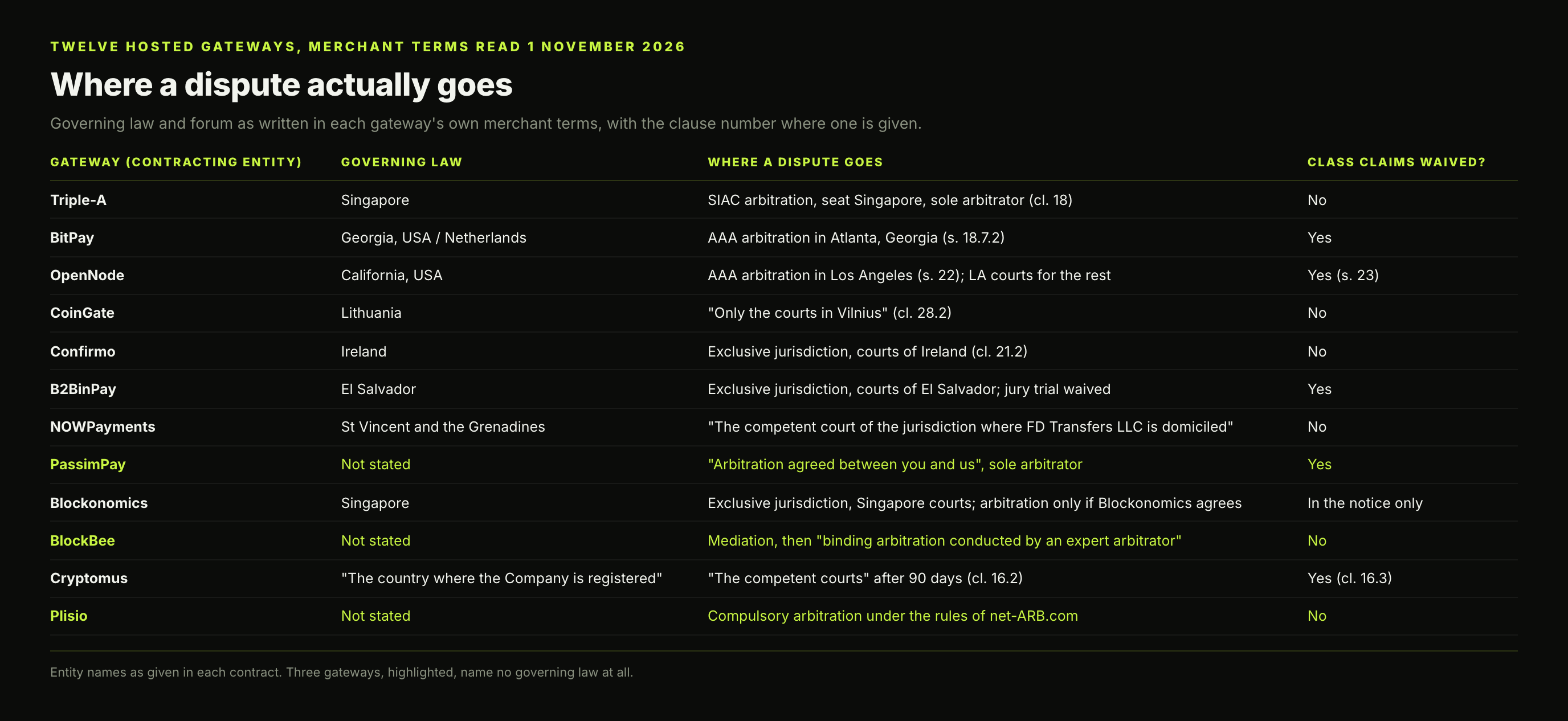
A dispute clause is four decisions stacked in one paragraph. Governing law picks whose rules interpret the contract. Forum picks who hears it, a court or a private tribunal. Procedure picks the institution, seat and rules, which is what fixes the cost. Standing decides whether you may join other merchants, the only mechanism that makes a hundred-dollar loss worth pursuing. Here is every one of the twelve, in the operative wording.
| Gateway (contracting entity) | Governing law | Where a dispute goes | Class claims waived? |
|---|---|---|---|
| Triple-A (Triple-A Technologies Pte. Ltd.) | Singapore | SIAC arbitration, seat Singapore, sole arbitrator (cl. 18) | No |
| BitPay (BitPay, Inc. / BitPay B.V.) | Georgia, USA / Netherlands | AAA arbitration in Atlanta, Georgia (s. 18.7.2) | Yes |
| OpenNode (OpenNode, Inc.) | California, USA | AAA arbitration in Los Angeles (s. 22); LA courts for the rest (s. 24) | Yes (s. 23) |
| CoinGate (UAB "Decentralized") | Lithuania | "Only the courts in Vilnius" (cl. 28.2) | No |
| Confirmo (Confirmo Limited) | Ireland | Exclusive jurisdiction, courts of Ireland (cl. 21.2) | No |
| B2BinPay (B2BINPAY El Salvador S.A. de C.V.) | El Salvador | Exclusive jurisdiction, courts of El Salvador; jury trial waived | Yes |
| NOWPayments (FD Transfers LLC) | St Vincent and the Grenadines | "The competent court of the jurisdiction where FD Transfers LLC is domiciled" (s. 22.2) | No |
| PassimPay (NILESPAY FINANCE INC.) | Not stated | "Arbitration agreed between you and us", sole arbitrator; jury trial waived (s. 12) | Yes |
| Blockonomics (OneByZero Tech Pte. Ltd.) | Singapore | Exclusive jurisdiction, Singapore courts; arbitration only if Blockonomics agrees | In the notice only |
| BlockBee (Blockbee Inc., Panama) | Not stated | Mediation, then "binding arbitration conducted by an expert arbitrator" | No |
| Cryptomus (no entity named) | "The country where the Company is registered" | "The competent courts" after 90 days (cl. 16.2) | Yes (cl. 16.3) |
| Plisio | Not stated | Compulsory arbitration under the rules of net-ARB.com | No |
The second column is the one that surprised us. Governing law is the cheapest clause in a contract to get right: one sentence, one country, and the gateway picks it unilaterally. Three of twelve still do not have one.
Three contracts name no governing law at all
PassimPay's is the strangest, because the section promises one. Section 12 is headed "ARBITRATION, WAIVER OF CLASS ACTION AND JURY TRIAL AND GOVERNING LAW". The body covers arbitration, the jury waiver and the class waiver, and then stops. No law is named. The document mentions a governing law exactly once, in the clause on unclaimed cryptocurrency: after "the applicable statutory limitation period for claims under the governing law" your coins pass to the company's own balance. That provision depends on a term the contract never defines. The named operator, NILESPAY FINANCE INC., is a British Columbia company with a FINTRAC money services registration — a strong hint, not a choice of law.
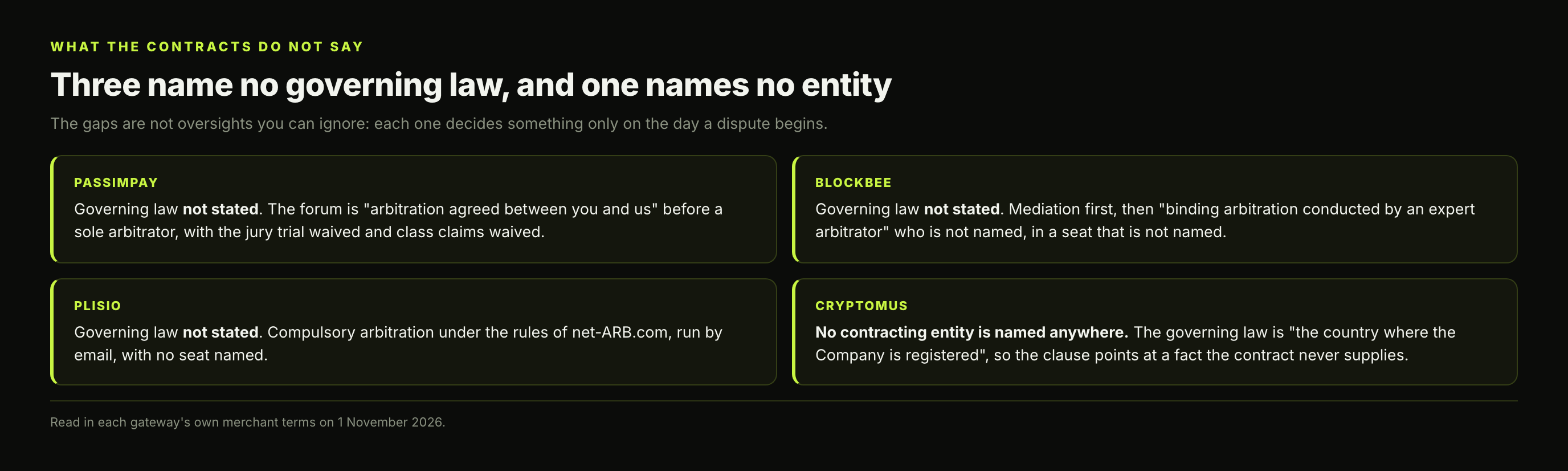
BlockBee's terms contain the word "governed" zero times. The whole of its dispute provision is two sentences under the heading "Resolving Disputes": mediation first, and if that fails, "the dispute will be resolved through binding arbitration conducted by an expert arbitrator or as agreed upon by the parties". The preamble names Blockbee Inc. of Panama City, so Panamanian law is the likely answer, but the contract does not say so, does not name a mediator, does not name an arbitrator and does not name a seat.
Plisio names a forum but no law, which we come back to below. Cryptomus belongs here in substance despite having a governing-law clause, because of how it is drafted: clause 16.1 selects "the laws of the country where the Company is registered", and the Terms define "Company" as Cryptomus, full stop — no entity, no registration number, no country. It is a pointer to a fact the document withholds. That makes four of twelve where the answer to "whose law?" is not in the contract, against CoinGate, which says Lithuania and Vilnius in two clauses you can read in fifteen seconds.
Blockonomics announces a clause it does not contain
Blockonomics is the one internal contradiction in the set, and it is a clean one.
Near the top of the Terms, in capitals, sits this: "ARBITRATION NOTICE: THESE TERMS CONTAIN AN ARBITRATION CLAUSE FOR USERS IN CERTAIN JURISDICTIONS. IF YOU ARE A USER LOCATED IN THE UNITED STATES OR CANADA YOU AGREE THAT DISPUTES BETWEEN YOU AND ONEBYZERO TECH WILL BE RESOLVED BY BINDING, INDIVIDUAL ARBITRATION IN THE UNITED STATES OR CANADA AS APPLICABLE, AND YOU ARE WAIVING YOUR RIGHT TO A TRIAL BY JURY OR TO PARTICIPATE AS A PLAINTIFF OR CLASS MEMBER IN ANY PURPORTED CLASS ACTION OR REPRESENTATIVE PROCEEDING."
The terms contain no such clause. The only dispute provision in the document reads, in full: "These Terms are governed by Singapore law. Both you and we irrevocably submit to the exclusive jurisdiction of the Singapore courts for any legal proceedings relating to these Terms. If we agree with you that arbitration would be an appropriate forum, we may joint refer the dispute for arbitration." That is the opposite arrangement on every limb: a court rather than a tribunal, Singapore rather than North America, and arbitration available only when the gateway consents. There is no jury waiver and no class waiver in the operative text at all.
Be precise about what this means. A conspicuous notice is normally how an arbitration clause is made enforceable, not a substitute for one, so the likeliest reading is template boilerplate over a live Singapore clause. A US merchant cannot rely on that, which is the problem: the only sentence addressed to them describes something the contract does not do. The same document caps Blockonomics' liability at USD 100, and it is published at the site's /privacy path — /terms returns 404.
Ninety days to negotiate, three months to sue
Most of these contracts make you wait before starting anything, which is normal and usually sensible. Cryptomus is the one where the waiting period and the deadline collide.
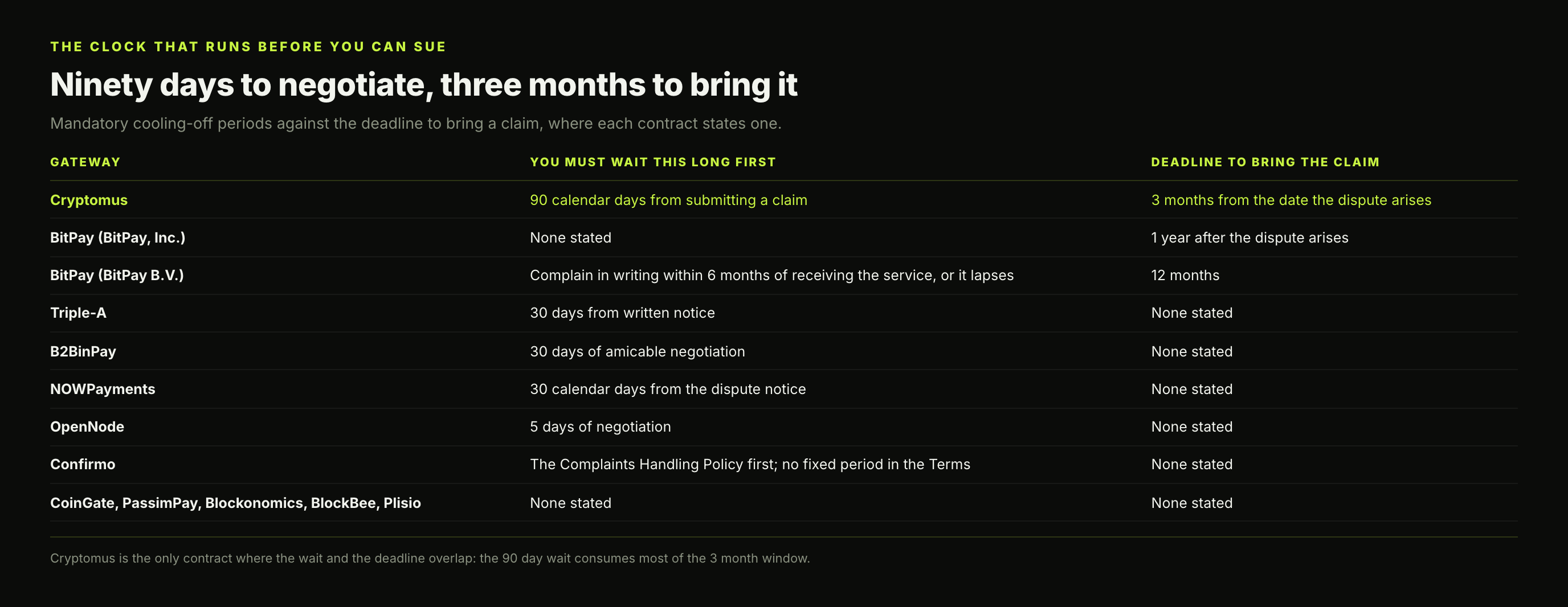
Clause 16.2 says that before filing a lawsuit the parties will negotiate, and that if the dispute is not resolved "within ninety (90) calendar days from the date of submission of a claim, it shall be finally resolved in the competent courts". Clause 16.4, two lines later, says any claim "must be submitted within three (3) months from the date the dispute arises" and that "after this period, the claim shall be deemed permanently waived and cannot be filed".
Read together on the most favourable timeline — you submit your claim the same day the dispute arises — the negotiation period ends on day 90 and the right to file ends at three months, which is day 90, 91 or 92 depending on the months involved. The gap is about two days. Wait a week before complaining and it closes entirely. Whether a court would enforce a three-month contractual limitation period is a separate question with a different answer in every jurisdiction, and here you cannot tell which jurisdiction that is.
| Gateway | You must wait this long first | Deadline to bring the claim |
|---|---|---|
| Cryptomus | 90 calendar days from submitting a claim | 3 months from the date the dispute arises |
| BitPay (BitPay, Inc.) | None stated | 1 year after the dispute arises |
| BitPay (BitPay B.V.) | Complain in writing within 6 months of receiving the service, or it lapses | 12 months |
| Triple-A | 30 days from written notice | None stated |
| B2BinPay | 30 days of amicable negotiation | None stated |
| NOWPayments | 30 calendar days from the dispute notice | None stated |
| OpenNode | 5 days of negotiation | None stated |
| Confirmo | The Complaints Handling Policy first; no fixed period in the Terms | None stated |
| CoinGate, PassimPay, Blockonomics, BlockBee, Plisio | None stated | None stated |
Six of twelve take dispute resolution out of court
Arbitration is not automatically worse than court for a merchant. It is private, usually faster, and an award is enforceable across borders under the New York Convention in a way a judgment often is not. What makes the clause good or bad is the procedure, and procedure is where two of these six stop writing.
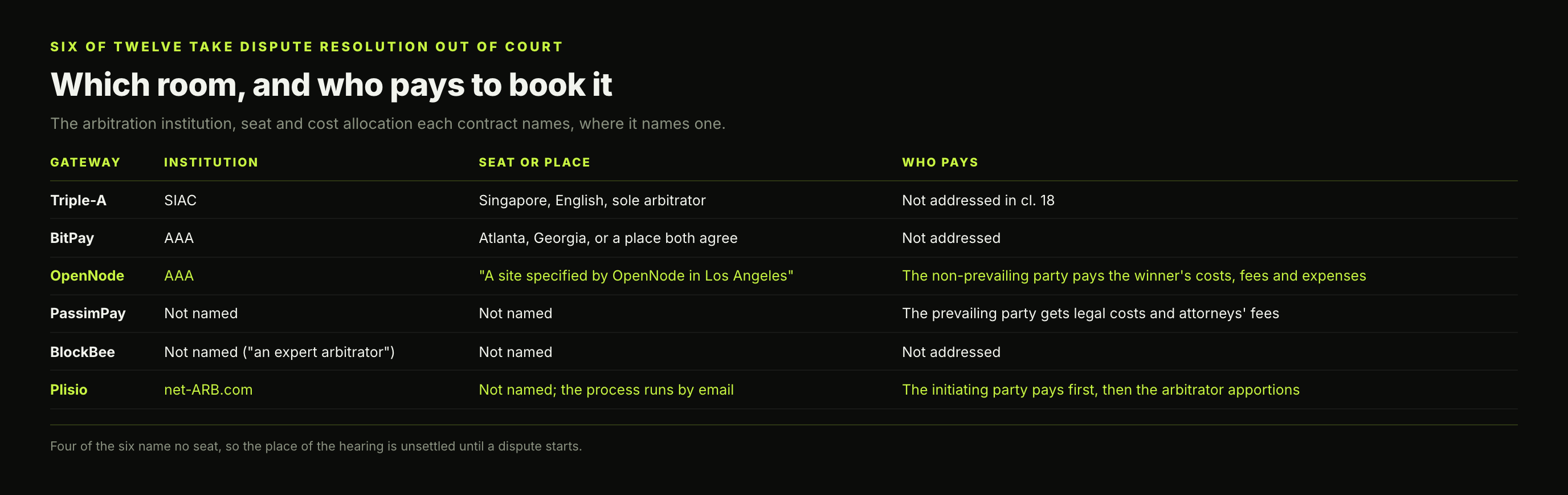
| Gateway | Institution | Seat or place | Who pays |
|---|---|---|---|
| Triple-A | SIAC | Singapore, English, sole arbitrator | Not addressed in cl. 18 |
| BitPay | AAA | Atlanta, Georgia, or a place both agree | Not addressed |
| OpenNode | AAA | "A site specified by OpenNode in Los Angeles" | The non-prevailing party pays the winner's costs, fees and expenses |
| PassimPay | Not named | Not named | The prevailing party gets legal costs and attorneys' fees |
| BlockBee | Not named ("an expert arbitrator") | Not named | Not addressed |
| Plisio | net-ARB.com | Not named; the process runs by email | The initiating party pays first, then the arbitrator apportions |
PassimPay's clause is unusable as drafted. A dispute "shall be finally settled in arbitration agreed between you and us, by a sole arbitrator, in the English language, with limited discovery". Everything after the comma is procedure; the forum is left to an agreement that does not exist yet, with no fallback appointing authority. Two parties already in dispute are least likely to agree on an arbitrator. The same section bars the courts ("ARBITRATION PREVENTS YOU FROM SUING IN COURT") and waives the jury, so the one route it leaves open is a room nobody has booked.
OpenNode's is the most one-sided of the three that are properly drafted. Arbitration happens at a site OpenNode specifies within Los Angeles, the non-prevailing party pays the winner's costs and fees, and three categories are carved out "at the election of OpenNode": intellectual property, allegations of criminal activity, and any claim for injunctive relief. So a gateway that suspects a merchant of illegality can keep that fight in court while the merchant's claim about a withheld settlement stays in arbitration. Confirmo carves out urgent relief for either party and sends the rest to one set of courts.
Plisio's arbitrator decides by equity, not law
Plisio has the oldest document in the set, "last edited" 12 March 2019, and the only clause that names a private arbitration provider: disagreements "must be resolved by compulsory arbitration in accordance with the rules of net-ARB.com", the initiating party bears the costs first, and "the decision of the arbitrator will be binding and cannot be appealed".
We checked the forum, because a clause that names a website is only as good as the website. net-ARB is live, trading since 2005 as net-ARB, Inc., and it runs arbitrations by email starting, on its own figures, at "less than $300 per party" — genuinely cheap next to any institutional tribunal. The part a merchant should read before relying on it is how it decides. Its FAQ states that it is not affiliated with any sanctioning body, that there is no licensing organisation for arbitration administrators, and that its president is registered as an arbitrator and mediator with the Georgia Office of Dispute Resolution. Its arbitrator guidelines say awards are to be based on "general principles of equity and common law", "common sense analysis of circumstances and context" and "personal experience & expertise", with "applicable laws and regulations presented by the parties" fourth on the list. Its summary of its own method: "net-ARB's primary guidance to its arbitrators is 'do equity'." Parties do not choose the arbitrator, and some arbitrators and staff use only a first name.
That is a coherent, openly stated design for small consumer disputes. For a merchant arguing over a five-figure settlement hold it means something specific: the contract names no governing law, and the forum it does name decides primarily by fairness rather than by the law you never chose. A self-hosted processor has no operator to argue with at all, which is one reason BTCPay Server keeps appearing in our risk comparisons.
What a court did with an unspecified forum
The gap between a clause that names its forum and one that does not is not academic. In Lochan v. Binance Holdings Limited, 2024 ONCA 784, decided 28 October 2024, the Court of Appeal for Ontario dismissed Binance's appeal against a refusal to stay a class action in favour of arbitration. The motion judge had held the arbitration clause void both as contrary to public policy and as unconscionable, and the findings he relied on read like a checklist of the defects above.
Among them: the platform prompted users to open accounts in "under 30 seconds", during which they purported to agree to roughly 50 pages of terms; the clause let the platform change any part of the arbitration agreement unilaterally; the forum and governing law had been changed four times, including a period when they were an "unspecified location, under unspecified law, under unspecified administration and rules"; and the final forum, Hong Kong under Hong Kong law before the HKIAC, carried a median cost of USD 26,743 for disputes under USD 1 million, before travel, experts and legal fees. The judge found that a starting cost of roughly CAD 36,000 made the forum inaccessible.
Two cautions. Lochan concerned retail investors on an exchange, not merchants on a gateway, and its access-to-justice reasoning leans on the claimants being consumers; a business signing a commercial contract is a harder case. It is also Ontario law, which governs none of the twelve. But the finding about an "unspecified" forum is not consumer-specific, and three of these contracts are unspecified today, with a fourth pointing at a country it does not name. For the other end of the scale, read Confirmo's clause 21 or CoinGate's 28.1 and 28.2: one country, one court, nothing to argue about.
Four questions before you integrate
All four are answerable in ten minutes from a published document.
One: does the contract name a country? If "governed by the laws of" is followed by a country, you are ahead of a quarter of this set. If it is followed by a description, as Cryptomus' is, treat it as unnamed.
Two: court or tribunal, and can you find its price list? SIAC, the AAA and net-ARB all publish fee schedules. "Arbitration agreed between you and us" and "an expert arbitrator" do not, because they are not institutions.
Three: how long have you got, and how long must you wait? Only two of the twelve set a deadline. Read it against the pre-action period in the same section, because a compliance hold can run longer than both and the clock does not stop for it.
Four: who pays, and who can opt out? Loser-pays changes what a small claim is worth bringing, and a carve-out exercisable by one side only means the forum is theirs to pick once the facts are known. It is the same asymmetry as the indemnity clauses and the liability caps: consistent, and consistently one-directional.
Three of these twelve contracts do not tell you whose law you agreed to.
We read fees, custody, KYC and contract terms for every processor in the directory. CoinGate names one law and one court in two clauses; Confirmo is the only regulated firm in the set and carves out urgent relief for both sides; BTCPay Server puts no operator in the chain to dispute with at all.
Compare Crypto Payment Gateways →Affiliate disclosure: Payyd earns a commission if you sign up to some providers linked on this page. It changes none of the clauses or findings reported here, all of which come from the providers' own published documents and are linked below.
FAQ
Which law governs a crypto payment gateway contract?
Whichever one the gateway picked, and three of the twelve contracts we read picked none. The nine that do name a law name Singapore (Triple-A, Blockonomics), Georgia and the Netherlands (BitPay), California (OpenNode), Lithuania (CoinGate), Ireland (Confirmo), El Salvador (B2BinPay), St Vincent and the Grenadines (NOWPayments), and "the country where the Company is registered" (Cryptomus), which names no country.
Do crypto payment gateways force merchants into arbitration?
Six of twelve do: Triple-A, BitPay, OpenNode, PassimPay, BlockBee and Plisio. The other six send disputes to a court — Vilnius for CoinGate, Ireland for Confirmo, El Salvador for B2BinPay, the court where the operator is domiciled for NOWPayments, Singapore for Blockonomics, and unnamed "competent courts" for Cryptomus. Only Blockonomics makes arbitration optional, and only at its own election.
How long do I have to bring a claim against a crypto gateway?
Only two of the twelve set a contractual deadline. Cryptomus sets three months from the date the dispute arises, after which the claim is "permanently waived". BitPay sets one year to initiate arbitration against BitPay, Inc., and for BitPay B.V. a written complaint within six months plus a twelve-month limitation period. The other ten are silent, leaving the statutory period of whichever law governs — which you cannot look up if the contract does not name the law.
Can I join other merchants in a claim against a crypto gateway?
Not under five of the twelve. BitPay, OpenNode, B2BinPay, PassimPay and Cryptomus require claims to be brought individually and bar class, collective and representative proceedings. Blockonomics prints a class waiver in its arbitration notice and has none in its operative terms. The remaining six are silent, which is not a promise that a class claim would succeed.
What does it cost to start the arbitration my gateway requires?
It depends on the institution, which is why two clauses naming none is a real problem. Plisio's named provider, net-ARB, advertises arbitration from under $300 per party. At the other end, the Ontario Court of Appeal in Lochan v. Binance recorded a median USD 26,743 for an HKIAC arbitration of a claim under USD 1 million, before travel, experts and legal fees. A clause that names no institution gives you nothing to price at all.
Is a one-sided arbitration clause enforceable?
Sometimes not, but do not plan on it. In Lochan v. Binance, 2024 ONCA 784, the Ontario Court of Appeal upheld a finding that an exchange's arbitration clause was void both as contrary to public policy and as unconscionable — partly because its forum and governing law had at one point been an "unspecified location, under unspecified law, under unspecified administration and rules", and partly because the cost put the forum out of reach. Those claimants were retail investors; a merchant on a commercial contract is a weaker candidate for the same reasoning.
Which crypto payment gateway has the clearest dispute clause?
Confirmo and CoinGate. Confirmo's clause 21 names Irish law, gives the Irish courts exclusive jurisdiction, requires pre-action escalation through a published complaints policy, and preserves urgent relief for either party. CoinGate uses two sentences: Lithuanian law, and only the courts in Vilnius. Neither waives a jury or a class claim, neither sets a short deadline, and a merchant can price either forum before signing.
Sources
Governing law, forum, arbitration, class-waiver and limitation clauses read 1 November 2026:
- Triple-A General Terms and Conditions — version date 20 April 2026; cl. 17.5, 18
- BitPay Merchant and Donee Terms of Use — effective 1 April 2026; ss. 18.7.1–18.7.3
- OpenNode Terms and Conditions — last update 29 August 2024; ss. 22, 23, 24
- CoinGate Merchant Terms of Service — published 6 February 2024; cl. 28.1–28.3; UAB "Decentralized"
- Confirmo Limited Terms and Conditions (PDF) — 2 October 2026; cl. 21.1–21.6, 22
- B2BinPay Terms of Use — 26 June 2026; Governing Law and Dispute Resolution; "No class actions"; B2BINPAY El Salvador S.A. de C.V.
- NOWPayments Terms of Service (PDF) — 19 October 2026; ss. 22.1–22.2; FD Transfers LLC, St Vincent and the Grenadines
- PassimPay Terms of Service — 11.05.2026; s. 12; NILESPAY FINANCE INC., FINTRAC MSB C100000852
- Blockonomics Terms of Service — undated; Arbitration Notice, Dispute Resolution; OneByZero Tech Pte. Ltd.
- BlockBee Terms and Conditions — effective 2 October 2026; Resolving Disputes; Blockbee Inc., Panama
- Cryptomus Terms of Use — 17 August 2026; cl. 16.1–16.5
- Plisio Terms of Use (PDF) — last edited 12 March 2019; Arbitration
- net-ARB frequently asked questions — arbitrator guidelines and selection; net-ARB, Inc.
- Lochan v. Binance Holdings Limited, 2024 ONCA 784 (PDF) — Court of Appeal for Ontario, 28 October 2024, paras. 6–8