
Crypto Gateway Liability Caps 2026: $100 to $50,000
We read the liability caps in 12 crypto payment gateway contracts in October 2026. Two publish a number worth suing for; two cap recovery at $100.
 Brian Ormond
Key Takeaways
- Two of twelve publish a liability figure worth suing for. Triple-A caps at the greater of six months' fees or USD 50,000; Confirmo caps an unauthorised transfer at the debited amount.
- A fee-based cap is a fixed share of one month's volume: the window times the rate. B2BinPay works out at 0.75–1.5%, CoinGate 3%, Confirmo's general limb 9.6%, BitPay 12%.
- Two unrelated gateways cap at the same number: USD 100. PassimPay and Blockonomics. PassimPay's clause also excludes direct damages.
- Four state no cap at all, and that is worse than a small one. Cryptomus governs by "the laws of the country where the Company is registered" without naming it; Plisio names no entity and is dated 12 March 2019.
- Only one clause in the twelve was written by a regulator. Confirmo is authorised by the Central Bank of Ireland, so its transfer-liability section is Irish payment-services law: a 13-month claim window, the burden of proof on the gateway, EUR 50 on your share.
A gateway loses $40,000 of your settled balance to an intrusion on its side, or executes a payout you never authorised, and you read the contract for the first time. The crypto gateway liability clause is where you find out what your money was worth to them: for most of the twelve processors below it is the fees you paid them, and for two of them it is one hundred dollars. The industry's own due-diligence writing says merchants bear the loss "by default" and quotes no clause at all.
So we read the limitation-of-liability section of twelve hosted crypto payment gateways on 28 October 2026 and ran each cap against the fee rates in our own directory. The spread between the best and worst published cap is 500 times. Two gateways name no company you could sue, one governs its contract by the law of a country it declines to identify, and the strongest clause in the set belongs to the gateway that had no choice about it.
The one number in the contract that is about you
Everything else in a gateway's terms describes what you must do. The cap is the only clause describing what happens when they fail, and it is the one merchants skip, because it sits twenty sections past the fee table in capital letters.
It bites in a narrow, expensive set of events: a payout you did not authorise, a balance lost to an intrusion on the gateway's side, an API reporting a payment as confirmed when it is not, a breach of the gateway's own systems. It does nothing about an AML hold, which is the gateway using a right the contract grants it, and nothing about crypto sent to a wrong address, which all twelve exclude and are right to.
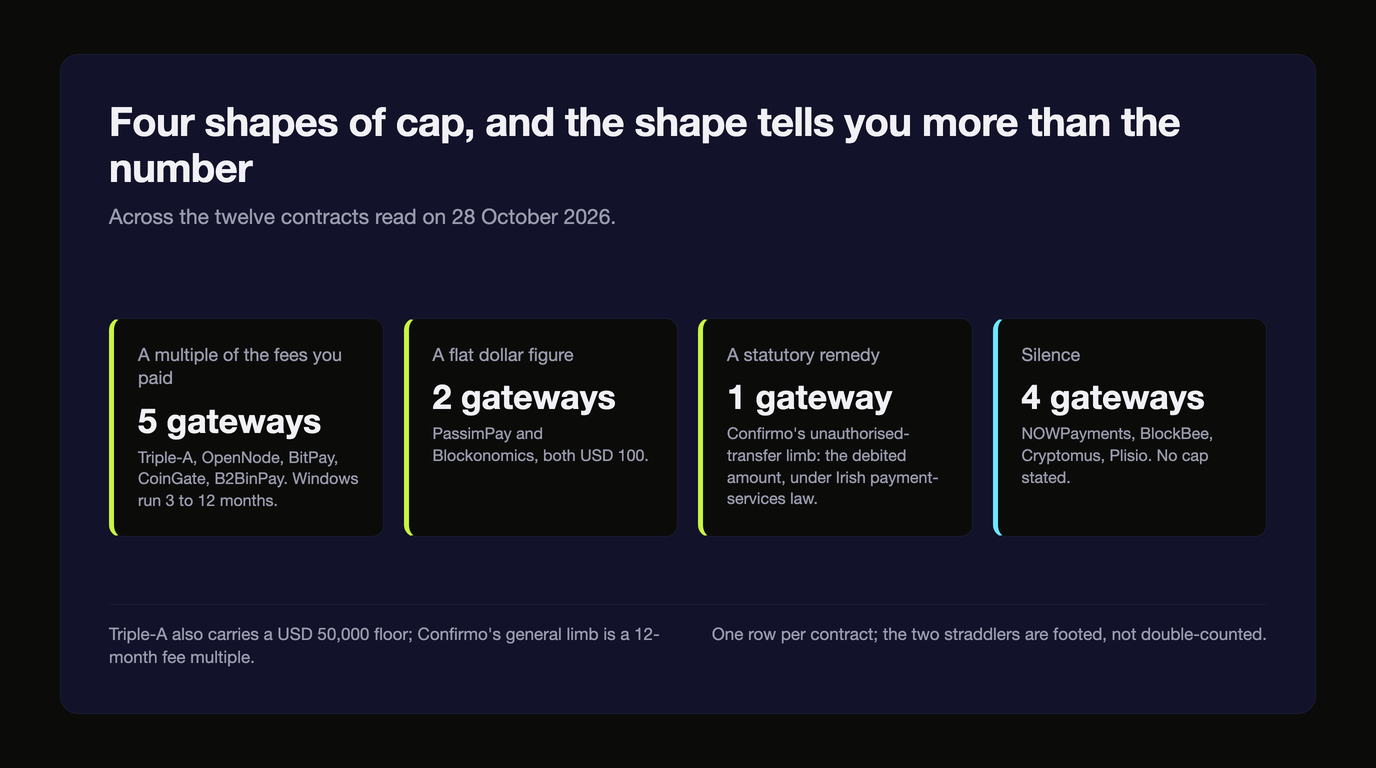
Four shapes turn up, and the shape tells you more than the number: a multiple of the fees you have paid, a flat dollar figure, a statutory remedy, and silence.
What twelve gateways actually cap at
Here is every cap, with the entity that owes it and the law that governs the claim. The last columns matter as much as the first: a cap is a promise by a named company in a named forum, and three of these documents miss one or both.
| Gateway | Published cap on its liability | Contracting entity | Governing law | Doc date |
|---|---|---|---|---|
| Triple-A | Greater of 6 months' fees or USD 50,000 | Triple-A Technologies Pte. Ltd. | Singapore | 20 Apr 2026 |
| Confirmo | The debited amount on an unauthorised transfer; 12 months' fees otherwise | Confirmo Limited | Ireland | 2 Oct 2026 |
| OpenNode | Fees paid, preceding 12 months | OpenNode | California, USA | 29 Aug 2024 |
| BitPay | Fees earned, preceding 6 months | BitPay, Inc. / BitPay B.V. | Georgia, USA / Netherlands | 1 Apr 2026 |
| CoinGate | Fees earned, last 3 months | UAB "Decentralized" | Lithuania | 6 Feb 2024 |
| B2BinPay | Fees paid, 3 months, less costs already incurred | B2BINPAY El Salvador S.A. de C.V. | El Salvador | 26 Jun 2026 |
| PassimPay | USD 100 flat | NILESPAY FINANCE INC. (BC1516629) | None stated | 11 May 2026 |
| Blockonomics | USD 100 flat | OneByZero Tech Pte. Ltd. | Singapore | Not shown |
| NOWPayments | No cap stated | FD Transfers LLC | St Vincent and the Grenadines | 19 Oct 2026 |
| BlockBee | No cap stated; "reasonable … foreseeable" carve-in | Blockbee Inc. (Panama) | "Applicable Law", undefined | 2 Oct 2026 |
| Cryptomus | No cap stated; ten separate non-liability clauses | None named | Country not named | 17 Aug 2026 |
| Plisio | No cap; excludes direct damages too | None named | None stated; net-ARB arbitration | 12 Mar 2019 |
Two things to notice before the arithmetic. The best two clauses belong to Triple-A and Confirmo, the two most heavily licensed companies in the set. And the oldest document, Plisio's, is about a website: it predates the question it now answers by years.
A fee cap is a percentage of one month's volume
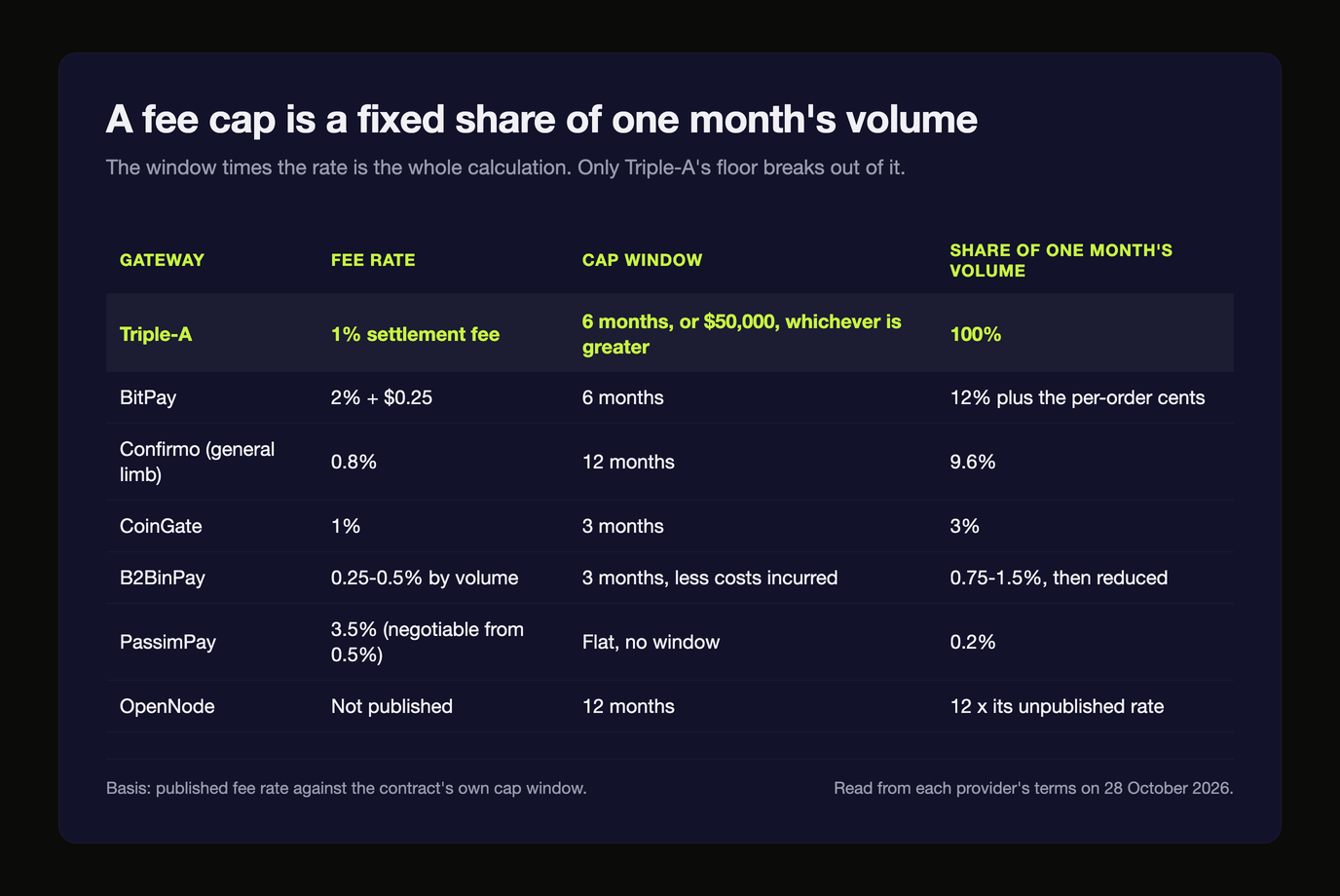
"Capped at the fees you paid us in the last three months" sounds like a number until you notice it is a number you set, moving with your volume rather than with the loss. Do the multiplication and it collapses: a fee-based cap equals the window in months times the fee rate, as a share of one month's processed volume. Your size does not change that percentage.
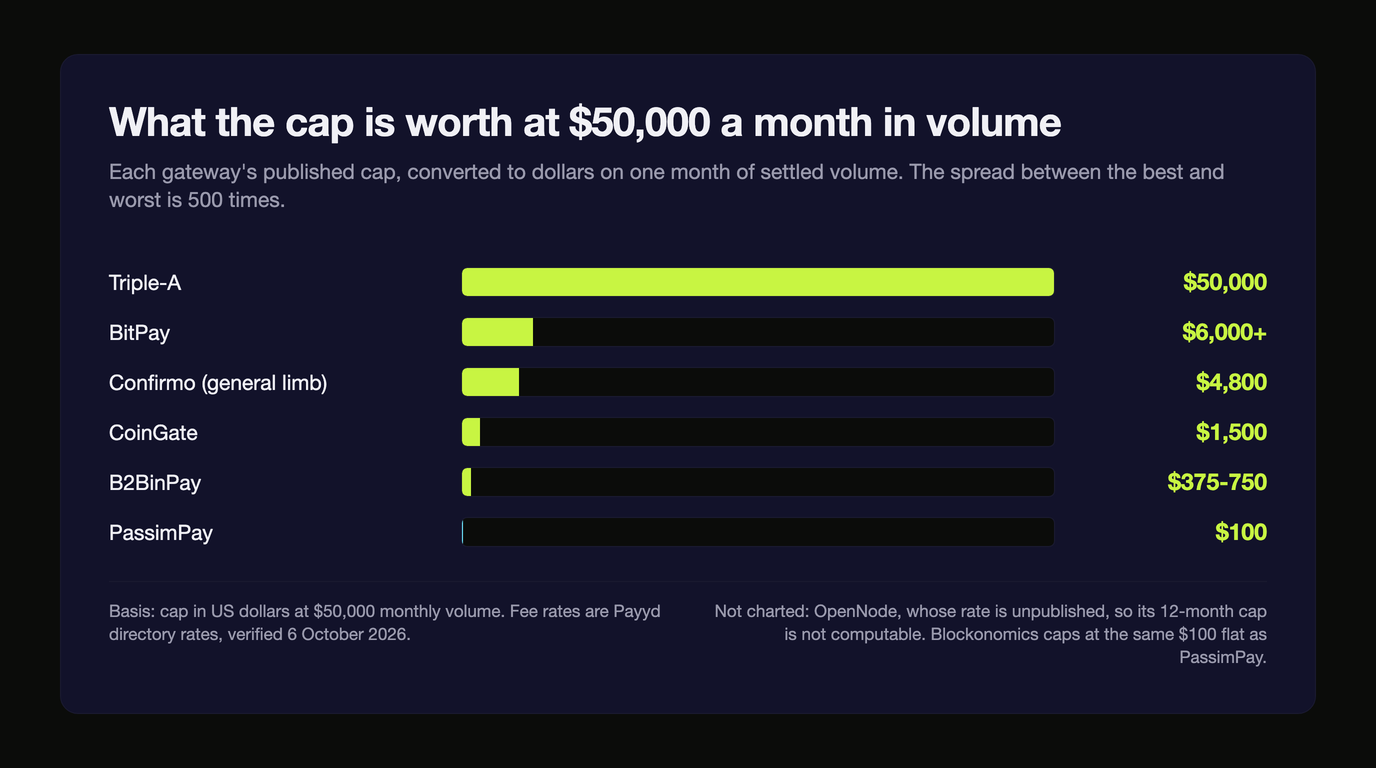
Put our directory's verified rates through each window and this is what the clause promises. The last column takes a merchant settling $50,000 a month — a small shop, not an edge case.
| Gateway | Fee rate (Payyd directory) | Cap window | Cap as share of one month's volume | Cap at $50,000/mo |
|---|---|---|---|---|
| Triple-A | 1% settlement fee | 6 months, or $50,000, whichever is greater | 100% | $50,000 |
| BitPay | 2% + $0.25 | 6 months | 12% plus the per-order cents | $6,000+ |
| Confirmo (general limb) | 0.8% | 12 months | 9.6% | $4,800 |
| CoinGate | 1% | 3 months | 3% | $1,500 |
| B2BinPay | 0.25–0.5% by volume | 3 months, less costs incurred | 0.75–1.5%, then reduced | $375–750 or less |
| PassimPay | 3.5% (negotiable from 0.5%) | Flat, no window | 0.2% | $100 |
| OpenNode | Not published | 12 months | 12 × its unpublished rate | Not computable |
Three results fall out. B2BinPay's is the smallest cap in the fee-based group by a wide margin — the lowest rate in our directory times the shortest window, and then its clause subtracts "any processing or service costs already incurred", which no other gateway does. It is the only cap here that can be argued downwards after the event.
Second, the cap moves opposite to the price. PassimPay charges the highest headline rate in the group and offers the lowest ceiling; Confirmo charges 0.8% and offers a statutory remedy. Expensive does not mean insured.
Third, and the one that should change a shortlist: for every gateway there except Triple-A, the cap is a fraction of a single month's takings, while the exposure is the whole settled balance plus whatever is in flight. The cap is not sized to the risk. It is sized to the invoice.
The two hundred-dollar ceilings
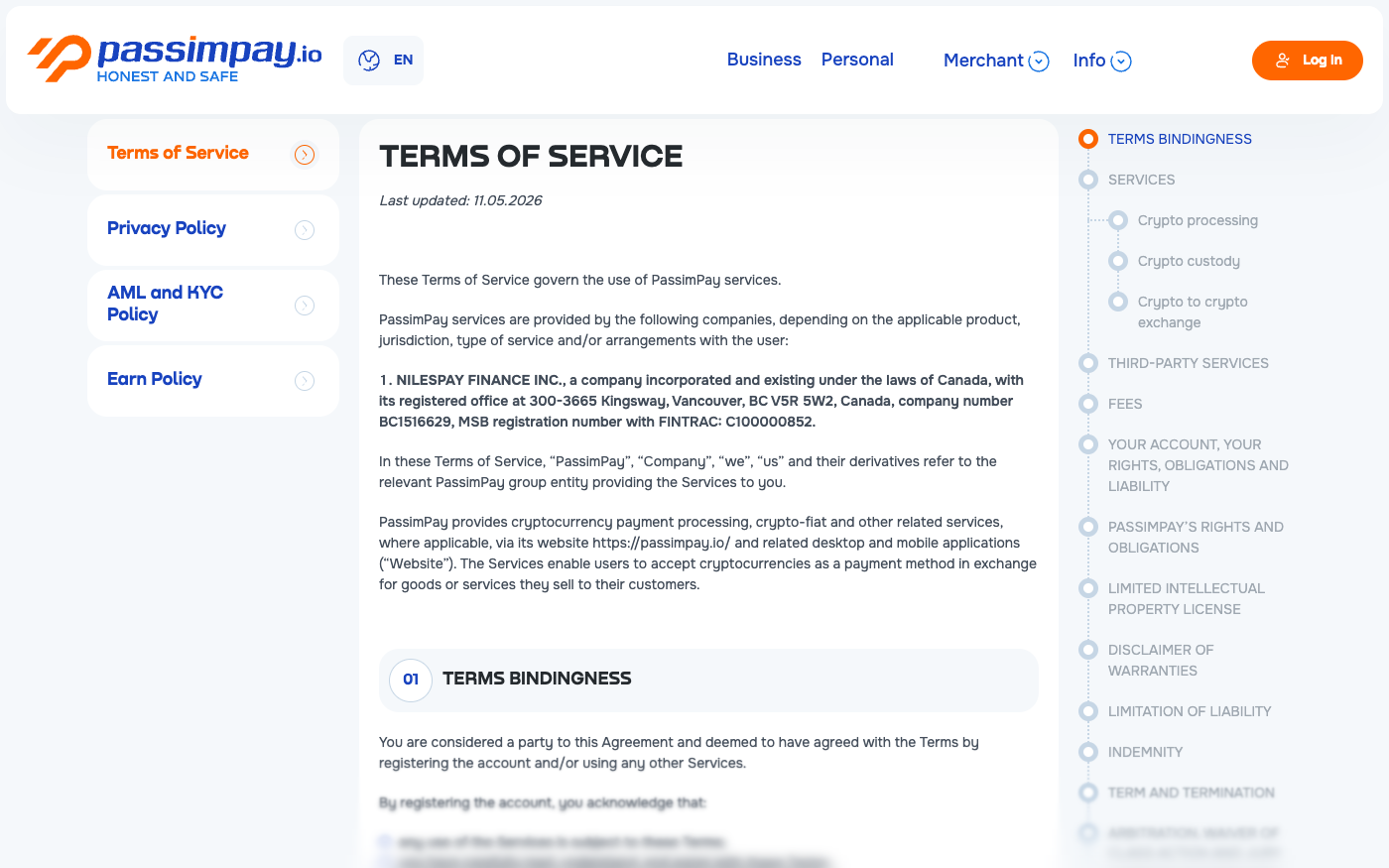
PassimPay and Blockonomics have nothing to do with each other — a British Columbia company and a Singapore company, different products, different custody models — and they arrived at the same figure. "IN NO EVENT SHALL OUR LIABILITY TO YOU FOR ALL DAMAGES EXCEED THE AMOUNT OF ONE HUNDRED U.S. DOLLARS", says PassimPay's section 09. Blockonomics' terms, under OneByZero Tech Pte. Ltd., cap total liability at the same "ONE HUNDRED U.S. DOLLARS (US$100.00)".
One hundred dollars is the shape of a consumer software licence, not a payments contract: the clause was drafted for an app and then pointed at money. Blockonomics has the better argument for it, because its terms also say it "DOES NOT HOLD YOUR DIGITAL TOKENS OR DIGITAL ASSETS" — a non-custodial processor never has your balance to lose, so the cap covers software faults, not funds.
PassimPay cannot make that argument. Its section 02.02 describes crypto custody, and the same section 09 that caps at $100 adds that it "is not responsible for, and cannot assist with recovery of, a loss of Digital Assets" where the service is compromised.
Triple-A's cap is a floor, not a ceiling
Clause 14.3 of Triple-A's general terms is the only one in the set built as a "greater of": aggregate liability is capped at the higher of the fees the merchant paid in the preceding six months or "USD 50,000 (fifty thousand US dollars)". Every other fee-based clause is a pure multiple, so it shrinks towards nothing for a small merchant. Triple-A's cannot go below $50,000 however little you spend, which inverts the pattern: it is the only cap in the twelve that protects a small merchant more than a large one.
Clause 14.4 then carves fraud, fraudulent misrepresentation and wilful misconduct out of the cap entirely, so the $50,000 is a floor on ordinary claims and no limit on the bad ones. Four gateways have a version of that carve-out; B2BinPay's also names gross negligence.
Triple-A is also clearest about what it does not promise. Its Monetary Authority of Singapore notice says plainly that "this does not mean that you will be able to recover all the money you paid to Triple-A if Triple-A's business fails". A $50,000 cap and an insolvency warning are the same honesty applied twice.
The clause a regulator wrote
Confirmo's general cap is unremarkable: 12 months' fees, clause 15.5, the same furniture as everyone else. Then section 16 begins, titled "Liability – Unauthorised or incorrectly initiated/executed transfer", and the document stops sounding like a vendor agreement. The remedy there is not fees. Under 16.3 Confirmo must credit your balance "in an amount equivalent to the debited amount", and 16.7 limits its liability for that subsection to "the debited amount in the affected transfer".
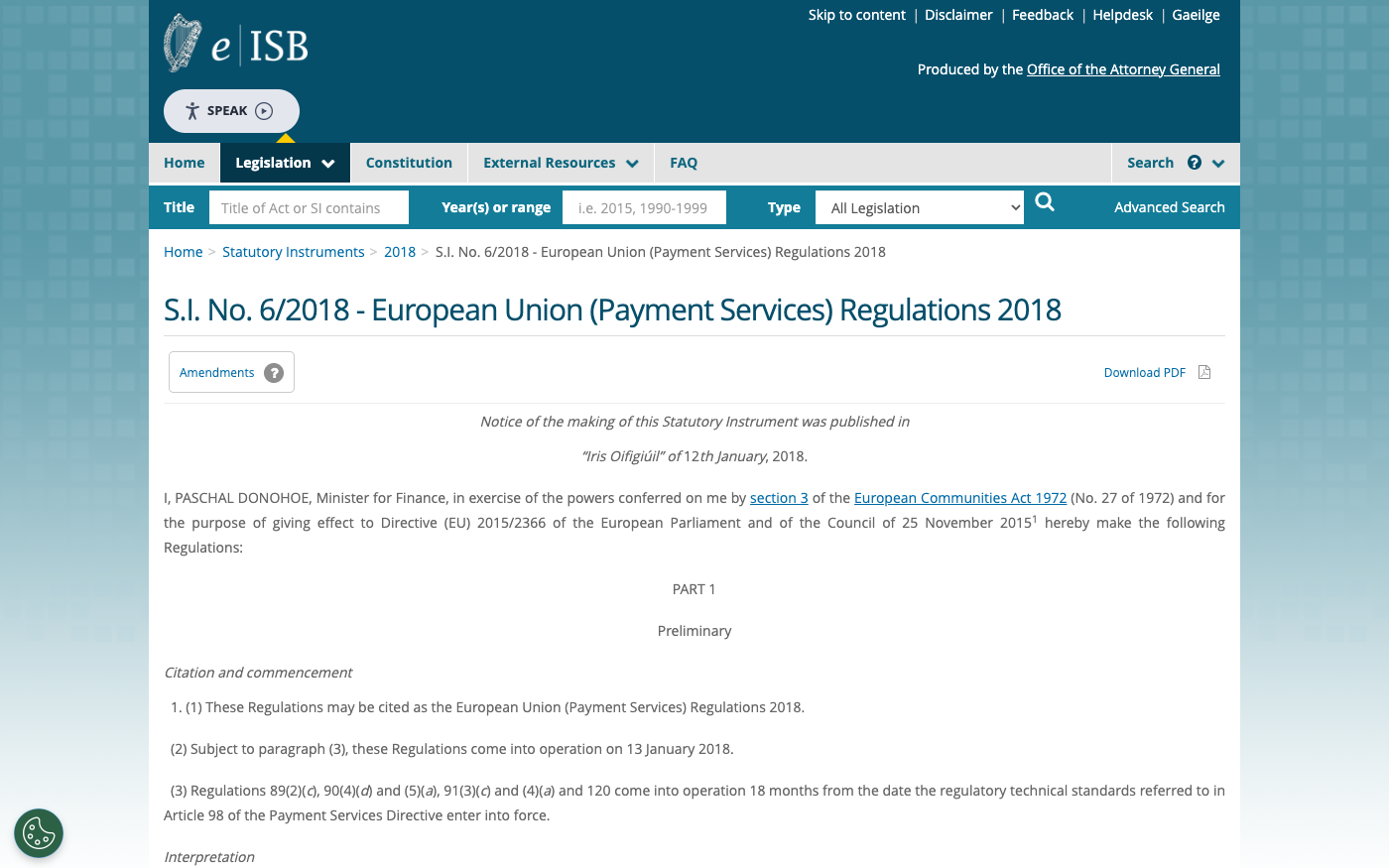
That is not generosity. Confirmo Limited is regulated by the Central Bank of Ireland — the footer of every page of its terms says so — so Irish payment-services law applies, and section 16 is that law copied into the contract, almost line for line against the European Union (Payment Services) Regulations 2018.
| Confirmo clause | What it says | Irish regulation it tracks (S.I. 6/2018) |
|---|---|---|
| 16.1 | Notify "no later than 13 months after the time the transfer was debited" | Reg. 95(1) — "no later than 13 months after the debit date" |
| 16.2 | "We bear the burden to demonstrate that the transfer was authenticated, accurately recorded, and not affected by a technical failure of our systems" | Reg. 96(1) — burden on the provider to prove the transaction was "authenticated, accurately recorded, entered in the accounts and not affected by a technical breakdown" |
| 16.3 / 16.7 | Credit the balance with "the debited amount"; liability limited to that amount | Reg. 97(1)(a) — "refund the payer the amount of the unauthorised payment transaction immediately", and by end of the next business day at the latest |
| 16.4 | "you are liable for losses resulting from the misappropriation of your security credentials up to EUR 50"; nothing after notification unless you acted fraudulently | Reg. 98(1) and 98(6) — payer bears losses "up to a maximum of €50", and none after notification except on fraud |
One difference runs the gateway's way. Reg. 97(1)(a) sets a deadline — the refund is due by "the end of the business day immediately following" notification. Confirmo's 16.3 says "without undue delay" and names no day. The remedy is the statutory one; the clock is not. Confirmo also adds a duty the regulation does not: 16.6 requires you to verify material state changes through the API before releasing goods, and failure to do so "may reduce or exclude any recovery".
Why no cap is worse than a small cap
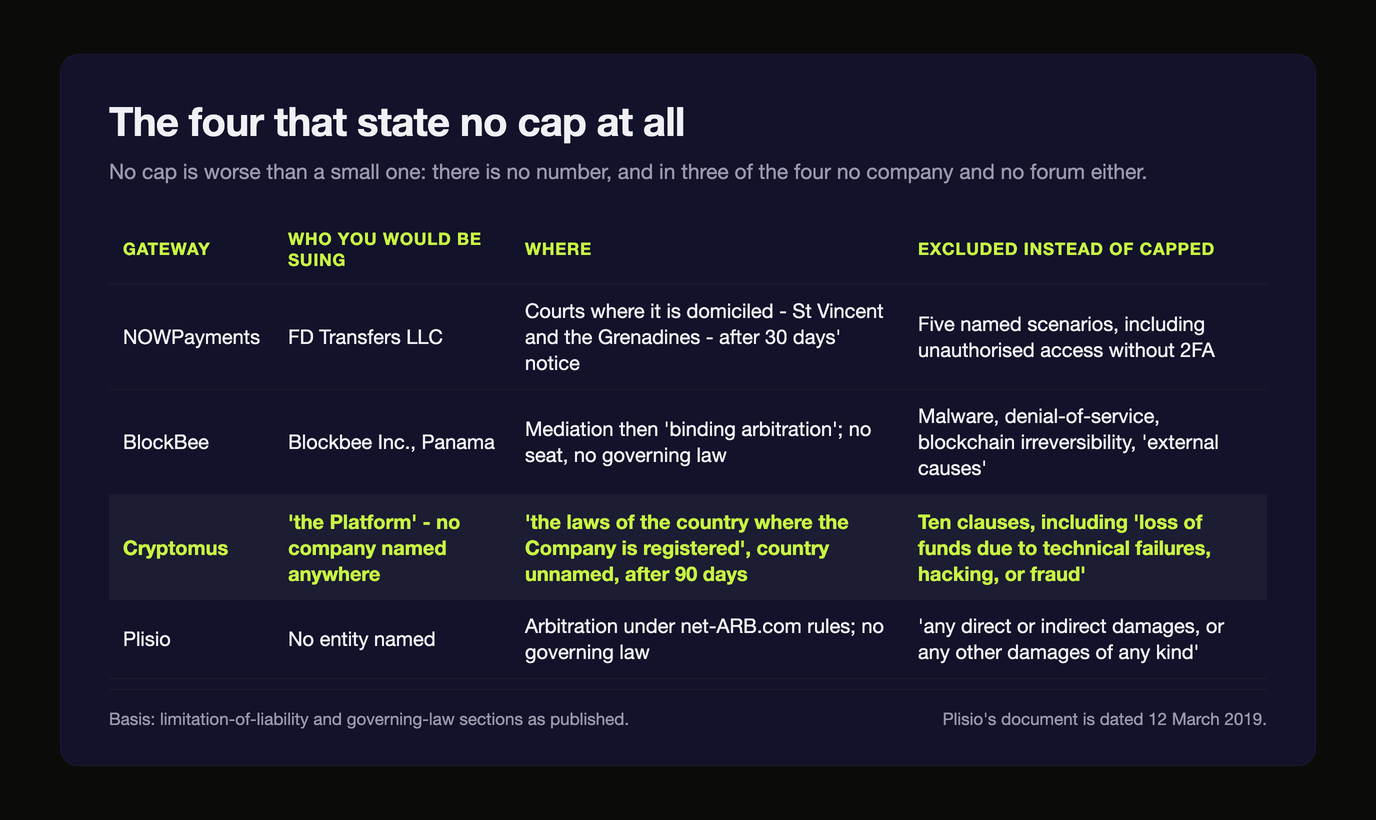
Four of the twelve state no monetary cap: NOWPayments, BlockBee, Cryptomus and Plisio. That looks merchant-friendly. In practice it is the weakest position in the table, because a claim needs three things and the cap is one. You also need a company to sue and a court to sue in.
| Gateway | Who you would be suing | Where | Excluded instead of capped |
|---|---|---|---|
| NOWPayments | FD Transfers LLC | Courts where it is domiciled — St Vincent and the Grenadines — after 30 days' notice | Five named scenarios, including unauthorised access without 2FA |
| BlockBee | Blockbee Inc., Panama | Mediation then "binding arbitration"; no seat, no governing law | Malware, denial-of-service, blockchain irreversibility, "external causes" |
| Cryptomus | "the Platform" — no company named anywhere | "the laws of the country where the Company is registered", country unnamed, after 90 days | Ten clauses, including "loss of funds due to technical failures, hacking, or fraud" |
| Plisio | No entity named | Arbitration under net-ARB.com rules; no governing law | "any direct or indirect damages, or any other damages of any kind" |
Cryptomus shows why the absent cap is not a gift. Its terms, last updated 17 August 2026, contain no cap and no company name, and clause 16.1 governs by "the laws of the country where the Company is registered" — a choice of law whose referent appears nowhere in the document. An uncapped claim against an unnamed company under an unnamed law is not better than a $100 one. It is the same claim with the paperwork removed.
Plisio is the other end of the same problem. Its Terms of Use are dated 12 March 2019, apply by their own words "to your access to and use of the Plisio.net website", name no legal entity, and disclaim "any direct or indirect damages". Seven years of payment and crypto regulation have happened since, and none of it is in there. If what you want is no operator in the chain at all, BTCPay Server is self-hosted: nobody to cap anything, and every duty — keys, uptime, backups — yours.
What the law hands back
A contractual cap is a starting position, not a verdict. The Irish regulations behind Confirmo's section 16 are the clearest worked example in the set, and reading them turns up two things no gateway advertises.
First, the statutory protections are mostly waivable for business customers, but not all of them. Reg. 85(1)(a) lets a provider and a payment service user who is "not a consumer" agree that named regulations "do not apply in whole or in part" — and the list includes Reg. 96, the burden of proof, and Reg. 98, the EUR 50 ceiling. Reg. 97, the duty to refund an unauthorised transaction, is not on that list. A merchant on an Irish-authorised provider keeps the refund right whatever the contract says. Confirmo waived neither of the two it could have.
Second, a threshold worth knowing if you are small. Reg. 85(2) says the Part "applies to a micro enterprise as it applies to a consumer", and Reg. 85(3) ties that to Commission Recommendation 2003/361/EC: staff headcount under 10, turnover or balance sheet at or below EUR 2 million. Below that line a merchant gets consumer treatment by operation of law.
Reg. 97(4) adds a sentence that cuts across every cap here: the refund duty "does not affect any other right that the payer concerned may have to obtain compensation (including damages)". A fee cap and a statutory remedy are not alternatives.
Five clauses to read before you integrate
- Find the cap and convert it. Window times fee rate gives the cap as a share of one month's volume. Compare it to your largest settled balance; the gap is yours to carry.
- Check whether it excludes direct damages. Indirect-loss exclusions are standard; excluding direct loss aims at the money. PassimPay's and Plisio's do.
- Name the counterparty. If the terms state no registered company, there is nobody to serve. Cryptomus and Plisio both fail this; naming an entity, even in St Vincent, puts a gateway ahead.
- Find the governing law and forum. "Applicable Law", undefined, is BlockBee's answer; "the country where the Company is registered" is Cryptomus'. Both mean the forum gets chosen after the dispute starts, by them.
- Check the licence, then the clause. A regulated payment institution carries duties its contract cannot remove, which is why Confirmo's and Triple-A's are strongest. Our gateway comparison lists custody model beside fees.
Twelve documents, and two answer the question a merchant actually has: if you lose my money, what do you owe me? Read your gateway's answer before the integration, because on the day you need it you will not be reading.
- Crypto Gateway Prohibited Businesses 2026: 4 of 12
- Crypto Gateway Data Breach 2026: 1 of 12 Tells You
- Crypto Gateway AML Holds 2026: Nobody Says How Long
- Crypto Gateway API Key Security 2026: We Checked 9
- Crypto Payment Addresses 2026: One Per Order or Not
- Confirmo Review: Fees, Custody and Settlement
Ten of twelve gateways cap what your money is worth to them at a fraction of one month's fees.
We track fees, custody, KYC and settlement for every processor in the directory. Confirmo's transfer liability is a regulator's clause rather than its own; Triple-A publishes the only cap with a floor; BTCPay Server puts no operator in the chain.
Compare Crypto Payment Gateways →Affiliate disclosure: Payyd earns a commission if you sign up to some providers linked on this page. It changes none of the clauses, caps or figures reported here, all of which come from the providers' own published documents and are linked below.
FAQ
Is a crypto payment gateway liable if it loses your funds?
Only up to its published cap, and for ten of the twelve we read that cap is a fraction of the fees you have paid. BitPay limits liability to the fees it earned in the preceding six months, CoinGate to three, OpenNode to twelve; PassimPay and Blockonomics cap at USD 100 flat. The exceptions are Triple-A, which cannot go below USD 50,000, and Confirmo, which must credit back the debited amount of an unauthorised transfer because Irish law requires it.
Which crypto payment gateway has the strongest liability clause?
Triple-A on the number, Confirmo on the remedy. Triple-A's clause 14.3 caps at the greater of six months' fees or USD 50,000, the only cap that cannot shrink below a fixed floor. Confirmo's section 16 gives back the debited amount of an unauthorised transfer, puts the burden of proof on itself, and limits your share of a credential loss to EUR 50. Both are heavily licensed firms, which is the reason rather than a coincidence.
What does "no liability cap" mean in a gateway's terms?
Usually less than a small cap. NOWPayments, BlockBee, Cryptomus and Plisio state no ceiling, but NOWPayments is sued in St Vincent and the Grenadines, BlockBee names no governing law, and Cryptomus and Plisio name no company. An uncapped claim still needs a defendant and a forum.
Can a crypto gateway disclaim liability for direct losses?
Two of the twelve try. PassimPay's section 09 excludes "ANY DIRECT DAMAGES OR ANY LOST PROFITS, REVENUE OR DATA", and Plisio's disclaimer covers "any direct or indirect damages, or any other damages of any kind". Both also note that some jurisdictions do not allow those limitations, which is the drafter conceding the point.
Does EU law override a crypto gateway's liability cap?
For an authorised payment institution, partly. Under the Irish regulations implementing the EU payment services directive, Reg. 97 requires the provider to refund the amount of an unauthorised payment transaction, and Reg. 85(1)(a) does not allow that duty to be contracted away even with a business customer — while the burden of proof and the EUR 50 ceiling can be. Reg. 97(4) also preserves any other right to compensation. None of it applies to a gateway holding no EU payment licence.
Do small merchants get more protection than large ones?
Under EU payment-services law, yes: the Irish regulations treat a micro enterprise as a consumer, and Commission Recommendation 2003/361/EC defines that as fewer than 10 staff with turnover or balance sheet at or below EUR 2 million. In the contracts the opposite holds: a fee-based cap scales down with your volume, so a small merchant on BitPay or CoinGate has the smallest ceiling and the same exposure.
Sources
Clauses read and quoted 28 October 2026; fee rates from the Payyd directory, verified 6 October 2026:
- Triple-A General Terms and Conditions — 20 April 2026; 14.2–14.4, 16.1, 16.2.8
- Confirmo Limited Terms and Conditions (PDF) — 2 October 2026; 15.3–15.5, section 16
- European Union (Payment Services) Regulations 2018 (S.I. No. 6/2018) — Regs. 85, 95, 96, 97, 98
- European Commission, SME definition — micro-enterprise thresholds, Recommendation 2003/361/EC
- BitPay Merchant and Donee Terms of Use — 1 April 2026; sections 17, 6.2, 18.7
- OpenNode Terms and Conditions — 29 August 2024; sections 17, 15.2, 24
- CoinGate Merchant Terms of Service — 6 February 2024; 19.1–19.6, 28.1–28.2; UAB "Decentralized"
- B2BinPay Terms of Use — 26 June 2026; Limitation of Liability
- PassimPay Terms — 11.05.2026; sections 09 and 02.02; NILESPAY FINANCE INC.
- Blockonomics Terms of Service — OneByZero Tech Pte. Ltd., Singapore law
- NOWPayments Terms of Use (PDF) — 19 October 2026; sections 21, 22.1; FD Transfers LLC
- BlockBee Terms and Conditions — 2 October 2026; Blockbee Inc., Panama
- Cryptomus Terms of Use — 17 August 2026; 5.11, 6.8–6.9, 10.3, 12.3, 13.8, 15.8, 16.1
- Plisio Terms of Use (PDF) — 12 March 2019; Disclaimer of Liability
- BTCPay Server — self-hosted, no operator in the payment path
- Finance Magnates, "How to Choose a Crypto Payment Gateway and Processor" — 11 September 2026; source of the "most contracts assign the loss to the merchant by default" claim