
Crypto Gateway API Key Security 2026: We Checked 9
We read nine crypto gateway API key policies in October 2026. Real permission scopes exist on one. Replacing a leaked payout key costs a day at another.
 Jennifer McNally
Key Takeaways
- Crypto gateway API key security comes down to one question: what can this string do if it leaks? Only one of the nine gateways we read answers it with real permission scopes — BTCPay Server, which documents 48 permission strings and lets you pin any of them to one store ID. The eight hosted gateways offer one to three key types.
- Rotating a leaked payout credential costs Cryptomus merchants a day. Its own instructions say "withdrawals will be temporarily blocked for 24 hour after generate new payout API key".
- BlockBee's payout key has a key behind it. A V2 key ships with a Recovery Key "required to regenerate the API key if you lose it"; lose both and "your Self-Custodial Wallet funds become permanently inaccessible".
- OpenNode's IP allowlist cannot be retrofitted. It "must be added to the withdrawal API key when it is first generated"; to add one later, "you must make a new withdrawal API key".
- Three of the nine document no way to retire a credential at all. CoinGate, Plisio and Apirone each describe how to get a key and never how to replace one. Plisio is blunt about the blast radius: "This secret key will be used with all API calls."
The string in your environment file can move your money. That is the whole of crypto gateway API key security in one sentence, and almost nobody selling you a gateway will say how much of your money, or how fast you could stop it. So we read nine providers' reference documentation on 16 October 2026 rather than their marketing copy.
The stakes are not theoretical. A payment key copied out of a staging container is an annoyance; a payout key is a withdrawal. Of the nine, exactly one documents a permission model fine enough to issue a key that creates an invoice and nothing else, three document no way to retire a credential once it exists, and one charges a full day of frozen payouts for replacing the key you were right to replace. Here is what a crypto payment gateway API key is worth to an attacker, provider by provider.
What a crypto gateway API key can actually do
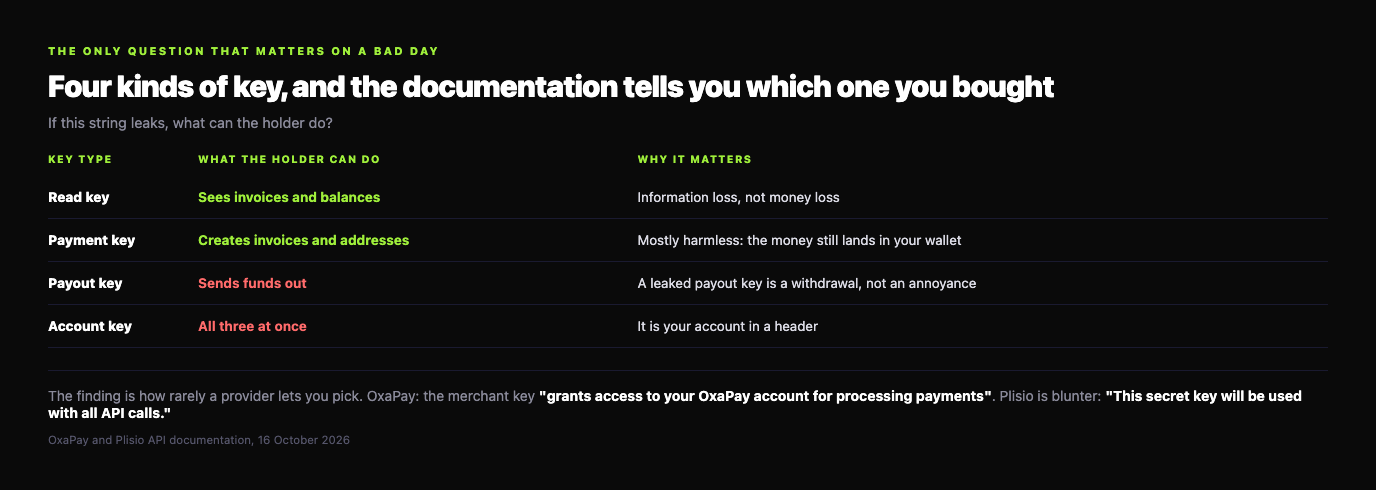
Start with the only question that matters on a bad day: if this string leaks, what can the holder do? There are four answers in circulation, and the documentation tells you which one you bought.
A read key sees invoices and balances. A payment key creates invoices and addresses, which is mostly harmless because the money still lands in your wallet. A payout key sends funds out. An account key does all three, because it is your account in a header.
The finding is how rarely a provider lets you pick. OxaPay says plainly what you are holding: the merchant key "grants access to your OxaPay account for processing payments". Plisio is blunter — "This secret key will be used with all API calls." Neither sentence reads as a warning in context. Both are an accurate description of your exposure.
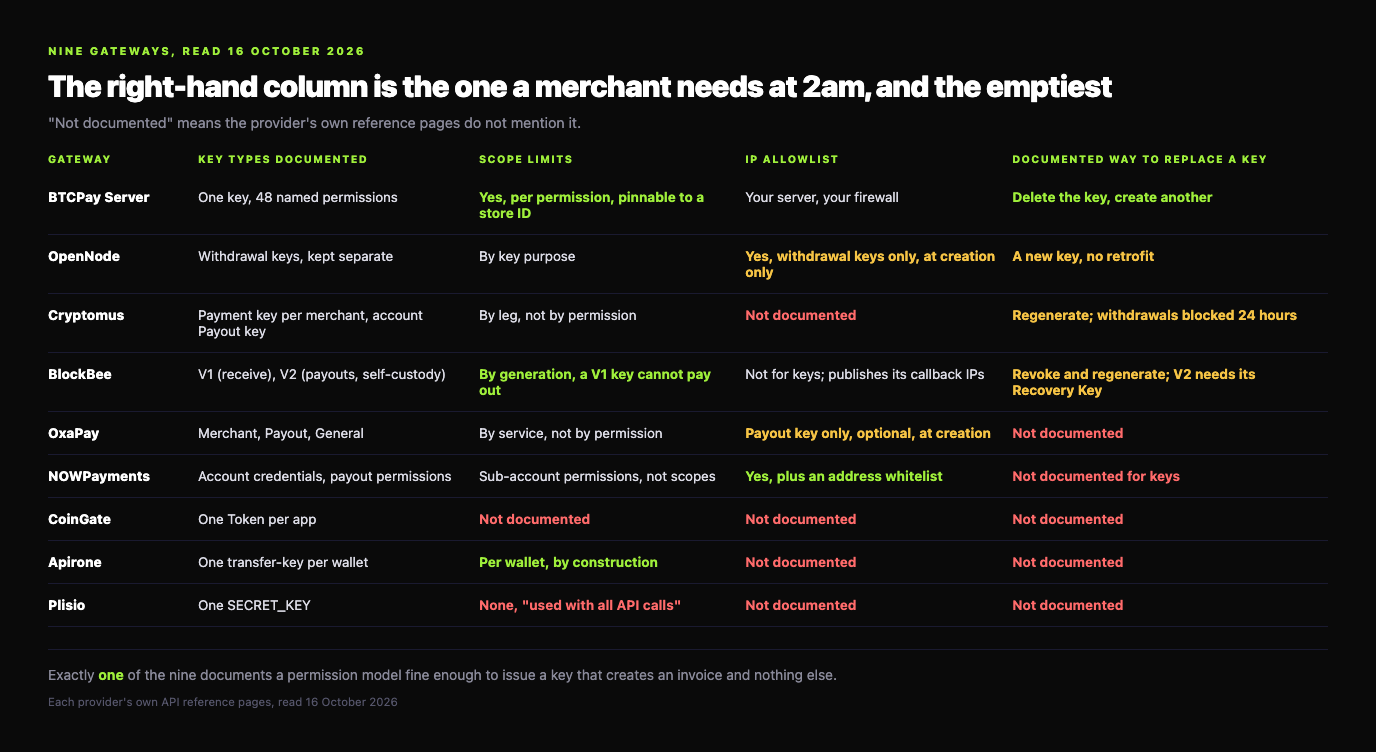
| Gateway | Key types documented | Scope limits | IP allowlist | Documented way to replace a key |
|---|---|---|---|---|
| BTCPay Server | One key, 48 named permissions | Yes — per permission, pinnable to a store ID | Your server, your firewall | Delete the key, create another |
| OpenNode | Withdrawal keys, kept separate | By key purpose | Yes — withdrawal keys only, at creation only | A new key — no retrofit |
| Cryptomus | Payment key per merchant, account Payout key | By leg, not by permission | Not documented | Regenerate; withdrawals blocked 24 hours |
| BlockBee | V1 (receive), V2 (payouts, self-custody) | By generation — a V1 key cannot pay out | Not for keys; publishes its callback IPs | Revoke and regenerate; V2 needs its Recovery Key |
| OxaPay | Merchant, Payout, General | By service, not by permission | Payout key only, optional, at creation | Not documented |
| NOWPayments | Account credentials, payout permissions | Sub-account permissions, not scopes | Yes — plus an address whitelist | Not documented for keys |
| CoinGate | One Token per app | Not documented | Not documented | Not documented |
| Apirone | One transfer-key per wallet | Per wallet, by construction | Not documented | Not documented |
| Plisio | One SECRET_KEY | None — "used with all API calls" | Not documented | Not documented |
Read the right-hand column twice. It is the one a merchant needs at 2am, and the emptiest.
BTCPay Server: 48 permissions, and you can pin one to a store
BTCPay Server is the outlier for a plain reason: it is software you run, so its permission model is a feature of the code rather than a tier of a plan. Its Greenfield API publishes all 48 permission strings in machine-readable form.
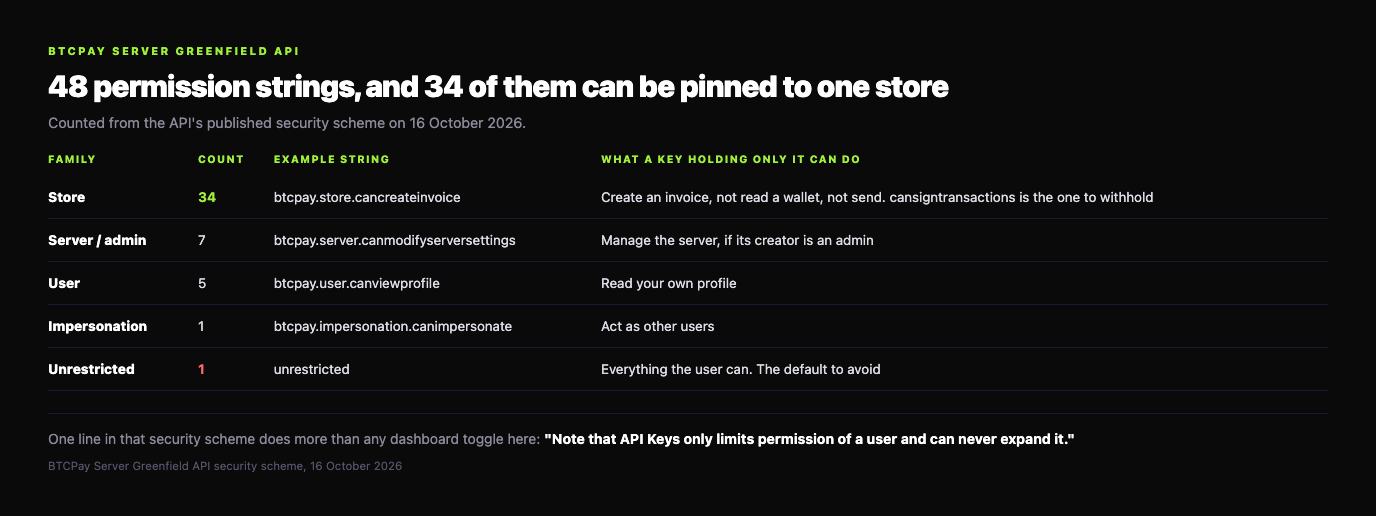
They break into families. Thirty-four are store-level, and the documentation gives the syntax for narrowing any of them to one store — append a colon and the store ID, as in btcpay.store.cancreateinvoice:6HSHAEU4iYWtjxtyRs9KyPjM9GAQp8kw2T9VWbGG1FnZ. Seven are administrator-only, five cover your own profile and notifications, one grants impersonation, and one is unrestricted.
| Family | Count | Example string | What a key holding only it can do |
|---|---|---|---|
| Store | 34 | btcpay.store.cancreateinvoice | Create an invoice — not read a wallet, not send. cansigntransactions is the one to withhold |
| Server / admin | 7 | btcpay.server.canmodifyserversettings | Manage the server, if its creator is an admin |
| User | 5 | btcpay.user.canviewprofile | Read your own profile |
| Impersonation | 1 | btcpay.impersonation.canimpersonate | Act as other users |
| Unrestricted | 1 | unrestricted | Everything the user can. The default to avoid |
One line in that security scheme does more for your risk profile than any dashboard toggle in this comparison: "Note that API Keys only limits permission of a user and can never expand it." A key issued by a non-admin cannot become an admin key, whatever you type into it.
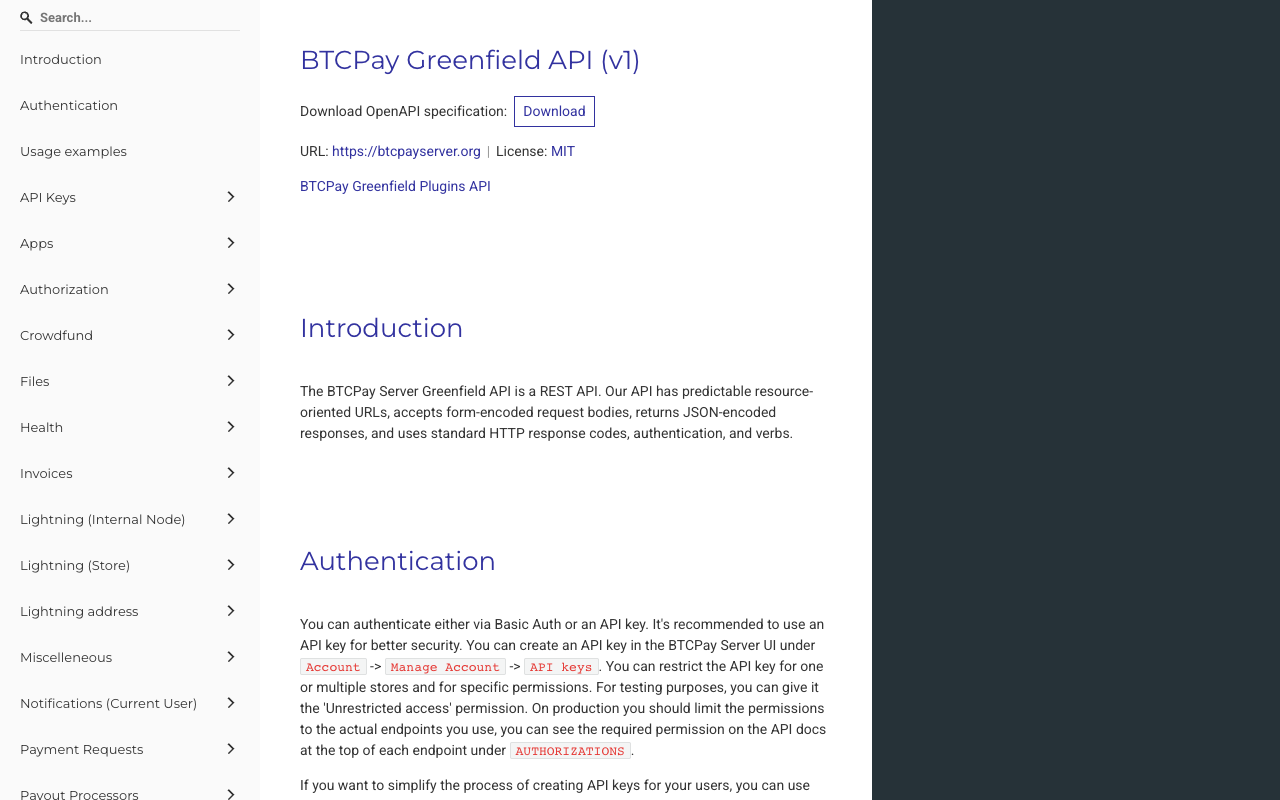
The practical setup is boring and effective. Give the storefront a key carrying btcpay.store.cancreateinvoice and btcpay.store.canviewinvoices, pinned to the one store it serves, and keep wallet and signing permissions out of anything facing the internet. Our BTCPay Server review covers the hosting cost of that trade.
Cryptomus: two-factor to get the key, 24 hours to replace it
Cryptomus splits credentials by leg rather than by permission, and it is the only provider here that makes two-factor authentication a precondition for holding a payout credential. Its instructions for generating one open with "Bind two-factor authentication if you haven't already done it": you cannot get the key that moves money until the account is protected.
That is the good half. The other half sits in the same numbered list, in parentheses: "Remember withdrawals will be temporarily blocked for 24 hour after generate new payout API key".
The payment leg is cleaner. A payment key belongs to a merchant you create inside the account, so a leaked storefront key exposes invoicing for one brand rather than withdrawals for all of them. The payout key comes from account-level Business settings, which is why regenerating it stops payouts everywhere — the same split we found from the other direction in running multiple stores through one gateway.
BlockBee: V1 receives, V2 pays, and there is a key behind the key
BlockBee has no permission list and no key-level IP allowlist, and still ends up with one of the better designs here, because it splits capability by key generation. A V1 key creates payment addresses and receives. Payouts and the self-custodial wallet need a V2 key, and the documentation says who should stay put: "Stay on V1 if: You only need to receive payments."
Never issue a V2 key and nothing in your stack can send funds — the outcome BTCPay reaches with a permission string, reached with a version number.
The catch is what a V2 key comes with: "A separate Recovery Key is generated when you create the V2 key. The Recovery Key is required to regenerate the API key if you lose it." Then the warning — "If you lose both, your Self-Custodial Wallet funds become permanently inaccessible."
BlockBee is also the only provider here whose API reference carries an unprompted security section, and it says the right things: keep the key out of client-side code and public repositories, use HTTPS, "Rotate keys periodically", and revoke a compromised key from the API Keys page. Our BlockBee review has the fee and custody detail underneath it.
NOWPayments: the whitelist is the control, not the key
NOWPayments takes the opposite route: little about scoping a key, a great deal about constraining where money can go and where a request can come from. Both mechanisms were revised in 2026, which makes it the most actively maintained security surface in the comparison.
Two things are fenced. The destination, because a payout address must be whitelisted before funds can reach it. And the origin: "If a payout request comes from an IP address that is not yet approved, the account shows an error", with your current address pre-filled in the form.
| Stage | What NOWPayments documents | Dated |
|---|---|---|
| Request an address | From the dashboard, manually or by CSV; it "goes directly through custody" | 30 Jun 2026 |
| Confirm it | "After the partner enters the 2FA code successfully, the address is automatically added to the whitelist" | 30 Jun 2026 |
| Code window | "The 2FA code is valid for 15 minutes" | 30 Jun 2026 |
| Unconfirmed | "If an address remains in REQUESTED status, it means the partner has not confirmed the request with the 2FA code" | 30 Jun 2026 |
| Remove an address | In-account; "confirmed with two-factor authentication" | 30 Sep 2026 |
| While removing | "While the address is pending removal, payouts can still be created to it" | 30 Sep 2026 |
| Wrong origin IP | An error for an IP "not yet approved" | 30 Sep 2026 |
The row to plan around is the second-to-last. A removal is a request, not an event: the address stays payable until custody finishes processing it, so "I took that address off the whitelist" and "funds can no longer go there" are not the same statement on the day you need them to be. If you are retiring an address you no longer trust, the gap between the two is the window an attacker wants.
All of it is gated on the account's second factor, which puts NOWPayments and Cryptomus together as the two providers treating 2FA as part of the payment path rather than a login nicety. The NOWPayments review covers the fee and KYC side.
OxaPay and OpenNode: allowed IPs you can only set once
Two providers offer a per-key IP allowlist, both on the credential that sends money, both with the same structural flaw: the list is a creation-time decision.
OpenNode states it outright. "IP address whitelists must be added to the withdrawal API key when it is first generated", you are prompted for the address as part of the key request, and several are comma-separated. To add one to a key that lacks it, "you must make a new withdrawal API key". Enforcement runs both ways: with a list, "OpenNode will not authorize BTC transfer requests from other IP Addresses"; without one, "OpenNode will allow any remote IP to initiate a BTC transfer request".
OxaPay is the same shape, one step softer. It issues three key types by service — Merchant, Payout and General — and only the Payout key takes an allowlist: "Optionally, you can set the Allowed IPs for transfer in the provided field."
Note what an allowlist cannot do: it constrains a request's origin, not its content. A leaked key plus a compromised server inside the allowlist is an unprotected key. Good against credential theft, poor against intrusion.
CoinGate, Plisio and Apirone: one credential, no fence
Three of the nine publish nothing about scopes, allowlists or rotation, and each silence has a different shape.
CoinGate hands you a token and an Authorization header. Its API-authentication reference carries an updatedAt date of 10 June 2025 and covers one thing — "Provide generated Token to HTTP Authorization Header" — plus a note that sandbox credentials are separate. No permissions, no IP restrictions, no revocation path. Its support article on creating a key sits behind a bot wall we could not read, so this is what the developer documentation says, not proof the dashboard offers nothing.
Plisio is the clearest statement of maximum blast radius here, and it is not framed as a caveat: "This secret key will be used with all API calls." One key, every endpoint, passed as a query parameter in the documented examples — and query parameters land in access logs and proxy logs in a way headers do not.
Apirone has the most interesting accident. Create a wallet with one POST and the response body contains a transfer-key, the credential that authorises transfers out of that wallet. Nothing documents revoking or rotating it — but because it is per wallet rather than per account, a leak exposes one wallet instead of a treasury. Containment as a side effect of the object model still beats no containment.
51.77.105.132 and 135.125.112.47) and asks you to allow them so security systems do not drop its retries. OxaPay's SDK notes say to "Whitelist OxaPay IPs on your firewall (ask support)" — a control you can only use after opening a ticket.
The rotation test: what replacing a leaked key costs
Here is the test we would apply to any gateway before integrating. Assume the credential is already public: how long until it is worthless, and what does getting there cost you? Crypto gateway API key security is mostly this one question, and the answers are worse than the marketing suggests.
| Gateway | Documented path | What it costs | Worst case |
|---|---|---|---|
| BTCPay Server | Delete, re-create with the same permissions | One secret redeploy | None documented |
| BlockBee | Revoke on the API Keys page, generate another | V2 needs the Recovery Key | Lose both: funds "permanently inaccessible" |
| Cryptomus | Generate a new Payout key (2FA required) | "Withdrawals ... blocked for 24 hour" | A full day with no payouts, mid-incident |
| OpenNode | "You must make a new withdrawal API key" | Redeploy, re-enter the allowlist | A key with no allowlist cannot be fixed in place |
| OxaPay | Generate another key of that type | Re-entering Allowed IPs | Rotation appears only in SDK notes |
| NOWPayments | Not documented for keys | — | A removed address stays payable while pending |
| CoinGate | Not documented | Unknown until you need it | Reference last updated June 2025 |
| Apirone | Not documented | Unknown | Contained to one wallet by design |
| Plisio | Not documented | Unknown | One key, every endpoint |
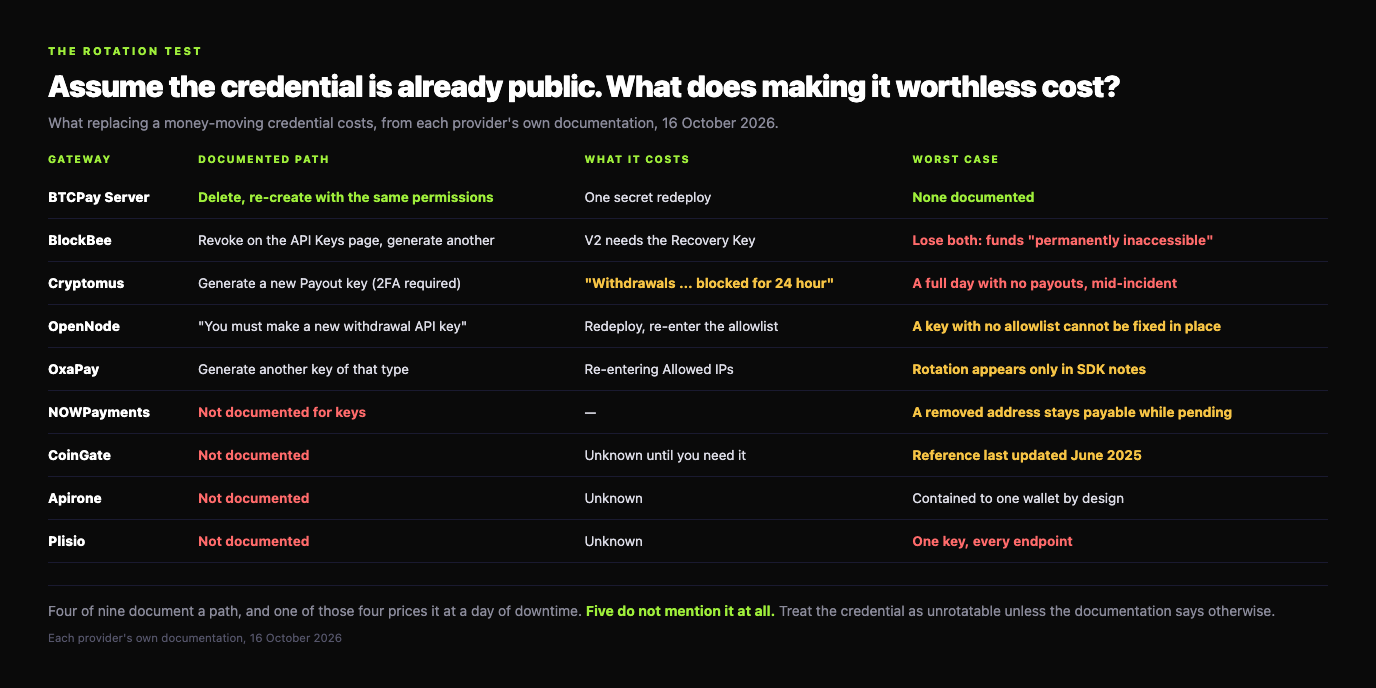
Four of nine document a path, and one of those four prices it at a day of downtime. Five do not mention it at all, which in practice means a support ticket written under time pressure, in whatever timezone the provider answers.
So build the assumption in: treat the credential as unrotatable unless the documentation says otherwise, and put every control you do have in front of it — a dedicated payout key, an allowlist, a destination whitelist, and the key itself nowhere near a repository or a client bundle.
Six questions to ask before you integrate
Ask these of any gateway, including the nine here. Key models change more often than fee tables.
- Can one credential both invoice and withdraw? If so, your storefront holds a withdrawal key whether you call it that or not.
- Is there a separate payout credential, and does getting it need 2FA? Cryptomus requires it; most do not ask.
- Can the key be restricted by IP, and changed later? OpenNode and OxaPay: yes to the first, no to the second.
- How do I replace a compromised key, and what breaks while I do? Five of nine do not answer. Get it in writing before you need it.
- Can destinations be whitelisted, and how fast can one be removed? NOWPayments is the fullest implementation, pending-removal window included.
- Where does the key travel? Header or query parameter decides whether it lands in your logs.
Credential design is one layer. The others are where the money sits and who can stop it: how gateways screen inbound payments and how long a compliance hold can last both override every control on this page.
- Multiple Stores, One Crypto Gateway: 2026 Limits
- Crypto Payment Addresses 2026: One Per Order or Not
- Crypto Payment Screening 2026: Where the Money Goes
- Crypto Gateway AML Holds 2026: Nobody Says How Long
- OpenNode Review: Bitcoin and Lightning Fees, KYB and Custody
- OxaPay Review: Fees, Coins, KYC Terms and Custody Risks
The credential model is set on the day you integrate. Check it before the leak, not after.
We track fees, custody, KYC and settlement for every processor in the directory. BTCPay Server is the only one in this set with real permission scopes; NOWPayments has the fullest destination and origin whitelisting.
Compare Crypto Payment Gateways →Affiliate disclosure: Payyd earns a commission if you sign up to some providers linked on this page. It changes none of the key types, permission strings or limits reported here, all of which come from the providers' own reference pages and are linked below.
FAQ
Can you restrict a crypto payment gateway API key to one permission?
On one of the nine we read. BTCPay Server publishes 48 permission strings and lets you issue a key carrying only the ones you pick, narrowed to a single store with a colon and the store ID. The hosted eight separate by key type at best — OxaPay has three, Cryptomus and OpenNode separate the payout leg, BlockBee separates by key generation — and CoinGate, Plisio and Apirone document no scoping at all.
Do crypto payment gateways support IP whitelisting?
Some do, for payouts only. OpenNode attaches one to a withdrawal API key, OxaPay offers Allowed IPs on its Payout key, and NOWPayments has an account-level IP whitelist. At OpenNode and OxaPay the list is set when the key is generated, so plan a static egress IP first. The other six document no per-key allowlist.
What happens if my crypto gateway API key is leaked?
It depends which key it is. A payment or invoicing key lets an attacker create invoices, which is a nuisance rather than a theft. A payout or account-wide key is a withdrawal credential. Revoke it where the provider documents a path — BlockBee and BTCPay Server both do — and open a support ticket where it does not, which is five of the nine. Then check your destination whitelist: an attacker who cannot change it cannot send funds anywhere new.
Does a separate payout API key actually help?
Yes, and it is the highest-value control available on a hosted gateway. The credential sitting in your web application cannot move funds, so the common leak — a key in a repository, a log, a CI variable or a client bundle — stops being a theft. Cryptomus, OpenNode, OxaPay and BlockBee all offer a way to keep the money-moving credential out of the storefront.
Do crypto payment gateways require two-factor authentication?
Rarely as a condition of anything. Cryptomus is the exception: its instructions say to "Bind two-factor authentication if you haven't already done it" before you can generate a Payout key. NOWPayments requires a 2FA code to add a payout address to the whitelist, and another to remove one. Elsewhere 2FA is a login setting, with nothing tying it to issuing credentials or moving funds.
Should I whitelist my payout address or my server's IP?
Both, if the provider offers both, because they stop different attacks. An IP allowlist stops a stolen key being used from elsewhere. A destination whitelist stops funds reaching an address you did not approve, even from your own server — the stronger of the two against a compromised host, which is why NOWPayments routing it through custody with a 2FA confirmation is a design and not a formality.
How often should I rotate a crypto gateway API key?
BlockBee is the only provider here that offers guidance, and its answer is "Rotate keys periodically" with no interval. The more useful question is whether you can rotate at all: the cost ranges from a redeploy to a 24-hour payout freeze to an undocumented support ticket. Rotate on events you can see — a contractor leaving, a key in a log, a host migration — rather than on a calendar.
Sources
Primary documentation, read 16 October 2026:
- BTCPay Server — Greenfield API reference (48 permission strings, store-scoped syntax)
- Cryptomus — Getting API keys (2FA prerequisite, 24-hour withdrawal block)
- BlockBee — Authentication, API Key V1 vs V2 (Recovery Key, revoke and regenerate)
- OpenNode — Withdrawal API keys and IP whitelisting (creation-time allowlist)
- OxaPay — Payout API (Allowed IPs for transfers)
- OxaPay — Merchant API ("grants access to your OxaPay account")
- NOWPayments — API integrations and payout controls (30 Sep 2026: pending removal, IP whitelist)
- NOWPayments — Dashboard and whitelisting (30 Jun 2026: 15-minute 2FA code, REQUESTED status)
- CoinGate — API authentication (token header only; dated June 2025)
- Plisio — API documentation ("This secret key will be used with all API calls")
- Apirone — Wallet API (per-wallet transfer-key in the response)