
Crypto Payment Screening 2026: Where the Money Goes
We read the inbound screening policies of ten crypto payment gateways in October 2026. Eight can stop your customer's payment. One says where it goes.
 Brian Ormond
Key Takeaways
- Crypto payment screening stops your customer's payment at eight of the ten gateways we read. Only three of those eight publish what then happens to the money.
- One gateway says the funds go back to the sender. trybit's check "runs automatically as a payment arrives, before it's credited to your balance", and if it fails, "it isn't credited — the funds are returned to the sender".
- BitPay publishes the only full mechanism, and bills the sender for it. Payment exceptions are "refunded in the cryptocurrency used to make the payment", and BitPay "deducts the corresponding miner fee used to return the payment from the total refund amount".
- CoinGate and PassimPay may block or reverse a transaction your customer started, and neither says where the funds end up. CoinGate can do it "even when funds are already debited".
- One AML policy has a section titled "Monitoring the Transactions" and never decides a transaction. In NOWPayments' policy, "incoming", "deposit", "reject", "return" and "block" appear zero times.
Your customer pays an invoice. The chain confirms it. Your dashboard does not. Somewhere in between, a crypto payment screening system decided the coins arriving at your address were worth a second look — and that decision now determines whether you ship, whether your customer is out of pocket, and which of you chases the other for money neither controls. We read the published policies, terms and documentation of ten gateways on 10 October 2026.
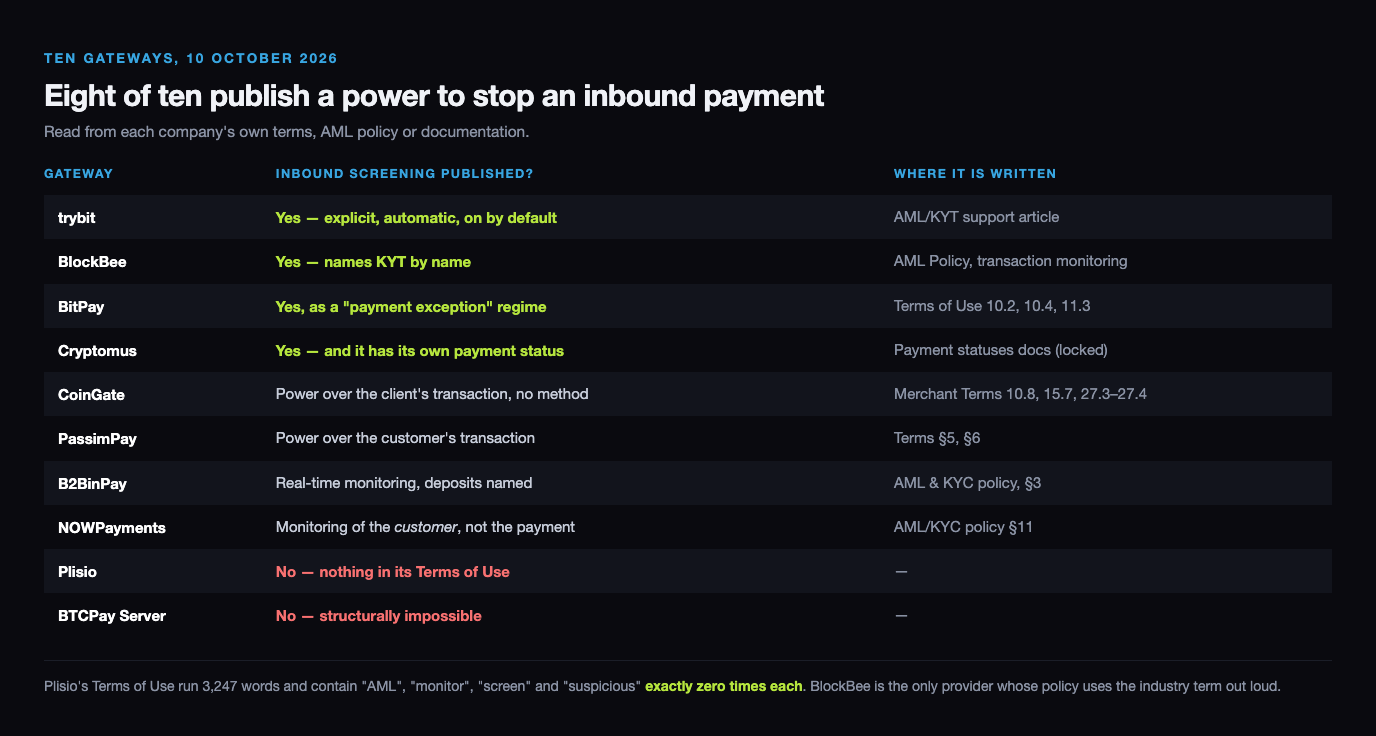
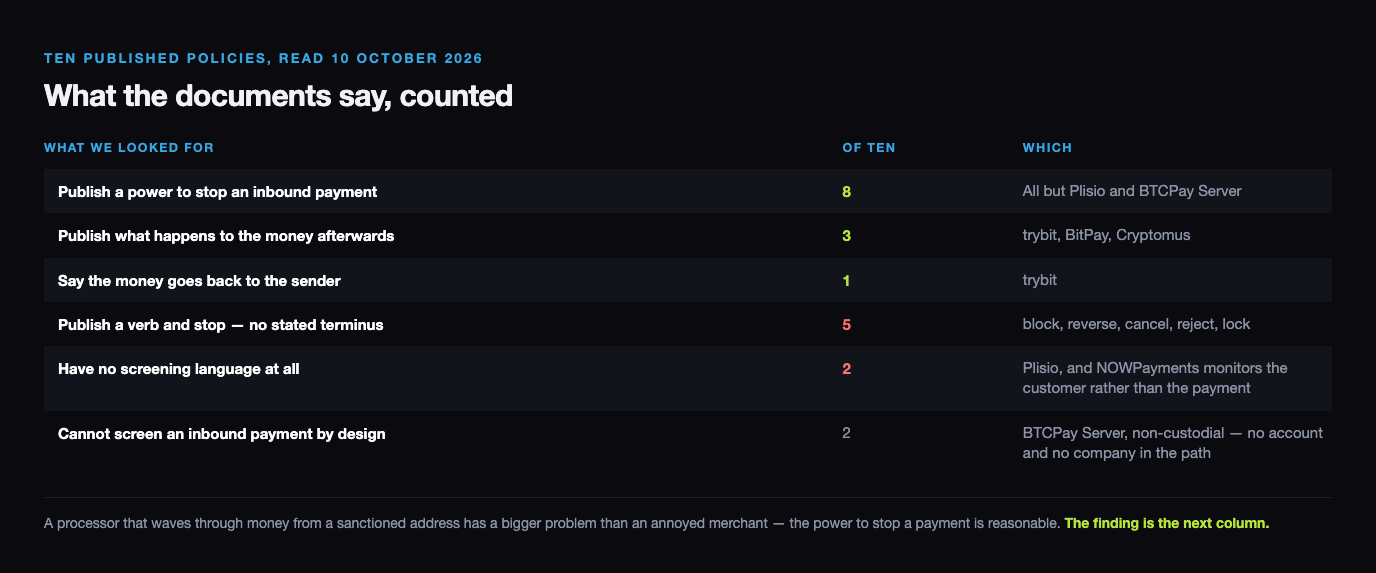
Eight of the ten publish a power to stop an inbound payment. That is unsurprising and reasonable: a processor that waves through money from a sanctioned address has a bigger problem than an annoyed merchant. The finding is the next column. Only three of the eight publish what happens to the money afterwards, and only one says it goes back to the sender.
We read the documents rather than the marketing pages, and counted words where a document says nothing — "their policy is silent on this" is a finding only if you measured the silence. Two gateways have no screening language at all; two more cannot do this by design.
Which gateways publish crypto payment screening on inbound funds
Inbound crypto payment screening means a check on the payment your customer sends, at or before the moment it becomes your balance. Not the compliance review a gateway runs on you at onboarding, and not a hold on money you have already earned, which we covered in crypto gateway AML holds.
| Gateway | Inbound screening published? | Where it is written |
|---|---|---|
| trybit | Yes — explicit, automatic, on by default | AML/KYT support article |
| BlockBee | Yes — names KYT by name | AML Policy, transaction monitoring |
| BitPay | Yes, as a "payment exception" regime | Terms of Use 10.2, 10.4, 11.3 |
| Cryptomus | Yes — and it has its own payment status | Payment statuses docs (locked) |
| CoinGate | Power over the client's transaction, no method | Merchant Terms 10.8, 15.7, 27.3–27.4 |
| PassimPay | Power over the customer's transaction | Terms §5, §6 |
| B2BinPay | Real-time monitoring, deposits named | AML & KYC policy, §3 |
| NOWPayments | Monitoring of the customer, not the payment | AML/KYC policy §11 |
| Plisio | No — nothing in its Terms of Use | — |
| BTCPay Server | No — structurally impossible | — |
Two rows need a note. Plisio's Terms of Use run 3,247 words and contain "AML", "monitor", "screen" and "suspicious" exactly zero times each; its only freeze power is account-level and regulator-triggered. BlockBee is the only provider whose policy uses the industry term out loud, monitoring transactions "using Know Your Transaction (KYT) and other risk-screening tools" whose systems "automatically screen transactions against applicable risk indicators and generate alerts".
Where the money goes when a payment is flagged
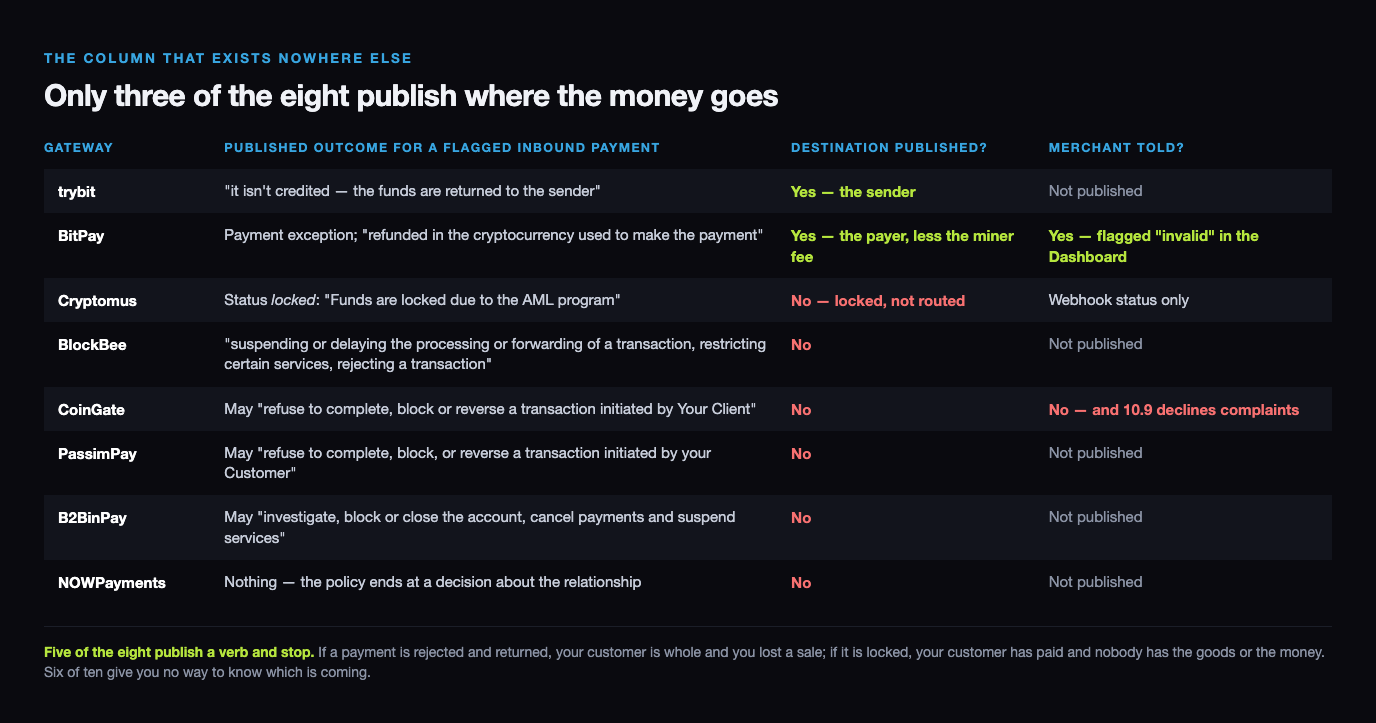
This is the column that exists nowhere else, and the only one that matters at 2am with an unshipped order and a customer on chat. Three providers say where the funds are.
| Gateway | Published outcome for a flagged inbound payment | Destination published? | Merchant told? |
|---|---|---|---|
| trybit | "it isn't credited — the funds are returned to the sender" | Yes — the sender | Not published |
| BitPay | Payment exception; "refunded in the cryptocurrency used to make the payment" | Yes — the payer, less the miner fee | Yes — flagged "invalid" in the Dashboard |
| Cryptomus | Status locked: "Funds are locked due to the AML program" | No — locked, not routed | Webhook status only |
| BlockBee | "suspending or delaying the processing or forwarding of a transaction, restricting certain services, rejecting a transaction" | No | Not published |
| CoinGate | May "refuse to complete, block or reverse a transaction initiated by Your Client" | No | No — and 10.9 declines complaints |
| PassimPay | May "refuse to complete, block, or reverse a transaction initiated by your Customer" | No | Not published |
| B2BinPay | May "investigate, block or close the account, cancel payments and suspend services" | No | Not published |
| NOWPayments | Nothing — the policy ends at a decision about the relationship | No | Not published |
Five of the eight publish a verb and stop. "Block", "reverse", "cancel", "reject", "lock" — an action with no stated terminus. If a payment is rejected and returned, your customer is whole and you lost a sale; if it is locked, your customer has paid and nobody has the goods or the money. Different conversations, and six of ten give you no way to know which is coming.
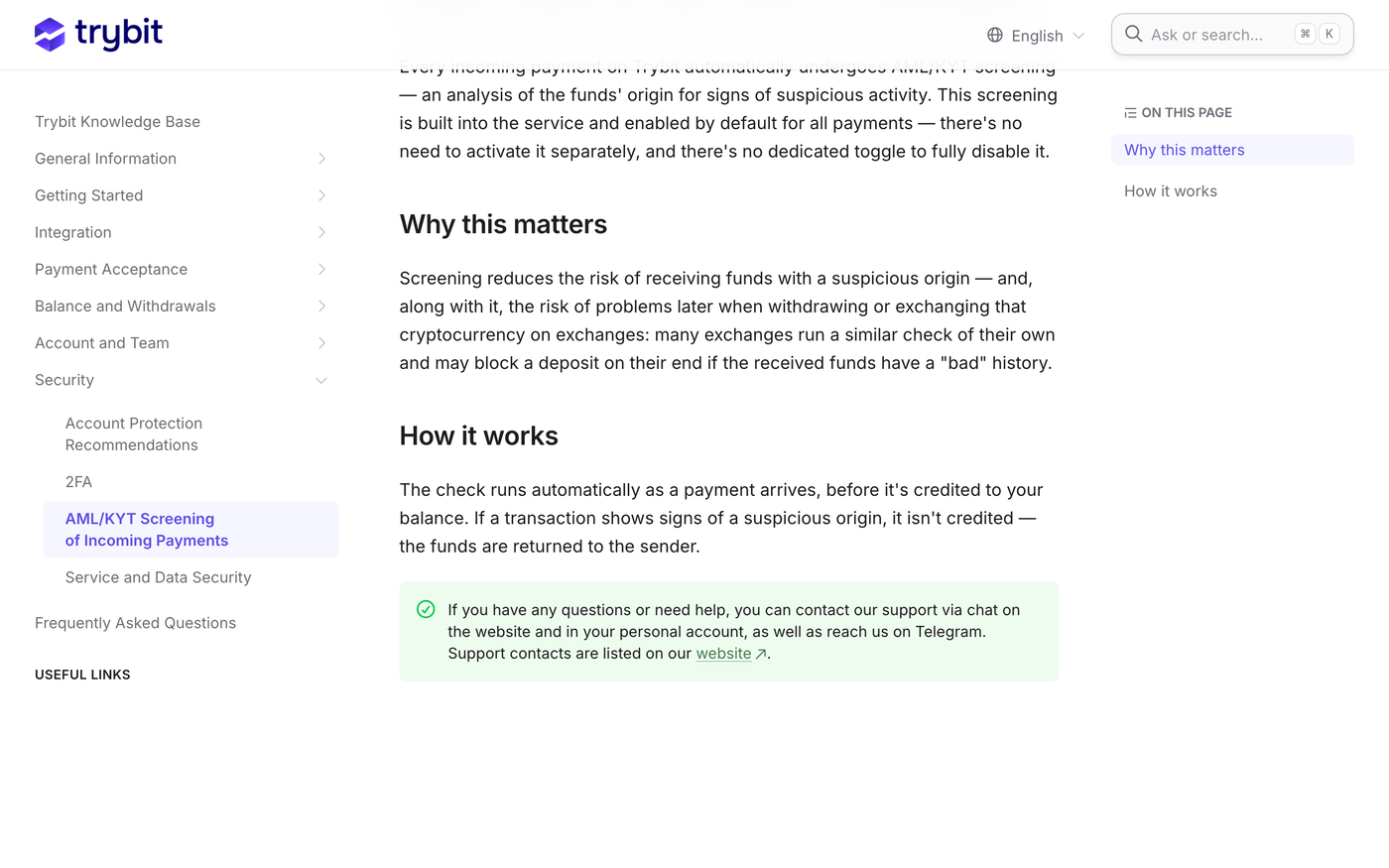
trybit is the clearest, and the whole policy fits in two sentences. The check "runs automatically as a payment arrives, before it's credited to your balance"; if a transaction shows signs of a suspicious origin, "it isn't credited — the funds are returned to the sender". Screening is "enabled by default for all payments" with "no dedicated toggle to fully disable it". You cannot opt out — and you cannot be left holding a locked balance, because there was never a balance. The cost is the appeal: there is not one, only support channels. That is a real trade-off, and the one the other seven leave unstated.
BitPay's payment exceptions, and who pays the miner fee
BitPay is the one provider that has built the rejected payment into a named regime rather than a discretion. Its "payment exceptions" vocabulary is the most complete published answer to this article's question.
| BitPay clause | What it covers | Published treatment |
|---|---|---|
| 10.2 | Fraudulent or otherwise invalid payment | "we are not required to settle with you"; marked invalid in the Dashboard |
| 10.4 | Payment invalid for "potential fraud or regulatory reasons" | Becomes a payment exception |
| 10.4.1 | Underpayment | "is not credited to your Account" |
| 10.4.3 | Orphan payments | "failed payments, and cannot be applied to an Invoice" |
| 11.3 | All payment exceptions | "refunded in the cryptocurrency used to make the payment" |
| 14.4 | The return transaction itself | BitPay "deducts the corresponding miner fee used to return the payment from the total refund amount" |
Read 11.3 and 14.4 together and you get what no other provider publishes: not just that the money goes back, but who pays for the trip. The sender absorbs the network fee out of the returned amount, so a flagged payment is never fully undone — your customer gets back less than they sent, through no decision of their own, and the explaining is yours.
One edge in the same document belongs in your refund policy: for XRP sent without a destination tag "BitPay will not be able to provide a refund", and senders of unsupported payments "will not be able to recover" them at all. Mechanical failures rather than compliance ones — the kind catalogued in our guide to gateway payment statuses — but they land on the same support ticket.
The clause that reverses your customer's payment
Two providers go further than refusing to credit a payment: they reserve the right to reverse one. The wording is almost identical, and in both cases it names your customer, not you.
CoinGate, clause 10.8: may "refuse to complete, block or reverse a transaction initiated by Your Client". Clauses 27.3 and 27.4 extend the same power to transactions initiated by you, and add the words that matter: "(even when funds are already debited)".
PassimPay, §6: may "refuse to complete, block, or reverse a transaction initiated by your Customer" where it reasonably believes the Terms have been violated. §5 adds that it may "refuse to process or cancel any pending Digital Assets transaction as required by law or any court", and may "delay any Digital Asset transaction if we perceive a risk of fraud".
PassimPay's version carries a tension worth reading twice. §2.1 says "Payment by a Customer to PassimPay is considered the same as payment made directly to you" — exactly what you want a processor to say, because it is what makes the order safe to fulfil. §6 then permits reversing that same payment. Same document; the merchant between them already shipped.
CoinGate's own tension is not quite the one it looks like: 10.8 disclaims any duty to "control, monitor, assess, authorize and/or supervise your activities", while 15.7 states "We shall perform monitoring of your transactions". Different objects, so not a contradiction — the monitoring is of the transactions, the disclaimer is of the outcome. And neither company says where a reversed payment goes: CoinGate's refund clauses (12.1–12.8) cover client-requested under- and overpayments, permit declining one "without any explanation or reason", and never mention an originating wallet.
Who bears the loss when a payment is stopped
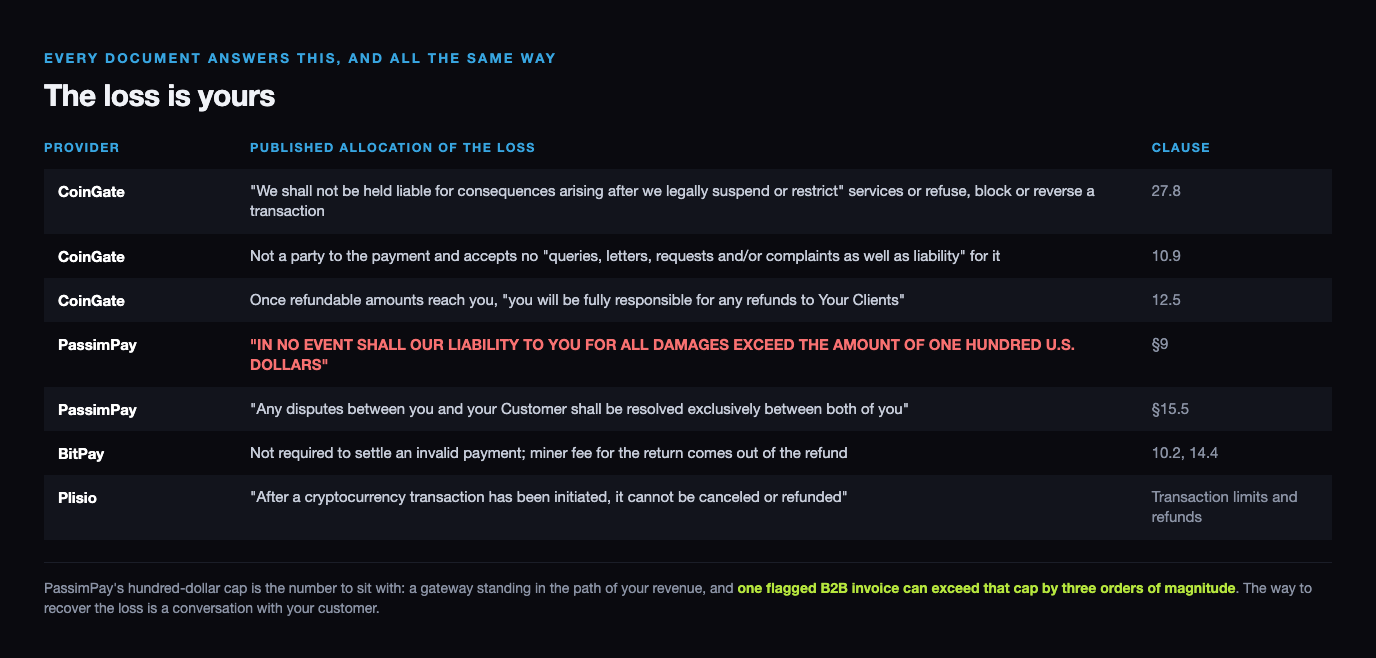
If the money does not reach you and does not obviously go back, somebody is out of pocket. Every one of these documents answers that, and all the same way.
| Provider | Published allocation of the loss | Clause |
|---|---|---|
| CoinGate | "We shall not be held liable for consequences arising after we legally suspend or restrict" services or refuse, block or reverse a transaction | 27.8 |
| CoinGate | Not a party to the payment and accepts no "queries, letters, requests and/or complaints as well as liability" for it | 10.9 |
| CoinGate | Once refundable amounts reach you, "you will be fully responsible for any refunds to Your Clients" | 12.5 |
| PassimPay | "IN NO EVENT SHALL OUR LIABILITY TO YOU FOR ALL DAMAGES EXCEED THE AMOUNT OF ONE HUNDRED U.S. DOLLARS" | §9 |
| PassimPay | "Any disputes between you and your Customer shall be resolved exclusively between both of you" | §15.5 |
| BitPay | Not required to settle an invalid payment; miner fee for the return comes out of the refund | 10.2, 14.4 |
| Plisio | "After a cryptocurrency transaction has been initiated, it cannot be canceled or refunded" | Transaction limits and refunds |
PassimPay's hundred-dollar cap is the number to sit with. Unremarkable in a software contract — but a gateway is standing in the path of your revenue, and one flagged B2B invoice can exceed that cap by three orders of magnitude. §15.5 then sends you to the customer whose payment a third party neither of you chose has stopped.
Across all seven rows: the loss is yours, and the way to recover it is a conversation with your customer. Price that into which gateway you integrate, the way you price the percentage.
The policies that monitor and never decide
Two documents here are why we counted words instead of reading for impressions. Both are real AML policies — published, dated, detailed — and neither tells a merchant anything about their money.
NOWPayments' policy (FD Transfers LLC, last updated 15 December 2025) has a numbered section called "MONITORING THE TRANSACTIONS", and its subject is the account holder throughout: the Processing Provider may investigate a case, "determine the customer's profile and identify the source and origin of the funds used in a transaction", conduct "activity research", research counterparties "if it is applicable in the case", and document findings supporting its decision "about closing". The transaction is evidence; the decision is about you.
The count, from the published PDF: 5,082 words. "monitor" appears 9 times, "risk score" 3 times, "screening" once. "incoming", "deposit", "reject", "return", "block", "withhold", "suspend" and "freeze": zero occurrences each. A policy can be thorough about how it will look at you and silent about what it will do to a payment.
B2BinPay reaches the same place from the other direction. It does name the inbound leg — "All transactions are monitored in real time" — and on detecting "suspicious activity, deposits from untrusted sources or any signs of fraud" it may "investigate, block or close the account, cancel payments and suspend services". Four powers, no destinations, no notification commitment, no vendor named. "Cancel payments" is the whole published treatment of your customer's money.
Plisio's absence is total: no AML language in the Terms of Use, plus a flat statement the other way — once initiated, a transaction "cannot be canceled or refunded". That is what a provider that has not reserved the right to stop your customer's payment looks like in writing. Silence is not a guarantee, though: Plisio can still freeze an account on a regulator's request "until further clarification of the circumstances".
Cryptomus sells the check it runs on you
Cryptomus is the only gateway here that gives a compliance stop its own machine-readable status. Its docs publish thirteen, one of them locked, whose complete definition is "Funds are locked due to the AML program". Seven words: no sequence, no terminal state, no action for you to take.
The same company sells the screening as a product. Its AML Checker returns a risk score for a wallet or transaction "based on over 25 factors like suspicious activity and regulatory flags" across BTC, TRON, ETH, BSC, ARB, AVAX and MATIC. Prices from its own page on 10 October 2026:
| Pack | Checks | Price | Per check |
|---|---|---|---|
| Basic | 10 | 4.4 USDT | 0.44 USDT |
| Standard | 20 | 8.6 USDT | 0.43 USDT |
| Plus | 50 | 21.00 USDT | 0.42 USDT |
That price tag is the most useful number here, because it tells you what the decision costs. Forty-three cents buys a risk score on an address. If a B2B-sized payment can be locked by a seven-word status with no published release process, screening the paying address yourself before you ship is cheap insurance, whoever you buy it from.
It also reframes the silence elsewhere: the check is not expensive, exotic or slow, so a provider that will not tell you its outcome is not withholding something costly to produce.
The two designs with no screener in the path
Two providers cannot stop your customer's payment, and they get there in opposite ways.
BTCPay Server removes the party. Its FAQ describes "an open-source self-hosted software stack, not a company", a "non-custodial invoicing system which eliminates the involvement of a third-party", where "payments with BTCPay go directly to your wallet" and "the BTCPay Server community does not hold or have access to any funds of a store using the BTCPay Server software, only the merchant does". Nothing in the path can reject, lock or reverse anything. The page says nothing about AML monitoring and should not be cited as if it did — the point is structural. What moves to your side is screening, custody, key management and your own legal obligations, none of which vanish because the software is yours. We cover that trade in our breakdown of what no-KYC gateways actually ask for.
trybit removes the balance instead: screening before crediting and returning failures to the sender, it never holds money it might have to decide about. You keep a hosted gateway and lose the appeal; BTCPay keeps your autonomy and hands you the infrastructure. Neither is the general answer, but both are honest about where the risk sits — ahead of five providers that publish a verb and stop.
What to do before and during a stopped payment
None of this is actionable when a payment is flagged: the decision is not yours, and most of these documents do not explain it. It is actionable before, and in how you handle the customer.
- Read the inbound clause before you integrate, not the fee page. Two questions: "can you stop my customer's payment" and "where does the money go". Eight of ten answer the first and not the second.
- Do not treat a confirmed chain transaction as a paid invoice. Ship on your gateway's credited status, not a block explorer. BitPay says it outright: a payment counts once credited; accepting it earlier is your risk.
- Write the bounce into your own refund policy. Say what happens when the processor returns a payment, who absorbs the network fee, and how long you hold the order. BitPay deducts the miner fee, so your customer will be short — decide now whether you cover it.
- Keep the paying address, transaction hash, invoice ID and raw webhook payload for every order. That set is the only thing connecting a stranger's wallet to a customer who says they paid — and on Cryptomus the payload's status string is the only signal that this was a compliance event rather than a delay.
- Price a pre-ship crypto payment screening check on high-value orders. At 0.42–0.44 USDT a check, screening the paying address above your pain threshold costs less than one disputed order.
None of those steps makes a gateway reverse its decision. They make it land on a documented order rather than a mystery, and turn the customer conversation into one about a known network fee.
- Crypto Gateway AML Holds 2026: Nobody Says How Long
- Crypto Payment Statuses 2026: 9 Gateways Compared
- No-KYC Crypto Payment Gateways: What Each One Asks For
- trybit Review: Fees, Screening and Coin Support
- BitPay Review: Settlement, Fees and Payment Exceptions
- BTCPay Server Review: Self-Hosted and Non-Custodial
The inbound screening clause is part of the price. Read it before you integrate.
We track fees, custody, KYC and settlement for every processor in the directory, and what a provider writes down about your customer's payment belongs on that list. trybit publishes the only return-to-sender commitment we found; BTCPay Server removes the screener by removing the third party.
Compare Crypto Payment Gateways →FAQ
What happens if a crypto payment gateway rejects my customer's payment?
It depends on the provider, and six of the ten we read on 10 October 2026 do not publish an answer. trybit returns the funds to the sender. BitPay treats it as a payment exception, refunded "in the cryptocurrency used to make the payment" less the miner fee. Cryptomus locks it under a locked status with no published release process. CoinGate, PassimPay, BlockBee, B2BinPay and NOWPayments publish a power to stop the payment without saying where the money ends up.
Do crypto payment gateways screen incoming customer payments for tainted coins?
Eight of the ten publish some form of it. BlockBee alone names the technique, monitoring transactions "using Know Your Transaction (KYT) and other risk-screening tools" whose systems "automatically screen transactions against applicable risk indicators and generate alerts". trybit runs the check "automatically as a payment arrives, before it's credited to your balance", on by default with no toggle. Plisio's Terms of Use contain no screening language at all, and BTCPay Server has no third party in the path to run one.
Can a crypto payment be reversed after my customer has sent it?
The chain transaction cannot be, but your gateway's ledger entry can. CoinGate's clause 10.8 reserves the right to "refuse to complete, block or reverse a transaction initiated by Your Client", and 27.3 extends that "even when funds are already debited". PassimPay's §6 uses almost identical wording for a transaction "initiated by your Customer". Plisio publishes the opposite position: once initiated, a transaction "cannot be canceled or refunded".
Who pays the network fee when a flagged crypto payment is returned?
Where it is published at all, the sender does. BitPay's clause 14.4 "deducts the corresponding miner fee used to return the payment from the total refund amount", so your customer receives less than they sent. No other provider publishes who absorbs the cost of the return — in practice a question you and your customer settle between you.
Will I be told why a crypto payment was blocked?
Only BitPay commits to a signal, flagging affected payments as invalid in the merchant Dashboard. Cryptomus gives you a status string and nothing else. CoinGate goes the other way: clause 10.9 states that it is not a party to the payment and accepts no "queries, letters, requests and/or complaints as well as liability" for it, while 12.1 reserves the right to decline a refund "without any explanation or reason".
Who bears the loss if a gateway stops a payment I have already shipped against?
You do, under every set of terms we read. CoinGate's 27.8 excludes liability for "consequences arising after we legally suspend or restrict" services or reverse a transaction. PassimPay caps total liability at one hundred US dollars and sends merchant-customer disputes back to the two of you. BitPay is not required to settle a payment it deems invalid. Which is why shipping on a block explorer rather than the gateway's credited status is the expensive habit.
How much does it cost to screen a crypto payment myself before shipping?
About forty-three cents an address. Cryptomus' AML Checker, read on 10 October 2026, sells 10 checks for 4.4 USDT, 20 for 8.6 USDT and 50 for 21.00 USDT — 0.42 to 0.44 USDT per check — returning a risk score "based on over 25 factors like suspicious activity and regulatory flags" on BTC, TRON, ETH, BSC, ARB, AVAX and MATIC. On high-value invoices that is cheaper than one disputed order, and it is the same class of check the gateways run without telling you the result.
Affiliate disclosure: Payyd earns a commission if you sign up to some providers linked on this page. That changes none of the clauses, definitions, prices or word counts reported here, all of which come from the providers' own documents and can be checked below.
Sources
Primary documents, read 10 October 2026:
- trybit: AML/KYT screening of incoming payments — return-to-sender, and no toggle
- BitPay: Terms of Use — clauses 10.2, 10.4.1–10.4.4, 11.3, 11.3.1, 14.4
- CoinGate: Merchant Terms of Services — clauses 10.8, 10.9, 12.1–12.8, 15.7, 27.3–27.8
- PassimPay: Terms of Service — §2.1, §5, §6, §9, §15.5
- BlockBee: AML Policy — KYT monitoring, and the list of actions
- Cryptomus: payment statuses — thirteen statuses, and
locked - Cryptomus: AML Checker — pack prices and the 25-factor risk score
- B2BinPay: AML & KYC policy — "deposits from untrusted sources"
- NOWPayments: AML and KYC/KYB policy of FD Transfers LLC (PDF) — section 11, "Monitoring the Transactions"
- Plisio: Terms of Use (PDF) — transaction limits and refunds; the regulator-triggered freeze
- BTCPay Server: general FAQ — the non-custodial design
- Chargebacks911: crypto chargebacks — irreversibility background only
Method notes. Word counts for the NOWPayments and Plisio PDFs come from the text layer of the published files (5,082 and 3,247 words). Cryptomus' /terms and /aml paths return 403 to automated requests, so its status definition was read from its developer docs and its prices from the live AML Checker page. OxaPay, Blockonomics and CoinPayments serve no readable legal text to an automated request, so none of the three is counted rather than guessed at.