
Crypto Gateway Audit Rights 2026: Only Two Can Look
Crypto gateway audit rights, read across 11 merchant contracts in November 2026: only two may inspect your records and just one names a retention period.
 Brian Ormond

Key Takeaways
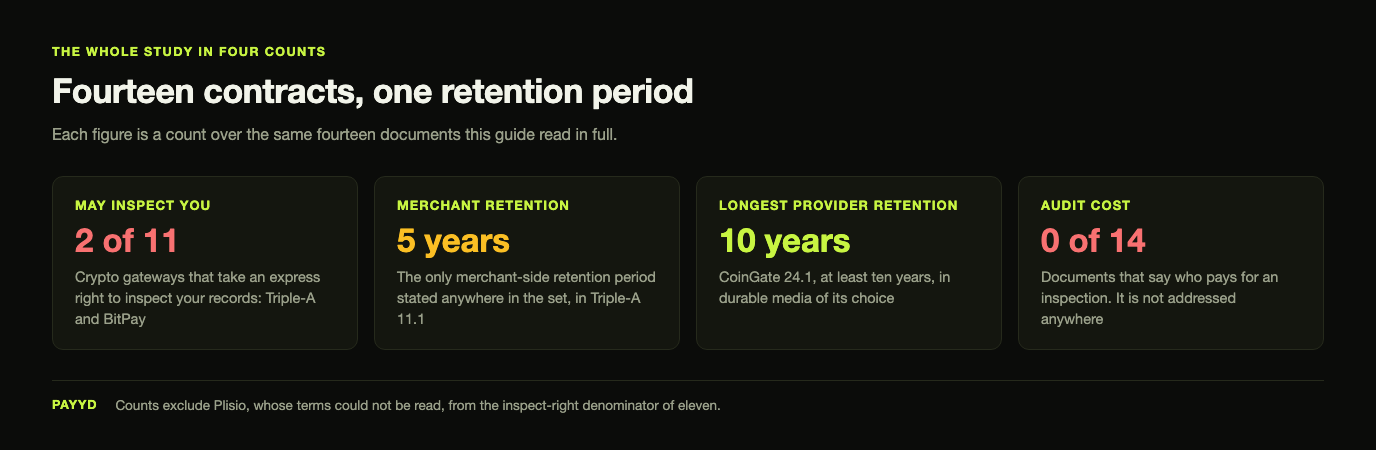
- Crypto gateway audit rights exist in only two of eleven readable merchant contracts. Triple-A cl. 11.2 may "audit or request copies of such records, systems, policies, and procedures"; BitPay cl. 4.7.3 may "request to obtain and inspect certain of your business records". The other nine have no inspection right of any kind.
- One contract names a retention period for the merchant, and it is five years. Triple-A cl. 11.1 requires records "for at least five (5) years, or such longer period as required by Applicable Law". Nobody else gives a number, so ten of eleven leave you to work out your own retention duty unaided.
- Where a provider publishes a number, it is for its own records, not yours. CoinGate cl. 24.1 stores information "for at least 10 (ten) years"; cl. 24.2 tells the merchant only that "you should save" theirs. PassimPay keeps unclaimed-transaction records "for a minimum of six (6) years" and asks nothing of you.
- No contract says who pays for an audit, or how many days' notice you get. "Reasonable notice" is the only standard either inspection clause offers. CoinGate cl. 22.10 is the one place paperwork is priced, and it is priced to you: all "drafting, delivery, certification, notarization, apostillization and translation" costs are the merchant's.
- BitPay gives donees an annual right to inspect BitPay, and merchants nothing. The same clause that lets BitPay inspect you, and suspend you for refusing, hands the matching right to donees alone. BlockBee's terms contain "audit" and "records" zero times; Blockonomics contains neither "audit" nor "inspect".
A compliance officer emails asking for eighteen months of transaction records, and you discover that nobody ever told you to keep them. Crypto gateway audit rights are the clause that decides whether that email can arrive at all, what it can demand, and what happens to your account if you cannot answer it — and across the merchant contracts in this directory the clause is missing far more often than it is present.
That absence is not the relief it sounds like. A gateway with no audit clause has not promised to leave you alone; it has declined to say what it will ask for, while keeping a general power to suspend you for an unsatisfactory answer. And the retention duty an AML regime imposes does not disappear because your processor forgot to mention it. We read the audit, inspection, information-request and record-keeping clauses in the merchant terms of twelve hosted crypto gateways on 13 November 2026, and added Stripe and Authorize.net for contrast. Eleven gateways were readable. Two may inspect your records, one names a retention period, and none states who pays.
These are the same twelve contracts we read for the assignment comparison and the account closure comparison. The twelfth, Plisio, is still serving the security-incident notice that stood before both of those readings, with payments suspended, so its terms could not be opened again today.
Fourteen documents, side by side
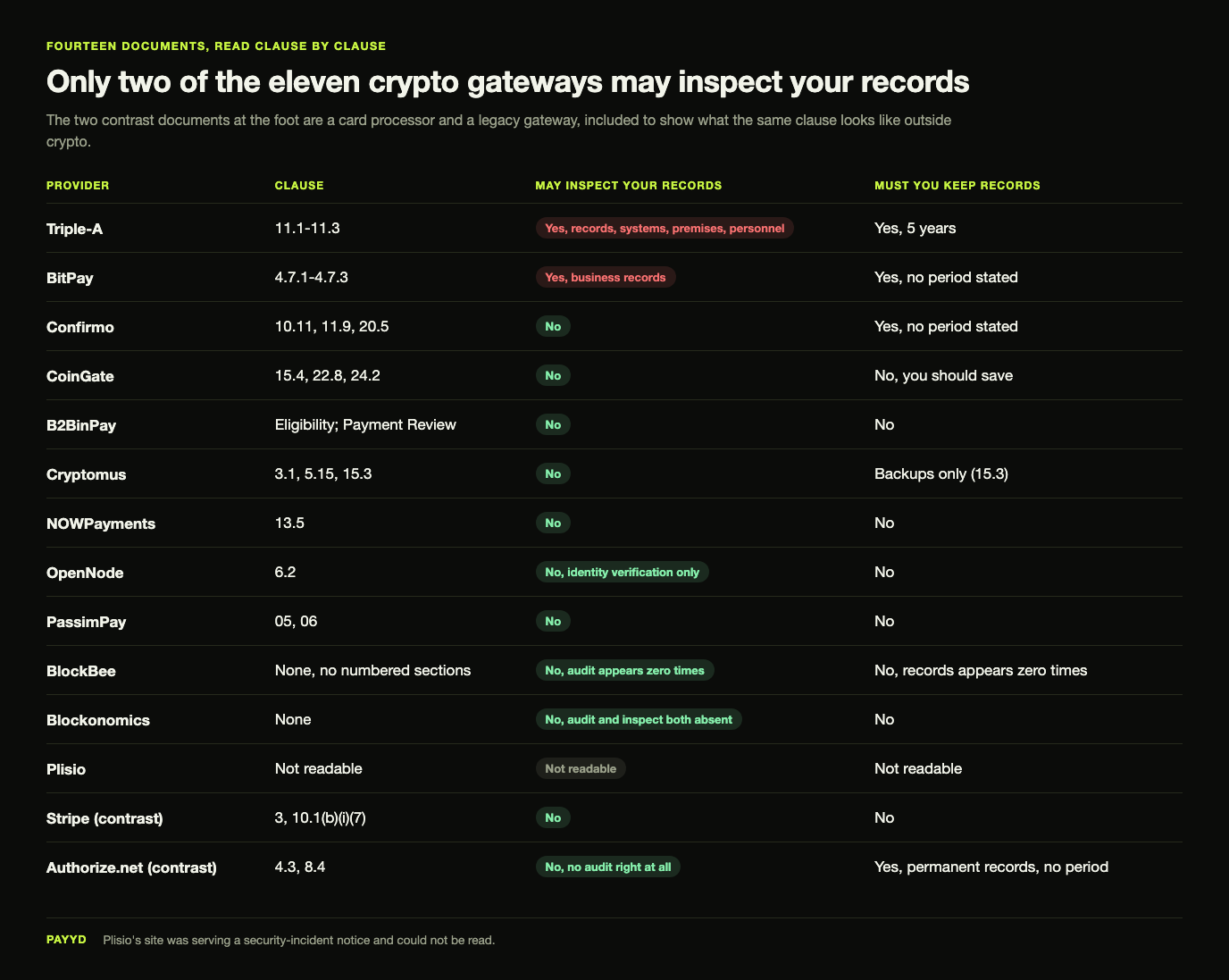
An audit clause answers five questions. May the provider demand documents? May it inspect your records or premises? Must you keep anything, and for how long? What does it cost you? And what happens if you say no? Almost every contract here answers the first with yes and the rest with silence.
| Provider | Clause | May inspect your records | Must you keep records | If you refuse |
|---|---|---|---|---|
| Triple-A | 11.1–11.3 | Yes — records, systems, premises, personnel | Yes, 5 years | Suspension (3.6); termination for cause (3.4(a)) |
| BitPay | 4.7.1–4.7.3 | Yes — business records | Yes, no period stated | "Suspend or terminate your Account" (4.7.3) |
| Confirmo | 10.11, 11.9, 20.5 | No | Yes, no period stated | Material breach; refusal, delay, suspension or termination (10.12) |
| CoinGate | 15.4, 22.8, 24.2 | No | No — "you should save" | Restrict or terminate the Services (15.5) |
| B2BinPay | Eligibility; Payment Review (unnumbered) | No | No | Restrict the Account, suspend Services |
| Cryptomus | 3.1, 5.15, 15.3 | No | Backups only (15.3) | Restrictions or suspension (5.15) |
| NOWPayments | 13.5 | No | No | Not stated |
| OpenNode | 6.2 | No — identity verification only | No | Freeze the account until verified; terminate (6.2) |
| PassimPay | 05, 06 | No | No | Reject registration or close the Account (05) |
| BlockBee | None — no numbered sections | No — "audit" appears zero times | No — "records" appears zero times | Restrict, suspend or terminate the account |
| Blockonomics | None | No — "audit" and "inspect" both absent | No | Terminate "at our sole discretion for any reason" |
| Plisio | Not readable | Not readable | Not readable | Site serving a security-incident notice |
| Stripe (contrast) | 3, 10.1(b)(i)(7) | No | No | Immediate suspension (10.1(b)(i)(7)) |
| Authorize.net (contrast) | 4.3, 8.4 | No — no audit right at all | Yes — "permanent records", no period | Suspend; terminate if uncured after 30 days (8.4) |
Read down the third column and the shape of the market is clear: nine of eleven readable crypto contracts claim no right to look at anything you hold. Read down the fourth and the reason that is cold comfort is just as clear.
Only two of eleven may look at your records
Triple-A is the only provider in the directory with a section headed "Audit and Inspection", and it is the most complete treatment of the subject in the set. Clause 11.2 lets "Triple-A, its auditors, or any competent Supervisory Authority" act "on reasonable notice" to "audit or request copies of such records, systems, policies, and procedures as are reasonably necessary to verify the Merchant's compliance". Clause 11.3 then makes you "cooperate fully… including by granting reasonable access to relevant records, premises, and personnel".
Premises and personnel is a long reach for a payments contract. Triple-A is a regulated operator, and cl. 11.2 ties the power to verifying compliance with the terms, applicable law and Triple-A's own compliance obligations: a supervised firm passing its regulator's expectations down the chain. That is why it reads as the most intrusive clause in the set while being the most ordinary.
BitPay cl. 4.7.3, headed "Request for Documentation and Right to Inspect Records", is narrower and blunter: BitPay "or its auditors, an appropriate regulator, or other relevant competent authority may request to obtain and inspect certain of your business records with reasonable advance notice or immediately if required by law, a regulator, or other relevant authority". Business records only, with no mention of systems, premises or people. Then one short sentence does the work: "If you refuse such a request, we reserve the right to suspend or terminate your Account."
That sentence is the only express refusal penalty in the set. Everywhere else the consequence of saying no has to be assembled from the general suspension clauses, which is weaker to rely on and harder to argue about. The nine contracts with no inspection right still reach the same destination by a longer road: Cryptomus cl. 5.15 warns that failure or delay "may result in restrictions or suspension of the Account", CoinGate cl. 15.5 may "restrict or terminate the provision of our Services", and Blockonomics can terminate "at our sole discretion for any reason". Our reading of the AML hold clauses covers the money side of the same power.
BitPay inspects you; donees inspect BitPay
The second half of BitPay cl. 4.7.3 is the oddest thing we found this month. Having let BitPay inspect a merchant's records and suspend a merchant who refuses, the clause carries straight on: "Donees may request to obtain and inspect BitPay's business records… with reasonable advance written notice once in every twelve-month period", or sooner where a law, court order or regulator requires it.
One document, one clause, two classes of customer. A charity taking donations through BitPay gets an annual audit right over BitPay; a shop taking payments through the identical Acceptance Service gets none. The contract is called the Merchant and Donee Terms of Use and covers both, and nothing in it explains the split.
BitPay's separate Send Terms of Use go further again. Clause 4.5.3 there is drafted symmetrically: "Either Party or its auditors, an appropriate regulator, or other relevant competent authority may request to obtain and inspect certain of the other Party's business records" on the same reasonable-notice standard. That is the only genuinely two-way inspection right in anything we read, crypto or card.
The symmetry does not survive the next sentence: "If you refuse such request, we reserve the right to suspend or terminate your Account." Both parties may ask; only one loses its account for declining. That is the pattern this series keeps finding — a right granted in balanced language and enforced in unbalanced language. Note too that the Send Terms have been effective since 1 January 2022 while the Merchant and Donee Terms were reissued on 1 April 2026, so the asymmetric version is the newer drafting.
One number in the whole set: five years
Here is the finding that should change what you do this week. Across fourteen documents — eleven readable crypto gateways, two card-rail agreements and one unreadable site — exactly one tells a merchant how long to keep records.
Triple-A cl. 11.1: "The Merchant shall maintain complete and accurate records of its use of the Services and of all transactions processed through the Services for at least five (5) years, or such longer period as required by Applicable Law."
Three others impose a duty without a period. Confirmo cl. 10.11: "You will keep records required by law and the Agreement". BitPay cl. 4.7.2 requires "all records needed to fulfil orders… and provide post-sale support to your Shoppers as required by applicable laws". Authorize.net s. 4.3 is the bluntest, from the card side: the customer "is solely responsible for compiling and retaining permanent records of all Transactions and End-User data", and "at no time" is Authorize.net obliged to retain copies.
All three resolve to the same instruction: find out what your own law requires. That is not wrong, and it is not much help at 11pm when a bank is asking. The remaining seven readable crypto contracts say nothing, and CoinGate cl. 24.2 manages something stranger than silence by writing the duty as advice — "you should save corresponding information" — creating an expectation without an obligation.
| Contract | What the provider keeps, and for how long | What you must keep, and for how long |
|---|---|---|
| CoinGate | At least 10 years, "in durable media of our choice" (24.1) | No duty — "you should save", no period (24.2) |
| PassimPay | Minimum 6 years for unclaimed-transaction records (06) | Nothing stated |
| Triple-A | Not stated in the General T&Cs | At least 5 years, or longer if law requires (11.1) |
| BitPay | While the Account is active "and after your Account is closed" (4.7.1) | Records to fulfil orders and support Shoppers; no period (4.7.2) |
| Confirmo | Personal data "as long as necessary" (13.8) | "Records required by law and the Agreement"; no period (10.11) |
| Cryptomus | Personal-data retention periods only (13.4) | "Full responsibility for backing up and storing their data" (15.3) |
| Authorize.net (contrast) | "At no time" obliged to store or retain (4.3) | "Permanent records" of all Transactions and End-User data; no period (4.3) |
| Stripe (contrast) | Not obliged to retain data after the Term (4.4) | Nothing stated |
| B2BinPay, NOWPayments, OpenNode, BlockBee, Blockonomics | Nothing stated for merchant transaction records | Nothing stated |
They keep records longer than they ask you to
Set the two columns of that table against each other and a gap appears. Where a contract publishes a retention number at all, it is almost always the provider's own, and longer than anything asked of the merchant.
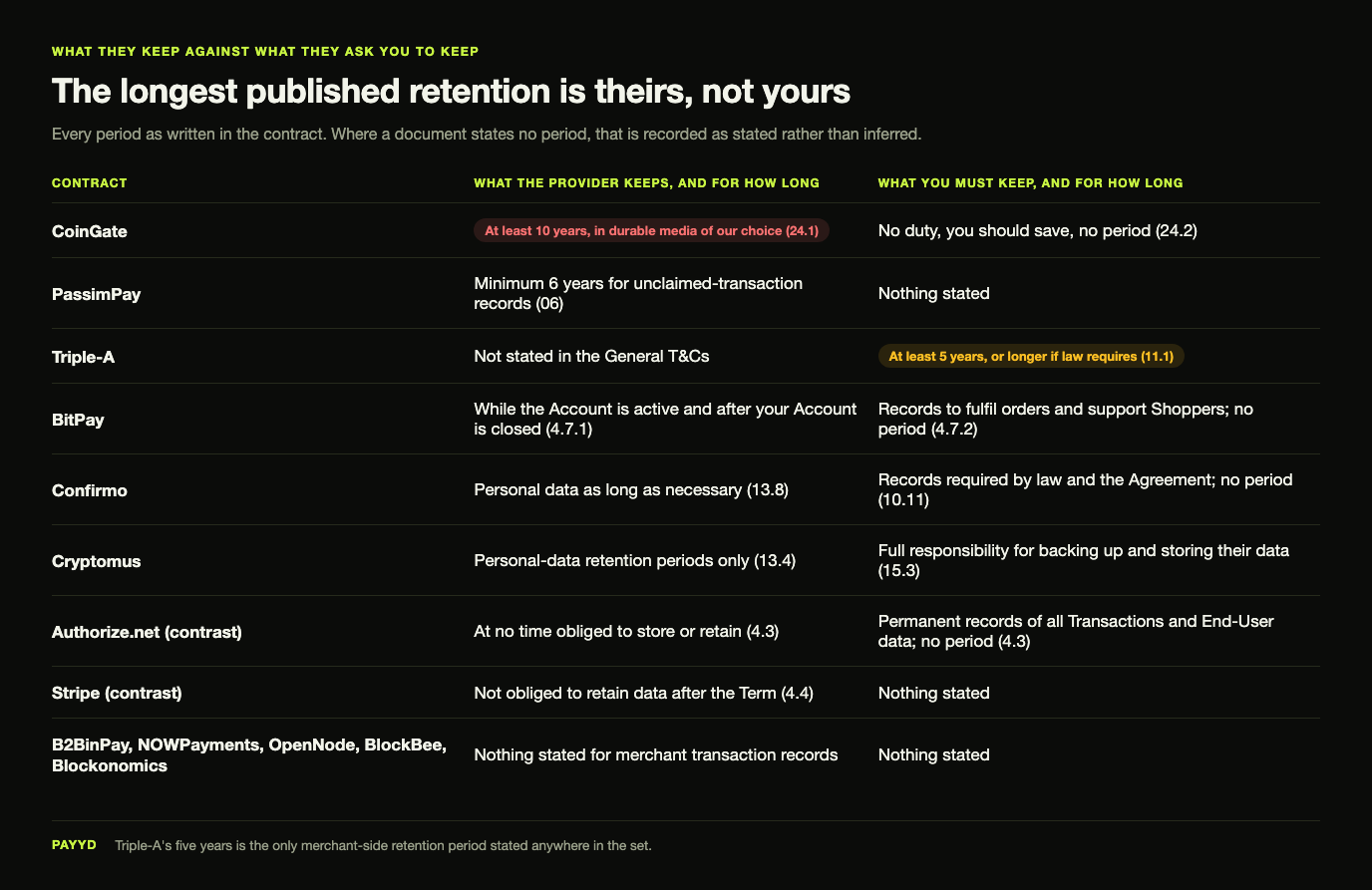
CoinGate is the clearest case, because both halves sit in one section headed "Information Storage". Clause 24.1: "We store essential information related to the use of CoinGate System for our own needs for at least 10 (ten) years in durable media of our choice." Clause 24.2 opens "On the other hand" and asks you to save things so there is "proof of actions taken by you or by us". Ten years, firm, for them; a suggestion, for you, in a clause whose stated purpose is evidence of what both parties did.
PassimPay commits to "a minimum of six (6) years" for records of unclaimed transactions — the same crypto its terms let it move to its own balance once the limitation period expires — and imposes no retention duty on you. BitPay cl. 4.7.1 is open-ended rather than long: account documentation is kept "for the duration that your Account is active and after your Account is closed", with no end date.
None of this is sinister. Regulated firms have statutory retention schedules and write them down; merchants have their own, and a gateway sensibly declines to advise on them. But the result is an asymmetry of evidence. In a dispute two years on, the provider will have the records and you may not. Our reading of the dispute resolution clauses found claim windows as short as three months, and short windows plus thin records is how a good claim dies.
Two headings that promise an audit and do not deliver
Twice in this set a merchant searching the terms for the word "audit" will land on a heading that looks like the answer and is not.
Confirmo cl. 20.5 is headed "Audit and information requests": "We may provide information to competent authorities and our auditors as required by law or regulation. You will reasonably cooperate with our lawful requests for information related to compliance…" There is no audit of the merchant in it — it is a disclosure permission pointing at Confirmo's own auditors, plus a cooperation duty. The real information power sits at cl. 11.9, which may "request information or documents" and "suspend processing until they are received": a suspension trigger filed under invoicing rather than under the heading with "audit" in it.
Cryptomus inverts the idea. Its terms claim no audit right over you, but cl. 12.2(e) lists an "audit, review, or investigation related to the User's activities" among the grounds for suspending or terminating your services. Somebody else's audit of you is a reason to cut you off; Cryptomus asking to see your books is not contemplated at all.
These are drafting artefacts rather than traps, but a heading is how a merchant navigates a contract, and two of these send you to the wrong place. Checking a provider before you integrate, search the full text for "records", "inspect" and "documentation" too: in this set the operative power is rarely under the obvious heading.
Notice, cost and certified paperwork
Three practical questions remain.
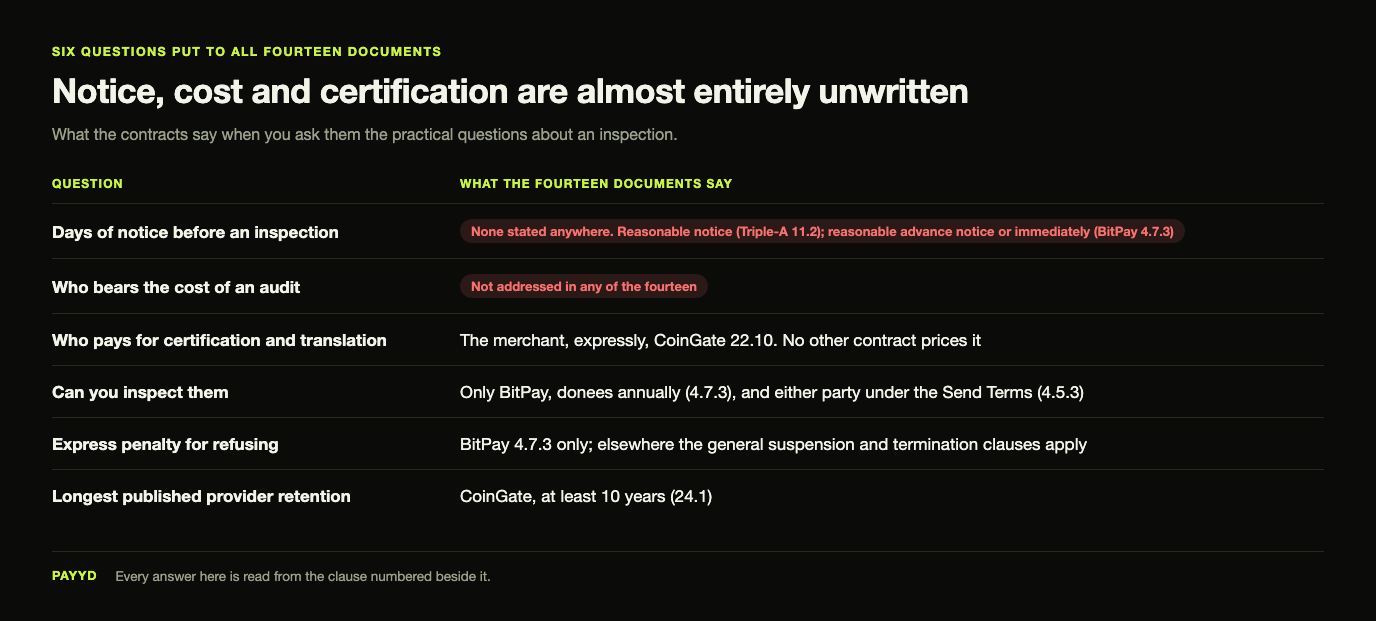
How much notice do you get? No contract states a number of days. Triple-A cl. 11.2 says "reasonable notice"; BitPay cl. 4.7.3 says "reasonable advance notice or immediately if required by law, a regulator, or other relevant authority". Both carve out the regulator-driven case, which is the one most likely to arise.
Who pays for an audit? Nobody says. Not one of the fourteen documents allocates the cost of an inspection, in either direction. Negotiated agreements usually spell this out; published click-through terms simply do not.
Who pays to produce the documents? One contract is explicit. CoinGate cl. 22.8 may "require the Merchant to provide original documents and/or copies certified by a notary", and require foreign documents to be "translated into English and/or legalized and/or attached with an Apostille". Clause 22.10 settles the bill: all costs of "drafting, delivery, certification, notarization, apostillization and translation" are "borne by the Merchant".
| Question | What the fourteen documents say |
|---|---|
| Days of notice before an inspection | None stated anywhere. "Reasonable notice" (Triple-A 11.2); "reasonable advance notice or immediately" (BitPay 4.7.3) |
| Who bears the cost of an audit | Not addressed in any of the fourteen |
| Who pays for certification and translation | The merchant, expressly — CoinGate 22.10. No other contract prices it |
| Can you inspect them | Only BitPay — donees annually (4.7.3), and either party under the Send Terms (4.5.3) |
| Express penalty for refusing | BitPay 4.7.3 only; elsewhere the general suspension and termination clauses apply |
| Longest published provider retention | CoinGate, at least 10 years (24.1) |
Three things follow. Keep five years of transaction records whatever your provider says, because it is the only number any of them chose and sits at or above most AML retention floors. Export on a schedule, not on demand, since every one of these contracts can suspend your dashboard before you finish downloading — the failure mode in our account closure comparison. And if you trade across borders, treat CoinGate cl. 22.10 as a live cost line: apostilles and certified translations are billed per document.
- Crypto Gateway Assignment 2026: None Needs Your Consent
- Crypto Gateway Account Closure 2026: Who Keeps Your Balance
- Crypto Gateway AML Holds 2026: How Long Funds Sit
- Crypto Gateway Customer Data 2026: We Checked 10
- Crypto Gateway GDPR 2026: Who Signs a DPA
- Crypto Gateway Dispute Resolution 2026: We Read 12
Nine of eleven readable crypto contracts never tell you what to keep.
We read fees, custody, KYC and contract terms for every processor in the directory. Triple-A is the only one that names a retention period and the only one with a section headed Audit and Inspection; BitPay is the only one that writes down what happens if you refuse; BTCPay Server is self-hosted, so the records never leave your own server in the first place.
Compare Crypto Payment Gateways →Affiliate disclosure: Payyd earns a commission if you sign up to some providers linked on this page. It changes none of the clauses or findings reported here, all of which come from the providers' own published documents and are linked below.
FAQ
Can my crypto payment gateway audit my business?
Two of the eleven readable contracts say so in terms. Triple-A cl. 11.2 may "audit or request copies of such records, systems, policies, and procedures" on reasonable notice, and cl. 11.3 extends your cooperation duty to "records, premises, and personnel". BitPay cl. 4.7.3 may inspect "certain of your business records". The other nine claim no inspection right, though all can demand documents and suspend you while they wait.
How long do I have to keep crypto payment records?
Only one contract gives a number: Triple-A cl. 11.1, at least five years, or longer where applicable law says so. Confirmo cl. 10.11, BitPay cl. 4.7.2 and Authorize.net s. 4.3 impose a duty but point you at your own law for the period. The rest say nothing. Five years is a sensible floor regardless — it sits at or above most AML record-keeping requirements and is the only figure any provider here has published.
What happens if I refuse to send documents to my gateway?
BitPay cl. 4.7.3 is the only contract that spells it out: "If you refuse such a request, we reserve the right to suspend or terminate your Account." Elsewhere the same outcome arrives through general clauses — CoinGate cl. 15.5 may restrict or terminate the services, Cryptomus cl. 5.15 warns of suspension for failure or delay, OpenNode s. 6.2 may freeze the account until verification completes.
Does my gateway keep records for longer than it asks me to?
Where both numbers are published, yes. CoinGate stores information for its own needs "for at least 10 (ten) years" under cl. 24.1, while cl. 24.2 only suggests you save your own. PassimPay retains unclaimed-transaction records for a minimum of six years and asks nothing of you. BitPay keeps account documentation while the account is open and after it closes, with no end date.
Who pays for an audit under a crypto gateway contract?
No contract says, in either direction. The one cost that is allocated is document production: CoinGate cl. 22.10 puts all drafting, delivery, certification, notarization, apostillization and translation costs on the merchant, and cl. 22.8 is what can require notarized originals and apostilles in the first place.
How much notice will I get before an inspection?
No number appears anywhere. Triple-A cl. 11.2 says "reasonable notice"; BitPay cl. 4.7.3 says "reasonable advance notice or immediately if required by law, a regulator, or other relevant authority". Both carve out the regulator-driven case, the most likely reason an inspection happens at all, so the notice you can count on is none.
Can I audit my payment gateway in return?
Almost never. The only reciprocal rights belong to BitPay customers: donees may inspect BitPay's relevant business records once every twelve months under cl. 4.7.3, and the separate Send Terms cl. 4.5.3 let "either Party" inspect the other. Even there enforcement runs one way — the penalty for refusing is suspension of your account, and nothing is said about BitPay declining.
Which crypto gateway handles records best?
Triple-A, on the narrow question of clarity: it is the only one that tells a merchant how long to keep records, the only one with a section headed Audit and Inspection, and the only one tying its inspection right to verifying compliance rather than leaving it open. The trade-off is that it is also the most intrusive clause in the set, reaching premises and personnel. This is one input to a shortlist, not a ranking.
Sources
Audit, inspection, information-request and record-keeping clauses, read 13 November 2026:
- Triple-A General Terms and Conditions — version date 20 April 2026; cl. 5.4, s. 11 "Audit and Inspection" (cll. 11.1–11.3), cll. 3.4, 3.6
- BitPay Merchant and Donee Terms of Use — effective 1 April 2026; s. 4.7 Records (cll. 4.7.1–4.7.4); and BitPay Send Terms of Use, effective 1 January 2022, s. 4.5 (cll. 4.5.1–4.5.3)
- Confirmo Limited Terms and Conditions (PDF) — last updated 2 October 2026; cll. 10.11, 10.12, 11.9, 13.8, 20.5
- CoinGate Merchant Terms of Service — v1 06/02/2024; cll. 15.3–15.5, 22.8, 22.10, 22.11, s. 24 Information Storage (cll. 24.1–24.2)
- B2BinPay Terms of Use — last updated 26 June 2026; Eligibility and Payment Review (unnumbered); no audit or record-retention clause
- Cryptomus Terms of Use — last updated 17 August 2026; cll. 3.1, 5.15, 9.1, 12.2(e), 13.4, 15.3
- NOWPayments Terms of Service (PDF) — last updated 19 October 2026; cl. 13.5 (FD Transfers LLC); no audit or merchant-retention clause
- OpenNode Terms and Conditions — last update 29 August 2024; ss. 4.4, 4.5, 6.2, 8
- PassimPay Terms of Service — last updated 11.05.2026 in the document's own format; ss. 05, 06 (Recordkeeping), 11
- BlockBee Terms and Conditions — effective 2 October 2026; Monitoring and Enforcement, under Use of the Service. The words "audit" and "records" do not appear
- Blockonomics Privacy Policy and Terms of Service — undated; General Terms (OneByZero Tech). The words "audit" and "inspect" do not appear
- plisio.net security-incident notice — the whole site, legal pages included, served this notice on 13 November 2026; terms not readable and not reported
- Stripe Services Agreement — last modified 28 September 2026; ss. 3, 4.4, 7.3(c)(ii), 10.1(b)(i)(7), 10.3(e)
- Authorize.net Payment Gateway Merchant Services Agreement — ss. 4.3, 8.2, 8.4, 10.2