Crypto Gateway Account Closure 2026: Who Keeps Your Balance
Crypto gateway account closure, read across 12 merchant contracts in November 2026: five promise to send your balance back, and one says it need not.
 Brian Ormond
Key Takeaways
- Crypto gateway account closure turns on one clause, and five of twelve contracts contain it: an obligation to send your balance back. BitPay, Confirmo and B2BinPay say so plainly; OpenNode does, after converting your crypto to fiat; PassimPay does, with a 30-day clock. Five say nothing or the opposite.
- Cryptomus heads a clause "Return of Assets" and states it has no obligation to return them (cl. 5.18) — triggered by suspicion, not a finding.
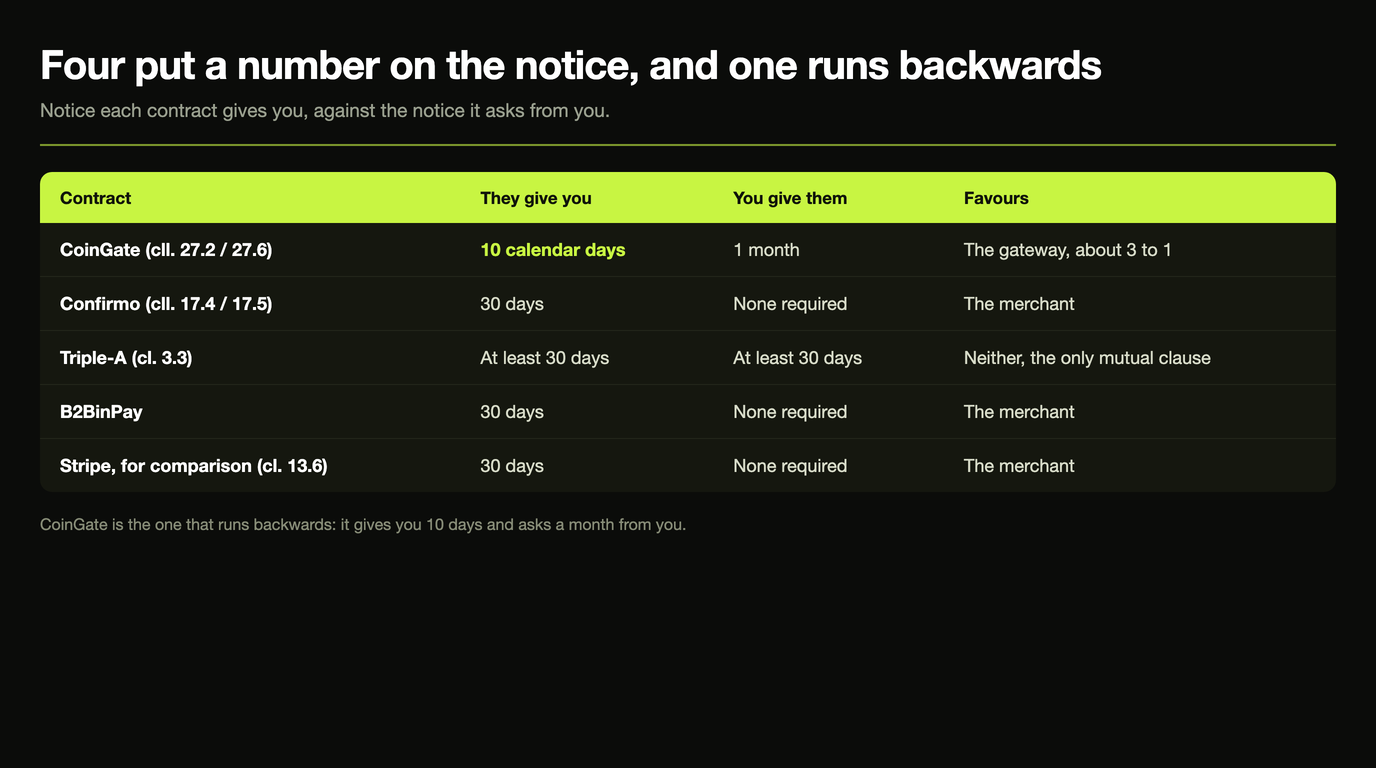
- Four put a day count on closure notice: CoinGate 10 days, Confirmo, Triple-A and B2BinPay 30. CoinGate runs backwards — it owes you 10 days, you owe it a month.
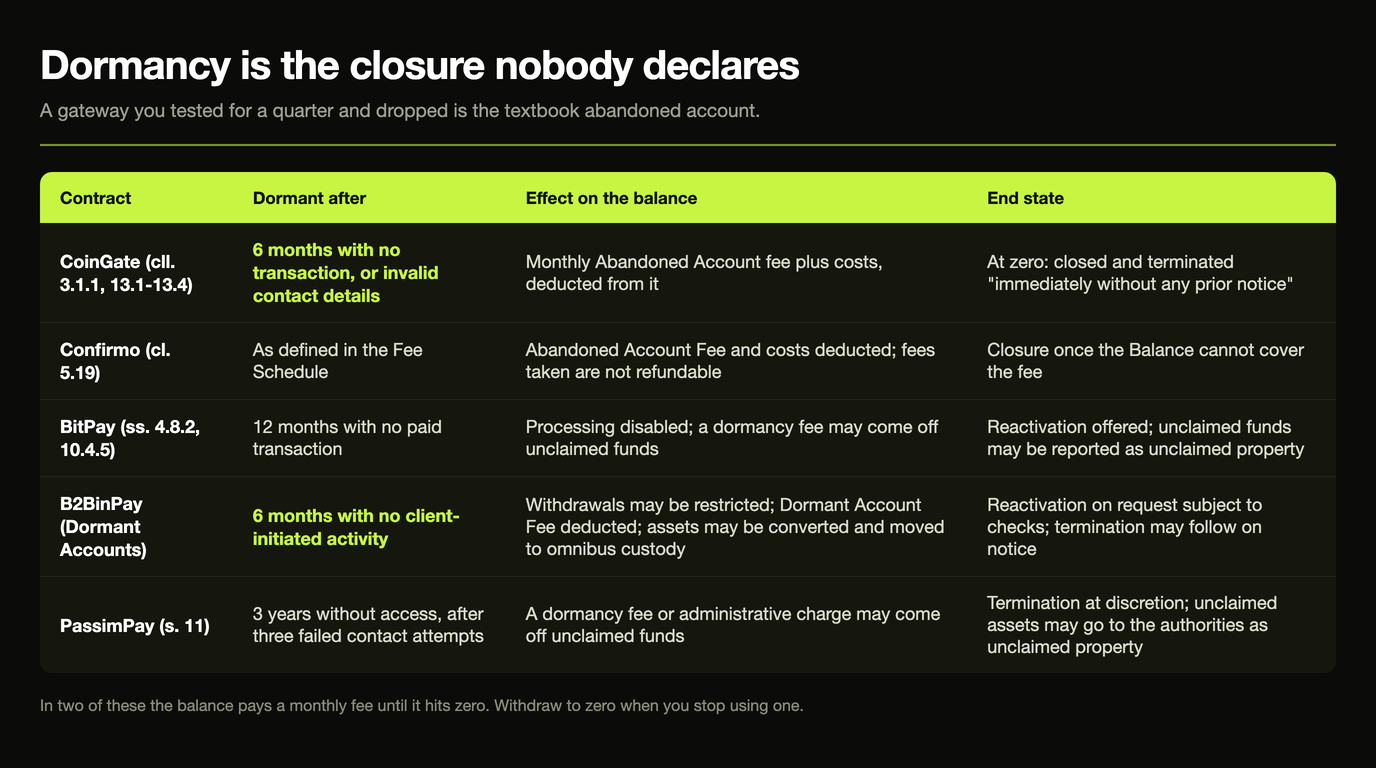
- Five can close you for doing nothing. Dormancy starts at six months on CoinGate and B2BinPay, and B2BinPay's clock resets only when you log in — not when your customers pay.
- Three let the gateway refuse your own closure request — Cryptomus where it conflicts with "the Platform's internal policies", BlockBee and PassimPay while an investigation is open.
Your gateway emails you that the account is closed. The dashboard still shows a balance. The question nobody asks before signing is the only one that matters at that moment: is there a clause anywhere in the contract obliging them to send it to you? That is what crypto gateway account closure turns on, and it is not the clause people read.
The stakes are the balance, not a fee: a merchant settling weekly on $60,000 a month carries roughly $14,000 on the platform at any moment. And the card-processing answer everyone quotes — a 90 to 180 day reserve, then a payout — does not transfer. Reserves exist because cardholders reverse payments, and nobody reverses a confirmed on-chain payment. A hold here is not a chargeback buffer. It is discretion.
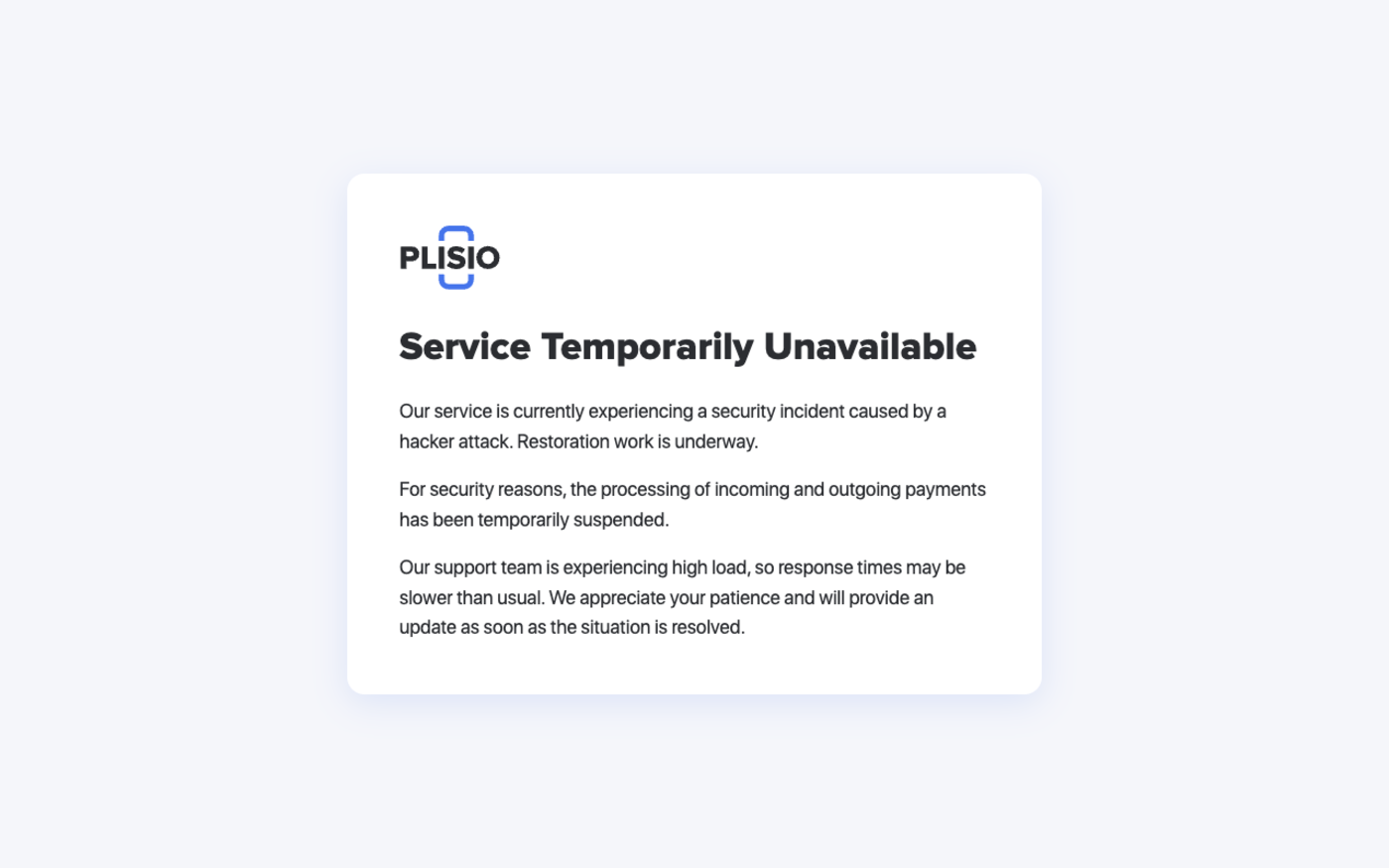
So we read the termination, suspension, dormancy and closure clauses in the merchant terms of the same twelve hosted gateways we used for the fee-change comparison and the liability caps comparison, on 7 November 2026. Eleven were readable. The twelfth, Plisio, had taken its site down behind a security-incident notice that suspends outgoing payments — this article's subject arriving while we wrote it, and set out below with exactly what we did and did not verify.
Crypto gateway account closure: twelve contracts, side by side
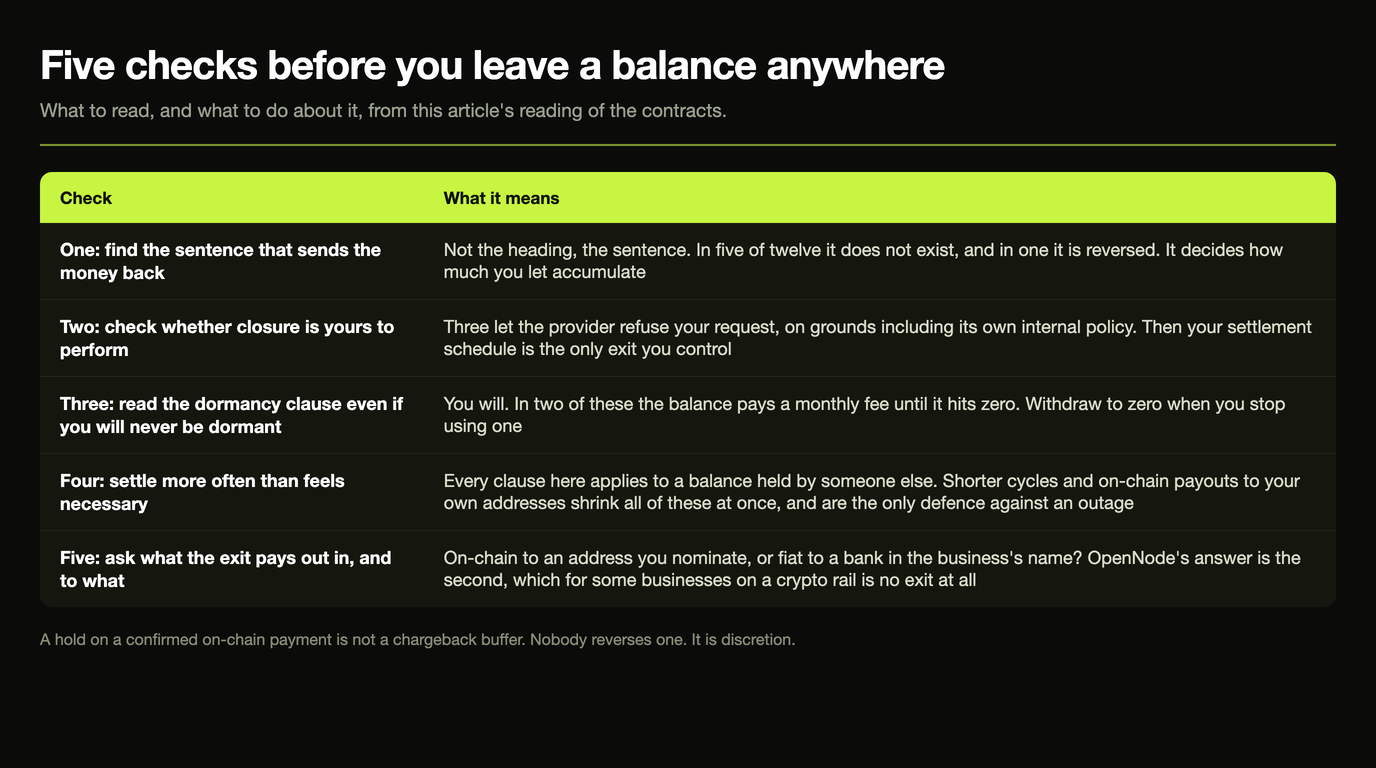
Read the fourth column first. Five of its twelve rows have nothing to put there and one has the opposite — and that clause is missing rather than unfavourable: a termination section can be three paragraphs long, perfectly clear, and never mention your money.
| Gateway (entity) | Notice before they close you | Notice you give | Clause obliging return of your balance? |
|---|---|---|---|
| CoinGate (UAB "Decentralized") | 10 calendar days (cl. 27.2) | 1 month (cl. 27.6) | No — cl. 27.7(iii) remits fees due, not your balance |
| BitPay (BitPay, Inc. / B.V.) | None — "immediately suspend or close" (s. 4.8.2) | None; any time | Yes — "we will remit … funds not yet paid to you" (s. 4.8.1) |
| Confirmo (Confirmo Ltd, Ireland) | 30 days (cl. 17.4) | None; any time | Yes — will "process any permitted withdrawals/Settlements of your Balance" (cl. 17.6(b)) |
| Triple-A (Triple-A Technologies) | 30 days, not before the initial term ends (cl. 3.3) | 30 days — the only mutual clause | None express; may withhold settlement for investigations (cl. 3.7(b)) |
| NOWPayments (FD Transfers LLC) | None — "for any or no reason", and "shall not give reasons" (s. 18.2) | Not stated | No — s. 18 is silent on your funds; may cancel withdrawal rights on suspected hacking (s. 1.8) |
| OpenNode (OpenNode, Inc.) | "Upon notice", no day count; breach revokes access automatically (s. 8) | None; any time | Yes, as fiat only — you supply a bank account, OpenNode converts (s. 8) |
| Cryptomus (no entity named) | None — "without prior notice" (cl. 12.2) | Request only; may be refused (cl. 9.5) | The opposite — cl. 5.18: "no obligation to return Digital Assets" |
| B2BinPay (El Salvador S.A. de C.V.) | 30 days, plus immediate-effect causes | Request plus a verification step | Yes, twice — payouts "remain active" after termination, and it will "return any remaining funds" |
| BlockBee (Blockbee Inc., Panama) | Email notice with "an explanation"; no day count | Any time; refusable during an inquiry | None — it forwards rather than holds, so no balance clause exists |
| PassimPay (NILESPAY FINANCE INC.) | "By giving notice", no day count (s. 11) | None — you close by withdrawing all balances | Yes — "will be delivered to you", but only "if the Digital Assets can be recovered and returned at all", and a 10% fee applies after 30 days (s. 11) |
| Blockonomics (OneByZero Tech) | None — "immediate effect … without notice" | None; any time | Not applicable — users "self custody digital assets" |
| Plisio | Not assessable on 7 November 2026 — the whole site, including its terms document, serves a security-incident notice and outgoing payments are suspended. See below. | ||
Five contracts carry an obligation, and not the five the marketing would suggest: B2BinPay, with the most generous exit clause here, charges an onboarding fee and runs a KYB process, while two of the contracts silent on your money are no-KYC options chosen precisely to stay at arm's length. That is the trade nobody prices — the lighter the onboarding, the thinner the exit clause, because both measure how much of a relationship the gateway has agreed to have with you.
Cryptomus disclaims the clause it headed "Return of Assets"
Clause 5.18 of the Cryptomus Terms of Use, last updated 17 August 2026, is titled Return of Assets. A merchant scanning for the clause that protects the balance would stop on that heading. It reads:
"In the event of Account and/or Virtual Card suspension, restriction, or blocking due to violations of these Terms, suspected Prohibited Activity, or in compliance with legal or regulatory obligations, the Platform shall have no obligation to return Digital Assets or funds held therein."
It then asks you to acknowledge that "returns may be partial, delayed, or entirely impossible", that "any related losses are borne solely by the User", and that the Platform is not liable for the damages.
The trigger is the part to read twice. It is not a finding of wrongdoing but "suspected Prohibited Activity" — suspected by the Platform, under a list the Platform writes, with no stated process for testing the suspicion and no limit on how long it lasts. Clause 12.2 permits suspension without notice for, among other things, an "audit, review, or investigation".
Two neighbours tighten it. Clause 9.6 lets the Platform liquidate, withhold, deduct or convert your assets "without prior notice and without any liability". Clause 9.5 lets it refuse to close your account where that conflicts with the Platform's internal policies — a document you have not read and cannot cite.
Four put a number on the notice, and one runs backwards
| Contract | They give you | You give them | Favours |
|---|---|---|---|
| CoinGate (cll. 27.2 / 27.6) | 10 calendar days | 1 month | The gateway, about 3 to 1 |
| Confirmo (cll. 17.4 / 17.5) | 30 days | None required | The merchant |
| Triple-A (cl. 3.3) | At least 30 days | At least 30 days | Neither — the only mutual clause |
| B2BinPay | 30 days | None required | The merchant |
| Stripe, for comparison (cl. 13.6) | 30 days | None required | The merchant |
CoinGate is the interesting one, and not because ten days is short — ten days of warning beats seven of these eleven contracts. It is interesting because the same document asks you for three times as much. Clause 27.2 lets CoinGate end the agreement on not less than ten calendar days' emailed notice; clause 27.6 lets you end it on one month's. A merchant who wants out on a Monday is contractually still a merchant into the following month, still carrying the balance, still inside clause 15.7's right to suspend a withdrawal "for a certain period of time".
Triple-A deserves credit the headline numbers hide: thirty days each way, in one clause, is the only genuinely bilateral termination provision in any of these documents. The catch sits in the same sentence — notice cannot take effect before the initial term expires, and that term is years.
The Stripe row is there because the card-rails comparison everyone cites does not survive a read. Those pages quote a 90-to-180-day post-termination hold. The Stripe Services Agreement (28 September 2026) gives the same 30 days' notice as the best three here (cl. 13.6) — but clause 10.2, "Effect of Termination", never mentions returning the balance, and the Reserve it defines as collateral Stripe "holds and controls" carries no release period. That figure is the card-network dispute window, not a contractual term. So four of these eleven match Stripe on notice, and five beat it on the duty to return your balance.
OpenNode returns your bitcoin as fiat, into a bank account
OpenNode has the most specific post-closure payout mechanic in the set, and the one most likely to surprise the merchant who chose it. Section 8 says that if you have cryptocurrency assets linked to the account you shall provide OpenNode a valid bank account number promptly following termination. Within a reasonable time, OpenNode converts your holdings to fiat and deposits that, less fees, and may require proof you own the account.
Read what that asks. A Bitcoin-native processor, chosen in many cases precisely so a business need not put a bank in the settlement path, makes the bank the only exit. There is no option to receive the balance on-chain, and no second branch for a business that cannot produce a bank account in its own name — the ordinary reason a merchant is on a crypto rail at all.
It is also undated: "within a reasonable time" is the whole deadline, and conversion happens at whatever rate applies then, leaving the exchange-rate risk with you. Against that, clause 15.4 is the bluntest sentence in any of these documents — your account "may be wholly and permanently unrecoverable and unusable", and OpenNode "will not contest any legal process on your behalf".
This is no claim that OpenNode behaves badly — only that the exit it wrote down is a fiat exit, worth knowing the week you integrate rather than the week you leave.
Dormancy is the closure nobody declares
Every clause so far needs someone to make a decision. Dormancy needs nobody. Five of the twelve can close an account — and in three cases erode the balance inside it — because the merchant stopped doing anything. That is the ordinary end state of a gateway a business tried and moved on from with a few hundred dollars still on it.
| Contract | Dormant after | Effect on the balance | End state |
|---|---|---|---|
| CoinGate (cll. 3.1.1, 13.1–13.4) | 6 months with no transaction, or invalid contact details | Monthly Abandoned Account fee plus costs, deducted from it | At zero: closed and terminated "immediately without any prior notice" |
| Confirmo (cl. 5.19) | As defined in the Fee Schedule | Abandoned Account Fee and costs deducted; fees taken are not refundable | Same mechanism — closure once the Balance cannot cover the fee |
| BitPay (ss. 4.8.2, 10.4.5) | 12 months with no paid transaction | Processing disabled; a dormancy fee may come off unclaimed funds | Reactivation offered; unclaimed funds may be reported as unclaimed property |
| B2BinPay (Dormant Accounts) | 6 months with no client-initiated activity | Withdrawals may be restricted; Dormant Account Fee deducted; assets may be converted and moved to omnibus custody | Reactivation on request subject to checks; termination may follow on notice |
| PassimPay (s. 11) | 3 years without access, after three failed contact attempts | A dormancy fee or administrative charge may come off unclaimed funds | Termination at discretion; unclaimed assets may go to the authorities as unclaimed property |
B2BinPay's definition is the most precise and the most counter-intuitive. Inactivity means six continuous months with no activity initiated by the client — a login, an invoice, a withdrawal, a settings change — and then, expressly, that deposits from your end users "do not prevent or reset Inactivity". A shop still quietly taking crypto through an old deposit address, with nobody logging in, accrues inactivity the whole time its balance grows.
CoinGate and Confirmo share the other mechanism in nearly identical wording: a monthly fee against a balance you are not watching, and closure without notice the moment the fee can no longer be paid. Neither caps the total taken, because the process ends when the money runs out.
One thing we could not verify: neither fee amount is published where the contract says it is. CoinGate's clause 13.1 sets the fee "as indicated on our Website"; its pricing page, read on 7 November 2026, lists a 1% processing fee and the words "No monthly fees", with no abandoned-account figure on it. Confirmo's clause 5.19 points at a Fee Schedule that "forms part of the Agreement". If you are leaving a balance on either, ask support for the number in writing.
PassimPay charges 10% to hand back what is left
PassimPay is the only contract here that prices the exit as a percentage. Section 11 says you close by withdrawing all balances, and that the balance goes to the address you nominate, less what you owe and the network fee. Normal enough. The next sentence is not:
"If you fail to claim and remove Digital Assets in your Account within 30 days of your Account's closure date, a recovery and return fee equal to ten percent (10%) of all the Digital Assets in your Account will be charged by us".
Thirty days is a short clock for an event you may not have chosen, and the same section controls both ends: PassimPay may require identity verification before permitting a withdrawal after it closes you, and may refuse your closure request while an investigation is pending. A merchant can sit inside a 30-day window it did not start, gated on a verification step with no stated turnaround.
Two qualifications travel with that obligation, in the same sentence as the fee: assets come back only "if the Digital Assets can be recovered and returned at all", and PassimPay "reserve[s] the right in our sole discretion to not attempt to recover and return to you small amounts" — a discretion not to bother below an unstated threshold.
Section 06 covers crypto it holds that cannot be returned: a three-month holding period, then the unclaimed amount is debited to "a designated internal wallet", and after the statutory limitation period it is "considered unrecoverable and transferred to the company's balance". The only clause in the set that writes the final destination down.
What crypto gateway account closure looks like from outside the contract
We had this article half-written when the twelfth contract stopped being readable — which illustrates the gap between a clause and an outcome better than we could have arranged.
At 18:23 UTC on 7 November 2026, plisio.net began serving a single notice in place of its entire site: the service "is currently experiencing a security incident caused by a hacker attack", restoration work is underway, and — the line that matters here — "for security reasons, the processing of incoming and outgoing payments has been temporarily suspended". We read it at 18:41 UTC and recorded the last-modified header.
We verified the notice, its timestamp, and that the terms document our earlier comparison cited now 404s, as do the pricing and documentation paths. We assert nothing about scale, cause, whether merchant balances are affected, or what any merchant will recover; there was no third-party reporting eighteen minutes in. Treat it as the company's own first statement and watch its channels, not ours.
The point here is narrower, and it is not a prediction. Every withdrawal in these contracts is a request to a running service. The strongest return-of-balance clause in the set binds a company whose API has to be answering for you to use it — and three of these contracts reserve the right to suspend withdrawals on exactly the grounds a breach presents: NOWPayments may "cancel withdrawal rights" where hacking is suspected (s. 1.8), CoinGate may suspend one "for a certain period of time" (cl. 15.7), and Cryptomus may suspend withdrawals to resolve "technical or other incidents".
So the clause that protects you during an incident is the one that keeps the balance small — which is the case for the models holding nothing. Blockonomics' terms describe an app letting merchants "self custody digital assets"; BlockBee forwards rather than holds; BTCPay Server puts no operator in the chain. None has a return-of-balance clause, and none needs one.
Five checks before you leave a balance anywhere
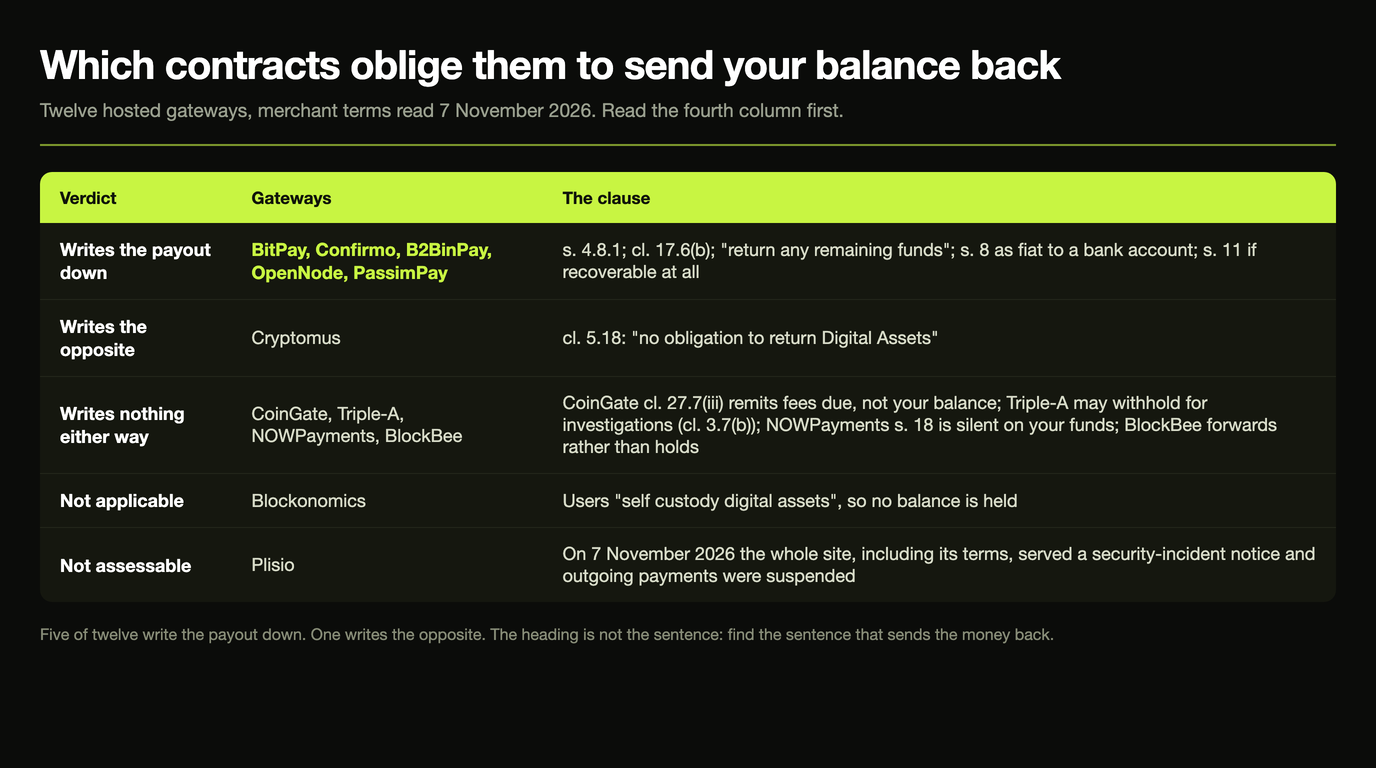
One: find the sentence that sends the money back. Not the heading — the sentence. In five of twelve it does not exist, and in one it is reversed. Not a dealbreaker, but it decides how much you let accumulate.
Two: check whether closure is yours to perform. Three let the provider refuse your request, on grounds including its own internal policy. Where that is so, your settlement schedule is the only exit you control.
Three: read the dormancy clause even if you will never be dormant. You will. A gateway you tested for a quarter and dropped is the textbook abandoned account, and in two of these the balance pays a monthly fee until it hits zero. Withdraw to zero when you stop using one.
Four: settle more often than feels necessary. Every clause here applies to a balance held by someone else, so shorter cycles and on-chain payouts to your own addresses shrink all of these exposures at once — and are the only defence against an outage.
Five: ask what the exit pays out in, and to what. On-chain to an address you nominate, or fiat to a bank in the business's name? OpenNode's answer is the second, which for some businesses on a crypto rail is no exit at all. Ask in writing before you integrate — and ask about the compliance hold that can sit on top of it.
- Crypto Gateway Fee Changes 2026: One Gives 30 Days
- Crypto Gateway AML Holds 2026: Nobody Says How Long
- Crypto Gateway Liability Caps 2026: $100 to $50,000
- Crypto Gateway Dispute Resolution 2026: We Read 12
- Crypto Gateway Indemnity 2026: Yours Has No Cap
- No-KYC Crypto Payment Gateways: What You Trade Away
Five of these twelve contracts contain no clause obliging anyone to send your balance back, and one says it need not.
We read fees, custody, KYC and contract terms for every processor in the directory. B2BinPay keeps payouts live after termination; Confirmo commits to process your withdrawals and gives 30 days' notice; BTCPay Server never holds the balance at all.
Compare Crypto Payment Gateways →Affiliate disclosure: Payyd earns a commission if you sign up to some providers linked on this page. It changes none of the clauses or findings reported here, all of which come from the providers' own published documents and are linked below.
FAQ
What happens to my balance when a crypto payment gateway closes my account?
It depends on whether the contract obliges the gateway to send it to you, and five of twelve do not. BitPay, Confirmo, B2BinPay and PassimPay commit to releasing the balance, and OpenNode converts it to fiat and pays your bank. Cryptomus states the opposite in clause 5.18. The rest are silent, so the payout rests on policy rather than a term you can enforce.
How much notice does a crypto payment gateway have to give before closing my account?
Four of twelve state a number: CoinGate not less than 10 calendar days (cl. 27.2), and Confirmo, Triple-A and B2BinPay 30 days each. The other seven readable contracts allow closure with no notice at all, and all eleven have a for-cause clause permitting immediate action — so a stated period governs only termination for convenience.
Can a crypto payment gateway refuse to let me close my account?
Three can. Cryptomus clause 9.5 lets the platform refuse where closure conflicts with legal requirements, regulatory orders or its own internal policies. BlockBee may deny a request while an inquiry is open, and PassimPay adds that it may hold your assets to protect itself against legal liability.
Can a crypto gateway keep my funds if it suspects something?
Cryptomus writes that it can: clause 5.18 is triggered by "suspected Prohibited Activity", not a finding. Others stop short but can delay indefinitely — CoinGate may suspend a withdrawal "for a certain period of time", Triple-A may withhold settlement for investigations. None of the twelve caps how long a hold may last.
What is a dormant crypto gateway account, and can it cost me money?
Yes, and in two cases the whole balance. CoinGate treats an account as abandoned after six months with no transaction, then charges a monthly fee against it; once the balance cannot cover the fee it is closed without notice. Confirmo's clause 5.19 works the same way. B2BinPay goes dormant after six months with no client-initiated activity — your customers' payments do not reset that clock.
Is it safer to use a non-custodial crypto payment gateway?
For this risk the question stops applying. Blockonomics' terms describe an app whose users self-custody their assets, BlockBee forwards rather than holds, and BTCPay Server has no operator in the chain. None can strand a balance it never holds. You trade away hosted conversion, fiat settlement and support — but it removes the one exposure no clause here covers.
My gateway has suspended withdrawals during an incident. What does the contract say?
Usually that it may. NOWPayments may cancel withdrawal rights where hacking is suspected (s. 1.8); Cryptomus may suspend withdrawals to resolve technical incidents; CoinGate may suspend one for an unspecified period. None promises a timetable for restoring withdrawals, and none makes the gateway liable for losses during a suspension.
Sources
Termination, suspension, closure and dormancy clauses, read 7 November 2026:
- CoinGate Merchant Terms of Service — cll. 13.1–13.4, 15.7, 27.2–27.11
- CoinGate Pricing and Service Fees — checked for the cl. 13.1 Abandoned Account fee; not listed
- BitPay Merchant and Donee Terms of Use — ss. 4.8, 10.4.5, 13.7
- Confirmo Limited Terms and Conditions (PDF) — cll. 5.19, 17.2–17.7
- Triple-A General Terms and Conditions — cll. 3.3–3.7
- NOWPayments Terms of Service (PDF) — ss. 1.8, 8.3–8.9, 18.1–18.5; FD Transfers LLC
- OpenNode Terms and Conditions — ss. 8, 9, 15.4
- Cryptomus Terms of Use — 17 August 2026; cll. 5.18, 9.5–9.6, 12.2
- B2BinPay Terms of Use — Dormant Accounts, Suspension and Termination
- BlockBee Terms and Conditions — effective 2 October 2026; Blockbee Inc., Panama
- PassimPay Terms of Service — ss. 06 and 11; NILESPAY FINANCE INC.
- Blockonomics Terms of Service — Termination; OneByZero Tech Pte Ltd
- plisio.net security-incident notice — read 18:41 UTC on 7 November 2026,
last-modified18:23 UTC the same day - Stripe Services Agreement — 28 September 2026; cll. 10.2, 13.6
- Authorize.net Payment Gateway Merchant Services Agreement — s. 8.3, cl. 14.4