
Crypto Gateway Assignment 2026: None Needs Your Consent
Crypto gateway assignment clauses, read across 13 merchant contracts in November 2026: not one needs your consent before your contract can be sold on.
 Brian Ormond
Key Takeaways
- Crypto gateway assignment clauses run one way. Not one of the eleven readable merchant contracts needs your consent to hand your agreement to somebody else, and every one of them forbids you from assigning yours without written permission. The asymmetry is unanimous; only the wording varies.
- Cryptomus is the only contract that says out loud what happens to your balance. Clause 14.1 transfers the account, "digital assets and other funds", rights, obligations and data to a buyer "without additional notice… and without the need for separate consent"; cl. 14.3 disclaims liability for the acquirer's acts and for any change in rates or functionality.
- Three of eleven promise to tell you at all. Confirmo cl. 23.1 says it "will notify you"; CoinGate cl. 28.11 informs you within 10 business days after the assignment has happened; nobody else commits to notice, and PassimPay, B2BinPay and Cryptomus expressly rule it out.
- The only merchant veto in the set belongs to Stripe customers in three jurisdictions. Its UK, Switzerland and Gibraltar term cl. 13.3 bars Stripe from novating to a non-affiliate without the user's prior written consent. Under cl. 11.10, which governs everywhere else including the EEA and the US, no consent is needed; only Australia and New Zealand get prior notice.
- Two clauses limit who the buyer can be: OpenNode may assign only to a party "that assumes OpenNode's obligations", and Triple-A's cl. 17.3 requires that the transfer "does not materially prejudice the Merchant's rights". BlockBee has no assignment clause in any of its nineteen sections, and Blockonomics may "freely assign or transfer these Terms without restriction".
Your gateway gets bought. The dashboard looks the same on Monday, the API keys still work, and the company on the other side of your merchant agreement is now somebody you never signed with — holding whatever balance was in your account when the deal closed. The clause that permits all of that is crypto gateway assignment, it is usually two sentences long, and it sits under Miscellaneous between Severability and Waiver where nobody reads it.
The stakes are not theoretical this year: Mastercard completed its acquisition of BVNK, a stablecoin payments provider in this directory, on 3 August 2026. A merchant settling weekly on $60,000 a month carries roughly $14,000 on a platform at any moment, and this clause decides whether that float, the fee schedule it was earned under and the custody behind it can change hands without a word to you. We read the assignment, novation and transfer clauses in the merchant terms of twelve hosted crypto gateways on 11 November 2026, and added Stripe and Authorize.net for contrast. Eleven gateways were readable. Not one needs your consent, and three promise to tell you afterwards.
These are the same twelve contracts we read for the account closure comparison and the force majeure comparison. The twelfth, Plisio, is still serving the security-incident notice that has stood since before our last two readings, with incoming and outgoing payments suspended, so its terms could not be opened again tonight.
Thirteen contracts, side by side
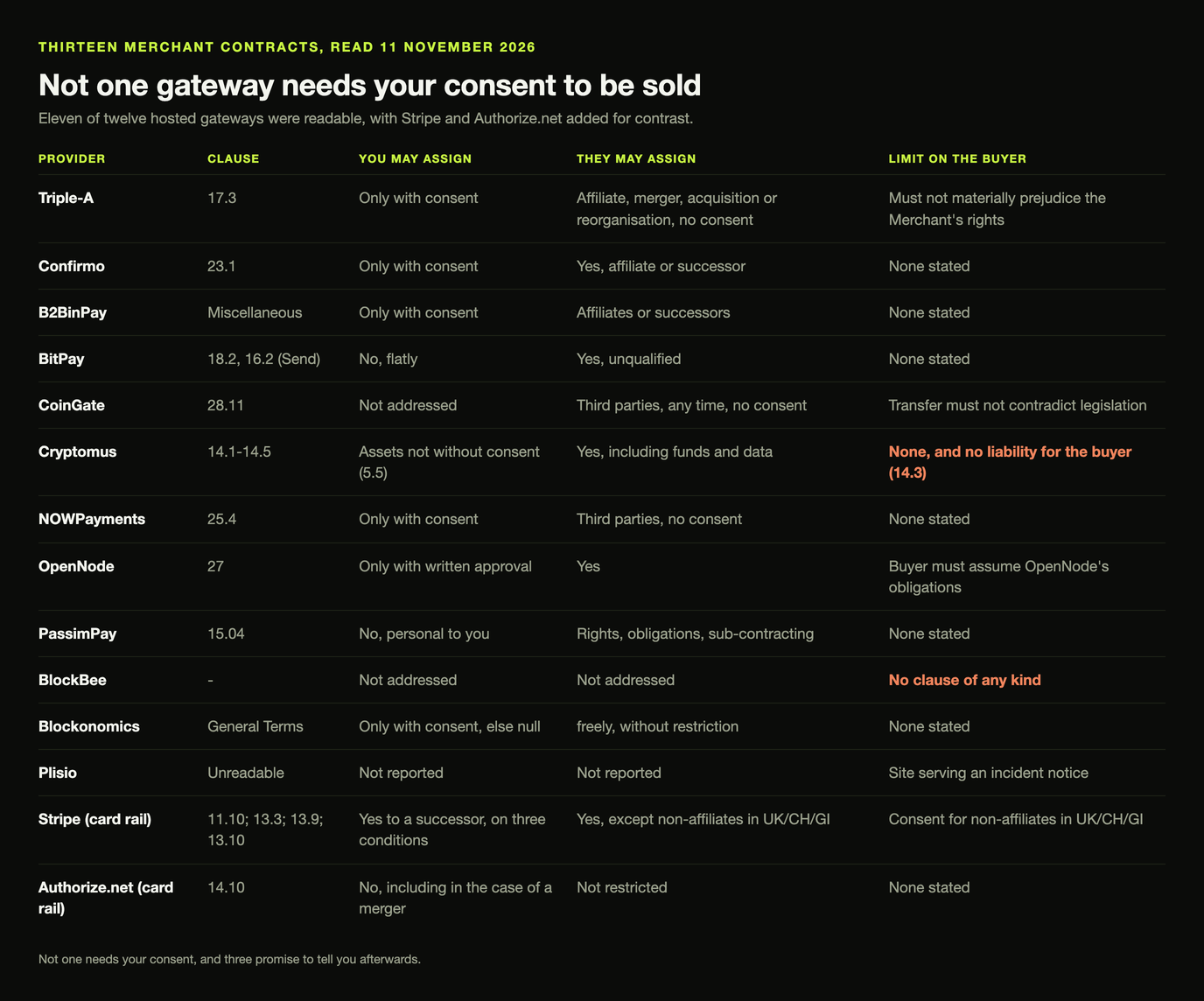
An assignment clause answers four questions, and the market answers them in a consistent order. May the merchant transfer the agreement? May the provider? Does anyone have to be told? And is there any limit on who the new counterparty can be, or on what moves with the contract?
Eleven of thirteen readable documents answer the first with no, the second with yes, the third with nothing, and the fourth with silence.
| Provider | Clause | You may assign | They may assign | Limit on the buyer |
|---|---|---|---|---|
| Triple-A | 17.3 | Only with consent | Affiliate, merger, acquisition or reorganisation, no consent | Must not "materially prejudice the Merchant's rights" |
| Confirmo | 23.1 | Only with consent | Yes, affiliate or successor | None stated |
| B2BinPay | Assignment, under Miscellaneous | Only with consent | Affiliates or successors | None stated |
| BitPay | 18.2 (merchant), 16.2 (Send) | No, flatly | Yes, unqualified | None stated |
| CoinGate | 28.11 | Not addressed | Third parties, any time, no consent | Transfer must not contradict legislation |
| Cryptomus | 14.1–14.5 | Assets not without consent (5.5) | Yes, including funds and data | None, and no liability for the buyer (14.3) |
| NOWPayments | 25.4 | Only with consent | Third parties, no consent | None stated |
| OpenNode | 27 | Only with written approval | Yes | Buyer must assume OpenNode's obligations |
| PassimPay | 15.04 | No, "personal to you" | Rights, obligations, sub-contracting | None stated |
| BlockBee | — | Not addressed | Not addressed | No clause of any kind |
| Blockonomics | General Terms | Only with consent, else "null" | "freely", "without restriction" | None stated |
| Plisio | Unreadable | Not reported | Not reported | Site serving an incident notice |
| Stripe (card rail) | 11.10; 13.3 UK/CH/GI; 13.9 AU; 13.10 NZ | Yes to a successor, on three conditions | Yes, except to non-affiliates in UK/CH/GI | Consent required for non-affiliates in UK/CH/GI |
| Authorize.net (card rail) | 14.10 | No, "including in the case of a merger" | Not restricted | None stated |
Read down the third and fourth columns and the pattern is the whole story. Your side of this contract is personal, non-transferable and conditional on permission; their side is an asset they can sell. That is not unique to crypto, but crypto is where the counterparty also holds your money.
The one-way street, and the two clauses that narrow it
Two of the eleven put a condition on the buyer rather than on the merchant, and they are worth naming because they cost the provider almost nothing and would have saved real money in other industries.
OpenNode, in s. 27 of its Additional Terms: "OpenNode may assign this Agreement to any party that assumes OpenNode's obligations hereunder." Six words of qualification — that assumes OpenNode's obligations — and they mean the thing you are left holding is still a contract rather than a cheerful welcome email from a company that bought the customer list.
Triple-A, at cl. 17.3, allows assignment to an affiliate or "in connection with a merger, acquisition, or corporate reorganisation" without the merchant's consent, "provided that such assignment does not materially prejudice the Merchant's rights". It is a softer standard than OpenNode's and harder to invoke in a hurry, but it is the only clause in the set that makes the merchant's position a condition of the transfer at all.
Everyone else in the crypto set writes it bare. BitPay cl. 18.2 is the shortest: "You may not transfer or assign these Terms or any rights granted by these Terms. You agree and acknowledge that we may assign or transfer these Terms." The identical pair appears at cl. 16.2 of the BitPay Send Terms. Blockonomics is blunter still: an attempt by you to assign "will be null", while "we may freely assign or transfer these Terms without restriction".
Cryptomus wrote five clauses for the day it is sold
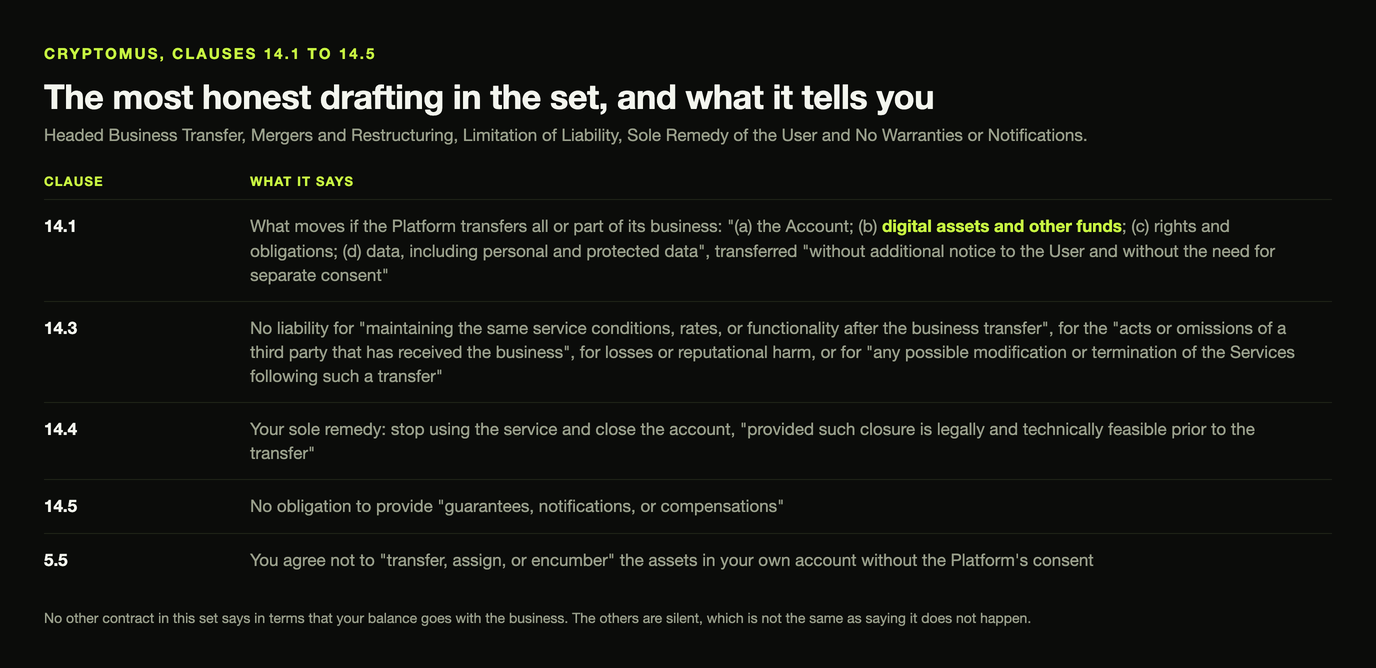
Most of these contracts handle assignment in two sentences. Cryptomus devotes a numbered section to it — cll. 14.1 to 14.5, headed Business Transfer, Mergers and Restructuring, Limitation of Liability, Sole Remedy of the User and No Warranties or Notifications — and it is the most honest drafting in the set, in the sense that it tells you exactly how little you are owed.
Clause 14.1 lists what moves if the Platform transfers all or part of its business: "(a) the Account; (b) digital assets and other funds; (c) rights and obligations; (d) data, including personal and protected data", and anything else needed, "fully or partially transferred to a third party without additional notice to the User and without the need for separate consent". No other contract in this set says in terms that your balance goes with the business. The others are silent, which is not the same as saying it does not happen.
Then cl. 14.3 removes the consequences. Cryptomus is not liable for "maintaining the same service conditions, rates, or functionality after the business transfer", for the "acts or omissions of a third party that has received the business", for losses or reputational harm arising from the transfer, or for "any possible modification or termination of the Services following such a transfer". Clause 14.4 names your sole remedy if you disagree: stop using the service and close the account, "provided such closure is legally and technically feasible prior to the transfer". Clause 14.5 confirms there is no obligation to provide "guarantees, notifications, or compensations".
Set that beside cl. 5.5 of the same document, where the user agrees not to "transfer, assign, or encumber" the assets in their own account without the Platform's consent, and the shape is complete: your funds are yours to hold and theirs to move. We rate Cryptomus poorly on custody in our Cryptomus gateway profile for reasons that have nothing to do with this clause, and this is one more of them.
Who promises to tell you, and when
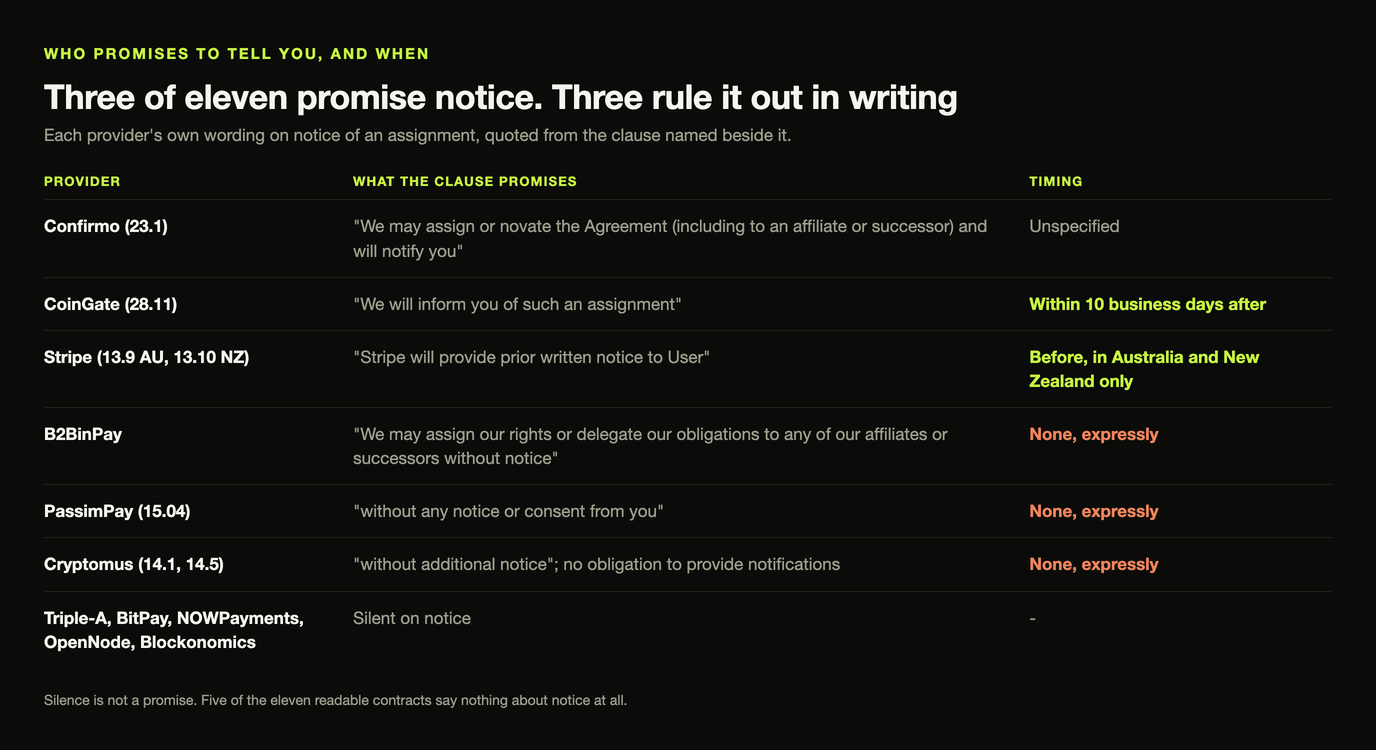
Notice is the cheapest merchant protection in contract drafting and the one most often left out. Three of eleven crypto gateways commit to it in any form.
| Provider | What the clause promises | Timing |
|---|---|---|
| Confirmo (23.1) | "We may assign or novate the Agreement (including to an affiliate or successor) and will notify you" | Unspecified |
| CoinGate (28.11) | "We will inform you of such an assignment" | Within 10 business days after the assignment |
| Stripe (13.9 AU, 13.10 NZ) | "Stripe will provide prior written notice to User" | Before, in Australia and New Zealand only |
| B2BinPay | "We may assign our rights or delegate our obligations to any of our affiliates or successors without notice" | None, expressly |
| PassimPay (15.04) | "without any notice or consent from you" | None, expressly |
| Cryptomus (14.1, 14.5) | "without additional notice"; no obligation to provide notifications | None, expressly |
| Triple-A, BitPay, NOWPayments, OpenNode, Blockonomics | Silent on notice | — |
CoinGate's is the interesting one, because it is a real commitment pointed the wrong way. Clause 28.11 reserves the right to assign "at any time without your consent if such transfer of rights and obligations does not contradict the legislation", and then promises to inform you "within 10 (ten) Business Days after the assignment". You will be told. You will be told once the counterparty has already changed, which is useful for your records and useless for a decision.
Stripe's split is the sharpest illustration of how much of this is geography rather than principle. Under the main agreement at cl. 11.10, "Stripe and its Affiliates may assign and transfer its rights and obligations under this Agreement (in whole or in part) without User's consent". Users in the UK, Switzerland and Gibraltar read cl. 13.3 instead: Stripe may move the agreement inside its own group freely, but "may not novate or transfer this Agreement… to any other party without the User's prior written consent, which must not be unreasonably withheld or delayed". Australia and New Zealand get prior written notice. The EEA and the United States get neither. One company, one product, four different answers depending on where you signed up.
When you are the one being acquired
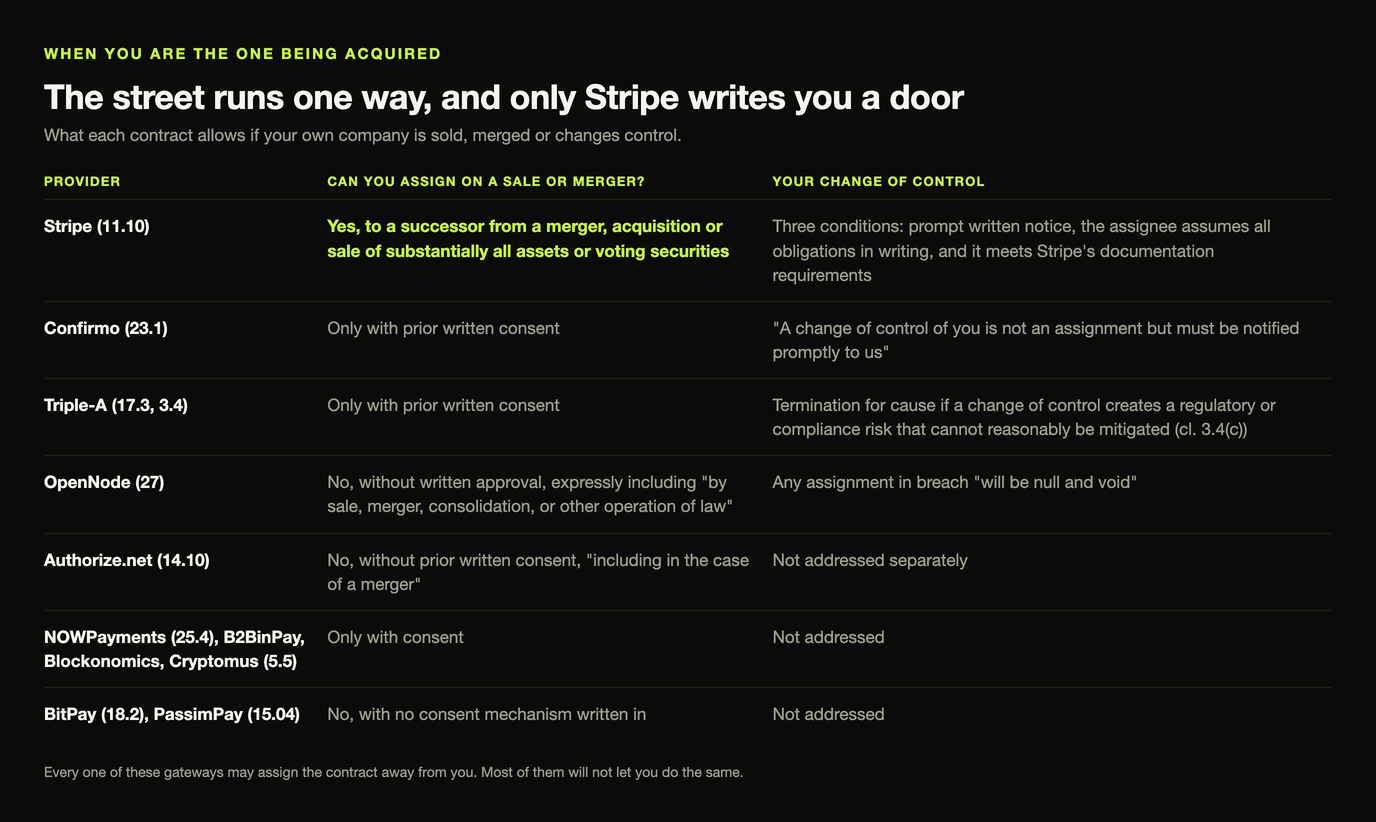
The mirror case gets less attention and bites harder, because it arrives on a deadline. If you sell your business, merge it, or restructure it, the gateway contract usually cannot come along without permission — and your buyer's diligence will ask about payment continuity before it asks about almost anything else.
| Provider | Can you assign on a sale or merger? | Your change of control |
|---|---|---|
| Stripe (11.10) | Yes, to a successor from a merger, acquisition or sale of substantially all assets or voting securities | Three conditions: prompt written notice, the assignee assumes all obligations in writing, and it meets Stripe's documentation requirements |
| Confirmo (23.1) | Only with prior written consent | "A change of control of you is not an assignment but must be notified promptly to us" |
| Triple-A (17.3, 3.4) | Only with prior written consent | Termination for cause if a change of control creates a regulatory or compliance risk that cannot reasonably be mitigated (cl. 3.4(c)) |
| OpenNode (27) | No, without written approval — expressly including "by sale, merger, consolidation, or other operation of law" | Any assignment in breach "will be null and void" |
| Authorize.net (14.10) | No, without prior written consent, "including in the case of a merger" | Not addressed separately |
| NOWPayments (25.4), B2BinPay, Blockonomics, Cryptomus (5.5) | Only with consent | Not addressed |
| BitPay (18.2), PassimPay (15.04) | No, with no consent mechanism written in | Not addressed |
Two things fall out of that table. Stripe is the only contract here that engineers the merchant-side case properly, which is what a successor-assignment clause is for. Authorize.net is the strictest on this exact point — it blocks assignment "including in the case of a merger" and places no matching restriction on itself — so the card rail with the better force majeure clause has the worse assignment clause.
And two gateways turn your corporate events into their rights: Triple-A can terminate for cause on your change of control where it creates unmitigable regulatory risk, and Confirmo wants prompt notice of yours while promising only unspecified notice of its own. If a raise, a sale or a holdco restructure is in prospect, both belong on the diligence list beside the liability caps.
Mastercard closed on BVNK in August
This is the year the clause ran in public. Mastercard announced in March 2026 that it would acquire BVNK, a stablecoin payments provider, and its investor release records the completion on 3 August 2026: "Mastercard (NYSE: MA) today completed its acquisition of BVNK". BVNK is in this directory, and nothing about that deal suggests anything went wrong for its customers.
It is still the right case study, for a reason that has nothing to do with Mastercard. We could not read BVNK's merchant agreement to see which clause governed the transfer. The only legal documents linked from bvnk.com are a website terms-of-use article and a privacy policy on its help centre, both of which refused our requests; there is no public merchant agreement URL. So for the one assignment in this market that completed in 2026, a merchant cannot check the clause that moved the contract — the ordinary condition of enterprise-contracted providers, not an exception.
Plisio makes the same point from the other direction. Its terms have been unreadable since its security incident began, with the whole site, legal pages included, serving one notice. Both cases argue for the same habit: keep your own dated copy of the terms you signed, because the copy on the website is the only one most of these providers publish, and it can disappear with the site or be superseded without a diff.
Four checks before you integrate
One: find the assignment clause and read the second sentence. The first sentence always restricts you. The second says what they may do, and the only words that matter are whether a buyer must assume the obligations (OpenNode), whether your rights must not be materially prejudiced (Triple-A), and whether anyone will tell you (Confirmo, CoinGate, Stripe in two countries).
Two: check whether your own corporate events need their permission. If a sale or a holdco reshuffle is plausible within the contract term, the clause you want is Stripe's 11.10 successor carve-out, not Authorize.net's 14.10 or OpenNode's s. 27, which both catch mergers expressly. Ask at onboarding, where it is a standard request.
Three: assume your balance travels with the contract. Only Cryptomus says so outright, and silence elsewhere is not a promise to the contrary. Whatever sits in the gateway is exposed, so settle often and withdraw to addresses you control. A non-custodial or forwarding gateway removes the question: no balance to transfer, often no account to sell.
Four: keep your own dated copy. No deadline in these clauses runs in your favour, so there is nothing to diary — but a dated PDF of the terms, the fee schedule and the custody description as they stood when you signed is the only evidence you will have if a new owner reads the document differently.
- Crypto Gateway Account Closure 2026: Who Keeps Your Balance
- Crypto Gateway Force Majeure 2026: Only One Still Pays
- Crypto Gateway Dispute Resolution 2026: We Read 12
- Crypto Gateway Liability Caps 2026: $100 to $50,000
- Crypto Gateway Customer Data 2026: We Checked 10
- Crypto Gateway Fee Changes 2026: One Gives 30 Days
Eleven of eleven readable crypto contracts can be sold on without asking you.
We read fees, custody, KYC and contract terms for every processor in the directory. Confirmo is the one that pairs a transfer right with a promise to notify you; Triple-A conditions a transfer on not materially prejudicing your rights; BTCPay Server is self-hosted, so there is no account and no balance for anyone to transfer.
Compare Crypto Payment Gateways →Affiliate disclosure: Payyd earns a commission if you sign up to some providers linked on this page. It changes none of the clauses or findings reported here, all of which come from the providers' own published documents and are linked below.
FAQ
Can a crypto payment gateway transfer my merchant agreement without telling me?
On the wording of eight of the eleven readable contracts, yes. Only Confirmo cl. 23.1 and CoinGate cl. 28.11 promise notice, and CoinGate's arrives within 10 business days after the assignment has taken effect. B2BinPay, PassimPay cl. 15.04 and Cryptomus cl. 14.1 rule notice out in terms; Triple-A, BitPay, NOWPayments, OpenNode and Blockonomics simply say nothing about it.
What happens to my balance if my gateway is acquired?
Cryptomus is the only one that answers in its own words: cl. 14.1 transfers "digital assets and other funds" along with the account, rights, obligations and data, without notice or separate consent. Every other contract is silent, which leaves the balance to follow the account under general law. Treat silence as exposure, not protection.
Do I have to consent to my gateway being sold?
No crypto gateway in this set asks for your consent. The only consent requirement we found anywhere is Stripe's regional cl. 13.3 for users in the UK, Switzerland and Gibraltar, which bars Stripe from novating the agreement to a non-affiliate without the user's prior written consent, "which must not be unreasonably withheld or delayed". Stripe users elsewhere, including the EEA and the US, fall under cl. 11.10, which needs no consent.
Can I cancel if I do not like the new owner?
Not under an assignment clause. None of the eleven gives a merchant a termination right triggered by assignment. Cryptomus cl. 14.4 is the only one to address it, and its answer is that your "sole remedy" is to stop using the service and close the account, "provided such closure is legally and technically feasible prior to the transfer". Most of these contracts let you close for convenience anyway.
Can I transfer my gateway account if I sell my business?
Usually only with written permission. OpenNode s. 27 catches assignment "by sale, merger, consolidation, or other operation of law" and makes a breach "null and void"; Authorize.net s. 14.10 blocks it "including in the case of a merger". Stripe cl. 11.10 is the exception, permitting assignment to a successor from a merger or sale of substantially all assets on three conditions.
Does a change of control of my own company affect the contract?
With two providers it does. Confirmo cl. 23.1 says a change of control of you is not an assignment "but must be notified promptly to us". Triple-A cl. 3.4(c) makes a change of control a termination-for-cause ground where it creates a regulatory or compliance risk that cannot reasonably be mitigated. The rest do not address it, so the general assignment restriction is what applies.
Which crypto gateway has the best assignment clause?
OpenNode s. 27, narrowly: requiring the buyer to assume its obligations is the only condition here that protects the merchant automatically rather than on request. Triple-A cl. 17.3 is next on the no-material-prejudice proviso, and Confirmo cl. 23.1 is the only one pairing a transfer right with a promise to tell you. This is one input to a shortlist, not a ranking.
Is any of this unusual for payments contracts?
No, and that is the point worth taking away. One-way assignment is standard platform drafting, and the card rails are no better: Authorize.net restricts the merchant and not itself, Stripe gives a veto in three jurisdictions and nothing in the rest. What is specific to crypto is that the counterparty is usually holding your money while it exercises the clause, so the same boilerplate carries a custody consequence a card processor's does not.
Sources
Assignment, novation and transfer clauses, read 11 November 2026:
- Triple-A General Terms and Conditions — version date 20 April 2026; cll. 3.4, 17.3
- Confirmo Limited Terms and Conditions (PDF) — last updated 2 October 2026; cl. 23.1
- B2BinPay Terms of Use — last updated 26 June 2026; Assignment, under Miscellaneous
- BitPay Merchant and Donee Terms of Use — effective 1 April 2026, cl. 18.2; and BitPay Send Terms of Use, effective 1 January 2022, cl. 16.2
- CoinGate Merchant Terms of Service — v1 06/02/2024; cl. 28.11
- CoinGate Special Terms of Crypto Payouts for Merchants — v1 27/09/2024; no assignment clause
- Cryptomus Terms of Use — last updated 17 August 2026; cll. 5.5, 14.1–14.5
- NOWPayments Terms of Service (PDF) — last updated 19 October 2026; cl. 25.4; FD Transfers LLC
- OpenNode Terms and Conditions — last update 29 August 2024; s. 27 Additional Terms
- PassimPay Terms of Service — last updated 11.05.2026 in the document's own format; s. 15.04
- BlockBee Terms and Conditions — effective 2 October 2026; no assignment or transfer-of-agreement clause in any section
- Blockonomics Privacy Policy and Terms of Service — undated; General Terms (OneByZero Tech)
- plisio.net security-incident notice — the whole site, legal pages included, served this notice when we checked on 11 November 2026; terms not readable and not reported
- Stripe Services Agreement — last modified 28 September 2026; cl. 11.10, plus regional cll. 13.3 (UK, Switzerland, Gibraltar), 13.9 (Australia) and 13.10 (New Zealand)
- Authorize.net Payment Gateway Merchant Services Agreement — s. 14.10
- Mastercard completes acquisition of BVNK — investor news, 3 August 2026
- bvnk.com — checked 11 November 2026: the only legal documents linked are a website terms-of-use article and a privacy policy on its help centre, both of which refused automated requests; no public merchant agreement URL