
Crypto Gateway Fee Changes 2026: One Gives 30 Days
We read the fee-change clause in 12 crypto payment gateway contracts in November 2026. Only one promises 30 days. Ten make your next API call consent.
 Kevin Richards
Key Takeaways
- Twelve merchant contracts govern crypto gateway fee changes with exactly two numeric notice periods between them, at two companies. CoinGate gives 30 calendar days on the terms and none on the fees; BitPay gives 30 days on the fees and no number on the terms.
- NOWPayments writes it down: advance notice of a fee change is "its right, not an obligation" (s. 11.5). OpenNode is blunter — fees "may be subject to change without notice, at any time".
- Ten of the twelve make your next API call the signature. Continued use after a change is express acceptance; CoinGate deems acceptance by silence instead.
- Only two of twelve let you exit because of a change — CoinGate cl. 26.3 and Confirmo cl. 17.2, the only one publishing instructions on how to object.
- The fallback remedy, closing the account, is conditional twice. Cryptomus cl. 9.5 may refuse to close it, and BlockBee may refuse mid-investigation.
You integrated at 1%. The pricing page still says 1%. The question here is narrower and more awkward than "what does it cost": who may move that number, how much warning do you get, and what counts as you agreeing to it? That is the amendment clause, and crypto gateway fee changes live or die by it.
The stakes are the difference between a rate and a quote. A 1% rate that can move to 2% on the day it is posted, with your next API call treated as consent, is not a rate. On a business running $80,000 a month, one unannounced point is $800 you did not budget, and most merchants find out from a settlement that is short.
So we read the amendment and fee clauses in the merchant terms of twelve hosted gateways on 5 November 2026, the same set we used for the liability caps comparison and the dispute resolution comparison. Between them, twelve contracts contain two numeric notice periods. Not two each — two in total, at two companies, on two clauses. Every one is quoted below.
What a fee-change clause actually controls
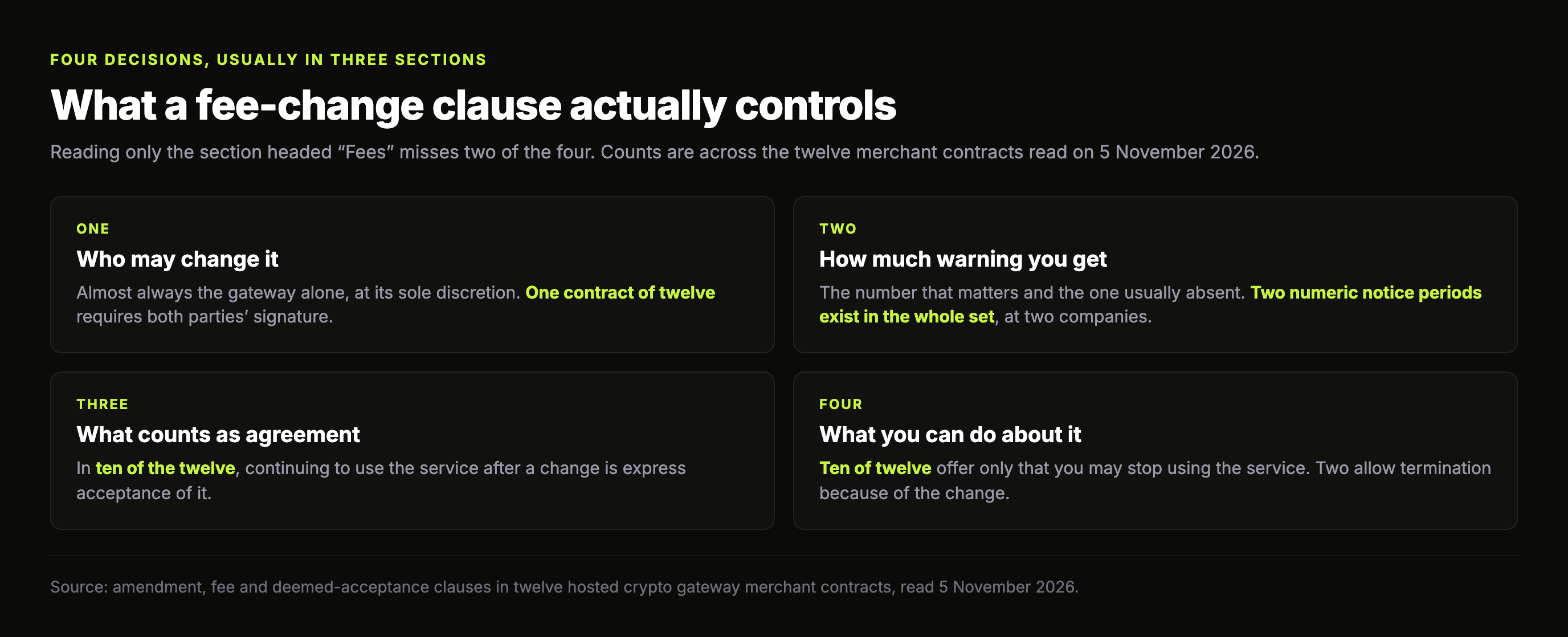
A fee-change clause is four separate decisions, usually scattered across three sections. Reading only the one headed "Fees" misses two of them.
Who may change it. Almost always the gateway alone, at its sole discretion. One contract in this set requires both signatures.
How much warning you get. This is the number that matters and the one usually absent. "We will notify you" without a day count is not a notice period; it is a promise to tell you at a time of the gateway's choosing, which may be the moment the change takes effect.
What counts as agreement. This is the clause merchants never look for. In ten of the twelve, continuing to use the service after a change is express acceptance of it — so the act of taking a payment is the act of signing.
What you can do about it. There is a real difference between a contract that lets you terminate because of a change, inside a defined window, and one whose only answer is that you may stop using the service. Ten of twelve offer the second.
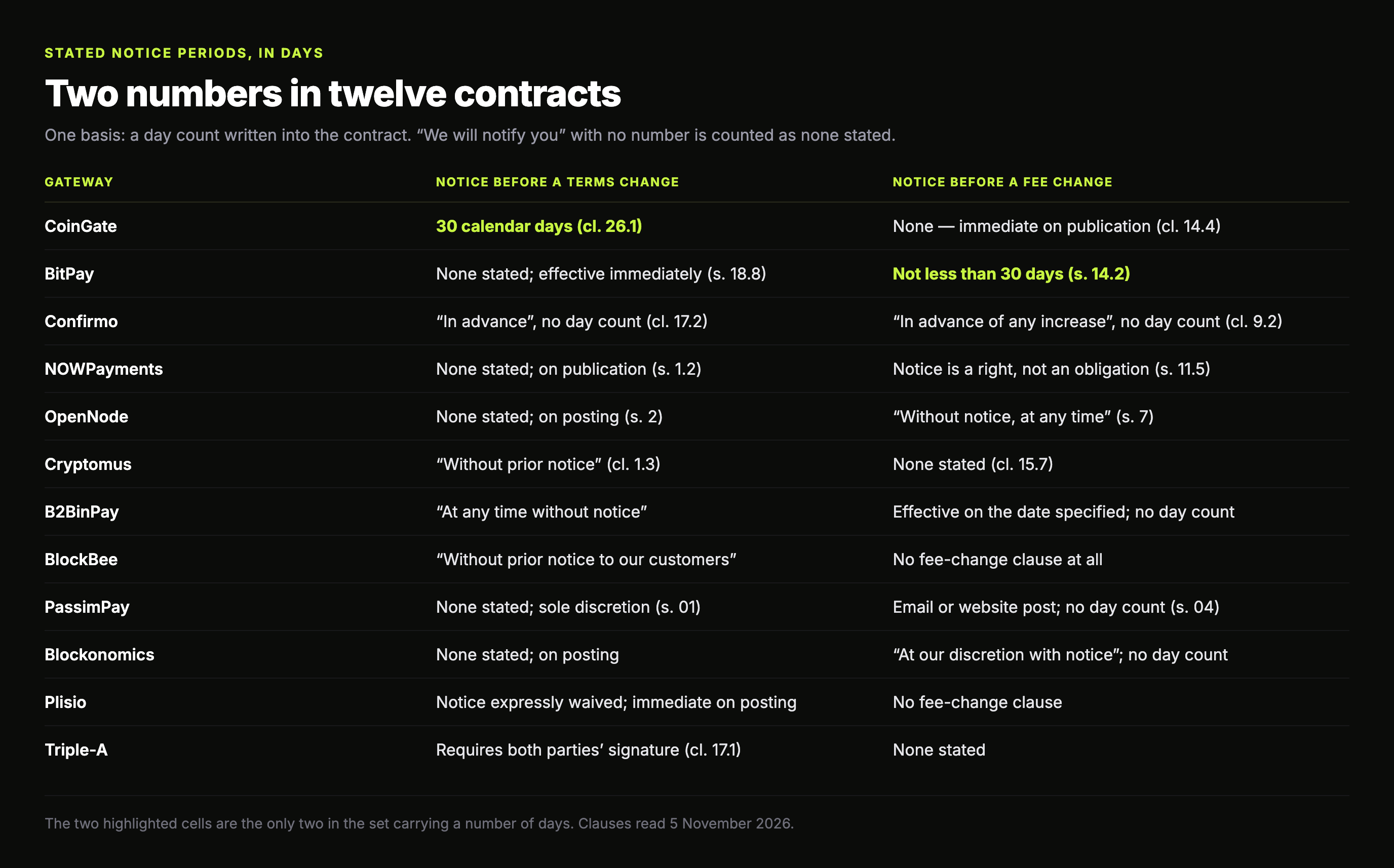
Crypto gateway fee changes: two numbers in twelve contracts
Every contract in the set, with the four decisions side by side. The two cells carrying a number of days are the only two in the table.
| Gateway (contracting entity) | Notice of a change to the terms | Notice of a fee change | Does use equal acceptance? | Can you exit because of the change? |
|---|---|---|---|---|
| CoinGate (UAB "Decentralized") | 30 calendar days (cl. 26.1) | None — immediate on publication (cl. 14.4) | Deemed accepted by silence (cl. 26.2) | Yes — terminate by emailed notice (cl. 26.3) |
| BitPay (BitPay, Inc. / BitPay B.V.) | None stated; effective immediately (s. 18.8) | Not less than 30 days (s. 14.2) | Yes (s. 18.8) | No — "you must stop using our Services" |
| Confirmo (Confirmo Limited, Ireland) | "In advance", no day count (cl. 17.2) | "In advance of any increase", no day count (cl. 9.2) | Yes, after the effective date (cl. 17.2) | Yes — terminate before the effective date (cl. 17.2) |
| Triple-A (Triple-A Technologies Pte. Ltd.) | Requires both parties' signature (cl. 17.1) | None stated | Not stated | No change-linked right; 30 days' notice, not before the 2-year initial term (cl. 3.3) |
| NOWPayments (FD Transfers LLC) | None stated; on publication (s. 1.2) | Notice is a right, not an obligation (s. 11.5) | Yes (ss. 1.2, 25.11) | No — "the Merchant shall not use our Services" |
| OpenNode (OpenNode, Inc.) | None stated; on posting (s. 2) | "Without notice, at any time" (s. 7) | Yes (s. 2) | No — may cease using the Services (s. 2) |
| Cryptomus (no entity named) | "Without prior notice" (cl. 1.3) | None stated (cl. 15.7) | Yes, "unconditional acceptance" (cl. 1.4) | No — must close the account, which cl. 9.5 may refuse |
| B2BinPay (B2BINPAY El Salvador S.A. de C.V.) | "At any time without notice" | Effective on the date specified; no day count | Yes (two clauses) | No — "sole remedy is to stop using the Services" |
| BlockBee (Blockbee Inc., Panama) | "Without prior notice to our customers" | No fee-change clause at all | Yes, bound from first use after | No — closure may be refused during an investigation |
| PassimPay (NILESPAY FINANCE INC.) | None stated; sole discretion (s. 01) | Email or website post; no day count (s. 04) | Yes (s. 01) | No change-linked right; 10% fee on assets unclaimed 30 days after closure (s. 11) |
| Blockonomics (OneByZero Tech Pte Ltd) | None stated; on posting | "At our discretion with notice"; no day count | Yes | No — "you may not use the Services" |
| Plisio | Notice expressly waived; immediate on posting | No fee-change clause; limits changeable at discretion | Yes | No |
Read down the third column. Four contracts state in writing that the terms can change with no prior notice at all — B2BinPay, BlockBee, Cryptomus and Plisio — and a fifth, OpenNode, says it of the fees. Six more promise notice without saying when. That is what a discretionary notice clause looks like when nobody on the other side has asked for a number.
The honest summary: the rate on a gateway's pricing page and the rate you are contractually entitled to are different things in ten of these twelve contracts, and the gap between them is whatever notice the gateway decides to give on the day.
CoinGate gives 30 days on the terms and nothing on the fees
CoinGate has the best amendment clause in the set and the worst fee clause, sitting nineteen clauses apart in one document.
Clause 26.1 is the good one: CoinGate may amend the general terms unilaterally by publishing them, and the amendments "shall come into force in 30 (thirty) calendar days upon their publication on our Website." Clause 26.2 deems you to have accepted them "if you do not notify us before the date of their entry into force", and 26.3 gives a real exit: object in time and "you shall have a right to terminate these General Terms by submitting an emailed notice". Clause 26.5 adds no retrospective effect. That is a proper procedure — a defined period, a defined consent mechanism, a defined way out.
Then clause 14.4 removes the fees from it. "The Fee and exchange rates schedule referred to in clause 14.1 is subject to change at our sole discretion", and those changes "shall come into force immediately upon publication of updated Fee and exchange rates schedule on our Website." Clause 26.1 expressly carves the fee clause out of its own 30-day rule.
So the clause governing the words takes a month, and the clause governing the price takes effect the moment it is posted. A merchant reading only the amendment section would reasonably conclude they had 30 days' warning of a price rise. They have none. It is worth knowing before you read a 30-day clause as protection. Our CoinGate review covers the rest of the pricing.
NOWPayments writes down that advance notice is optional
Most contracts leave the notice question vague. One answers it explicitly, and the answer is no.
NOWPayments' operative terms are published by FD Transfers LLC, last updated 19 October 2026. Section 11.5 reads: "FD Transfers LLC may change the transaction fee rates, range of such rates or payment procedure at any time. When applicable, FD Transfers LLC may give the Merchant advance notice of the remuneration rates or payment procedure changes (but it is FD Transfers LLC' right, not an obligation). If the Merchant doesn't agree with the remuneration rates or payment procedure changes, the Merchant shall not use our Services."
Three things are settled in those three sentences. Fees can move at any time. Notice is a discretion rather than a duty, put in a parenthesis so there is no arguing it. And the remedy for disagreeing is to stop trading.
We rate this the clearest clause of the twelve, which is not the same as the best. A merchant who reads section 11.5 knows exactly what they have: a price reviewable at will, and zero days of notice guaranteed. That is more useful than six contracts promising notice on no stated timetable, because you can plan around a known risk. Section 1.2 completes it — continued use "shall constitute your binding acceptance" — and 25.11 repeats it. See the NOWPayments review for the rates those clauses govern.
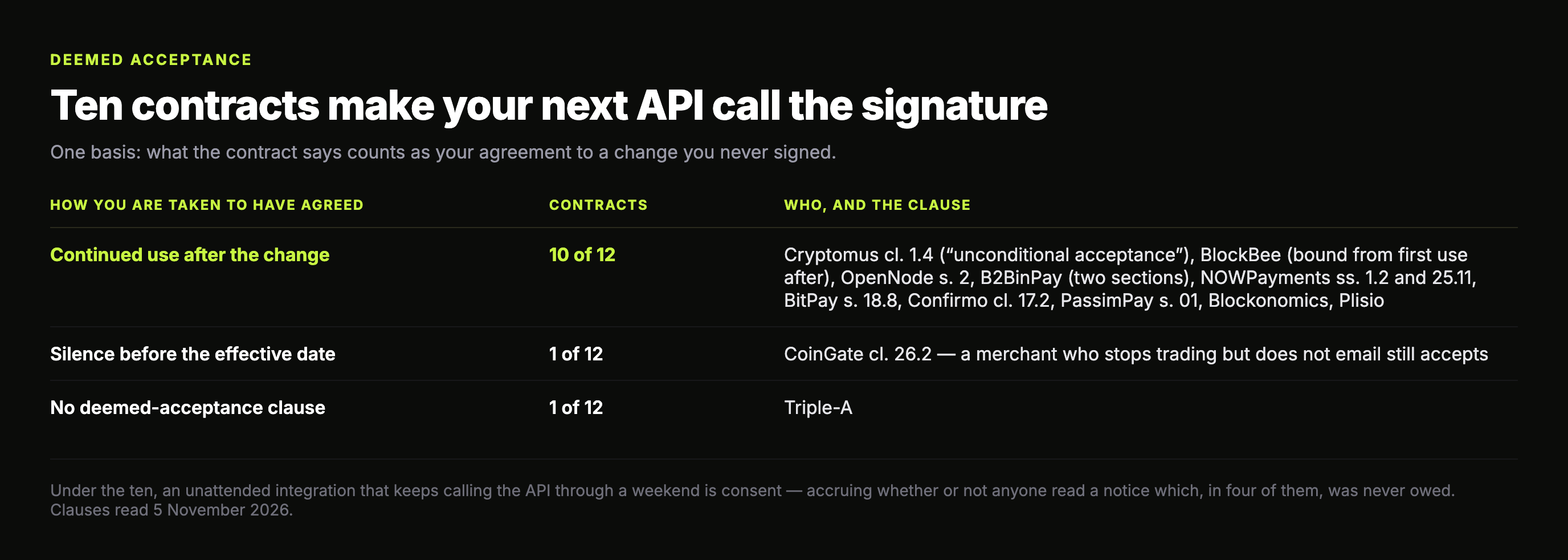
Ten contracts make your next API call the signature
The amendment clause decides who may change the deal. The consent clause decides how you are taken to have agreed, and it converts an ordinary business day into an act of acceptance.
Ten of the twelve say it in terms. Cryptomus clause 1.4 is the strongest: continued use after an update "constitutes your unconditional acceptance of the revised Terms", and if you disagree "you must discontinue using the Platform and close your account". BlockBee binds you from the first use after a change, OpenNode deems agreement "through Your continued use of the Services", and B2BinPay says it in two separate sections.
CoinGate is the one meaningful variant: clause 26.2 deems acceptance from silence rather than use — milder in one way, harsher in another, since a merchant who stops trading but does not email still accepts. Triple-A has no deemed-acceptance clause at all.
This matters most for an integration nobody is watching. A subscription biller keeps calling the API through a weekend, and under ten of these contracts that traffic is consent — accruing whether or not anyone read a notice which, in four of them, was never owed.
| Gateway | What the contract offers if you disagree | Objection route | What the exit costs |
|---|---|---|---|
| CoinGate | Object before it takes effect (cl. 26.3) | Emailed termination notice | Clean exit tied to the change |
| Confirmo | Terminate before the effective date (cl. 17.2) | Published objection instructions | Settle outstanding fees first (cl. 17.5) |
| BitPay | Stop using the Services (s. 18.8) | None | Fees incurred before closure still owed |
| OpenNode | Cease using or terminate (s. 2) | None | Fees already paid non-refundable (s. 7) |
| B2BinPay | Stop using and request closure | None | B2BinPay may itself terminate if you reject new pricing |
| NOWPayments | Do not use the Services (s. 11.5) | None | Fees non-refundable (s. 11.6) |
| PassimPay | Close the account (s. 11) | None | 10% fee on assets unclaimed after 30 days |
| Cryptomus | Close the account (cl. 1.4) | None | Closure may be refused (cl. 9.5); no liability for fee-change losses (cl. 15.8b) |
| BlockBee | Close the client account | None | Closure may be refused during an investigation |
| Blockonomics | Stop using the Services | None | In-app closure |
| Plisio | No stated remedy | Notice waived | Transactions cannot be reversed once initiated |
| Triple-A | No change-linked right | None | Exit cannot take effect before the 2-year initial term (cl. 3.3) |
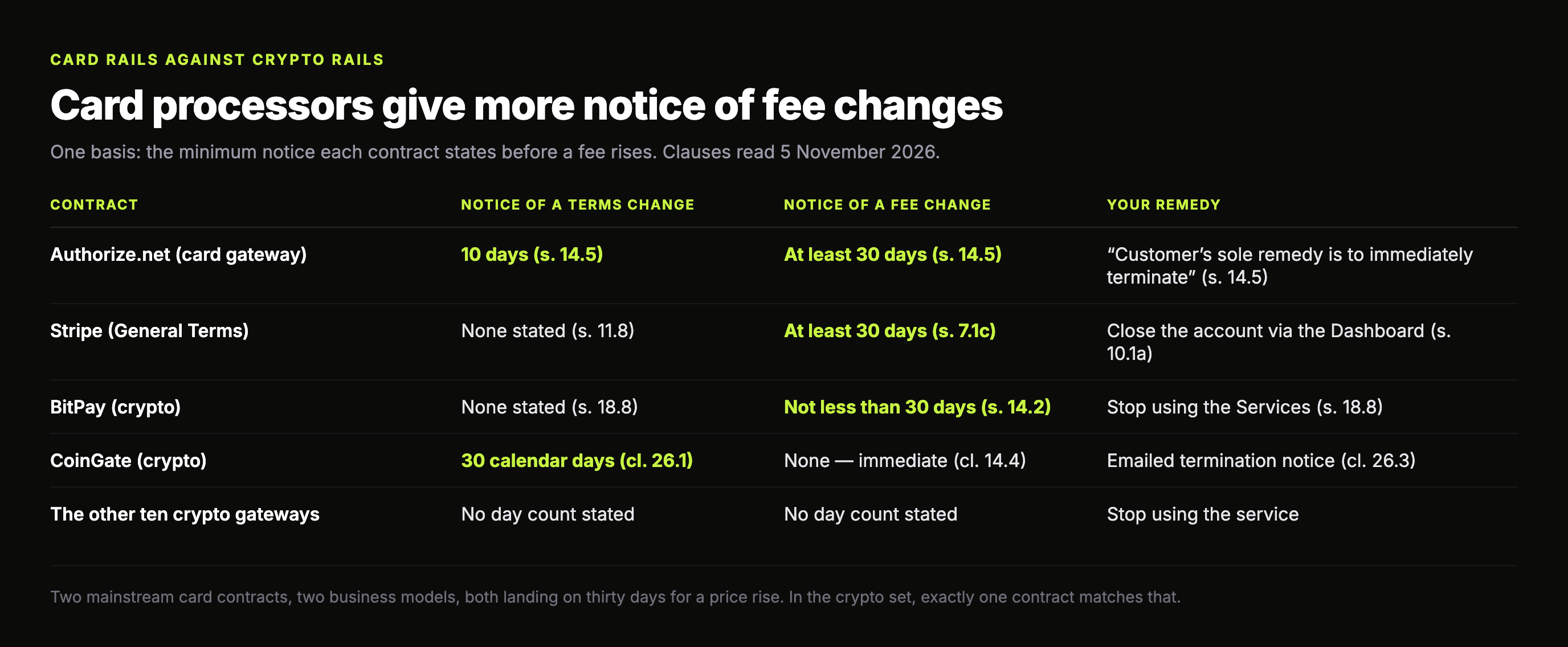
Card processors give more notice of fee changes than crypto gateways
The obvious objection is that discretionary pricing is simply how payments work, and a merchant leaving card rails should not expect more. So we checked the rails they left.
Authorize.net's merchant services agreement, section 14.5, gives not less than ten days' notice of a general amendment and at least thirty days' notice of a new or changed service fee. Stripe's section 7.1(c) promises "at least 30 days' notice of any increase in a Fee", while 11.8 leaves ordinary amendments effective on posting. Two mainstream contracts, two business models, both landing on thirty days for a price rise.
In the crypto set, exactly one contract matches that: BitPay, at thirty days under section 14.2.
| Provider | Notice of a terms amendment | Notice of a fee increase | Stated remedy if you object |
|---|---|---|---|
| Authorize.net (card gateway) | 10 days (s. 14.5) | At least 30 days (s. 14.5) | "Customer's sole remedy is to immediately terminate" (s. 14.5) |
| Stripe (General Terms) | None stated (s. 11.8) | At least 30 days (s. 7.1c) | Close the account via the Dashboard (s. 10.1a) |
| BitPay (crypto) | None stated (s. 18.8) | Not less than 30 days (s. 14.2) | Stop using the Services (s. 18.8) |
| CoinGate (crypto) | 30 calendar days (cl. 26.1) | None — immediate (cl. 14.4) | Emailed termination notice (cl. 26.3) |
| The other ten crypto gateways | No day count stated | No day count stated | Stop using the service |
Two caveats, because the comparison is not quite like for like. Card acquiring is regulated in most of the jurisdictions these contracts are written for, and network rules push notice periods down the chain in ways a hosted crypto gateway is not subject to, so some of this gap is regulation rather than goodwill. And more notice is not a better deal: Authorize.net's own clause says the merchant's "sole remedy is to immediately terminate", the same remedy ten crypto gateways offer, with a month's warning attached.
What survives both caveats is the planning point. Thirty days is long enough to reprice, renegotiate or migrate. Zero is not, and zero is what ten of these twelve guarantee.
Note also which crypto gateways cluster at the better end. BitPay and Confirmo are the two here that answer to a financial regulator — Confirmo's clause 1.3 describes it as a crypto-asset service provider authorised in Ireland — and they hold two of the three strongest clauses. That is a pattern in twelve documents, not a rule about regulation; one more contract either way would change it.
Plisio waives the notice, Cryptomus may refuse the exit
Two contracts go further than silence, failing in opposite directions.
Plisio's terms remove the notice itself: changes take effect "immediately after the changes are posted on the Site", and "You waive any right you may require to receive special notice of such changes or modifications." The clause does name a mechanism — notice is given "by posting the revised Terms on the Site and changing the 'Last edited' date at the top of the Terms". The document we read carries one date: Last Updated: March 12, 2019. So the sole stated way to detect a change to Plisio's terms is a timestamp that has not moved in over seven years. Check the Plisio review for the current published fees.
Cryptomus fails at the other end, on the exit. Clause 1.3 lets it modify the terms "at its sole discretion and without prior notice"; 15.7 lets it change fees and introduce new ones; 15.8(b) disclaims liability for "potential losses caused by changes in fees, tariffs, settlement rules, or other terms of Platform use". Clause 1.4 says that if you disagree you must close your account — and clause 9.5 lets the platform refuse to close it where that would conflict with legal requirements, regulatory orders or its own internal policies.
Taken together that is a loop: the price can change without notice, you have no claim for what the change costs you, and the only remedy is one the counterparty may decline. BlockBee has a narrower version, refusing closure while an inquiry is open. It is the same one-directional drafting we found in the indemnity clauses and the liability caps, arriving through the fee schedule.
Four checks before you accept a crypto gateway fee change
All four are answerable in ten minutes from a published document, before you integrate rather than after.
One: find the day count, and accept its absence as the answer. Search the terms for "days" near "fee". If there is no number, budget the notice period as zero. Two of twelve had a number; do not assume yours is one because the clause sounds reassuring.
Two: read the fee clause and the amendment clause together. CoinGate proves one can exclude the other. A 30-day amendment clause tells you nothing about the price until you check whether the fee schedule is carved out of it.
Three: find out what counts as agreement. If continued use is acceptance, an unattended integration consents on your behalf. Decide who reads the notices, and make sure the address on the account is one somebody opens — under four of these contracts there is no obligation to send one at all.
Four: price the exit before you need it. Ask whether closing the account is unconditional, whether a balance can be stranded behind it, and whether there is a minimum term. Thirty days' notice means little if, like Triple-A's, it cannot take effect for two years, or if, like PassimPay's, leaving costs 10% of whatever is still on the platform. A compliance hold can sit on top of all of it.
- Crypto Gateway Dispute Resolution 2026: We Read 12
- Crypto Gateway Indemnity 2026: Yours Has No Cap
- Crypto Gateway Liability Caps 2026: $100 to $50,000
- Crypto Gateway AML Holds 2026: Nobody Says How Long
- Crypto Gateway Prohibited Businesses 2026: 4 of 12
- Confirmo Review: Fees, Settlement and Coverage
Ten of these twelve contracts can move your rate the day they publish it.
We read fees, custody, KYC and contract terms for every processor in the directory. BitPay alone promises 30 days before a processing fee moves; Confirmo alone publishes instructions on how to object; BTCPay Server has no operator in the chain to reprice you.
Compare Crypto Payment Gateways →Affiliate disclosure: Payyd earns a commission if you sign up to some providers linked on this page. It changes none of the clauses or findings reported here, all of which come from the providers' own published documents and are linked below.
FAQ
Can a crypto payment gateway raise its fees without telling me?
Under ten of the twelve merchant contracts we read, yes. Four state in writing that the terms may change with no prior notice at all, and OpenNode says it of the fees: "The Fees may be subject to change without notice, at any time." Six more promise notice but set no deadline for giving it. Only BitPay commits to a number of days before a processing fee moves.
How much notice of a fee change do crypto payment gateways give?
One gives a figure: BitPay, at "not less than thirty (30) days' advance notice" (s. 14.2). CoinGate is explicit the other way — fee changes "come into force immediately upon publication" (cl. 14.4). NOWPayments says advance notice is its right, not its obligation. The other nine promise untimed notice or say nothing about fee changes.
Does using the API after a change mean I accepted it?
In ten of the twelve, yes. Cryptomus calls continued use "your unconditional acceptance of the revised Terms", and OpenNode, BitPay, B2BinPay, NOWPayments, PassimPay, Blockonomics, BlockBee, Confirmo and Plisio all have a version of it. CoinGate is the exception that still binds you: clause 26.2 deems acceptance unless you object before the change takes effect, so silence is enough even if you stop trading.
Can I refuse a change to my crypto gateway terms?
Only two of the twelve give you a process. CoinGate cl. 26.3 lets you terminate by emailed notice if you object before the amendment takes effect. Confirmo cl. 17.2 notifies you in advance with the effective date and instructions on how to object, then lets you terminate before that date. In the other ten, the answer to disagreeing is to stop using the service.
Can I just close the account if I do not like a new fee?
Usually, but check two things. Cryptomus cl. 9.5 lets the platform refuse to close an account where closure would conflict with legal requirements, regulatory orders or its internal policies, and BlockBee may refuse while an investigation is open. Closing can also cost: PassimPay applies a 10% recovery fee to assets not claimed within 30 days of closure, and Triple-A's termination notice cannot take effect before a two-year initial term ends.
Which crypto payment gateway has the fairest fee-change clause?
Confirmo on the procedure, BitPay on the number. Confirmo gives advance notice with a stated effective date, publishes instructions on how to object, lets you terminate before the change lands and promises no retrospective effect. BitPay is the only one of the twelve that puts a day count on a fee rise. Triple-A earns a mention for a different reason: cl. 17.1 says no amendment is valid unless signed by both parties, the only bilateral amendment clause here, though cl. 2 pulls against it.
Do card processors give more notice than crypto gateways?
On fee increases, measurably. Authorize.net gives at least thirty days for a fee change and ten for a general amendment; Stripe gives at least thirty for a fee increase. Only BitPay matches that in the crypto set. Some of the gap is regulatory rather than voluntary, and more notice is not a better remedy: Authorize.net still says the merchant's sole remedy is to terminate.
Sources
Amendment, fee-change and deemed-acceptance clauses read 5 November 2026:
- CoinGate Merchant Terms of Service — v1, 06/02/2024; cl. 14.4, 26.1–26.5, 27.6; UAB "Decentralized"
- BitPay Merchant and Donee Terms of Use — effective 1 April 2026; ss. 14.2, 18.8, 4.8.1
- Confirmo Limited Terms and Conditions (PDF) — last updated 2 October 2026; cl. 1.3, 4.6, 9.2, 17.2–17.6
- Triple-A General Terms and Conditions — version date 20 April 2026; cl. 2, 3.2–3.4, 6.2, 16.5, 17.1
- NOWPayments Terms of Service (PDF) — last updated 19 October 2026; ss. 1.2, 1.5, 11.5–11.6, 25.11; FD Transfers LLC
- OpenNode Terms and Conditions — last updated 29 August 2024; ss. 2, 5.1, 7, 27
- Cryptomus Terms of Use — last updated 17 August 2026; cl. 1.3–1.4, 9.5, 15.6–15.8
- B2BinPay Terms of Use — last updated 26 June 2026; Introduction and Acceptance, Fees and Payments, Amendments; B2BINPAY El Salvador S.A. de C.V.
- BlockBee Terms and Conditions — effective 2 October 2026; Modification of Service and these Terms and Conditions, Fees; Blockbee Inc., Panama
- PassimPay Terms of Service — last updated 11.05.2026; ss. 01, 04, 11, 15.06; NILESPAY FINANCE INC.
- Blockonomics Terms of Service — undated; Changes to Terms or Services, Fees; OneByZero Tech Pte Ltd
- Plisio Terms of Use (PDF) — last updated 12 March 2019; Changes to this Agreement, Transaction limits and refunds
- Authorize.net Payment Gateway Merchant Services Agreement — ss. 5.1, 8.1, 14.5
- Stripe Services Agreement — last modified 28 September 2026; ss. 7.1(c), 10.1(a), 11.8