
Crypto Gateway Force Majeure 2026: Only One Still Pays
Crypto gateway force majeure, read across 12 merchant contracts in November 2026: only one says the clause cannot excuse paying your balance back.
 Brian Ormond
Key Takeaways
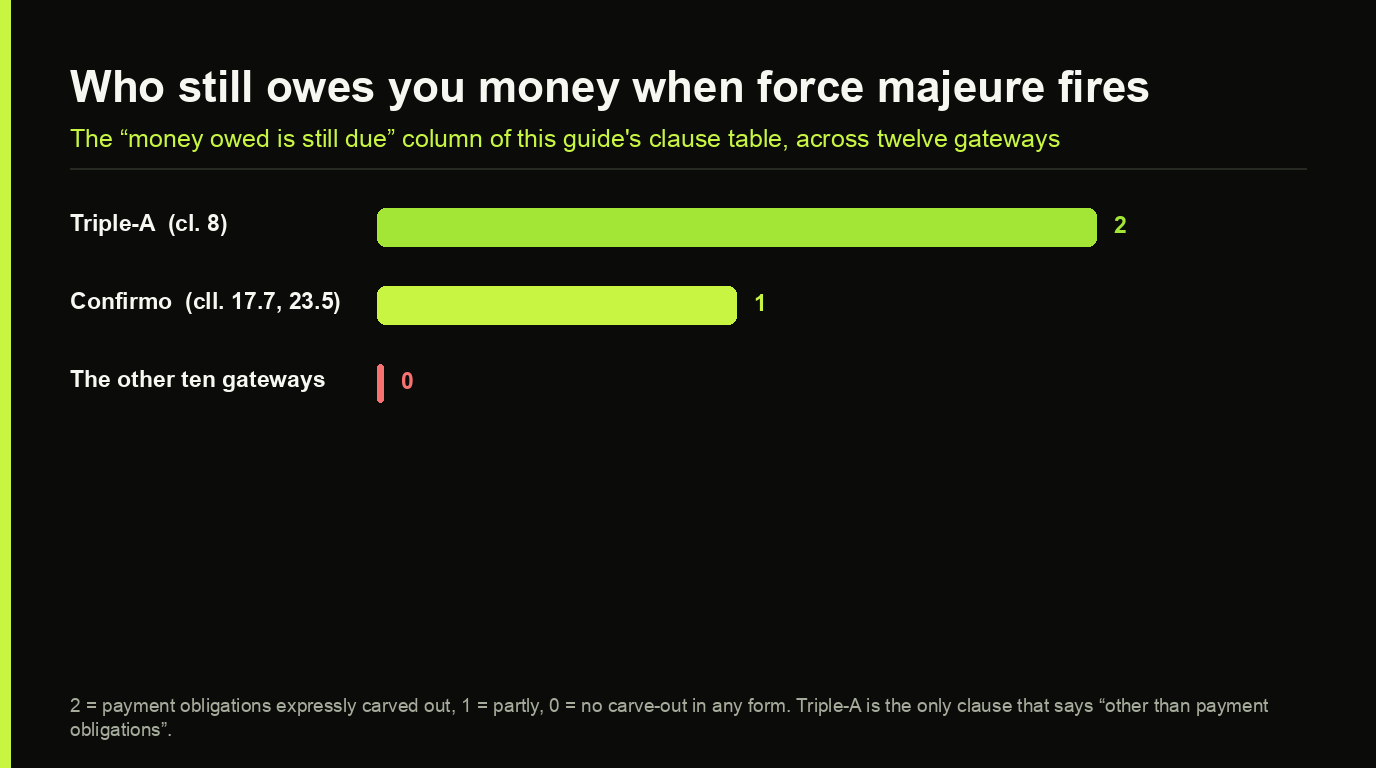
- One of eleven readable contracts says a force majeure event cannot excuse paying you. Triple-A cl. 8 excludes "other than payment obligations". Confirmo gets partway there by preserving "amounts properly due before termination". The other nine leave money owed inside the excuse.
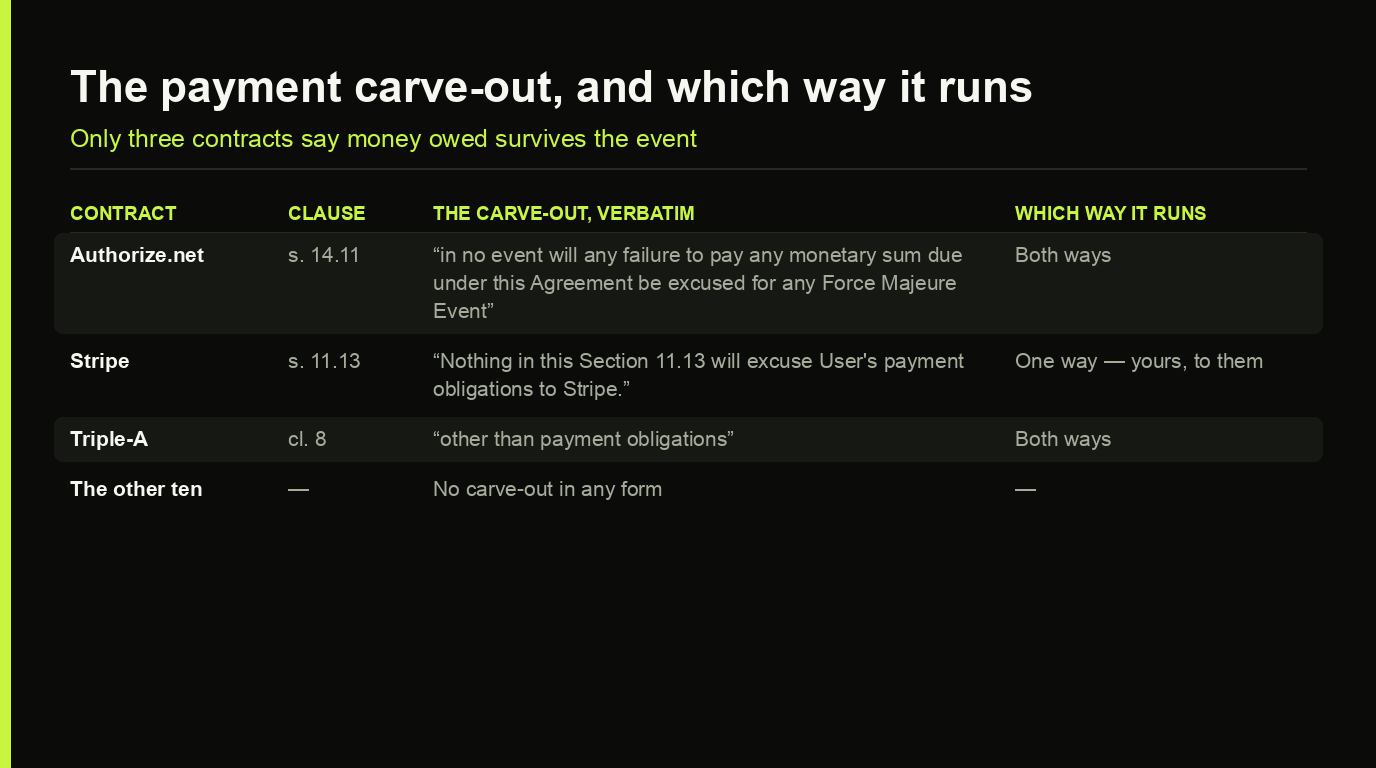
- Both card-rail contracts carve out payment — and Stripe's runs one way only. Stripe s. 11.13 preserves "User's payment obligations to Stripe" and says nothing about Stripe's to you. Authorize.net s. 14.11 covers "any monetary sum due", in both directions. Triple-A's wording is broader than Stripe's.
- CoinGate uses the phrase exactly once across both merchant documents, and it is a defence against refunding you — cl. 2.18.4 of the payouts terms, an exception to its own refund duty. Miss the cl. 2.16 five-business-day window and you waive the claim entirely.
- Cryptomus is the only one where force majeure is a ground to suspend or close you. Clause 12.2(g) permits both "without prior notice".
- NOWPayments' clause lists shortages of transportation, fuel and materials, and no network event at all. The words "force majeure" appear nowhere in its terms. Blockonomics has no such clause in any form.
Your gateway stops settling. Not because it closed your account, not because compliance put a hold on it — because something broke, and a notice on the homepage says processing is suspended. The clause that decides who carries that week is crypto gateway force majeure, and it is the clause nobody reads, because it looks like the boilerplate at the end.
The stakes are the float, and they are larger than the fee: a merchant settling weekly on $60,000 a month is carrying roughly $14,000 on the platform when the music stops. Commercial contracts have a standard answer to this — an event beyond your control excuses performance, except the obligation to pay money, because an outage is a reason you cannot ship, never a reason you cannot pay. We went looking for that exception in the merchant terms of twelve hosted crypto gateways on 9 November 2026. Eleven were readable, and one of them has it.
These are the same twelve contracts we read for the account closure comparison and the liability caps comparison. The twelfth, Plisio, is still behind the security-incident notice it put up before our last reading, with incoming and outgoing payments suspended — this article's subject, running live, on the one contract we could not open. That is set out in full below with exactly what we did and did not verify.

Twelve contracts, side by side
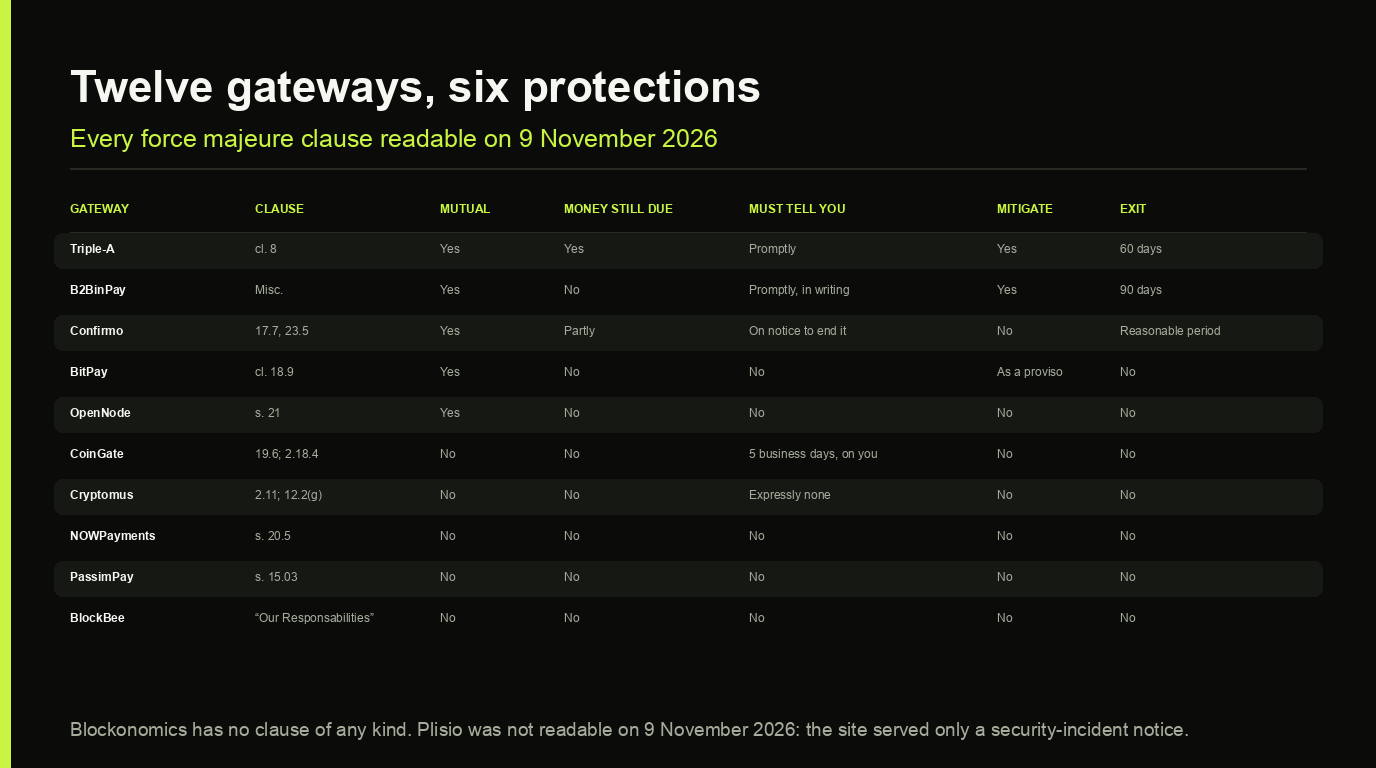
A force majeure clause does four separable things, and the market treats them as optional in roughly that order. It excuses performance. It decides whether money owed is excused along with everything else. It imposes duties on the party claiming it — tell the other side, and try to fix it. And it gives the stranded party an exit if the event does not end.
Ten of the eleven readable contracts do the first. One does the second.
| Gateway | Clause | Mutual | Money owed still due | Must tell you | Must mitigate | Exit if it drags on |
|---|---|---|---|---|---|---|
| Triple-A | cl. 8 | Yes | Yes | Promptly | Yes | 60 days |
| B2BinPay | Force Majeure (Misc.) | Yes | No | Promptly, in writing | Yes | 90 days |
| Confirmo | cll. 17.7, 23.5 | Yes | Partly | On notice to end it | No | "Reasonable period" |
| BitPay | cl. 18.9 | Yes | No | No | As a proviso | No |
| OpenNode | s. 21 | Yes | No | No | No | No |
| CoinGate | cl. 19.6; payouts cl. 2.18.4 | No | No | 5 business days — on you | No | No |
| Cryptomus | cl. 2.11; 12.2(g) | No | No | Expressly none | No | No |
| NOWPayments | s. 20.5 | No | No | No | No | No |
| PassimPay | s. 15.03 | No | No | No | No | No |
| BlockBee | "Our Responsabilities" | No | No | No | No | No |
| Blockonomics | No clause of any kind. Its terms are a section of its privacy page and carry no date. | |||||
| Plisio | Not readable on 9 November 2026 — the site serves only a security-incident notice. | |||||
The pattern in that table is worth sitting with: four of the eleven impose a duty of any kind on the gateway claiming the excuse. Everything below that line is a clause that protects one party and asks nothing of them.
The nine words that keep the money owed
Triple-A's clause 8 opens by excusing performance of obligations "other than payment obligations". That is the whole finding. Nine words, unqualified, and they mean a chain halt or a bank outage stops Triple-A owing you a service and does not stop it owing you your settlement.
It is also the only clause in the set that reads like it was drafted by someone who expected to be on the receiving end of it. The affected party "shall promptly notify the other Party", and "shall use reasonable efforts to mitigate its impact and resume performance as soon as reasonably practicable". If the event runs past 60 consecutive days and materially prevents performance, either side can terminate immediately on written notice.
Read it against the rest of Triple-A's contract before concluding anything, though: cl. 3.3 means termination cannot take effect before a two-year initial term. The best force majeure clause in the set is attached to the only lock-in in the set, which is a trade and not a recommendation.
Confirmo gets partway there by a different route. Clause 17.7 is headed "Force majeure and extended outages" and suspends its obligations for the duration of the event, then lets either party terminate affected transactions or the agreement on notice — "without liability other than for amounts properly due before termination". That is not the classic carve-out: it does not keep Confirmo paying you during the event. It does mean the exit does not wipe out what you were already owed, and clause 23.6 lists force majeure among the provisions that survive termination.
The card rails carve it out, and Stripe's runs one way
The benchmark is worth running because it is where the standard drafting lives, and because it does not flatter the card rails as much as you would expect.
| Contract | Clause | The carve-out, verbatim | Which way it runs |
|---|---|---|---|
| Authorize.net | s. 14.11 | "in no event will any failure to pay any monetary sum due under this Agreement be excused for any Force Majeure Event" | Both ways |
| Stripe | s. 11.13 | "Nothing in this Section 11.13 will excuse User's payment obligations to Stripe." | One way — yours, to them |
| Triple-A | cl. 8 | "other than payment obligations" | Both ways |
| The other ten | — | No carve-out in any form | — |
Authorize.net s. 14.11 is the full apparatus and the strongest clause we read anywhere: mutual, an unqualified carve-out for "any monetary sum due", notice "as soon as reasonably practicable", and "commercially reasonable efforts to minimize any delays". Its s. 11.2.2 adds a separate right to terminate immediately where its own efforts to fix an outage are not successful.
Stripe is the interesting one, because its carve-out is named, precise, and points in exactly one direction. Section 11.13 preserves User's payment obligations to Stripe, and is silent on Stripe's obligations to the user. So the clause everyone cites as the benchmark is, on its face, narrower for a merchant than Triple-A's unqualified nine words. Payouts to Stripe merchants rest on a great deal more contract than s. 11.13, so this is not a reason to pick one over the other — but on this one sentence, a crypto gateway out-drafts them.
Where the clause is the gateway's remedy, not its excuse
In two contracts force majeure is not a shield at all. It is something the gateway can do to you.
CoinGate names it exactly once across both of its merchant documents. The merchant terms of service never use the phrase — the nearest thing is cl. 19.6, excluding liability for "any other cause or condition beyond our reasonable control" and for "any 'hard fork', 'soft fork', or other change in the operating rules of an underlying Virtual Asset network", with cl. 19.3 adding "technical faults of the Virtual Asset system". The phrase itself appears in the separate outgoing-payments terms, at cl. 2.18.4, as one of four exceptions to CoinGate's duty to refund a transfer it failed to execute: "We were unable to process Your request due to circumstances beyond Our reasonable control (Force Majeure)."
So the only place the concept is named by name in CoinGate's merchant paperwork is a reason you do not get your money back. And cl. 2.16 puts a clock on you rather than on them: fail to notify within five business days and you "waive any rights to make a claim against Us for the Crypto-Asset Transfer in question". Of every number in this article, that is the one to diarise, because it is the only one that expires.
Cryptomus goes further and makes the event a ground for termination. Clause 2.11 defines force majeure conventionally enough — natural disasters, internet outages, wars, strikes, technical failures, acts of third parties. Clause 12.2(g) then lists "force majeure circumstances, including power outages, network failures, cyberattacks" among the grounds on which it may suspend or terminate, and clause 12.2 permits that "without prior notice". Clause 5.17(b) names force majeure as one of the circumstances triggering cl. 5.16(b), which allows suspending "any or all Services" and account access "at any time and without prior notice".
Read that next to what we found on closure: Cryptomus cl. 5.18 is headed "Return of Assets" and states it has no obligation to return them. A clause that lets the provider close you for an event neither of you caused, with no notice, sitting above a clause that disclaims the duty to send your balance back, is a specific combination worth knowing before you let a float build up there.
What counts as force majeure, and what nobody listed
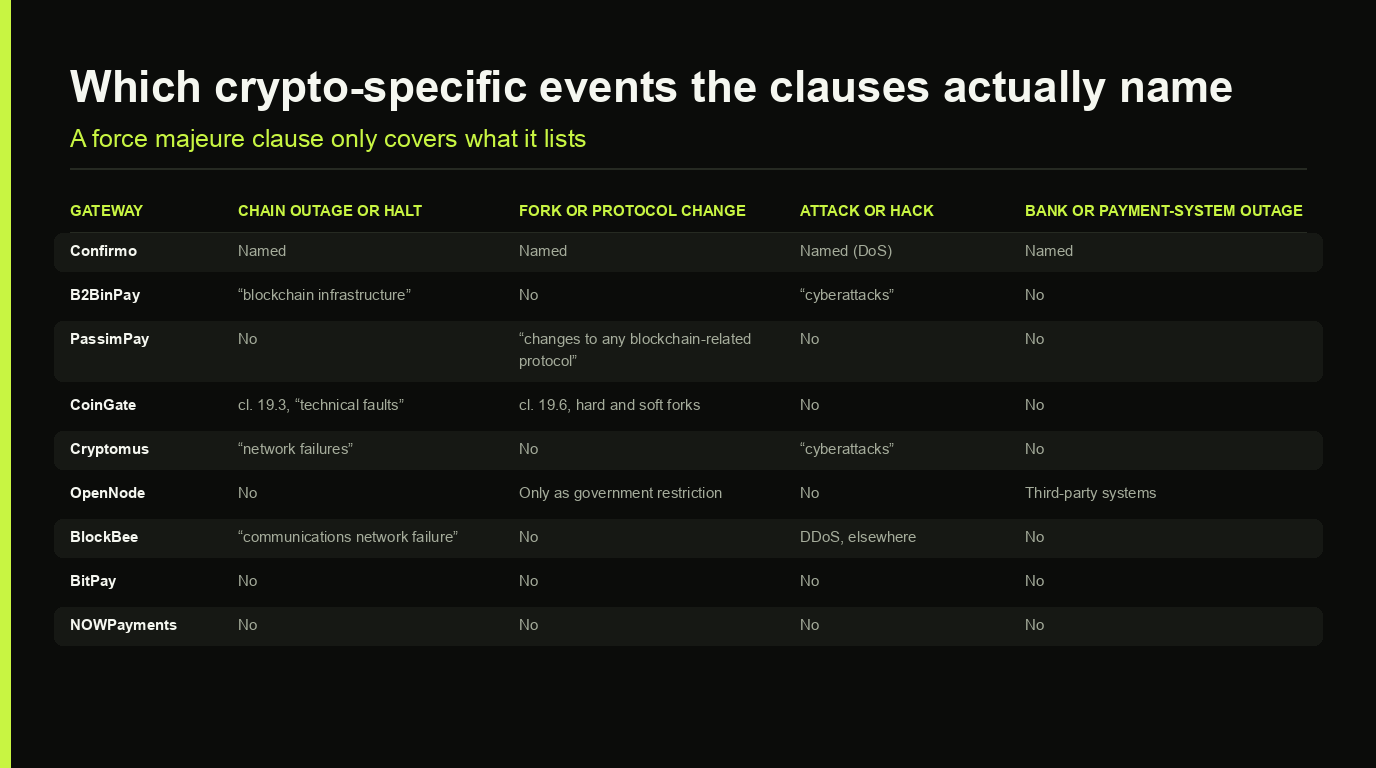
A clause is only as good as its list, and this is a sector whose characteristic outages — a chain halting, a reorg, a bridge hack, a protocol change — did not exist when the standard wording was written. Most of these lists have not caught up.
| Gateway | Chain outage or halt | Fork or protocol change | Attack or hack | Bank or payment-system outage |
|---|---|---|---|---|
| Confirmo | Named | Named | Named (DoS) | Named |
| B2BinPay | "blockchain infrastructure" | No | "cyberattacks" | No |
| PassimPay | No | "changes to any blockchain-related protocol" | No | No |
| CoinGate | cl. 19.3, "technical faults" | cl. 19.6, hard and soft forks | No | No |
| Cryptomus | "network failures" | No | "cyberattacks" | No |
| OpenNode | No | Only as government restriction | No | Third-party systems |
| BlockBee | "communications network failure" | No | DDoS, elsewhere | No |
| BitPay | No | No | No | No |
| NOWPayments | No | No | No | No |
Confirmo cl. 23.5 is the only crypto-native list in the set, and it reads as though someone sat down and asked what actually takes a crypto payment business offline: "network or blockchain outages or halts, significant protocol changes or forks, denial-of-service attacks, power or telecom failures, bank or payment-system outages, sanctions or regulatory actions, industrial disputes, acts of God". Every other list is a general commercial list with at most one crypto item bolted on.
NOWPayments is the other end. Section 20.5 excuses "any delay or failure to perform resulting from causes outside its reasonable control, including, but not limited to, acts of God, war, terrorism, riots, embargoes, acts of civil or military authorities, fire, floods, accidents, strikes, or shortages of transportation facilities, fuel, energy, labour, or materials." Shortages of transportation facilities and fuel, in the terms of a business that moves no physical goods; not one network, chain or protocol event. The phrase "force majeure" does not appear anywhere in the document. It is a freight clause, and it is one-sided — "FD Transfers LLC will not be liable", with no corresponding relief for you.
PassimPay has the one genuinely modern item nobody else does: s. 15.03 names "smart contract bugs or weaknesses" alongside "changes to any blockchain-related protocol". One-sided, no duties attached, but at least a clause about this industry.
BitPay ships two clauses and the older one is stripped
BitPay publishes six agreements concatenated at one URL, and two of them carry a force majeure clause built from the same sentence. They are not the same clause.
The Merchant and Donee Terms, effective 1 April 2026, at cl. 18.9: "Neither party will be liable for delays in processing or other non-performance caused by such events as fires, telecommunications, utility, or power failures, equipment failures, labor strife, riots, war, non-performance of our vendors or suppliers, acts of God, pandemics, or other causes over which the respective party has no reasonable control; provided that the party has procedures reasonably suited to avoid the effects of such acts."
The BitPay Send Terms, effective 1 January 2022, at cl. 16.9: the same list, with two changes. "Neither party" becomes "We", and the proviso is gone.
That proviso is the only one of its kind in any of the fifteen documents we read. It is not a duty to mitigate — it is a condition on the defence, which is arguably stronger, because a party with no procedures suited to avoiding a power failure cannot reach the excuse at all. The honest reading is that the newer agreement is the better one and merchant acceptance sits under it. But it matters if you use BitPay for payouts too: that product runs on the 2022 terms, where the clause protects one party and asks nothing.
Plisio is the live test, and its contract cannot be read
Plisio has been serving a single page since before our last reading. In full: "Our service is currently experiencing a security incident caused by a hacker attack. Restoration work is underway. For security reasons, the processing of incoming and outgoing payments has been temporarily suspended."
That is the exact scenario this clause governs. Merchant balances are on the platform, outgoing payments are suspended, nobody has published a timetable — and the terms that would say who carries the loss are not reachable, because the whole site including its legal pages serves the notice. There is no snapshot of Plisio's terms in the Internet Archive to fall back on; we checked three candidate paths and found none.
So we are not reporting what Plisio's force majeure clause says, because we could not read it on 9 November 2026. What the outage demonstrates is the more useful half anyway: the moment you most need to know how your contract allocates an outage is the moment the contract is least likely to be available. Download the terms when you integrate — a copy in your own files is the only one that survives the provider's bad week.
Four checks before the next outage
One: search the clause for the word "payment". Not the heading, the word. If the clause excuses performance without excepting money owed, then on its own terms an outage suspends the obligation to settle you. Ten of eleven read that way. It is not a reason to avoid a provider, but it tells you the float is yours to manage, not theirs to guarantee.
Two: find out whether anyone has to tell you. Four of eleven impose a notice duty on the gateway. Cryptomus expressly removes it. Where there is none, the homepage notice is your notification, which is how Plisio's merchants found out.
Three: check whether the event can be used against you. Cryptomus cl. 12.2(g) makes force majeure a ground to suspend or terminate without prior notice. No other contract in the set does this, and it is the single clause here that converts a shared misfortune into a one-sided remedy.
Four: settle more often than feels necessary, and keep your own copy of the terms. Every clause in this article applies to a balance somebody else is holding, so shorter settlement cycles and on-chain payouts to addresses you control shrink all of it at once. This is the same conclusion the fee-change comparison and the AML holds comparison reached from different directions, which is usually a sign it is the real answer: the contract terms vary, and the float is the exposure they all share.
- Crypto Gateway Account Closure 2026: Who Keeps Your Balance
- Crypto Gateway Liability Caps 2026: $100 to $50,000
- Crypto Gateway Fee Changes 2026: One Gives 30 Days
- Crypto Gateway Indemnity 2026: Yours Has No Cap
- Crypto Gateway AML Holds 2026: Nobody Says How Long
- No-KYC Crypto Payment Gateways: What You Trade Away
Ten of eleven readable contracts leave the money they owe you inside the excuse.
We read fees, custody, KYC and contract terms for every processor in the directory. Triple-A is the one that excepts payment obligations outright; Confirmo names chain halts and forks and preserves amounts already due; BTCPay Server holds no balance for an outage to strand.
Compare Crypto Payment Gateways →Affiliate disclosure: Payyd earns a commission if you sign up to some providers linked on this page. It changes none of the clauses or findings reported here, all of which come from the providers' own published documents and are linked below.
FAQ
Does force majeure mean a crypto gateway can stop paying me?
On the wording of ten of the eleven readable contracts, yes — the clause excuses performance without excepting the obligation to pay, so money owed sits inside the excused set. Triple-A cl. 8 is the exception: it excuses obligations "other than payment obligations". Confirmo cl. 17.7 is a partial exception, preserving "amounts properly due before termination" when a force majeure termination happens. Whether a court would read the others the same way is a separate question; what the documents say is what this article reports.
Is a blockchain outage a force majeure event under my gateway's terms?
Only sometimes, and the lists are mostly older than the problem. Confirmo cl. 23.5 names "network or blockchain outages or halts" and "significant protocol changes or forks" outright. B2BinPay names "blockchain infrastructure". PassimPay names protocol changes and "smart contract bugs or weaknesses". CoinGate handles forks in its liability exclusion at cl. 19.6 rather than a force majeure clause. BitPay cl. 18.9 and NOWPayments s. 20.5 name no network or chain event at all, so a chain halt would have to fall under their general "beyond reasonable control" wording.
Does my gateway have to tell me when it invokes force majeure?
Four of eleven say so. Triple-A cl. 8 requires prompt notice; B2BinPay requires prompt written notice stating the nature, scope and expected duration; Confirmo delivers notices via the site or email under cl. 17.8 and requires notice to terminate under cl. 17.7; BitPay imposes no notice duty but conditions the defence on having "procedures reasonably suited to avoid the effects". Cryptomus goes the other way, permitting suspension and termination "without prior notice" at cl. 12.2.
Can I walk away if the outage does not end?
Two contracts put a number on it. B2BinPay lets either party terminate with immediate effect once a force majeure event "continues for more than ninety (90) consecutive calendar days". Triple-A cl. 8 sets 60 consecutive days where the event materially prevents performance. Confirmo allows termination once the event lasts "beyond a reasonable period", without a day count. The remaining eight give no force-majeure-specific exit, though most let you close your account for convenience anyway — subject, in Triple-A's case, to the two-year initial term at cl. 3.3.
My gateway has suspended payments after a hack. What does the contract say?
Usually that it may, and rarely that it owes you anything while it does. Cryptomus lists cyberattacks in cl. 12.2(g) as a ground for suspension or termination without notice. B2BinPay and Confirmo name cyberattacks and denial-of-service attacks as force majeure events, which excuses performance for the duration. BlockBee excludes liability for distributed denial-of-service attacks. None of the eleven commits to a timetable for restoring payouts, and none makes the gateway liable for a merchant's losses during the suspension.
Which crypto gateway has the best force majeure clause?
Triple-A cl. 8, on this clause alone: mutual, a payment carve-out, a notice duty, a mitigation duty and a 60-day exit. Confirmo is the best-drafted for this industry specifically, with the only list that names chain halts, forks and DoS attacks. Both come with trade-offs covered elsewhere in the directory — Triple-A's two-year initial term in particular — so this is one input, not a ranking.
How do the card processors compare?
Both carve out payment, and one of them does it in only one direction. Authorize.net s. 14.11 is mutual and unqualified: "in no event will any failure to pay any monetary sum due under this Agreement be excused for any Force Majeure Event", plus notice and mitigation duties. Stripe s. 11.13 preserves "User's payment obligations to Stripe" and says nothing about Stripe's obligations to the user, which makes its carve-out narrower for a merchant than Triple-A's.
What should I actually do about any of this?
Three things, none needing a lawyer. Save a copy of your provider's terms now, because Plisio's outage took its legal pages offline with the rest of the site. Diarise CoinGate's five-business-day claim window at cl. 2.16 if you use its payouts. And settle often enough that a week's outage is an inconvenience rather than a cash-flow event, which is the only defence that works whatever the clause says.
Sources
Force majeure, excused-performance and beyond-reasonable-control clauses, read 9 November 2026:
- Triple-A General Terms and Conditions — version date 20 April 2026; cll. 3.3, 6.2, 8, 12
- Confirmo Limited Terms and Conditions (PDF) — cll. 17.7, 17.8, 23.5, 23.6
- B2BinPay Terms of Use — last updated 26 June 2026; Force Majeure, under Miscellaneous
- BitPay Merchant and Donee Terms of Use — effective 1 April 2026, cl. 18.9; and BitPay Send Terms of Use, effective 1 January 2022, cl. 16.9
- CoinGate Merchant Terms of Service — v1 06/02/2024, in force 7 May 2024; cll. 19.3, 19.6, 27.2
- CoinGate Special Terms of Crypto Payouts for Merchants — v1 27/09/2024, effective 9 October 2024; cll. 2.16, 2.18, 2.19
- Cryptomus Terms of Use — last updated 17 August 2026; cll. 2.11, 5.11, 5.16–5.18, 7.3, 12.2
- NOWPayments Terms of Service (PDF) — last updated 19 October 2026; s. 20.5; FD Transfers LLC
- OpenNode Terms and Conditions — last update 29 August 2024; ss. 15.2, 15.4, 21
- PassimPay Terms of Service — dated 11.05.2026 in the document's own format; s. 15.03; NILESPAY FINANCE INC.
- BlockBee Terms and Conditions — effective 2 October 2026; Our Responsabilities, Limitation of Liability
- Blockonomics Privacy Policy and Terms of Service — undated; no force majeure or beyond-reasonable-control clause in either part
- plisio.net security-incident notice — the whole site, including its legal pages, served this notice when we checked on 9 November 2026; terms not readable, and no snapshot found in the Internet Archive for three candidate paths
- Stripe Services Agreement — last modified 28 September 2026; s. 11.13 and the Force Majeure Event definition in s. 12
- Authorize.net Payment Gateway Merchant Services Agreement — ss. 11.2.2, 14.11