
Crypto Travel Rule 2026: We Read 12 Gateways
We read 12 crypto payment gateways' own documents in October 2026. Two name the Travel Rule. The UK threshold quietly fell to 800 pounds in June.
 Brian Ormond
Key Takeaways
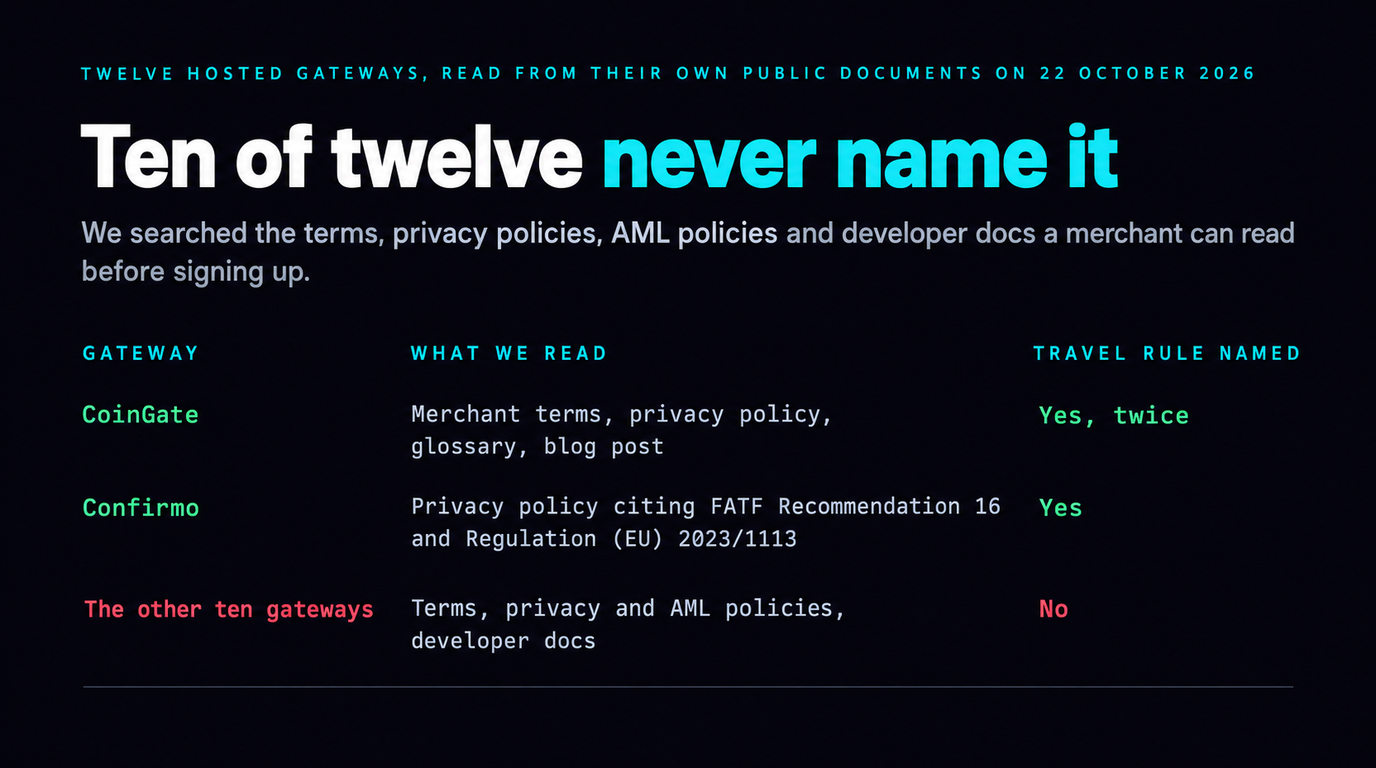
- Two of twelve hosted gateways name the Travel Rule in their own documents. CoinGate explains it twice; Confirmo's privacy policy cites "Financial Action Task Force (FATF) Recommendation 16" and "Regulation (EU) 2023/1113". The other ten never mention it.
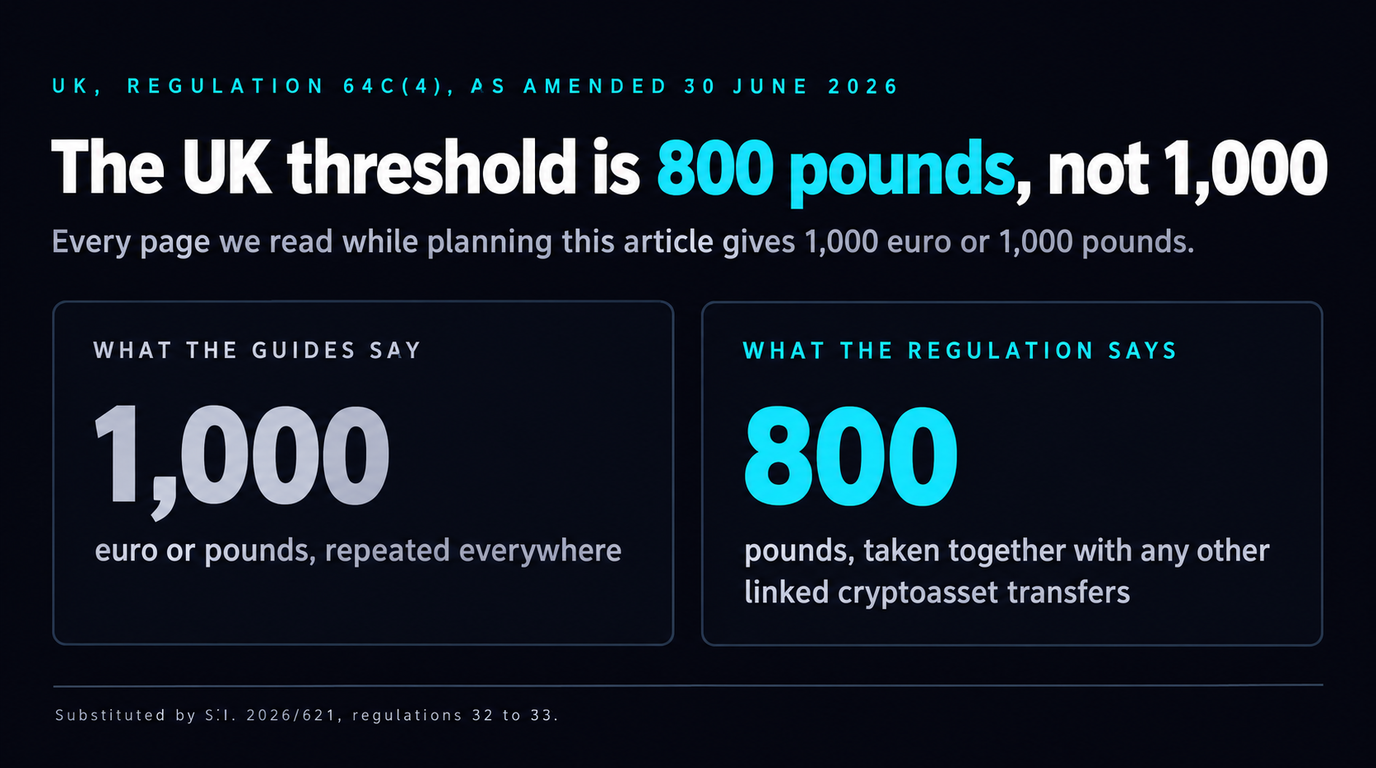
- The UK figure is £800, not £1,000, and has been since 30 June 2026, when S.I. 2026/621 substituted the sum in regulations 64C(4) and 64G(1)(b). Every explainer ranking for this query still prints £1,000 or €1,000.
- The leg that bites a merchant is the payout, not the checkout. CoinGate asks for "evidence of owning the external crypto wallet", and regulation 64G(4) says a business that does not get what it requested "must not make the cryptoasset available to the beneficiary".
- Confirmo expects your buyer's identity data from you. The dataset is "usually provided to us by the Merchant", and it reaches an "official personal document number".
Your gateway asks your customer for a date of birth and explains it with a compliance notice nobody reads. Then your own withdrawal stops, because the wallet you are paying yourself into is not one anyone has proved you own. That is the crypto travel rule as merchants meet it: invisible while you integrate, expensive the first time it moves.
The obligation is not yours. It sits on the regulated firm handling the transfer, which is why most merchants read nothing about it until a payment or a payout stalls. But the data the rule demands has to come from somewhere, and one gateway says plainly that it comes from you. So we read 25 documents — terms, privacy policies, AML policies — from twelve hosted crypto payment gateways on 22 October 2026, plus BTCPay Server's FAQ as the self-hosted control and the UK regulations as they now stand. Ten of the twelve never mention the rule.
Who the Travel Rule obliges, and why it is not you
The rule is older than crypto: information about both parties accompanies a transfer of value so it stays traceable, as banking has done for decades. A chain transfer carries no identity data, so the information moves alongside it, between the regulated firms at either end.
In the EU the duty arrives through the Transfer of Funds Regulation, which the European Commission says "ensures the traceability of crypto-assets transfers and the authentication of users, aligning with FATF standards" and "will apply as of December 2024", imposing it on "all crypto service providers involved in crypto transfers". In the UK the same standard sits in Part 7A of the 2017 money laundering regulations, which bites on a "cryptoasset transfer" — "an inter-cryptoasset business transfer or an unhosted wallet transfer".
Selling goods for crypto does not make you a cryptoasset business, so no clause in Part 7A addresses you. The rule reaches you through your counterparties, on five legs.
| The leg | Who carries the duty | What it costs you |
|---|---|---|
| Buyer pays from an exchange account | Their provider and your gateway swap the data | A form at checkout, unless you pre-fill it |
| Buyer pays from their own wallet | Your gateway, as the business at one end | Your gateway asks who owns that wallet |
| Gateway settles into your exchange account | Your gateway sends, the exchange checks | A name mismatch can hold the payout |
| Gateway settles into your own wallet | Your gateway, before it releases funds | Proof the address is yours |
| Buyer's own wallet pays your own wallet | Nobody — no business in the path | Nothing, and nothing is traceable |
Every explainer covers the first two. The third and fourth are where merchants lose money, and no page ranking for this query mentions them.
Ten of twelve gateways never name it
We looked for the phrase in the documents a merchant can read before signing up: terms, privacy policies, AML policies, developer docs. Two gateways name it.
| Gateway | Documents we read (date on them) | Travel Rule named |
|---|---|---|
| CoinGate | Merchant terms; privacy policy (Aug 2026); glossary; blog post (24 Oct 2025) | Yes — twice |
| Confirmo | Privacy policy (16.10.2026) | Yes — with the regulation |
| BitPay | Merchant terms (1 Apr 2026); privacy notice (10 Jan 2026) | No |
| NOWPayments | AML/KYC policy (15 Dec 2025); privacy policy | No |
| Cryptomus | AML/CFT policy (reviewed 1 Oct 2026); privacy policy (30 Jul 2026) | No |
| BlockBee | AML policy (7 Sep 2026); terms (2 Oct 2026); privacy policy (10 Sep 2025) | No |
| B2BinPay | AML and KYC policy (9 Mar 2026); terms of use | No |
| PassimPay | Terms (11.05.2026); privacy policy (10 Feb 2024) | No |
| Plisio | Terms of use; privacy policy (12 Mar 2019) | No |
| Apirone | Privacy policy (in effect 1 Sep 2017) — its only legal document | No |
| OpenNode | Terms and conditions; privacy policy (both undated) | No |
| Triple-A | Terms; privacy policy (both undated) | No |
| BTCPay Server (self-hosted control) | General FAQ | Not applicable — no third party |
The silence is not staleness. BlockBee's terms took effect on 2 October 2026 and Cryptomus reviewed its AML policy on 1 October 2026 — maintained documents, newer than either that explains the rule, and still silent on it. At the other end, Apirone's only legal document has been "in effect as of Sept 1, 2017" and Plisio's was last edited in March 2019. Silence is not a claim that a gateway ignores the rule; it is the absence of what a merchant needs — what gets asked, of whom, and when.
The UK crypto travel rule threshold fell to £800
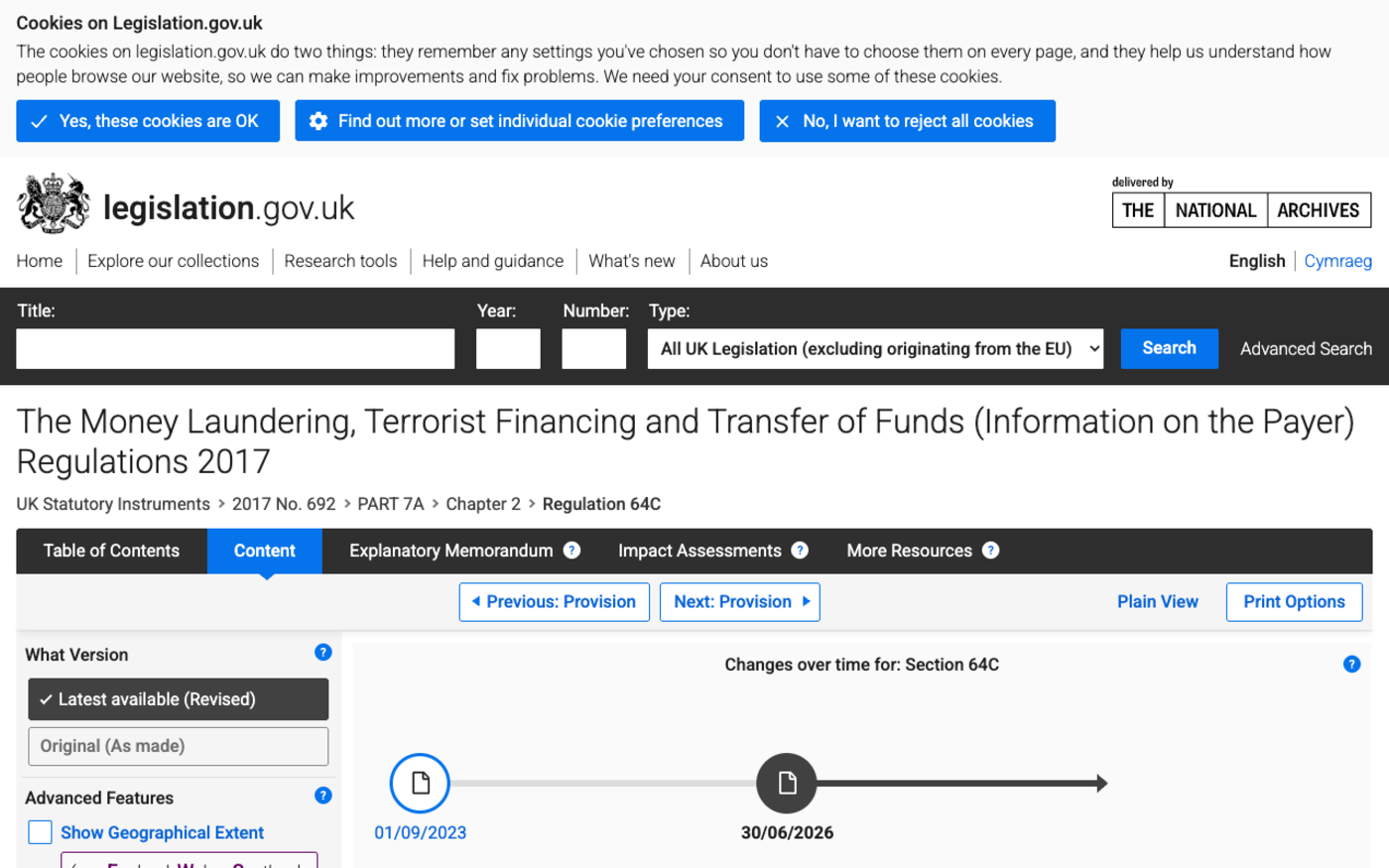
Every page we read while planning this article gives the threshold as €1,000 or £1,000. For the UK that has been wrong since the end of June. Regulation 64C(4) now applies the extended dataset where a transfer "is equal to or exceeds the equivalent in cryptoassets of [£800] in value (taken together with any other cryptoasset transfer which appears to be linked)". The annotation gives the provenance: "Sum in reg. 64C(4) substituted (30.6.2026) by The Money Laundering and Terrorist Financing (Amendment) Regulations 2026 (S.I. 2026/621)". The same instrument moved the matching sum in regulation 64G(1)(b), for unhosted wallet transfers.
A hundred pounds sounds like nothing until you see what sits in that band: a mid-range hardware order, two months of a B2B subscription, most single-item electronics sales. Payments that cleared without a second form in May can ask for one now.
| Regime | What triggers the extended dataset | Figure | Source read 22 Oct 2026 |
|---|---|---|---|
| UK, two cryptoasset businesses, not all UK-based | At or above the sum, counting linked transfers | £800 (was £1,000) | reg. 64C(4), substituted 30.6.2026 |
| UK, two UK cryptoasset businesses | No threshold: follows a request, within three working days | Any value | reg. 64C(2)-(3) |
| UK, unhosted wallet transfer | At or above the sum, where the customer is the beneficiary | £800 (was £1,000) | reg. 64G(1)(b), substituted 30.6.2026 |
| EU Transfer of Funds Regulation | Stated for "all crypto service providers involved in crypto transfers", from December 2024 | No threshold stated | European Commission AML/CFT page |
| What a MiCA-licensed gateway says it does | Name, country, date of birth always; more above unpublished thresholds | Not published | CoinGate's Travel Rule post |
Plan for the pattern, not the number: the basic dataset travels on everything, and the extended set arrives at a figure that moves. Build as though it is always coming, and a threshold change is somebody else's news story.
What has to travel with the transfer
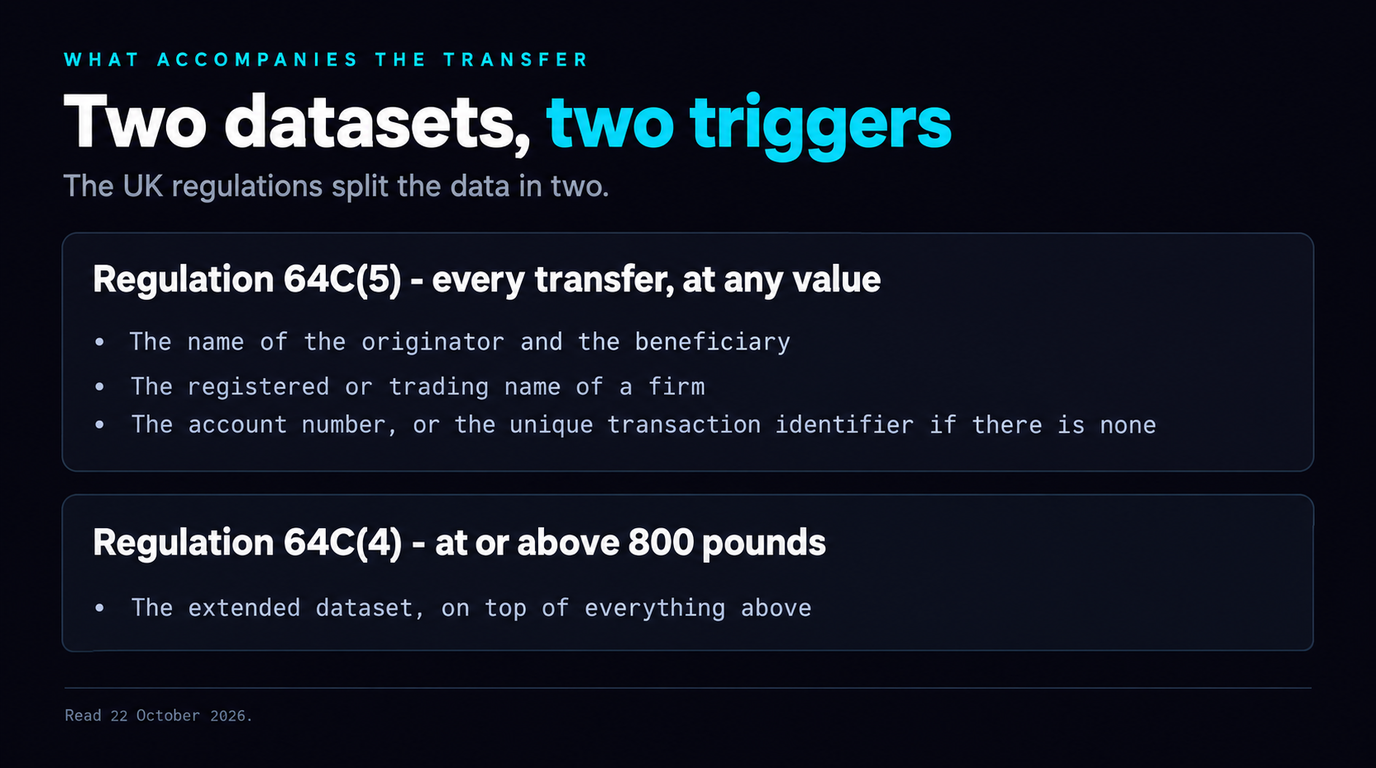
The UK regulations split the data in two. Regulation 64C(5) travels with every transfer: "the name of the originator and the beneficiary", the registered or trading name of a firm, and "the account number of the originator and the beneficiary, or if there is no account number, the unique transaction identifier". Regulation 64C(6) is the extended set, satisfied for an individual by any one of four things: a customer identification number, an address, a "birth certificate number, passport number or national identity card number", or a "date and place of birth".
That "one of the following" answers a question merchants ask constantly: why does one gateway want a date of birth and another an address? The regulation offers a menu, and each firm picks what it can collect most reliably.
| Dataset | Fields | When it applies |
|---|---|---|
| UK basic (reg. 64C(5)) | Names of originator and beneficiary; registered or trading name for a firm; account numbers, or a unique transaction identifier | Every inter-business transfer |
| UK extended (reg. 64C(6)) | For an individual, one of: customer ID number; address; birth certificate, passport or national ID number; date and place of birth | On request between UK firms; at or above £800 otherwise |
| CoinGate, from a shopper | Email, name, date of birth, country of residence | Before the payment can process |
| CoinGate, for a payout recipient | Email, name, surname, country of residence, address | When a beneficiary is paid by a merchant |
| Confirmo, about an end customer | Full name; account number or wallet address; full physical address; date and place of birth; official personal document number | On transactions processed for a merchant |
Two clauses decide how hard that data is to supply late. Regulation 64C(8) requires the originator's information to have been "verified" against "documents or information" from an independent reliable source, and 64C(9) is categorical: a business "must not make an inter-cryptoasset business transfer before ensuring full compliance with this regulation". Nothing here is fixable afterwards; the transfer does not go.
CoinGate tells merchants what it will ask
CoinGate is the only gateway here that has written the whole thing down for the person integrating it, and as a MiCA licence holder in Lithuania it is bound by the EU rule directly. Its post separates the two cases a merchant must keep apart. "When a crypto transaction happens between two regulated providers in jurisdictions where the Travel Rule applies (for example, between CoinGate and Kraken), we'll need to exchange data to ensure that both sides know who the sender and the recipient are." Then: "Conversely, if the transaction involves a self-hosted wallet, we'll need to make sure we know who owns that self-hosted wallet."
For shoppers the ask is stated exactly: "we'll collect your name, country of residence and date of birth", with more "if your payment exceeds certain thresholds or conditions". The glossary gives the checkout version in a line — "Email address, name, date of birth and country of residence, before the payment can process" — then makes the commercial point: those fields are a conversion loss you can choose not to take. If your checkout holds the buyer's billing details, pass them through when you create the order and the shopper only confirms them.
That is the cheapest compliance win a crypto merchant has, and it is one API object. We mapped what each checkout accepts, field by field, in our reading of ten gateways' customer data.
Confirmo expects the data from you, not your buyer
Confirmo does not publish a merchant guide to the rule, but its privacy policy is the most legally precise document in the set, and one sentence in it should change how a merchant plans an integration. The Travel Rule data about end customers, it says, "may be collected directly from the End-Customer, but it is usually provided to us by the Merchant or another Virtual/Crypto Asset Service Provider processing the transaction".
Read that as an operational requirement, not a disclosure: the usual path, by the gateway's own account, runs through your systems. And the dataset is the deepest we read — full name, account number or wallet address, full physical address, date and place of birth, and an "official personal document number". Most e-commerce checkouts do not hold a passport number, or want to.
Confirmo also names the parent standards, which no other gateway does: it processes end-customer data "as required to comply with binding legal and regulatory obligations, such as Financial Action Task Force (FATF) Recommendation 16 and its local implementations ('Travel Rule') such as Regulation (EU) 2023/1113". The legal basis is GDPR Article 6(1)(c), and retention for these records runs "ten years or more" after the relationship ends — your buyer's document number in someone else's system for a decade. Where that data lands is our reading of ten gateways' GDPR posture.
The leg that bites is your payout
On the checkout leg you are a bystander: the gateway collects what it needs and the payment processes or does not. On the payout leg you are the customer, the beneficiary, and the one whose information is missing.
Take the self-hosted case first. CoinGate states the consequence for business clients directly: "If you're making a transaction using a self-hosted wallet, we'll ask you to provide evidence of owning the external crypto wallet in your CoinGate account dashboard. This will typically be a one-time requirement, so long as you're depositing and/or withdrawing crypto using the same external address." The regulations say what happens if you do not: under regulation 64G(1)(b) a business may request the extended dataset where an unhosted wallet transfer reaches £800 and its customer is the beneficiary, and regulation 64G(4) closes it off — "In the event that the cryptoasset business involved in an unhosted wallet transfer does not receive information requested under paragraph (1) it must not make the cryptoasset available to the beneficiary."
Now the exchange case, which is how most merchants cash out. Paying from your gateway into your own exchange account is a transfer between two businesses, so the receiving side runs regulation 64D(1): before releasing funds it must confirm it got the required information and that "the information relating to the beneficiary corresponds with information verified by it under Part 3" — its own due diligence. In plain terms, the name your gateway sends has to match the name on your exchange account. A company paying out to a director's personal account, or to one opened under a trading name rather than the registered one, is a discrepancy the receiving firm must notice.
Neither failure looks like a compliance problem from your dashboard. It looks like a payout that has not arrived, which is why it is misread as an AML hold or as inbound screening — different mechanisms, different remedies.
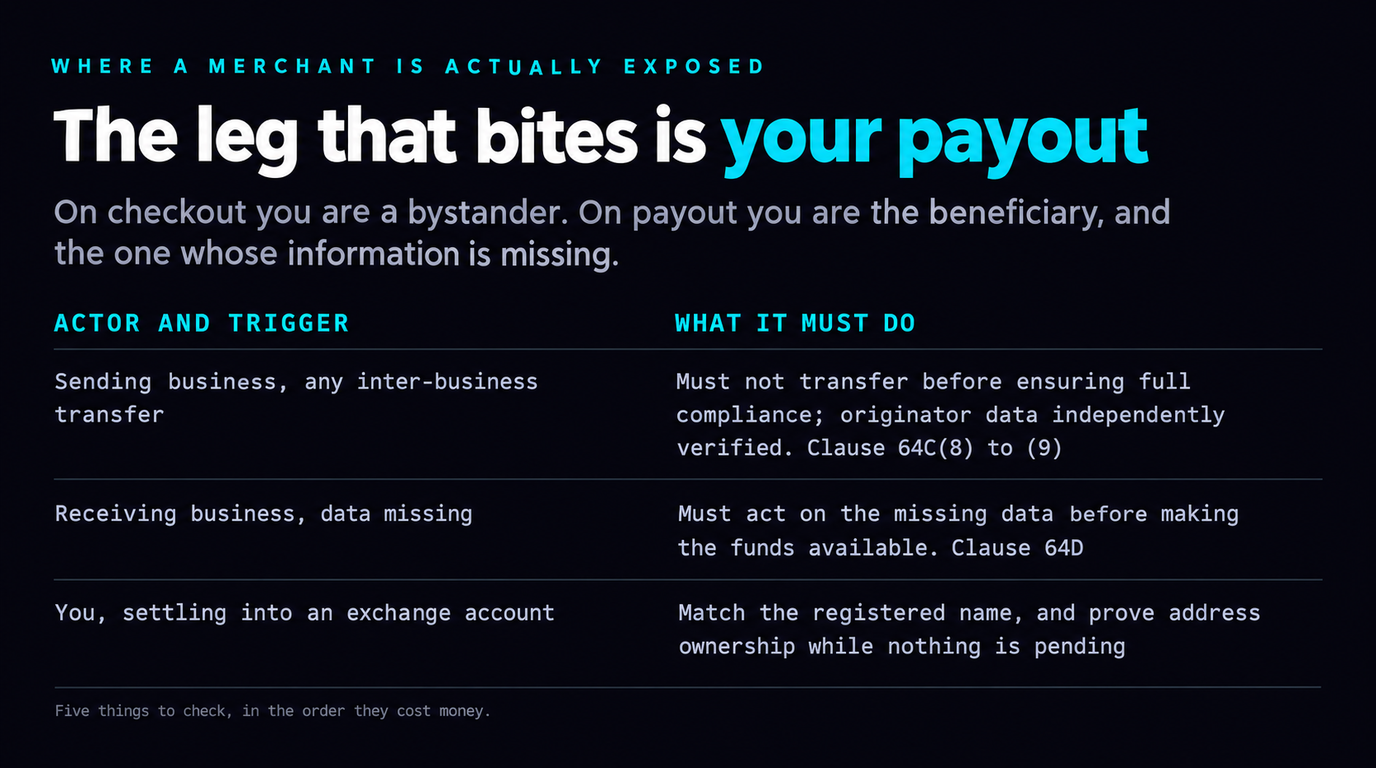
What the receiving provider must do when data is missing
The regulations set out the sequence, and reading it tells you what to ask for when a transfer stalls.
| Actor | Trigger | What it must do | Clause |
|---|---|---|---|
| Sending business | Any inter-business transfer | Must not transfer before "ensuring full compliance"; originator data independently verified | 64C(8)-(9) |
| Receiving business | Data missing, or beneficiary data does not match its records | Request it; consider enquiries; consider delaying release; if unresolved "within a reasonable time", consider returning the asset to the sender | 64D(2) |
| Receiving business | Repeated failures by one counterparty | Report the firm to the FCA, with the steps taken | 64D(5) |
| Intermediary | Data missing on an onward transfer | Request it; consider delay or return; pass on all it received | 64E(2), 64F |
| Either side | Unhosted wallet transfer, requested data not received | Must not make the asset available to the beneficiary | 64G(4) |
Three things follow. A delay under 64D(2) weighs risk factors including "the duration of its business relationship with the beneficiary", so a brand-new exchange account is the worst place to route a first large settlement. A return under 64D(2)(c)(ii) sends the asset to the sending business, not to you: recoverable, on someone else's timeline. And a stop under 64G(4) is no judgement call at all.
Where FATF appears without the rule
Four of the twelve name the Financial Action Task Force somewhere, which is how a gateway can look as though it has addressed this. Besides Confirmo, none of them is talking about transfers.
Cryptomus cites FATF six times in an AML policy reviewed on 1 October 2026, every time about posture or geography: a risk-based approach "in line with the principles set out by" FATF, exposure to "jurisdictions identified as high-risk". NOWPayments uses it once, to define a high-risk country. CoinGate's merchant terms use it for eligibility — refusing a merchant resident in "a country that is not a member of the Financial Action Task Force".
A FATF citation in an AML policy tells you how a gateway assesses you. Recommendation 16, the one that makes data travel, appears in one gateway document here.
The designs the rule does not reach
Two structures sidestep the whole question, and both are already in the directory.
The first is self-hosting. BTCPay Server calls itself "a non-custodial invoicing system which eliminates the involvement of a third-party", where "payments with BTCPay go directly to your wallet". Against the UK definitions the arithmetic is simple: a cryptoasset transfer is an inter-business transfer or an unhosted wallet transfer, the first needs two cryptoasset businesses and the second needs one. A buyer paying from their own wallet into your own node has none. There is a carve-out at the other extreme too: Part 7A "does not apply to a cryptoasset transfer where both the originator and the beneficiary is a cryptoasset business acting on its own behalf".
The second is the forwarding model, where the gateway watches the chain and funds land in a wallet you control — the pattern in our guide to non-custodial and forwarding gateways. It does not make the rule disappear, since the gateway may still be regulated for what it does, but it changes which legs exist: nothing settles into a third party's balance and back out, so the expensive leg is not there to fail. Neither route is free — a node to run, or no fiat conversion in the flow.
What to check before your next payout
Five things, in the order they cost money.
- Match the name. The registered name on your gateway account and on the exchange account you settle into must be the same legal person. Regulation 64D(1)(b) makes the receiving firm compare them.
- Do the ownership proof while nothing is pending. CoinGate says it is typically one-time per address: doing it early costs nothing, doing it late costs a stopped payout.
- Pre-fill the shopper fields. You already hold the buyer's name and country. Passing them through turns a form into a confirmation.
- Decide what you will not hold. If a dataset reaches a passport number, choose whether it crosses your systems or goes straight to the provider — through your database makes it yours to secure, behind your API credentials.
- Ask the question no page answers. Ask support what they require on a withdrawal to a self-hosted address, and at what value. Ten of twelve do not publish it, so the answer only exists in a ticket.
The fewer parties hold your settlement, the fewer have to ask who you are.
- Crypto Gateway Customer Data 2026: We Checked 10
- Crypto Payment Gateway GDPR 2026: We Read 10
- Crypto Gateway AML Holds 2026: Nobody Says How Long
- Crypto Payment Screening 2026: Where the Money Goes
- No-KYC Crypto Payment Gateways: 5 Options and Their Conditions
- CoinGate Review: Fees, MiCA Licence, KYB and Who Can Use It
A gateway that has not written down what it will ask will still ask it. Find that out before your first large payout, not during it.
We track fees, custody, KYC and settlement for every processor in the directory. CoinGate is the only one here that publishes a merchant-facing explanation of the rule; Confirmo names the regulation and the dataset; BTCPay Server puts no third party in the path at all.
Compare Crypto Payment Gateways →Affiliate disclosure: Payyd earns a commission if you sign up to some providers linked on this page. It changes none of the quoted clauses, figures or document dates reported here, all of which come from the providers' own published documents or the legislation itself and are linked below.
FAQ
What is the crypto Travel Rule?
It is the requirement that identifying information about the sender and recipient travels with a crypto transfer between regulated firms. It comes from FATF Recommendation 16, implemented in the EU by Regulation (EU) 2023/1113 — applying from December 2024, per the European Commission — and in the UK by Part 7A of the 2017 money laundering regulations.
Does the Travel Rule apply to merchants accepting crypto?
Not directly. The duty sits on the regulated provider handling the transfer, and selling goods for crypto does not make you one. It reaches you through your gateway: data about your buyer and your payout recipient, and evidence that a wallet you withdraw to is yours.
What is the Travel Rule threshold in 2026?
It depends on the jurisdiction, and the UK figure changed this year: regulation 64C(4) now sets it at £800, substituted on 30 June 2026 by S.I. 2026/621, and the matching sum in 64G(1)(b) moved with it. Between two UK firms there is no threshold for the extended dataset; it follows a request, within three working days.
Why does my crypto gateway ask my customer for a date of birth?
Because the extended dataset can be satisfied by any one of several identifiers. Regulation 64C(6) lists a customer identification number, an address, a passport or national ID number, or a date and place of birth. CoinGate collects name, country of residence and date of birth, and lets you pre-fill those fields.
Do I have to prove I own my own crypto wallet?
If you withdraw from a regulated gateway to a self-hosted address, expect to. CoinGate asks for "evidence of owning the external crypto wallet", typically once per address. Regulation 64G(4) is why: a business that does not receive the information it requested on an unhosted wallet transfer "must not make the cryptoasset available to the beneficiary".
What happens if the Travel Rule information is missing?
The receiving business must request it, consider enquiries and a delay, and if unresolved within a reasonable time consider returning the asset to the sender. Repeated failures by one counterparty go to the FCA. On an unhosted wallet transfer there is no discretion: without the requested information the asset is not released.
Does the Travel Rule apply to BTCPay Server or a self-hosted gateway?
On the UK definitions, a transfer with no cryptoasset business at either end is not a cryptoasset transfer, so neither limb of Part 7A is engaged. BTCPay Server has "no third-party involvement" and payments go "directly to your wallet" — at the cost of running your own node and fiat conversion.
Sources
Read 22 October 2026:
- The Money Laundering, Terrorist Financing and Transfer of Funds (Information on the Payer) Regulations 2017, Part 7A (regs. 64A–64H; £800 substituted 30.6.2026 by S.I. 2026/621, regs. 32-33)
- European Commission — Anti-money laundering and countering the financing of terrorism at EU level (TFR 2023/1113; "applies as of December 2024")
- CoinGate — The Travel Rule (TFR) at CoinGate, Explained (wallet ownership evidence; 24 October 2025)
- CoinGate — What is the travel rule? (checkout fields; shopper-object pre-fill)
- CoinGate — Privacy Policy (payee and beneficiary datasets; August 2026)
- CoinGate — Merchant Terms of Service (clause 27.5.9)
- Confirmo — Privacy Policy (PDF) (FATF R16 and Regulation (EU) 2023/1113 named; 16.10.2026)
- Cryptomus — AML/CFT Policy (FATF for risk approach only; reviewed 1 October 2026)
- NOWPayments — AML/KYC Policy (PDF) (FATF only defines a high-risk country; 15 December 2025)
- BitPay — Merchant Terms of Use (effective 1 April 2026; no Travel Rule clause)
- BlockBee — AML Policy (7 September 2026)
- B2BinPay — AML and KYC (9 March 2026)
- PassimPay — Terms (11.05.2026)
- Plisio — Privacy Policy (PDF) (12 March 2019)
- Apirone — Privacy Policy (in effect 1 September 2017)
- OpenNode — Terms and Conditions (undated)
- Triple-A — Terms (undated)
- BTCPay Server — General FAQ ("no third-party involvement")