Web3 Payment Gateways: Non-Custodial, Forwarding or Custodial
Which web3 payment gateways settle to your own wallet? BTCPay Server, ATLOS, Paymento, PayGate.to and Coinremitter checked on custody, fees and KYC.
 Brian Ormond
Key Takeaways
- "Web3" gateways use three custody models: non-custodial (payments land in your wallet), forwarding (they pass through an address someone else controls) and custodial (the provider holds your balance). The model decides who can freeze or lose your money.
- Non-custodial: BTCPay Server (self-hosted, 0%), ATLOS (wallet sign-in, 1%) and Paymento (account sign-up, 0.5%). Solana Pay is an open protocol for direct checkouts.
- PayGate.to forwards payments through third-party infrastructure. Coinremitter is custodial under its own terms.
- On-chain is not self-custody: Shopify's USDC payments use an open smart-contract protocol, but merchants are paid through Shopify Payments.
- With self-custody, fiat conversion, refunds and key security are your job.
If you want customer payments to land in a wallet only you control, there are three ready-made routes: run BTCPay Server yourself, connect a wallet to ATLOS, or use Paymento with your own addresses. All three settle on-chain and never take custody of the money. Other products marketed as "web3" or "decentralized" either forward funds through an address that they or their partners control, or hold your balance until you withdraw.
This guide sorts products by that difference first, because it decides who can freeze, lose or delay your money. Fees, networks and identity checks come second.
The Three Custody Models
Whoever holds the private key for an address controls the coins in it. So ask of any gateway: whose key controls the address where the customer's payment lands, and every address it passes through after that?
Non-custodial: straight to your wallet
The customer pays an address derived from your own keys, or a smart contract that passes the funds to you in the same transaction. The gateway creates payment requests, watches the blockchain and notifies your store, but cannot move the money. If the company shuts down, payments already received are unaffected.
Two mechanisms do most of the work. An extended public key (xpub) lets software generate a fresh address per order without being able to spend from it; BTCPay Server and Paymento use this on Bitcoin-style chains. A smart contract moves tokens from the customer's wallet to yours; ATLOS uses this on EVM chains such as Ethereum, Base and Polygon.
Forwarding: via someone else's address
The gateway creates a temporary address for each order, and its system sends what the customer pays on to your wallet, minus its fee. It is quick and automatic, but for a while your money sits at an address whose key you do not hold. PayGate.to works this way. Forwarding has its own failure mode: a payment too small to cover the forwarding transaction can get stuck.
Custodial: the provider holds your balance
Payments land in the provider's wallets and are credited to your account, and you withdraw later. BitPay and CoinGate work this way, which is what lets them pay out fiat. So does Coinremitter, whose terms appoint it as your agent "for the purpose of receiving, holding, and disbursing cryptocurrency funds".
- Is there a "withdraw" button or a withdrawal fee? If you have to withdraw, someone else holds the balance.
- What do you give the gateway? A non-custodial gateway needs only addresses, an xpub or a wallet signature. It never needs your seed phrase.
- Follow a test payment on a block explorer. Does it go to your address (or a contract that pays you in the same transaction), or to an address you do not recognise?
- Search the terms for words such as "holding", "agent" or "custody".
Comparison at a Glance
Ordered by custody model, then by how much you have to run yourself.
The Gateways in Detail
1. BTCPay Server: Self-Hosted, 0% Fee
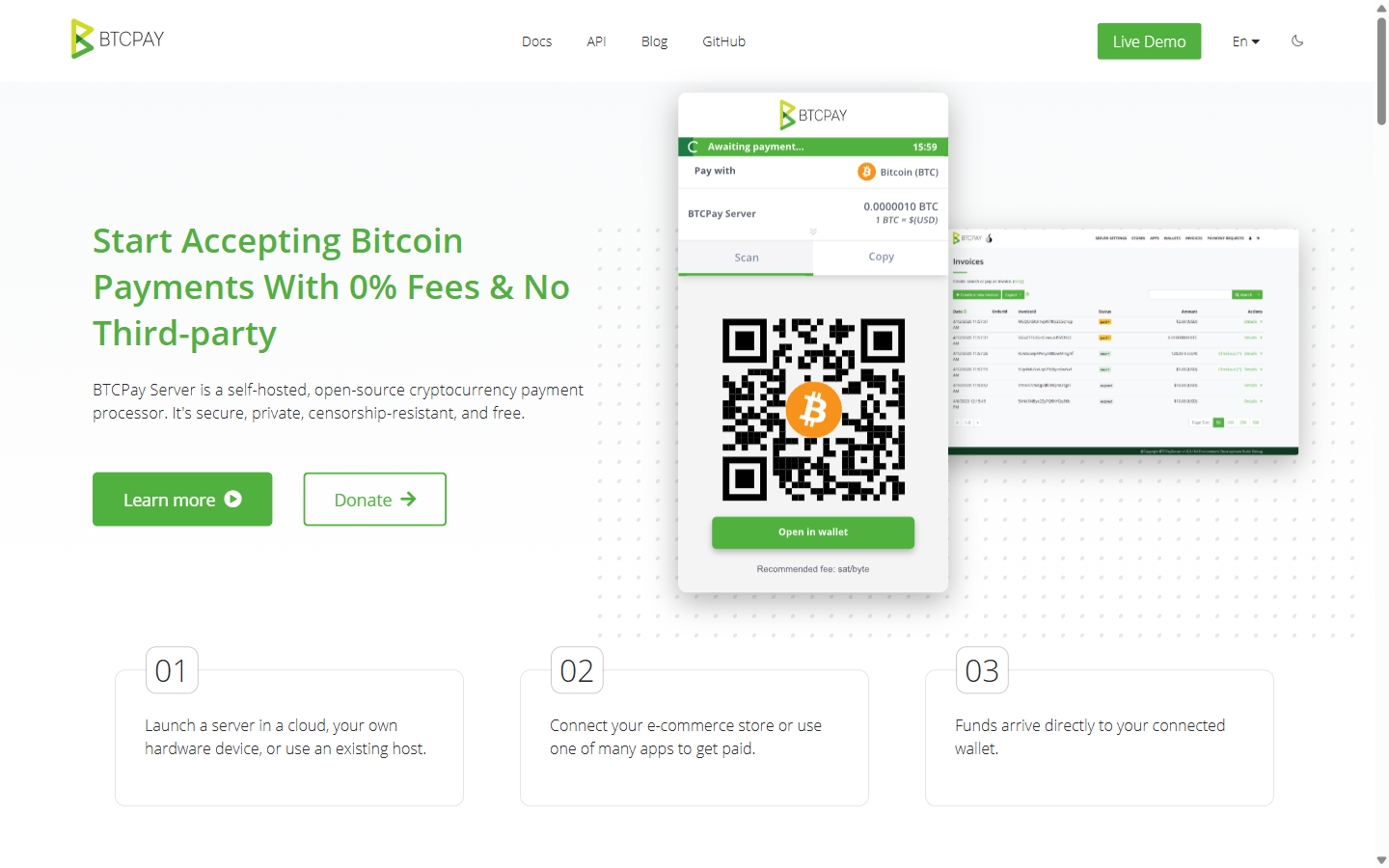
BTCPay Server is free, MIT-licensed software and "an open-source project, not a company", so there is no merchant account, approval or ID check. The GitHub repository dates from August 2017, and Nicolas Dorier is still its most active contributor. The latest release when we checked was v2.4.4, published on 7 September 2026.
- Custody: "Funds arrive directly to your connected wallet." The docs say private keys are never uploaded to the server, so third-party hosts "do not control user funds". The exception is opt-in: the hot wallet stores the seed on the server to sign automatically, so whoever controls that server could spend. Avoid it on a server you do not run.
- Fee: 0%. The docs estimate hosting at $10 a month on LunaNode and $10 to $70 a month on a VPS. Some third-party hosts are free.
- Coins: "Bitcoin is the only focus of the project and its core developers." Community integrations add Litecoin, Monero, Dogecoin, Dash, Zcash, Liquid (with USDt) and USDt on Tron. There is no Ethereum or ERC-20 support. Exchange plugins such as SideShift and Trocador convert other coins into bitcoin, at a fee to your customer.
- Lightning: run LND or Core Lightning yourself, connect an external node or a Lightning service provider, or use a custodial Lightning wallet. Only the self-run options keep Lightning funds under your control.
- Running it: a full node downloads about 300 GB (less if pruned), and the first sync can take one to five days.
- Integrations: WooCommerce, Shopify, Magento, PrestaShop, BigCommerce, OpenCart, Wix, WHMCS and more, plus a point-of-sale app, payment links, an API and pull payments for refunds.
Best for: bitcoin-focused merchants who can run or rent a server. See our BTCPay Server setup guide and the open-source gateway comparison.
2. ATLOS: Wallet Sign-In, Smart-Contract Settlement
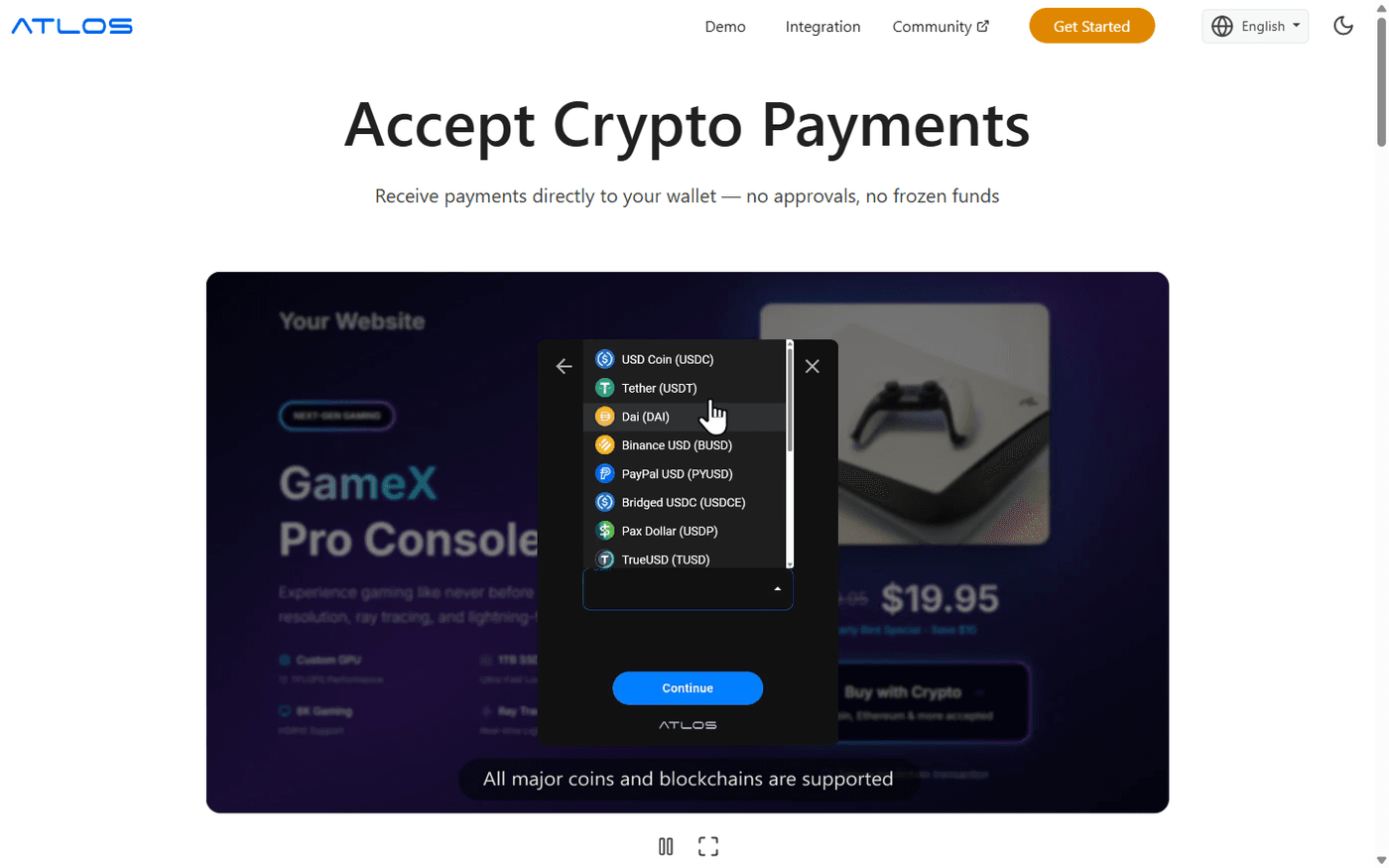
ATLOS replaces the merchant account with a wallet login: "There is no account verification, email, or phone number required." Its smart contract "pulls the correct amount of funds from the user's wallet and sends it directly to the merchant". ATLOS says it "does not custody your funds" and "cannot freeze your funds". It describes itself as a community-maintained project managed by ATLOS DAO.
- Fee: 1% per transaction, with no monthly, withdrawal, refund or chargeback fees. ATLOS says fees "are subject to change depending on business risk factors", and that paying fees in its ATLOS token saves up to 50%.
- Fee catch-up: ATLOS can only take its fee on payments through its smart contract. Payments on chains such as Bitcoin and Monero, where you add your own addresses or keys, build up a fee balance that is taken from a later smart-contract payment, so one payment can carry more than 1%.
- Networks (11): Bitcoin, Ethereum, Solana, BNB Smart Chain, Tron, Base, Arbitrum One, Polygon, Litecoin, Dogecoin and Monero. Stablecoins include USDC, USDT, DAI and PYUSD.
- Integrations: WooCommerce, Shopify, WHMCS, Kajabi and Telegram mini apps.
- Subscriptions and payouts: daily, weekly, monthly or yearly collection from the customer's wallet, plus a Payouts API.
Best for: merchants who want stablecoins across several chains, or crypto subscriptions, without running a server or opening an account. See crypto subscription billing for alternatives.
3. Paymento: An Account, but Your Keys
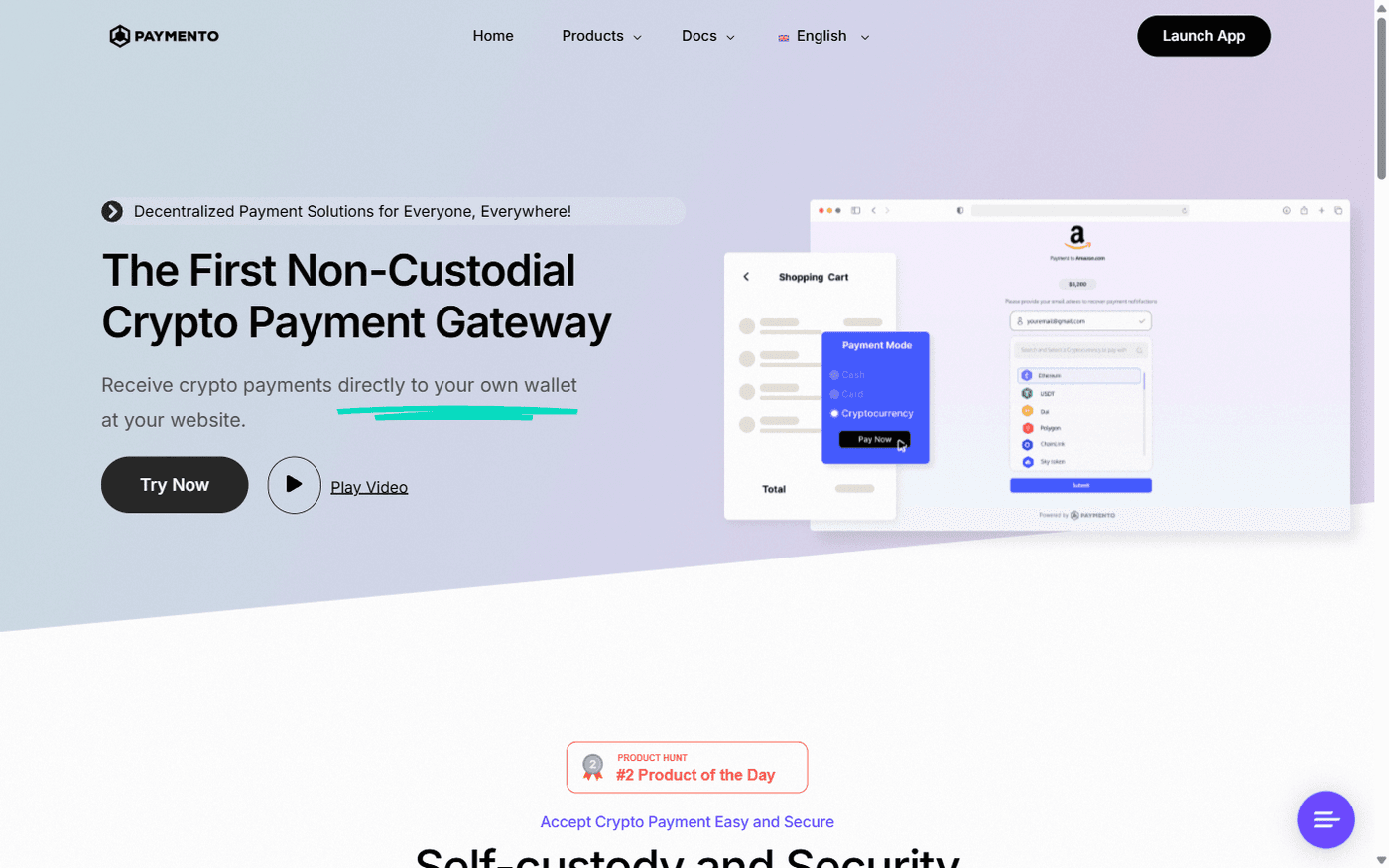
Paymento's terms say it does not "hold, manage, or control your crypto assets or funds in any way". Unlike ATLOS, you open an account, with email verification if required. Its setup guide has no identity-document step, and its homepage calls the service "KYC-free".
- Two ways to receive: With Bring Your Own Wallet, you give an xpub for Bitcoin-style chains or an address for account-based chains such as Ethereum and Solana, and "payments arrive directly in your existing wallet". With the Embedded Wallet, you register a passkey and "payments remain in the merchant-controlled store wallet until you authorize settlement" to an external wallet you choose.
- Fee: 0.5% per successful payment with your own wallet, or 0.5% plus $0.20 with the Embedded Wallet, plus a network fee when you settle. New accounts start with $15 of free fee credit, which Paymento says covers the first $3,000 of payments.
- Checkout: the docs say the Embedded Wallet lets customers on most account-based networks pay to an address and QR code instead of connecting a wallet, so with your own wallet expect them to connect one.
- Assets: "over 4000 crypto assets", by Paymento's own count.
- Plugins: WooCommerce, OpenCart and WHMCS are available. Its plugin documentation lists Shopify, Magento and BigCommerce as in development.
- Instalments: Paymento says merchants can offer buy now, pay later and instalment payments, with customers borrowing from DeFi lending protocols while their collateral stays in smart contracts.
Best for: a hosted dashboard and plugins at a lower percentage than ATLOS, with your own keys.
4. PayGate.to: No Sign-Up, Forwarding Model
PayGate.to needs no account, no API keys and "no KYC/KYB for merchants". You enter your wallet address in its WooCommerce plugin, WHMCS module or an API call. Each order gets a temporary address, and payments are "instantly forwarded to your original wallet". Its terms say it holds no private keys and that custody "resides solely with the applicable third-party provider operating the wallet or blockchain infrastructure".
- Fee: its crypto gateway page states a "1.5% flat rate fee + blockchain fees", and you choose whether you or the customer covers the blockchain fee. Its API documentation describes a 1% service fee on payouts instead. Check which applies on a small test order.
- Coins: its public API listed 105 coin and network combinations across 21 networks on 6 October 2026. These included BTC, LTC, BCH, DOGE, ZEC, XMR, ETH, SOL, TRX and TON, with stablecoins on Ethereum, Arbitrum, Base, Optimism, Polygon, Avalanche, BNB Smart Chain and Tron.
- Minimums: the API docs warn: "Any sent amount below the minimum will be stuck in the generated address forever as it is less than required fees to process your forwarding transaction." See minimum crypto payment amounts.
- Extras: payment links, split payouts to up to 19 wallets, and automatic forwarding when a customer pays on the wrong TRC-20 or EVM network.
Best for: WooCommerce or WHMCS merchants who want to go live in minutes and accept that funds pass through third-party addresses.
5. Coinremitter: Custodial, So Not Web3 in This Sense
Coinremitter is often listed as non-custodial, including in earlier versions of this guide. Its own documents say otherwise. Its FAQ says payments are accepted "in an internal wallet", with fees charged when you withdraw, and its terms make Coinremitter your agent for "receiving, holding, and disbursing" your funds.
- Fee: 0.23% processing fee, charged only when you withdraw, plus a fixed fee per coin, for example 0.0001 BTC, or 2 USDT on ERC-20 or TRC-20.
- Coins (12 mainnet): BTC, LTC, BCH, ETH, DOGE, DASH, BNB, TRX, ZANO, USDT (ERC-20 and TRC-20) and USDC (ERC-20).
- Identity: no ID to register, per the FAQ. The terms, however, ask for your legal name, business registration and beneficial owners, and allow identity checks and document requests at any time, with suspension if you do not comply.
- Other conditions: plan- and risk-based transaction limits, minimum age 22, no service for Singapore, possible suspension after a year of inactivity, no fiat settlement.
If you choose it for the low percentage, treat it like any custodial processor and withdraw regularly, weighing the fixed per-coin fee against how much you leave with the provider.
Smart Contracts and Stablecoin Rails
Smart-contract payments are already in production. Three patterns are worth knowing, because each answers the custody question differently.
Push: Solana Pay
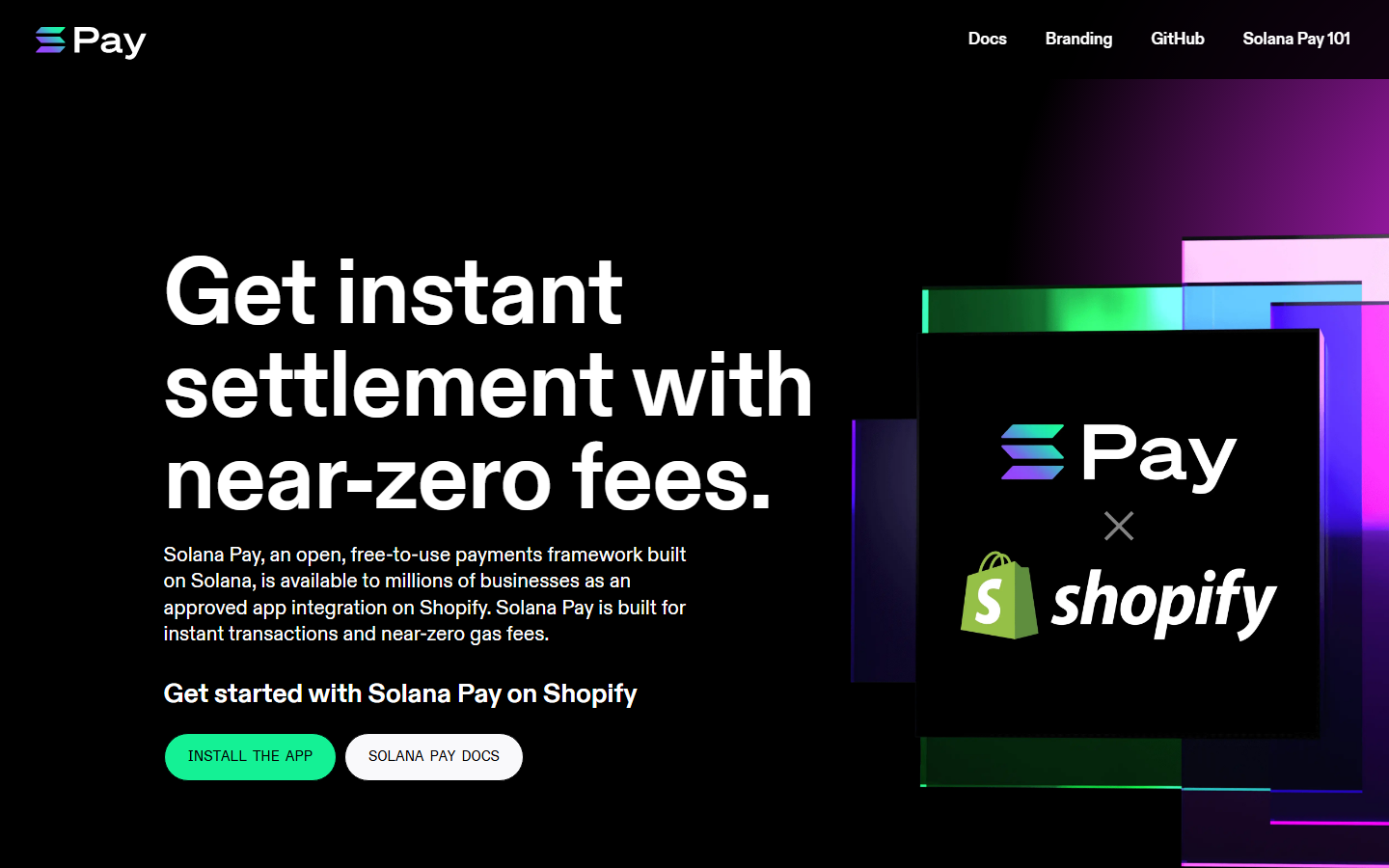
Solana Pay is "a standard protocol and set of reference implementations", not a company you sign up with. Its homepage calls it "an open, free-to-use payments framework", also available as an approved Shopify app. In its simplest form, a transfer request, a link or QR code tells the customer's wallet to send SOL or an SPL token such as USDC straight to the merchant's address. A unique "reference" key added to the transaction lets your system find and verify the payment on-chain. A transaction request is the interactive version, in which the wallet asks your server to build the transaction. The Solana Pay docs say the network confirms transactions in under a second at an average cost of $0.0005. Nobody sits between payer and merchant, but you build or install the checkout. See our Solana Pay review.
Pull: ATLOS and token allowances
On EVM chains, a contract can only move a customer's tokens if the customer has approved it. In the ERC-20 standard, approve "allows _spender to withdraw from your account multiple times, up to the _value amount". That is what makes on-chain subscriptions like ATLOS's possible. It also means a renewal fails if the customer resets the allowance or does not hold enough tokens on the due date. Plan for retries and reminders, as you would with card subscriptions. For more, see recurring crypto payments.
Escrow: the Commerce Payments Protocol
Coinbase and Shopify announced the Commerce Payments Protocol in June 2025. It is a set of open-source smart contracts (MIT licence) on Base that bring card-style operations on-chain: authorize, capture, charge, void, reclaim and refund. Between authorisation and capture, funds sit in an escrow contract. An "operator" address moves them, but operators "cannot modify the original payment intent" and "cannot lock funds in the escrow".
Shopify says the protocol powers its USDC payment method in Shopify Payments, which shows why "on-chain" and "self-custody" are separate questions. Shopify accepts USDC on Base, Ethereum, Optimism, Polygon and Arbitrum. The merchant, though, is paid through Shopify Payments, either in their payout currency or, where available, into a USDC balance they claim from the Shopify admin. The payment rail is on-chain, but your money is held by Shopify Payments until it pays you out. See Shopify crypto payment options.
Networks and Fees
The network a customer pays on sets their transaction fee and how fast you see the payment. Which networks each gateway lists:
Paymento is not in the table because the pages we checked give no per-network list; its homepage names Bitcoin, USDT, Ethereum and Solana.
The customer pays the network fee on every payment. Forwarding adds a second transaction from the temporary address to you (PayGate.to lets you choose who pays it), and custodial gateways add a withdrawal (Coinremitter charges a fixed per-coin fee).
Ethereum mainnet is not automatically expensive. When we loaded Etherscan's gas tracker on 6 October 2026, it showed 0.147 gwei, with a standard transaction estimated at $0.008 and a token swap at about $0.15. Gas rises when the network is busy, which is one reason to also accept an L2, Solana or Tron. See our guide to crypto payment networks.
What You Take On
Self-custody removes the gateway as a point of failure, and moves work from the gateway to you.
- Key security: nobody can recover a lost seed for you. Keep backups offline, and consider a hardware wallet for receiving.
- Fiat: none of the non-custodial or forwarding gateways here pays out to a bank. ATLOS's FAQ points merchants to exchanges or peer-to-peer marketplaces, which run their own identity checks. Custodial gateways do offer it: BitPay settles every business day in USD, EUR, GBP, AUD, CAD, MXN, NZD or CHF, and CoinGate converts to EUR, GBP, USD or stablecoins. Both verify your business first (BitPay asks for ID from every owner with 25% or more). Compare gateways with fiat settlement.
- Refunds: on-chain payments have no card-style chargeback, and ATLOS states it has none. You send refunds yourself; BTCPay Server's pull payments let the customer submit a refund address. See crypto refunds for merchants.
- Price risk: volatile coins land in your wallet unconverted. Pricing in stablecoins avoids most of this. See crypto payment volatility.
- Compliance: ATLOS's terms say it is not intended for use where it would be "contrary to local law or regulation". Skipping a gateway's identity checks does not change your tax or licensing obligations.
How to Choose
- You can run a server and mainly want bitcoin: BTCPay Server. No fee, no account, and Lightning if you want it.
- You want stablecoins on several chains, no server and no account: ATLOS, especially for subscriptions. Budget for 1% plus fee catch-up if you also take Bitcoin or Monero.
- You want a hosted dashboard, plugins and your own keys at 0.5%: Paymento, as long as its available plugins (WooCommerce, OpenCart, WHMCS) cover your platform.
- You want to be live on WooCommerce or WHMCS in minutes and can accept forwarding: PayGate.to. Test small payments against its per-coin minimums first.
- You are building your own checkout on Solana: Solana Pay.
- You need fiat in a bank account: a custodial gateway such as BitPay or CoinGate; see our BitPay and CoinGate reviews.
- You want the lowest percentage and accept custody: Coinremitter, after reading its terms on verification, limits and withdrawal fees.
Compare Non-Custodial Gateways
Custody model, fees and networks for gateways that pay into your own wallet.
See the Non-Custodial ShortlistFrequently Asked Questions
What is a web3 payment gateway?
In this guide, a gateway where each payment settles on-chain to a wallet the merchant controls, using an extended public key, a direct wallet transfer or a smart contract. BTCPay Server, ATLOS, Paymento and the Solana Pay protocol work this way. Products that hold your balance until you withdraw are custodial, however they are marketed.
What is the difference between non-custodial and forwarding?
With a non-custodial gateway, the customer pays an address derived from your own keys, or a contract that passes the funds to you in the same transaction. With a forwarding gateway, the customer pays a temporary address controlled by the gateway or its partner, which then sends the funds on to you. PayGate.to uses forwarding and warns that amounts below a coin's minimum stay stuck in the temporary address.
Is BTCPay Server really free?
The software is free and MIT-licensed, and the project takes no percentage of payments. You pay for hosting: BTCPay Server's documentation estimates about $10 a month on LunaNode and $10 to $70 a month on a VPS. Customers pay the bitcoin network fee when they send a payment.
Can a non-custodial gateway freeze my funds?
Not funds it never holds. ATLOS says it cannot freeze your funds, and BTCPay Server's docs say third-party hosts do not control user funds. The exception is any option that puts the key with someone else, such as BTCPay Server's optional hot wallet on a host you do not control, or a custodial Lightning wallet.
Can a web3 gateway pay me in dollars or euros?
Not the non-custodial or forwarding gateways in this guide. ATLOS's FAQ tells merchants to convert at an exchange or peer-to-peer marketplace, and Coinremitter's terms say fiat settlement is not available. BitPay and CoinGate settle to bank accounts in fiat, but they hold your funds and verify your business first.
Do web3 gateways support subscriptions?
Some do. ATLOS supports recurring payments at daily, weekly, monthly or yearly intervals by collecting from the customer's wallet. On EVM chains this relies on the ERC-20 approve mechanism, so a payment fails if the customer revokes the allowance or does not hold enough funds when it is due.
Sources
Primary sources checked on 6 October 2026:
- BTCPay Server: homepage, features and integrations
- BTCPay Server docs: deployment options and costs
- BTCPay Server docs: altcoin FAQ
- BTCPay Server docs: wallet and hot-wallet signing
- BTCPay Server docs: Lightning Network options
- BTCPay Server docs: node synchronisation
- BTCPay Server docs: payouts and pull payments
- BTCPay Server on GitHub: licence, history and releases
- ATLOS: homepage
- ATLOS: pricing
- ATLOS: accepted coins and networks
- ATLOS: FAQ
- ATLOS: terms of use
- Paymento: homepage
- Paymento: fees and pricing
- Paymento docs: getting started
- Paymento docs: prebuilt plugins
- Paymento: terms of service
- PayGate.to: crypto payment gateway
- PayGate.to: crypto payment API docs
- PayGate.to: terms
- PayGate.to: public coin and minimums API
- Coinremitter: FAQ
- Coinremitter: terms and conditions
- Coinremitter: fees
- Coinremitter: supported currencies
- Solana Pay: homepage
- Solana Pay docs: introduction
- Solana Pay docs: specification
- EIP-20: ERC-20 token standard
- Shopify Engineering: Commerce Payments Protocol
- Commerce Payments Protocol on GitHub
- Shopify Help Center: USDC payments
- BitPay developer docs: settlement
- BitPay developer docs: compliance and verification tiers
- CoinGate: accept crypto payments
- Etherscan: gas tracker