
Crypto Gateway Insolvency 2026: 6 of 11 Say Nothing
Crypto gateway insolvency, read across 11 merchant contracts in November 2026: one puts client assets outside its estate, and six never raise it at all.
 Brian Ormond
Key Takeaways
- Only five of eleven readable crypto merchant contracts address crypto gateway insolvency at all. Six never raise it, and five of those six use none of the relevant words anywhere.
- Confirmo is the only one that writes the outcome. Clause 5.11 says client funds and crypto-assets are "to be treated as trust property, excluded from our estate, and returned to you in priority to claims of our creditors, in accordance with Irish law".
- B2BinPay is the only one that admits the promise might not hold. It says none of your assets are subject to creditor claims, then warns that in an insolvency "a court may take a different view … despite our intended treatment".
- BitPay says plainly what the silent six leave unsaid. Clause 13.6: if BitPay, Inc. were to become insolvent, "as with any other credits to your Account, you would only have an unsecured claim". Cryptomus says a pooled balance "may be returned partially or not at all".
- The card rails are no better, which breaks the pattern. Stripe's agreement uses "insolvency" nine times and every one concerns the merchant's, not Stripe's.
Every custodial gateway holds your money for a while — between the moment a customer pays an invoice and the moment it settles to you. Crypto gateway insolvency is the question of who owns that money if the company holding it stops trading, and it is the one risk in this market never priced into a fee comparison. We read the custody, segregation and insolvency provisions in eleven crypto merchant agreements and one card-processor agreement on 21 November 2026. Five of the eleven address it. One says your assets sit outside the company's estate. Six never raise it.
Last checked November 2026. Every clause below was read in the provider's own current document on 21 November 2026 and is linked in the Sources section.
Eleven contracts, one question
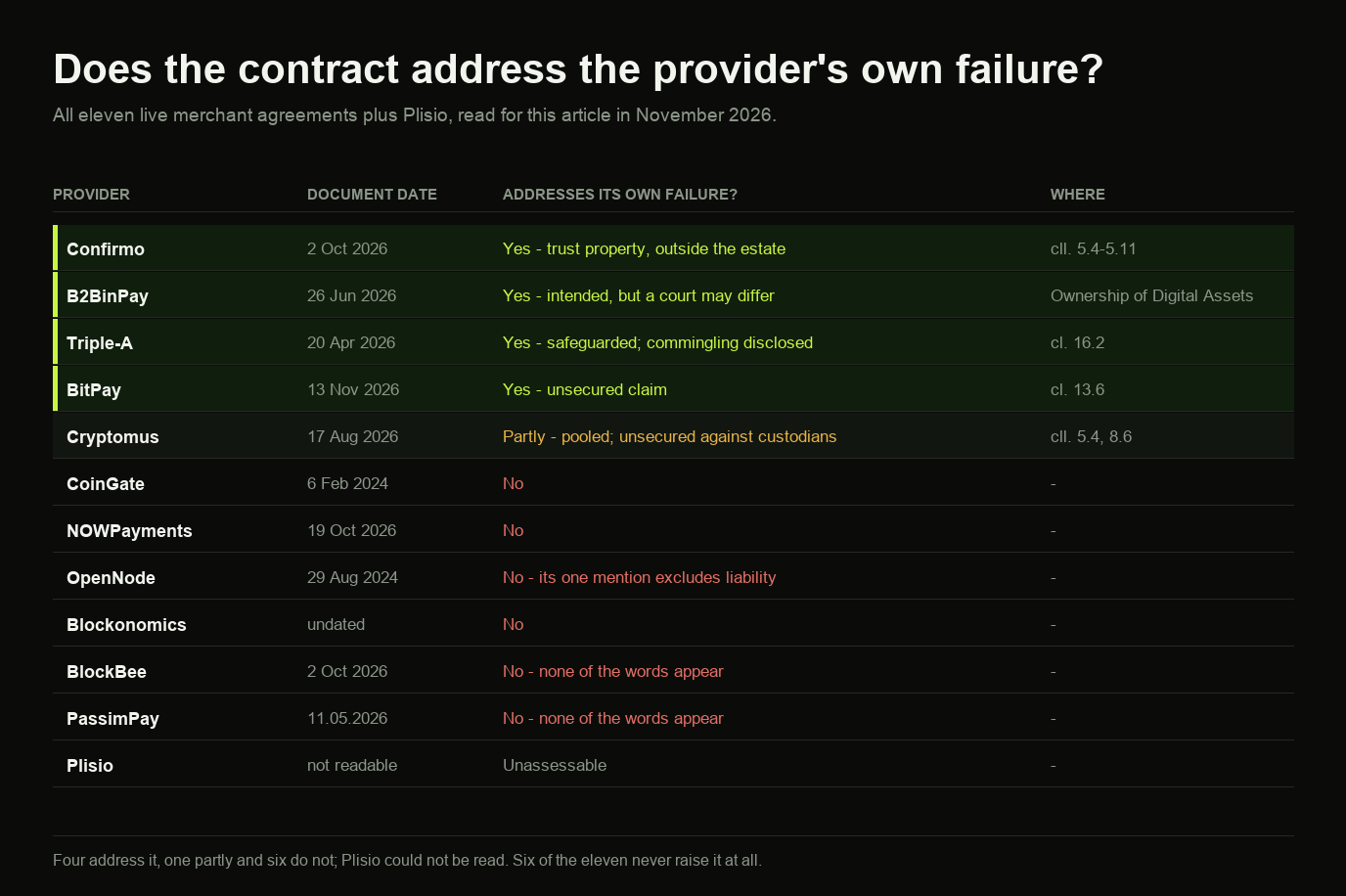
The question we put to each document was narrow and practical: if this company enters an insolvency process tomorrow, does its contract tell me whether my balance is mine or theirs? Not whether it is well run or licensed — only whether the agreement says anything about the outcome.
Eleven of the twelve gateways were readable. Plisio was not: the connection to plisio.net failed again tonight, the eighth consecutive run on which its terms could not be read, so it is left out of every count rather than guessed at.
| Provider | Document date | Addresses the provider's own failure? | Where |
|---|---|---|---|
| Confirmo | 2 Oct 2026 | Yes — trust property, outside the estate | cll. 5.4–5.11 |
| B2BinPay | 26 Jun 2026 | Yes — intended, but a court may differ | Ownership of Digital Assets |
| Triple-A | 20 Apr 2026 | Yes — safeguarded; commingling risk disclosed | cl. 16.2 |
| BitPay | 13 Nov 2026 | Yes — unsecured claim | cl. 13.6 |
| Cryptomus | 17 Aug 2026 | Partly — pooled; unsecured against custodians | cll. 5.4, 8.6 |
| CoinGate | 6 Feb 2024 | No | — |
| NOWPayments | 19 Oct 2026 | No | — |
| OpenNode | 29 Aug 2024 | No — its one mention excludes liability | — |
| Blockonomics | undated | No | — |
| BlockBee | 2 Oct 2026 | No — none of the words appear | — |
| PassimPay | 11.05.2026 | No — none of the words appear | — |
| Plisio | not readable | Unassessable | — |
That split understates the spread: the five that answer do not agree, and the distance between best and worst is the difference between owning your money and queueing for it.
Crypto gateway insolvency: the one contract that writes the outcome
Confirmo's terms, last updated 2 October 2026, are the only document that states what happens in an insolvency rather than disclaiming it. Clause 5.11, "Insolvency recognition of Client Assets", reads:
In any insolvency, examinership, or enforcement process, Client Funds and Client Crypto-Assets are to be treated as trust property, excluded from our estate, and returned to you in priority to claims of our creditors, in accordance with Irish law.
Four earlier clauses build the structure that claim depends on. Clause 5.4 holds client fiat "on trust for you" in segregated accounts, pooled in an omnibus account with client-by-client segregation in internal records, and says flatly that "our creditors have no recourse to Client Funds". Clause 5.7 repeats it for crypto-assets in omnibus wallets, adding that Confirmo "will not pledge, lend, or otherwise use Client Crypto-Assets for our own account".
Clause 5.6 is the one a lawyer would look for: "We hold legal title to Client Funds as trustee only." It also refuses the three things that turn custody into a credit risk — no security interest, no third-party lien or set-off, no rehypothecation — and pays no interest. Clause 5.5 goes further than any other contract here, promising a written acknowledgement from each bank that the account is held on trust and "not subject to set-off or any security interest in favour of the bank" — closing the gap that catches client money when the bank is the creditor.
Two caveats belong next to this, because the clause is strong enough to be misread. Clause 5.3 says Confirmo holds client assets "solely to provide the regulated Services of Transfer and Exchange, not to hold them indefinitely in custody" and is "not authorised to offer custody services for crypto-assets" — protection for money in transit, not a place to park a treasury. And under clause 5.12, where crypto is exchanged into your settlement asset, "title to the received asset transfers to us": the protection follows the balance, not the specific coins.
The contract that admits a court may disagree
B2BinPay, last updated 26 June 2026, builds almost the same structure, then does something no other document here does: it tells you the structure might not survive a court. Its segregation clause places merchant fiat with "partnered banks and electronic money institutions (EMIs), where they are held in fiduciary capacity for your exclusive benefit", not used "for proprietary trading, lending, or any other activity for the benefit of the Company". Its ownership clause states that none of the digital assets in your wallets "are subject to claims by the Company's creditors".
Then comes the sentence that is worth more than the three before it:
However, you acknowledge that in the event of insolvency or legal proceedings, a court may take a different view and determine that such assets are subject to the claims of the Company's creditors, despite our intended treatment.
Its risk acknowledgement spells out the consequence: "omnibus arrangements may involve commingling of assets", delays and restrictions may apply, and "your recovery in an insolvency may be uncertain, may be delayed, and may be less than the full amount of assets you believe you hold". Under a heading reading "No fiduciary; no bank", it adds that "your Account and any Wallet are not a bank account, deposit account, or e-money account and are not protected by any deposit insurance scheme".
One structural detail worth asking about
B2BinPay distinguishes an Enterprise Wallet, where assets sit in "segregated on-chain addresses" with a unique blockchain address per wallet, from a pooled merchant wallet. On-chain segregation is the one arrangement here that does not depend on a court agreeing with a contract, and the terms note it may cost more in gas and network fees.
Two say you would hold only an unsecured claim
BitPay's merchant terms, effective 13 November 2026, answer in a single clause, and the answer is the one nobody wants. Clause 13.6 describes the optional refund reserve, states that BitPay does not hold it "as a custodian or in a safekeeping capacity", and continues:
To the extent BitPay, Inc. were to become insolvent, as with any other credits to your Account, you would only have an unsecured claim and may lose some or all of the refund reserve amount.
The parenthetical clause in the middle does the real work: "as with any other credits to your Account" applies that treatment to your whole balance, not just the reserve. BitPay's risk disclosures reinforce it: balances are "not subject to Federal Deposit Insurance Corporation or Securities Investor Protection Corporation protections", and any bond or trust account it maintains for merchants "may not be sufficient to cover all losses incurred by customers".
Cryptomus, last updated 17 August 2026, reaches a similar position by another route. Clause 5.4 warns that assets "may be stored in pooled accounts together with the assets of other Users", are not covered by any deposit insurance scheme, are "not guaranteed to be recoverable in the event of loss or shortfall", and "may be returned partially or not at all in the event of an unrecoverable deficit". Clause 8.6.2 adds that "in case of insolvency of third parties, the User holds only an unsecured claim".
Note what that clause does not say. It covers the insolvency of third-party custodians, not of Cryptomus, which never says what happens if it fails itself — hence the partial answer in the table, and why clause 8.10.1 ("The Platform is not a bank; Accounts are not insured and are not covered by any government protection schemes") is the closest thing it offers to a direct response.
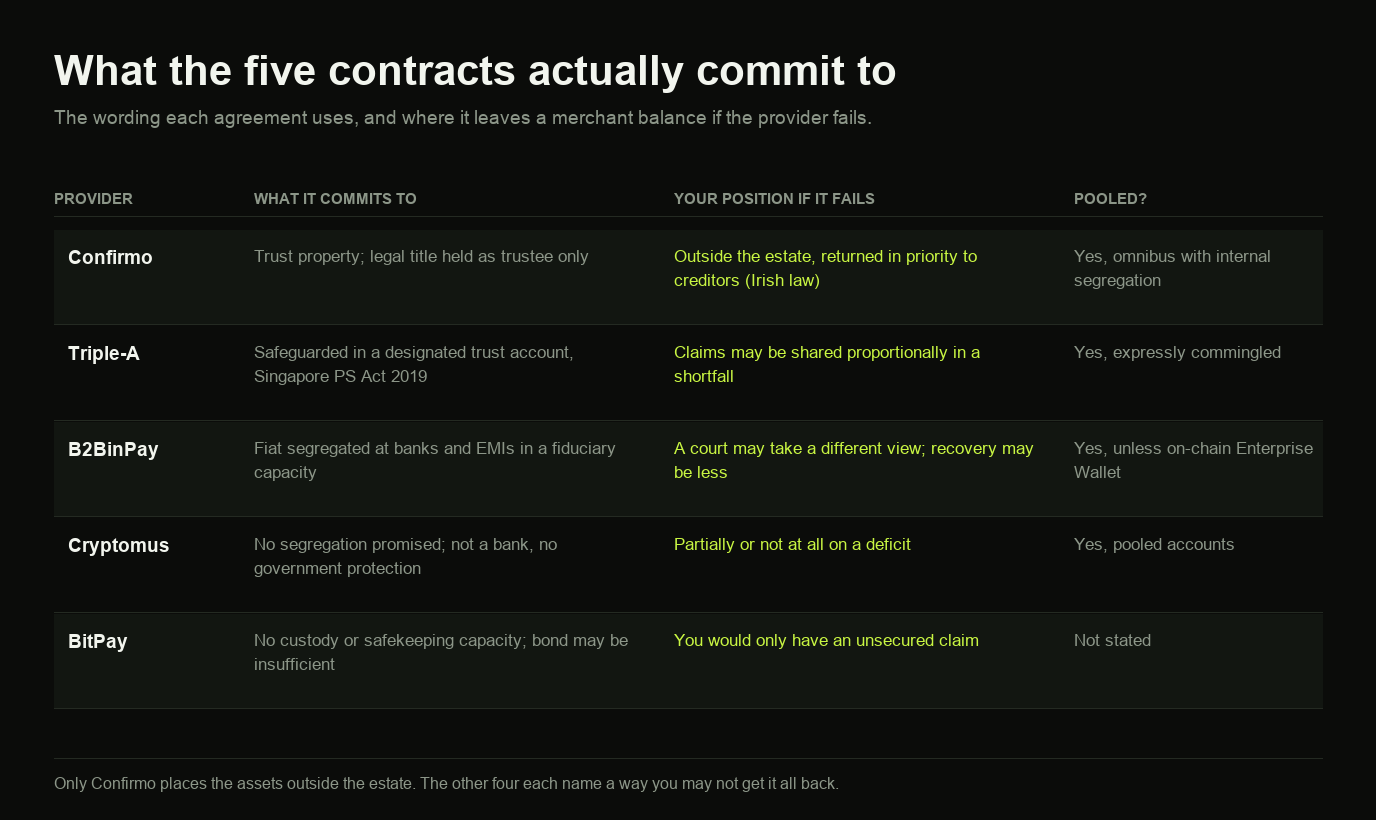
| Provider | What the contract commits to | Your position if it fails | Pooled? |
|---|---|---|---|
| Confirmo | Trust property, creditors have no recourse, legal title held as trustee only | Outside the estate, returned in priority to creditors (Irish law) | Yes, omnibus with internal segregation |
| Triple-A | Safeguarded in a designated trust account under the Singapore PS Act 2019 | Claims may be "shared proportionally" in a shortfall; may not recover all | Yes, expressly commingled |
| B2BinPay | Fiat segregated at banks/EMIs in fiduciary capacity; assets not creditor-claimable | A court "may take a different view"; recovery may be less than you hold | Yes, unless on-chain Enterprise Wallet |
| Cryptomus | No segregation promised; not a bank, no government protection | "Partially or not at all" on a deficit; unsecured against custodians | Yes, pooled accounts |
| BitPay | No custody or safekeeping capacity; bond may be insufficient | "You would only have an unsecured claim" | Not stated |
Triple-A safeguards the money and names the risk anyway
Triple-A's general terms, version dated 20 April 2026, contain the longest treatment in the set: seven sub-clauses at 16.2, written "in accordance with the requirements of the Singapore Payment Services Act 2019 and its subsidiary legislation". Funds are held on your behalf "in a designated trust account opened with a safeguarding institution" which must hold customer funds separately from its own assets.
What makes it the most useful document here is that it keeps going after the good news. Clause 16.2.2 states that your funds "may be deposited into the same trust account together with, and commingled with, funds received from other customers". Clause 16.2.3 prices that: "in the event of shortfalls or disputes, claims may need to be shared proportionally among all customers whose funds are in the account". Clause 16.2.4 covers the failure one layer down: if the safeguarding institution itself becomes insolvent, "you may not be able to recover all of your funds". Clause 16.2.6 concedes that individual entitlements "may not be identifiable through separate physical accounts".
Its US disclosures are equally direct: Triple-A "is not a bank and does not operate as a bank", customer assets are not insured by the FDIC, NCUA or SIPC, and the protection it does carry is a surety bond required by the California Department of Financial Protection and Innovation, "intended to provide limited protection". A statutory safeguarding duty is real protection, and Triple-A is the only gateway here that explains where even that protection stops.
Six contracts never raise crypto gateway insolvency at all
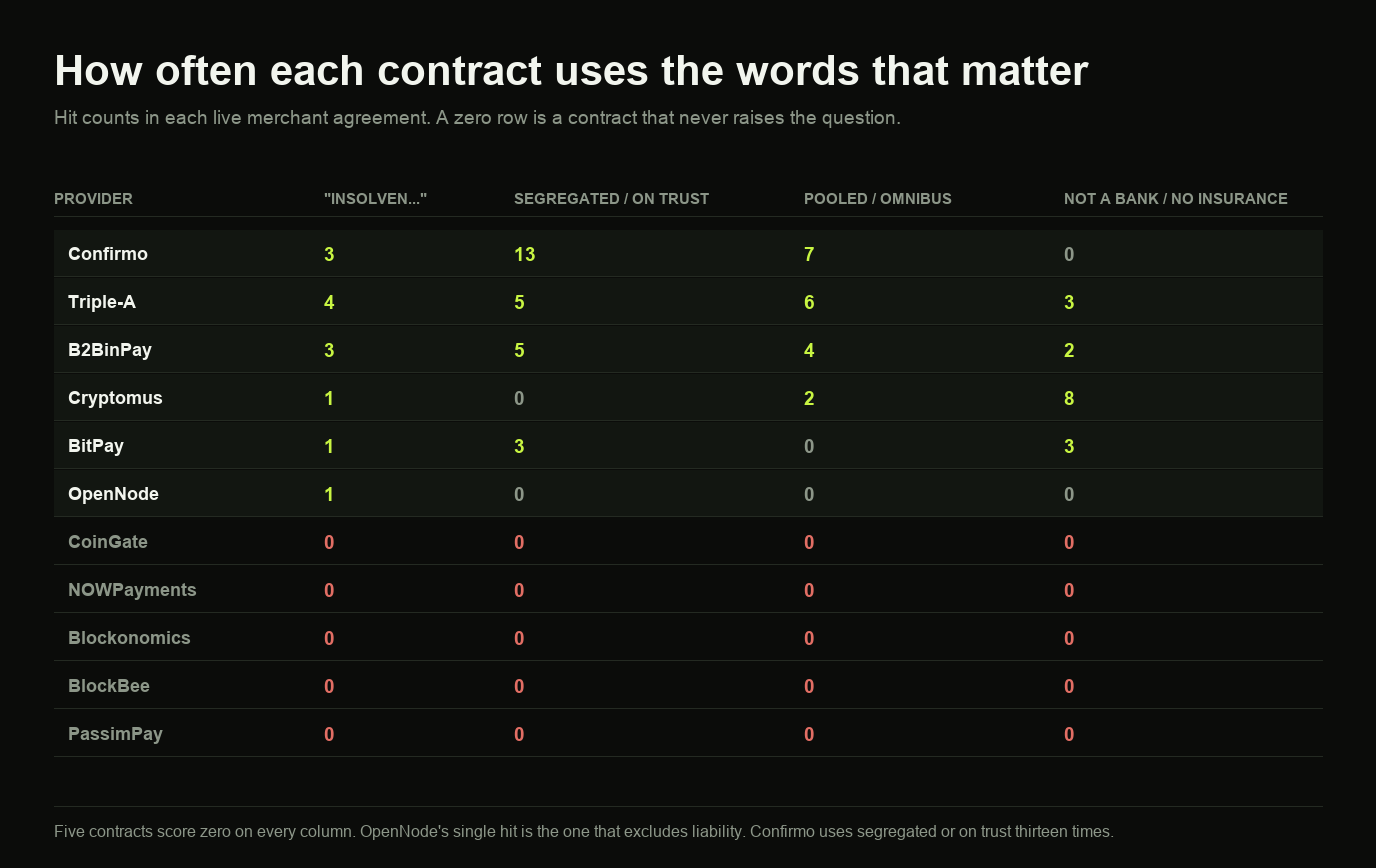
The remaining six say nothing a merchant could act on. We counted four groups of terms in each document, in the stripped text and, for the two zero-scoring contracts, the raw HTML too.
| Provider | "insolven…" | segregated / on trust | pooled / omnibus / commingled | not a bank / deposit insurance |
|---|---|---|---|---|
| Confirmo | 3 | 13 | 7 | 0 |
| Triple-A | 4 | 5 | 6 | 3 |
| B2BinPay | 3 | 5 | 4 | 2 |
| Cryptomus | 1 | 0 | 2 | 8 |
| BitPay | 1 | 3 | 0 | 3 |
| OpenNode | 1 | 0 | 0 | 0 |
| CoinGate | 0 | 0 | 0 | 0 |
| NOWPayments | 0 | 0 | 0 | 0 |
| Blockonomics | 0 | 0 | 0 | 0 |
| BlockBee | 0 | 0 | 0 | 0 |
| PassimPay | 0 | 0 | 0 | 0 |
BlockBee and PassimPay score zero in every column. Neither contains "insolvency", "segregated", "trust", "pooled", "custodian", "not a bank" or "deposit insurance" anywhere — checked in the stripped text and the raw HTML, where the only match for "trust" in either is a Trustpilot badge. BlockBee's terms took effect on 2 October 2026 and PassimPay's on 11.05.2026, so neither predates the question.
The other four are silent in a more interesting way: each uses an adjacent word for something else. CoinGate's terms — still the version published 6 February 2024 — mention bankruptcy and liquidation once, in the clause requiring you to disclose proceedings against your own company. OpenNode's single use of "insolvency" is a liability exclusion for "the insolvency of, or acts or omissions by a Bitcoin trading platform", and section 15 adds that it has "no special relationship with or fiduciary duty to You". NOWPayments safeguards only your login credentials and denies acting "in any fiduciary capacity". Blockonomics' only "safeguards" protect personal data.
Four denials of a fiduciary relationship and no statement of what replaces it is not a neutral position. It is the same pattern as the liability caps: the contract is precise about what the provider does not owe you and silent on what you get.
Why the wording matters more than the intention
B2BinPay's warning that a court "may take a different view" is not boilerplate caution. It describes something that has already happened in payments law.
In the UK, an e-money institution must safeguard the funds customers pay it, and those funds form an asset pool from which customer claims are paid ahead of all other creditors. Latham & Watkins' analysis of the Court of Appeal's 2022 decision in Ipagoo records two findings that matter here. First, the pool "should include funds which have not been properly safeguarded", so a firm's failure to segregate does not shrink what customers can claim against. Second, and less comfortably, the court held the relationship was "purely contractual", giving customers "no proprietary interest in the relevant funds the EMI holds for them". An EMI is also not covered by the Financial Services Compensation Scheme.
That is the gap between a promise and an outcome. Whether a clause saying your assets are not creditor-claimable binds an insolvency practitioner depends on the law of the seat, the form the assets take and whether the firm did what the clause says. Confirmo's drafting is built to survive that test: express trust, legal title as trustee only, bank acknowledgements, named governing law. B2BinPay describes the same intention and tells you the test exists. The more confident one has done more structural work to earn it.
The arrangement that avoids the question
None of this applies to a gateway that never holds your balance. A self-hosted processor like BTCPay Server settles to keys you control, so there is no custodial balance to argue over and no estate to be excluded from — the trade is that you carry key management and uptime yourself. Our no-KYC gateway comparison flags which providers hold funds.
Stripe says insolvency nine times and means yours
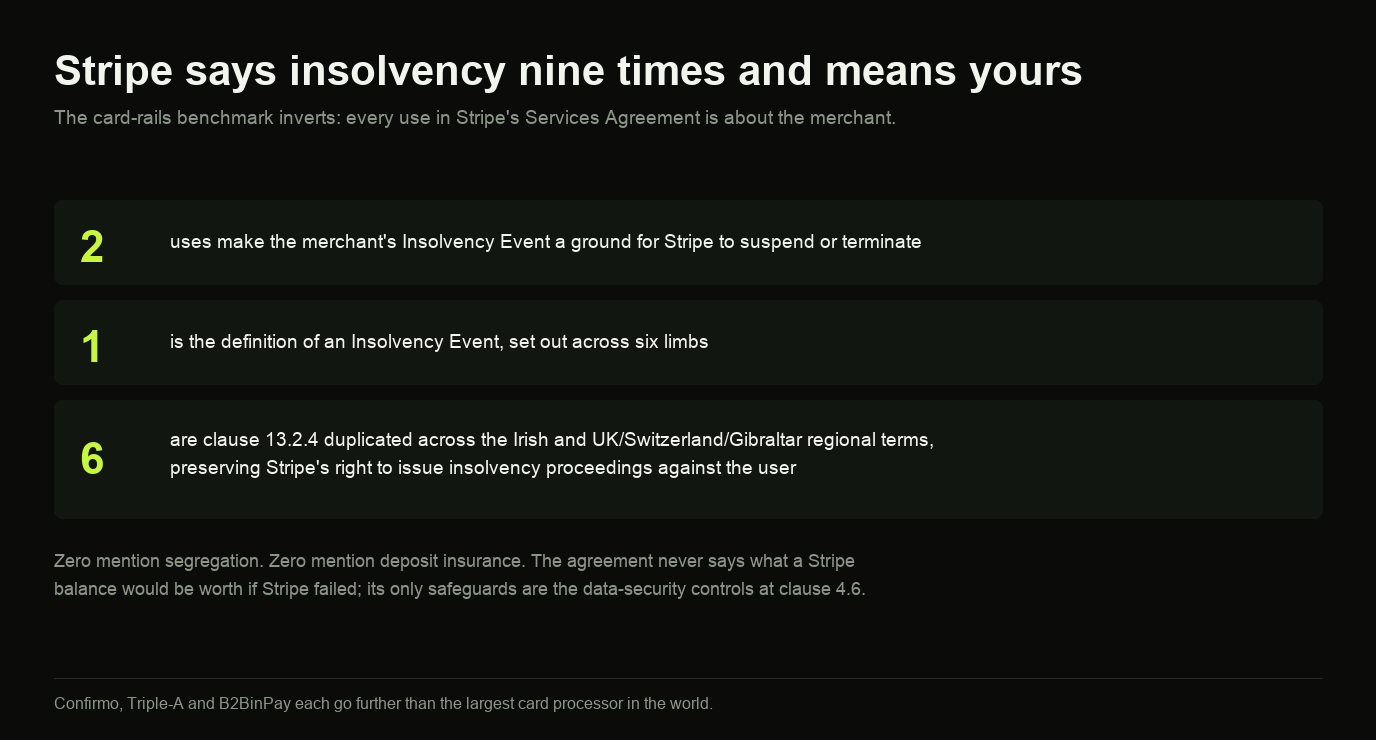
In every previous reading of these contracts, the card rails answered a question the crypto gateways dodged. This time the benchmark inverts. Stripe's Services Agreement uses "insolvency" or "insolvent" nine times and defines an "Insolvency Event" across six limbs, from inability to pay debts to the appointment of a receiver.
Every one of those nine uses is about the merchant. Two make the user's Insolvency Event a ground for Stripe to suspend or terminate, one is the definition, and the remaining six are a single clause, 13.2.4, duplicated across the Irish and UK/Switzerland/Gibraltar regional terms, preserving Stripe's right to issue insolvency proceedings against the user. The agreement mentions neither segregation nor deposit insurance, and never says what a Stripe balance would be worth if Stripe failed; its only "safeguards" are the data-security controls in clause 4.6.
So the honest summary is not that crypto is worse than cards here. It is that a merchant agreement is written to protect the provider from the merchant's failure, almost never the reverse — and that Confirmo, Triple-A and B2BinPay each go further than the largest card processor in the world in telling a merchant where its money sits.
Six checks before you leave a balance anywhere
- Search the terms for "insolven" and read every hit. If they are all the provider's rights against you, or a liability exclusion for someone else's failure, the question is unanswered.
- Look for the word "trust" used as a legal term, not a marketing one. "Held on trust" and "legal title as trustee only" are structural; a Trustpilot badge is not, and that is all two contracts here matched.
- Check whether the clause names a governing law. Confirmo's says "in accordance with Irish law". A protection with no stated seat is harder to rely on.
- Assume pooled unless told otherwise, then ask what a shortfall does. Triple-A is explicit that claims may be shared proportionally; Cryptomus that a balance may be returned "partially or not at all".
- Treat "not a bank, no deposit insurance" as information, not as the answer. It is true of every provider here; the useful question is what replaces it, and four contracts deny a fiduciary duty without naming one.
- Size the balance to the answer you got. Settlement frequency is the lever you control: the faster you sweep, the less the clause matters. Our guide to balances at closure covers the other end of the problem, and AML holds the case where the company is healthy and your money still is not moving.
Related Articles
- Crypto Gateway Account Closure 2026: Who Keeps Your Balance
- Crypto Gateway Liability Caps 2026: $100 to $50,000
- Crypto Gateway Indemnity 2026: Yours Has No Cap
- Crypto Gateway AML Holds 2026: Nobody Says How Long
- Crypto Gateway VAT 2026: Only 3 of 11 Tell You
- BTCPay Server Review: Self-Hosted, Non-Custodial
Six of eleven contracts never tell you what happens to your balance if the company fails.
We read fees, custody, KYC and contract terms for every processor in the directory. Confirmo writes the only clause putting client assets outside its own estate; Triple-A safeguards under Singapore law and discloses the commingling risk; B2BinPay offers on-chain segregated wallets and says a court may still disagree.
Compare Crypto Payment Gateways →Affiliate disclosure: Payyd earns a commission if you sign up to some providers linked on this page. It changes none of the clauses or figures reported here, all of which come from the providers' own published documents and are linked below.
FAQ
What happens to my balance if my crypto payment gateway goes bust?
It depends on what its contract says, and six of the eleven we read say nothing. Confirmo alone states that client assets are trust property excluded from its estate and returned ahead of its creditors. BitPay says the opposite: you hold only an unsecured claim.
Are crypto gateway balances segregated from the company's own money?
Three of eleven say so. Confirmo holds client funds on trust in segregated accounts, B2BinPay places merchant fiat with partner banks and EMIs in a fiduciary capacity, and Triple-A uses a designated trust account under the Singapore PS Act 2019. All three also pool assets, segregating in internal records only.
Is a crypto gateway balance covered by deposit insurance?
No. Every provider that addresses the point says so expressly: B2BinPay, Cryptomus, BitPay and Triple-A all state that accounts are not bank deposits and carry no deposit insurance, with BitPay and Triple-A naming the FDIC and SIPC. The others do not raise it.
What does an unsecured claim mean in practice?
You would rank alongside the company's ordinary trade creditors, with no prior right to any particular pot of money, and receive whatever percentage the estate eventually pays. It is the default wherever a contract creates no trust and no statutory safeguarding duty applies.
Does a contract clause actually protect my funds in an insolvency?
Not on its own. B2BinPay says a court "may take a different view … despite our intended treatment", and the Court of Appeal's 2022 decision in Ipagoo held an e-money institution's relationship with its customers was purely contractual, giving no proprietary interest in the funds held for them. Express trust wording, a named governing law and real segregation make a clause harder to displace.
Which crypto gateways say nothing at all about this?
CoinGate, NOWPayments, OpenNode, Blockonomics, BlockBee and PassimPay. BlockBee's and PassimPay's terms contain none of the relevant words. CoinGate's only mention of bankruptcy concerns your company, and OpenNode's only mention of insolvency excludes its liability for a trading platform's failure.
How do I reduce this risk without changing provider?
Sweep more often. The exposure is the balance sitting with the provider, so daily or per-payout settlement limits what is at stake whatever the contract says. A non-custodial or self-hosted processor removes it altogether, at the cost of running key management yourself.
Sources
Custody, segregation and insolvency provisions, read 21 November 2026:
- Confirmo Limited Terms and Conditions (PDF) — last updated 2 October 2026; cll. 5.3–5.13
- B2BinPay Terms of Use — 26 June 2026; "No fiduciary; no bank", "Segregation of funds", "Ownership of Digital Assets", "Client risk acknowledgement"
- Triple-A General Terms and Conditions — version dated 20 April 2026; cll. 16.2.1–16.2.7, Insurance and Loss Protection
- BitPay Merchant and Donee Terms of Use — terms effective 13 November 2026; cl. 13.6, risk disclosures
- Cryptomus Terms of Use — 17 August 2026; cll. 5.4, 8.6.1–8.6.2, 8.10.1
- CoinGate Merchant Terms of Service — last update published 6 February 2024; no custody or insolvency clause
- NOWPayments Terms of Service (PDF) — last updated 19 October 2026 (FD Transfers LLC); cll. 1.7.5, 12.4
- OpenNode Terms and Conditions — last update 29 August 2024; s. 15, and the trading-platform liability exclusion
- Blockonomics Terms of Service (OneByZero Tech) — undated; "Security Safeguards" (personal data only)
- BlockBee Terms and Conditions — effective 2 October 2026; none of the terms searched appear
- PassimPay Terms of Service — last updated 11.05.2026; none of the terms searched appear
- plisio.net — not readable on 21 November 2026; eighth consecutive unreadable run
- Stripe Services Agreement — cll. 4.6, 10.1, 13.2.4, definition of "Insolvency Event"
- Latham & Watkins, E-Money, Payment Services, and Insolvency — 10 November 2022; Ipagoo, the asset pool and the FSCS
- Monetary Authority of Singapore, Payment Services Act 2019 — the safeguarding regime Triple-A's cl. 16.2 invokes