Crypto Gateway VAT 2026: Only 3 of 11 Tell You
Crypto gateway VAT, read across 11 merchant contracts in November 2026: only three say tax can be added to the fee, and two never mention tax.
 Kevin Richards
Key Takeaways
- Crypto gateway VAT is addressed in three of eleven readable merchant contracts. Triple-A cl. 7.1, B2BinPay's "Taxes; withholding" clause and Blockonomics' Exhibit A all state that fees are exclusive of tax, so VAT or GST can go on top of the rate you compared.
- BlockBee's terms never use the word "tax". Zero occurrences in the version effective 2 October 2026, checked in the stripped text and the raw HTML. Cryptomus has no taxes clause either.
- None of the three published fee pages we checked mentions tax at all. CoinGate's 1% per transaction, NOWPayments' 1% service fee and BitPay's 2% + 25¢ are all published without a word about tax.
- Only Blockonomics prices the tax where a merchant will read it: "a one percent (1 %) fee … along with any applicable VAT or similar taxes". At the UK's 20% standard rate that 1% is 1.20%; at Hungary's 27% it is 1.27%.
- Two contracts handle withholding tax, in opposite directions. Triple-A cl. 7.2 makes you gross up so it still receives the full fee; B2BinPay pays you "net of such withholding". Authorize.net 5.3 is the only other gross-up, and Stripe alone accepts a tax-exemption certificate.
You pick a crypto gateway on the headline rate — 1% here, 2% plus a quarter there — and then a fee invoice arrives with a line nobody quoted you. Crypto gateway VAT is that line, and at the UK's 20% standard rate it turns a 1% fee into 1.20%: a fifth of your processing cost, appearing after you signed. We read the tax, fee and withholding clauses in eleven crypto merchant agreements, three card-processor agreements and one non-crypto payment provider's published VAT notice on 19 November 2026, and counted what each one commits to rather than what the pricing page implies. Three of the eleven tell you the fee can have tax added. Two never use the word tax.
Last checked November 2026. Every clause below was read in the provider's own current document on 19 November 2026 and is linked in the Sources section.
Fifteen documents, two different taxes
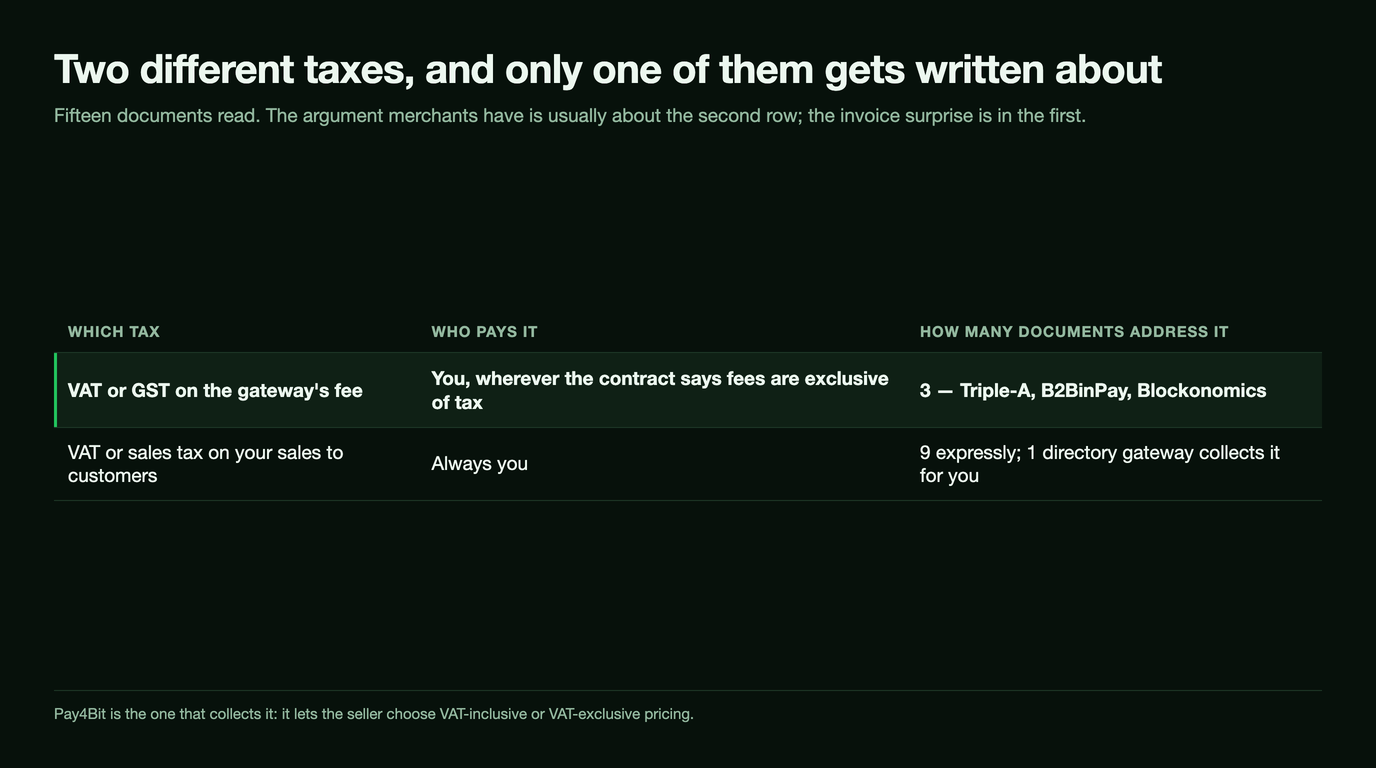
Almost every argument about tax and crypto payments is about the wrong tax. The question that gets written about is whether your sale carries VAT when the customer pays in USDT instead of euros. The answer is settled: it does, on the same terms as any other payment method, and CoinGate's own August 2026 explainer says so at length.
The question nobody answers is the second one: does the gateway add tax to the fee it charges you? That is a contract question, not a tax-law question, and it is answered in a clause most merchants never open. We read eleven crypto gateway agreements covering the processors in our gateway comparison, then three card-processor agreements as a benchmark, then the one published VAT notice in payments where a provider was ordered to start charging it.
Plisio is unreadable for the seventh reading running — plisio.net has no DNS record today — so it is noted in Sources and left out of every count.
| Tax | Who bears it | How many of the 11 address it |
|---|---|---|
| VAT or GST on the gateway's fee | You, wherever the contract says fees are exclusive of tax | 3 — Triple-A, B2BinPay, Blockonomics |
| Withholding tax on your payment of that fee | You under a gross-up; the gateway only if it pays net | 2 — Triple-A (gross up), B2BinPay (net) |
| VAT or sales tax on your sales to customers | Always you | 9 expressly; 1 directory gateway collects it for you |
| Tax on the gateway's own income | The gateway, where it is carved out | 1 — Triple-A cl. 15(f) |
Those four rows are different liabilities with different sizes, and a contract that is eloquent about the third can be silent on the first. Eight of the eleven are.
Crypto gateway VAT: the three that say tax can be added
Triple-A writes the clause a lawyer would recognise. Clause 7.1 of its General T&Cs, version dated 20 April 2026: "All Fees payable to Triple-A are exclusive of any applicable taxes, duties, or levies, including value-added tax (VAT), goods and services tax (GST), or withholding tax. The Merchant shall be responsible for the payment of all such taxes in connection with the Services." It is the only crypto contract in the set that names all three taxes, and clause 15(f) completes the allocation by making you indemnify Triple-A for "any taxes, duties, or levies arising from the Merchant's use of the Services, except for taxes payable on Triple-A's net income".
B2BinPay says it in nine words under a heading called "Taxes; withholding" in the terms last updated 26 June 2026: "All fees are exclusive of taxes unless stated otherwise." The sentence that follows matters more than the one in front of it, and we come back to it below.
Blockonomics is the only one that prices the tax in the fee schedule itself. Exhibit A of the OneByZero Tech terms — the one document in this set with no date on it — reads: "You shall pay OneByZero Tech a one percent (1 %) fee ('Transaction Fee'), along with any applicable VAT or similar taxes on all transactions". A merchant comparing a 1% rate against CoinGate's 1% is comparing one number that may grow by a fifth with another number nobody has characterised. The next sentence of that exhibit declares the pricing confidential, which we read in full two days ago.
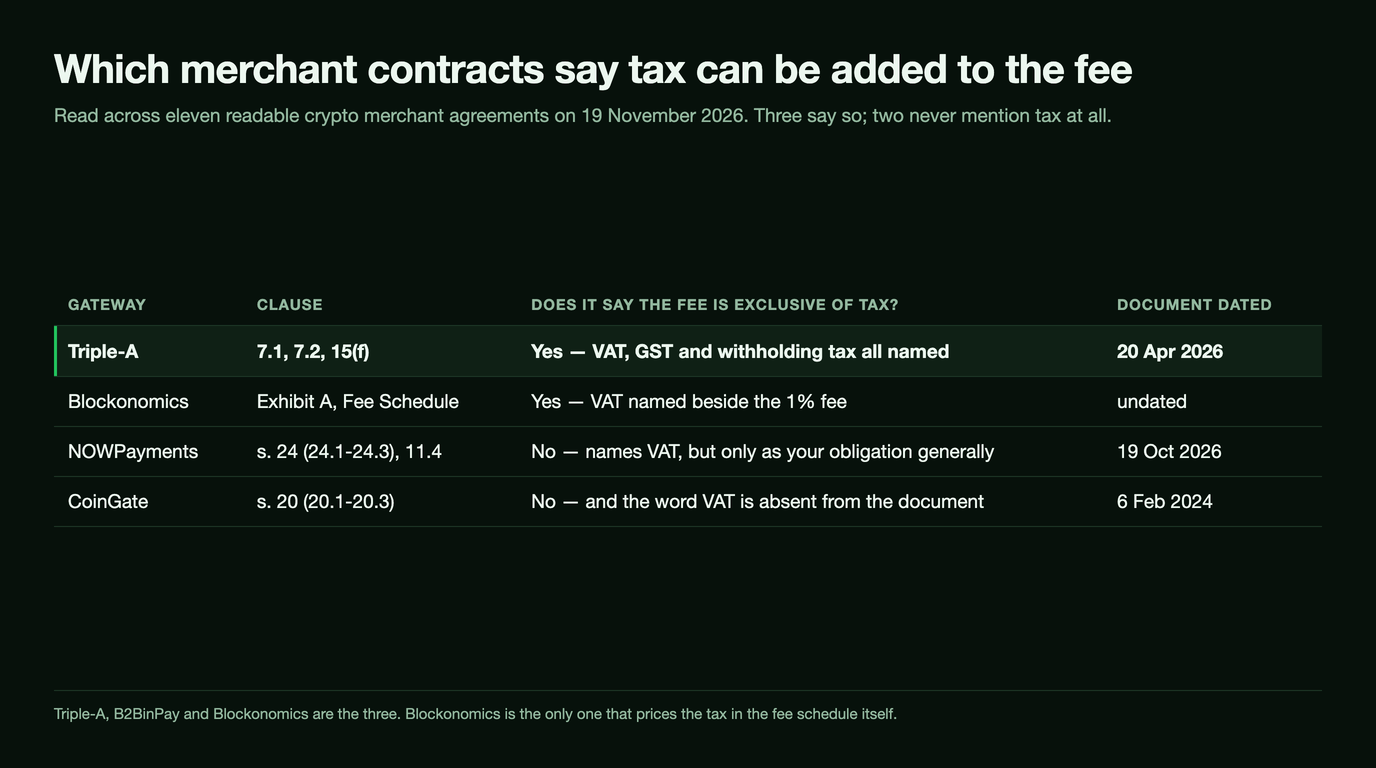
| Gateway | Tax clause | Does it say the fee is exclusive of tax? | Document date |
|---|---|---|---|
| Triple-A | 7.1, 7.2, 15(f) | Yes — VAT, GST and withholding tax all named | 20 Apr 2026 |
| B2BinPay | "Taxes; withholding" (unnumbered) | Yes — "unless stated otherwise" | 26 Jun 2026 |
| Blockonomics | Exhibit A, Fee Schedule | Yes — VAT named beside the 1% fee | undated |
| OpenNode | s. 7, s. 15.1 | Not of the fee — but taxes "imposed on your access to and use of the Services" are yours | 29 Aug 2024 |
| NOWPayments | s. 24 (24.1–24.3), 11.4 | No — names VAT, but only as your obligation generally | 19 Oct 2026 |
| BitPay | 18.1 ("No Advice; Tax") | No — your taxes only, plus IRS reporting | 13 Nov 2026 |
| CoinGate | s. 20 (20.1–20.3) | No — and the word VAT is absent from the document | 6 Feb 2024 |
| Confirmo | 10.9, 24.14, 23.6 | No — 9.1 simply points at the Fee Schedule | 2 Oct 2026 |
| PassimPay | in the transactions section | No | 11 May 2026 |
| Cryptomus | none — 8.3.1, 8.9.1, 9.6 in passing | No — 15.7 reserves the right to change fees and calls its own calculations final | 17 Aug 2026 |
| BlockBee | none — the word "tax" appears 0 times | No | 2 Oct 2026 |
The eight that never price the tax
Silence is not a promise that no tax will be added. It is the absence of a term, which means the answer is decided by the gateway's own tax position in its own jurisdiction — CoinGate in Lithuania, Confirmo under the Central Bank of Ireland, Triple-A under the MAS in Singapore — and by a rule you cannot read in your contract.
Four of the eight do address tax, just not the fee. CoinGate s. 20.1 is the type specimen: "It is your own responsibility for paying any taxes applicable to you in relation to using our Services." BitPay 18.1 is the same shape with a reporting rider: above U.S.$20,000 in gross payments and 200 payments in a calendar year, "BitPay will report annually to the U.S. Internal Revenue Service, as required by law". Confirmo 10.9 and PassimPay put the duty on you in one sentence each. All four tell you who pays tax on your sales. None tells you what happens to the fee.
If you want the pattern in one line: every contract in this set is willing to tell you that your taxes are your problem, and three are willing to tell you that their fee is taxable too.
Crypto gateway VAT arithmetic: what 1% becomes
This matters as arithmetic, not law, and the arithmetic is bigger than most of the differences merchants switch gateways over. The three published fee pages behind the most-compared rates, read 19 November 2026: CoinGate advertises "1% per transaction" with no monthly fee, NOWPayments a "1% service fee", and BitPay a volume ladder of 2% + 25¢ below $500,000 a month, 1.5% + 25¢ to $999,999 and 1% + 25¢ above $1,000,000, with a footnote that high-risk industries pay more.
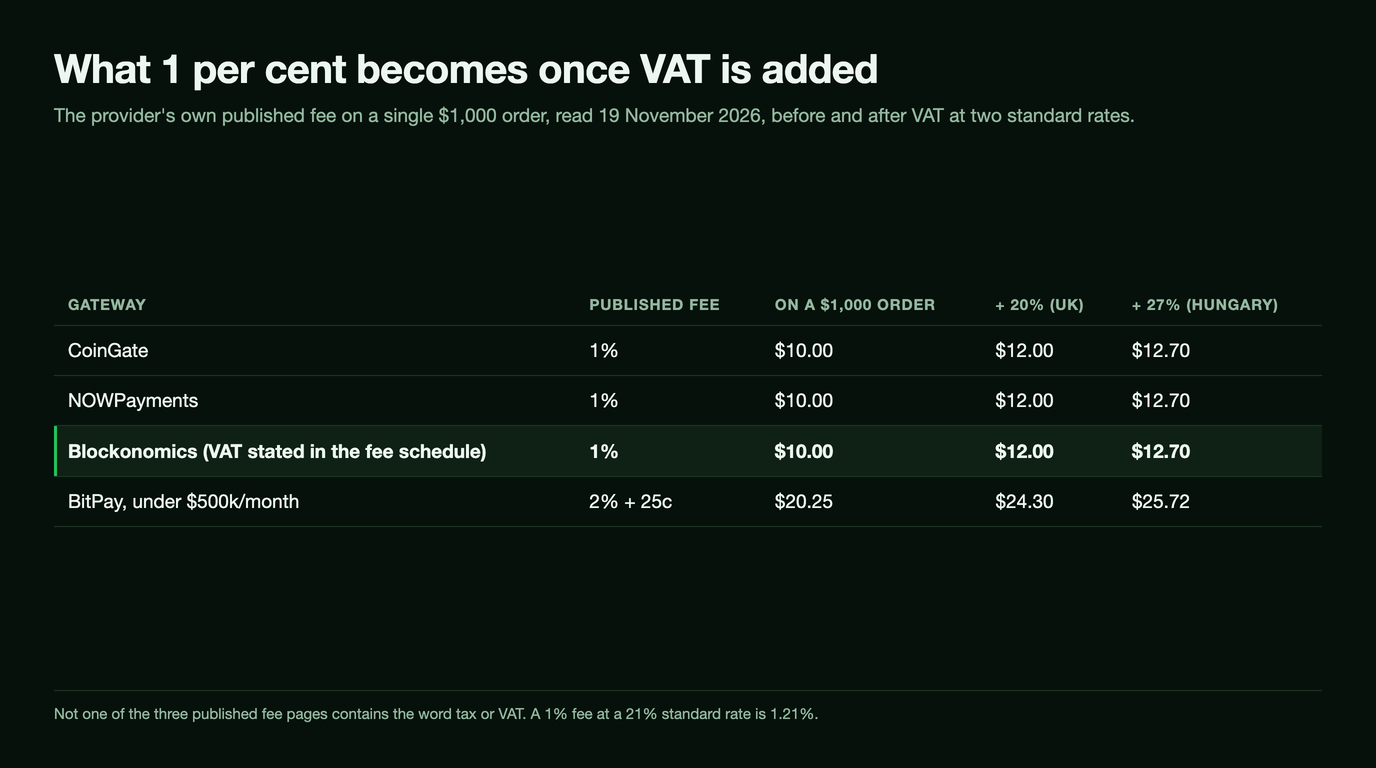
Not one of those three pages contains the word tax or VAT. So the table below does the sum the pages do not: the same fee on one $1,000 order, then the same fee with VAT added at two published national rates.
| Provider | Headline fee | Fee on a $1,000 order | + 20% (UK) | + 27% (Hungary) |
|---|---|---|---|---|
| CoinGate | 1% | $10.00 | $12.00 | $12.70 |
| NOWPayments | 1% | $10.00 | $12.00 | $12.70 |
| Blockonomics (VAT stated in the fee schedule) | 1% | $10.00 | $12.00 | $12.70 |
| BitPay, under $500k/month | 2% + 25¢ | $20.25 | $24.30 | $25.72 |
One basis: the provider's own published fee on a single $1,000 order, read 19 November 2026, before and after adding VAT at the stated standard rate. The two rates are the United Kingdom (20%) and Hungary (27%) as published in Pay4Bit's country table. Whether VAT is charged on a given fee depends on that provider's tax position and yours; of these four, only Blockonomics commits in writing to adding it. Network fees are excluded, as is the right each reserves to change the rate.
Gross-up, or net of withholding
Withholding tax appears only when money crosses a border, which for a merchant paying a Singaporean or Salvadoran processor is every month. If your jurisdiction makes you withhold tax from a payment to a foreign supplier, somebody absorbs it. Two contracts here name that somebody, and they name different parties.
Triple-A makes it you. Clause 7.2: "If any withholding or deduction is required by Applicable Law, the Merchant shall gross up the payment so that Triple-A receives the full amount it would have received had no such withholding or deduction been required." A 10% withholding on a 1% fee does not cut Triple-A's revenue; it raises your cost to about 1.11% before any VAT goes on top.
B2BinPay makes it B2BinPay — in the main terms. The sentence after "All fees are exclusive of taxes" reads: "We may deduct or withhold any taxes we are required to withhold by law, and payments will be made net of such withholding." That is the merchant-friendlier direction, and it is worth noticing because the same company takes the opposite position with its affiliates. Under the Partner Program, referral commissions are "stated exclusive of all present and future taxes" including "VAT/GST/sales taxes and withholding taxes", paid "net of any Withholding Tax", and the partner "will not be entitled to any gross-up, reimbursement, additional payment or 'make-whole' amount".
The other tax: your customers' VAT
Nine of the eleven contracts make the VAT on your own sales your problem, which is the expected answer. What is not expected is that one gateway in our directory takes the job on.
Pay4Bit is the exception. Its help centre states flatly: "By law, Pay4Bit must apply VAT / Sales Tax to any transaction where it is applicable." You then choose on a Sales Tax Settings page whether to "Include VAT in the price (VAT-inclusive pricing)" or "Add VAT to the price (VAT-exclusive pricing)", and its fee page lets you choose which party pays "the Payment Processing Fee and Sales Tax: Customer / Business". The documentation carries a published rate table for roughly eighty countries.
Treat it as a rate card rather than tax advice, and check it: the page's introduction cites 18% for Spain while its own table says 21% — the sort of slip worth catching before it reaches a customer's basket.
| Country | Rate in Pay4Bit's table | Why it is in this list |
|---|---|---|
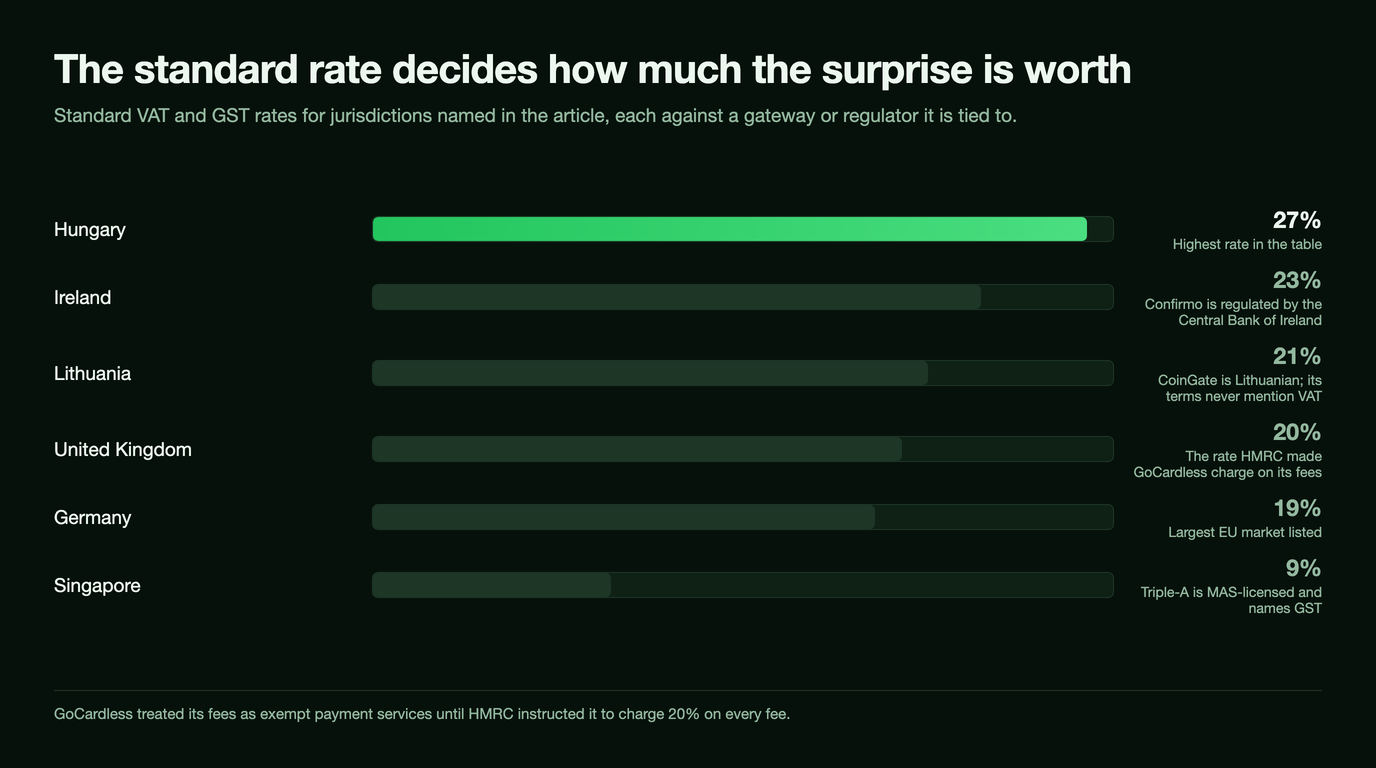
| Hungary | 27% | Highest rate in the table |
| Ireland | 23% | Confirmo is regulated by the Central Bank of Ireland |
| Lithuania | 21% | CoinGate is Lithuanian; its terms never mention VAT |
| United Kingdom | 20% | The rate HMRC made GoCardless charge on its fees |
| Germany | 19% | Largest EU market listed |
| Singapore | 9% | Triple-A is MAS-licensed and names GST |
The card rails answer every time
As with liability caps and audit rights, the benchmark inverts the expectation. All three card-processor agreements answer the fee question in a numbered clause, and two of the three are tighter than anything in crypto.
Stripe s. 7.3(a) is one sentence: "The Fees exclude all Taxes, except as the Stripe Pricing Page or other documents expressly state to the contrary." Its definition of Taxes runs to sales and use tax, excise, gross receipts, VAT, GST and withholding, and s. 8.4 puts payment obligations "including Fees, Assessed Fines and Taxes" outside the liability cap. It is also the only document here that gives you a way out: supply a certificate of exemption or reduced rate and "Stripe will not deduct the Taxes that certificate covers".
Authorize.net 5.3 is the strictest clause in all fifteen documents, as its confidentiality section was: fees "exclusive of all taxes", payment "without deduction or withholding", and if you must withhold, the amount you pay "shall be increased to the extent necessary to yield to Authorize.net (after withholding of such taxes) a net amount equal to the amount Authorize.net would have received". Adyen 3.8 needs one line: "All fees of Adyen are excluding applicable VAT, turnover and other taxes or levies which will be separately payable by Merchant".
| Card processor | Clause | Fee exclusive of tax? | Withholding |
|---|---|---|---|
| Stripe | 7.3(a)–(c) | Yes, all Taxes | Deducted by Stripe; exemption certificate accepted |
| Authorize.net | 5.3 | Yes, all taxes except tax on its own income | Full gross-up; no deduction permitted |
| Adyen | 3.8 (with 3.7) | Yes — VAT, turnover taxes and levies named | Fees withheld from settlement; 1% per month on arrears |
And then there is the precedent nobody in crypto cites. GoCardless spent years treating its fees as exempt payment services until, as its published VAT FAQ puts it, "HMRC has now informed us that our services no longer fall within the scope of the VAT exemption and we have been instructed by HMRC to charge VAT on all our fees at the UK Standard Rate, which is currently 20%" — on every fee it charges, "regardless of your VAT status". Its worked example: a £200 collection, a £2.20 fee, 44p of VAT, £2.64 to pay. That reclassification dates from 2020 and the notice is still published — which is why a contract silent on the fee has not told you who absorbs the next one.
Five checks before you sign
One: search the document for "tax" before you read anything else. It takes ten seconds and the answer is sometimes zero. A heading is not a clause, either — Cryptomus has four mentions of the word and no obligation attached to any of them.
Two: get it in writing whether the fee is exclusive of tax. Three of eleven say it. If your gateway is one of the eight that do not, the sentence you want added is short and asking for it costs an email.
Three: price the worst case, not the headline. A 1% fee at a 21% standard rate is 1.21% — more than the gap between most of the gateways you are choosing between.
Four: if you pay across a border, find the withholding sentence. "Gross up" means the tax is yours on top of the fee; "net of such withholding" means the provider absorbs it.
Five: ask whether the provider issues a tax invoice at all. None of these eleven promises one, and a fee deducted from a crypto settlement with no invoice behind it is a cost your accountant may not recover. Read the closure and final-balance terms while you have the document open.
- Crypto Gateway Fee Changes 2026: One Gives 30 Days
- Crypto Gateway Confidentiality 2026: Only Four Are Mutual
- Crypto Gateway Liability Caps 2026: $100 to $50,000
- Crypto Gateway Account Closure 2026: Who Returns Your Balance
- Crypto Gateway Indemnity 2026: Yours Has No Cap
- Crypto Gateway Audit Rights 2026: Only Two Can Look
Eight of eleven contracts never tell you whether tax goes on top of the fee.
We read fees, custody, KYC and contract terms for every processor in the directory. Triple-A writes the clearest tax clause in crypto and asks you to gross up for it; B2BinPay absorbs withholding on the merchant side; CoinGate publishes a flat 1% and says nothing about tax at all.
Compare Crypto Payment Gateways →Affiliate disclosure: Payyd earns a commission if you sign up to some providers linked on this page. It changes none of the clauses or figures reported here, all of which come from the providers' own published documents and are linked below.
FAQ
Do crypto payment gateway fees include VAT?
Usually the contract does not say. Of eleven crypto merchant agreements read in November 2026, three state that fees are exclusive of tax — Triple-A, B2BinPay and Blockonomics — so tax can be added on top. The other eight are silent, which is not the same as a promise that nothing will be added.
Which crypto gateways say their fees are exclusive of tax?
Triple-A cl. 7.1 names VAT, GST and withholding tax. B2BinPay's "Taxes; withholding" clause says all fees are exclusive of taxes unless stated otherwise. Blockonomics puts it in Exhibit A beside the 1% fee itself. No other contract in the set does.
Do I pay VAT on my sales when the customer pays in crypto?
Yes, on the same terms as any other payment method: the rail does not change the tax treatment of the supply. Nine of the eleven contracts say expressly that your own taxes are yours to determine, collect and remit.
What is a gross-up clause in a payment gateway contract?
It means that if the law makes you withhold tax from the fee you pay, you must increase the payment so the provider still receives its full fee. Triple-A cl. 7.2 and Authorize.net 5.3 both do this. B2BinPay goes the other way in its merchant terms and takes payment net of withholding.
Can a payment provider start charging VAT on fees that were previously exempt?
It has happened. GoCardless treated its fees as exempt payment services until HMRC told it the exemption no longer applied, and it now charges 20% on every fee regardless of the merchant's VAT status.
Does any crypto payment gateway collect VAT from my customers for me?
One in our directory does. Pay4Bit states that it must apply VAT or sales tax where applicable, lets you choose VAT-inclusive or VAT-exclusive pricing and whether the customer or your business bears the processing fee and sales tax, and publishes a rate table covering roughly eighty countries. Check the figures: its own page cites 18% for Spain where its table says 21%.
Does my crypto gateway report my revenue to a tax authority?
BitPay says it does above a threshold: more than U.S.$20,000 in gross payments and more than 200 payments in a calendar year triggers an annual report to the IRS under cl. 18.1. CoinGate 20.3 says you must hand over tax information it is obliged, or decides, to report. No other contract commits either way.
Sources
Tax, fee and withholding provisions, read 19 November 2026:
- Triple-A General Terms and Conditions — 20 April 2026; cll. 7.1, 7.2, 15(f)
- B2BinPay Terms of Use — 26 June 2026; "Taxes; withholding" and Partner Program clauses
- Blockonomics Terms of Service (OneByZero Tech) — undated; Exhibit A Fee Schedule
- NOWPayments Terms of Service (PDF) — last updated 19 October 2026 (FD Transfers LLC); s. 24 Taxes, cll. 11.4, 10.7. Pricing: 1% service fee, no mention of tax
- CoinGate Merchant Terms of Service — last update published 6 February 2024; s. 20 Taxes (20.1–20.3). Fees: 1% per transaction, no mention of tax
- BitPay Merchant and Donee Terms of Use — terms effective on 13 November 2026; cl. 18.1 No Advice; Tax. Pricing: 2% + 25¢ below $500,000 monthly, then 1.5% and 1%, no mention of tax
- Confirmo Limited Terms and Conditions (PDF) — 2 October 2026; cll. 9.1, 10.9, 23.6, 24.14
- OpenNode Terms and Conditions — 29 August 2024; ss. 7, 15.1
- PassimPay Terms of Service — last updated 11.05.2026 in its own format
- Cryptomus Terms of Use — 17 August 2026; no taxes clause; cll. 8.3.1, 8.9.1, 9.6, 15.7
- BlockBee Terms and Conditions — effective 2 October 2026; the word "tax" does not appear
- Pay4Bit, Tax and VAT Information and Service Fees and Charges — undated; VAT settings, country rate table
- plisio.net — not readable on 19 November 2026: no DNS record, no connection; seventh consecutive unreadable run
- Stripe Services Agreement — 28 September 2026; cll. 7.3(a)–(c), 8.4, definition of Taxes
- Authorize.net Merchant Services Agreement — cl. 5.3 Taxes
- Adyen Terms and Conditions — effective from 7 March 2023; cll. 3.7 and 3.8
- GoCardless VAT FAQ — HMRC's instruction to charge 20% VAT on all fees
- CoinGate, VAT and Tax on Accepting Crypto Payments — 11 August 2026; the sales-side question