Crypto Gateway Confidentiality 2026: Only Four Are Mutual
Crypto gateway confidentiality, read across 11 merchant contracts in November 2026: only four are mutual, four have none at all, and two gag your fees.
 Brian Ormond
Key Takeaways
- Crypto gateway confidentiality is mutual in only four of eleven readable merchant contracts. BitPay cl. 18.10, Triple-A s. 9, CoinGate s. 25 and Confirmo cl. 20.1 bind both sides. BitPay's is the only one that names "all Merchant or Donee, as applicable, data" as the protected information.
- Four have no confidentiality obligation at all. OpenNode, NOWPayments, Cryptomus and BlockBee. The word "confidential" does not appear once in BlockBee's terms, and Cryptomus's section 13 is titled "Confidentiality and Data Protection" while containing no confidentiality covenant — it is a privacy notice.
- Three bind only you. B2BinPay defines Confidential Information as information disclosed "by or on behalf of B2BINPAY … to you", and nothing the other way. Blockonomics' single obligation sits in its fee schedule; PassimPay's gags the arbitration.
- Two contracts make your own pricing a secret. B2BinPay expressly lists "pricing, fees, discounts and commercial terms not publicly posted"; Blockonomics states that "The pricing terms set forth herein are confidential" — directly beneath the 1% fee its own public document publishes.
- No crypto contract here has a fixed survival term, and only the card rails set a deletion clock. BitPay's obligation runs until the information becomes public; Authorize.net s. 10.2 requires destruction within thirty days plus certification from an officer.
You ask your gateway's support team where its screening thresholds sit, get a straight answer, and quote it in a forum thread six weeks later. Crypto gateway confidentiality clauses decide whether that was a breach of contract — and on four of the eleven readable merchant agreements in this directory there is no clause to breach, because the contract contains none.
That cuts both ways, which is the part merchants miss. A gateway with no confidentiality clause owes you nothing either: not over your transaction volumes, not over your customer list, not over the integration questions you asked before signing. We read the confidentiality, non-disclosure and survival provisions in the merchant terms of twelve hosted crypto gateways on 17 November 2026, then read Stripe, Authorize.net and Adyen against them. Eleven were readable. Four clauses are mutual, three bind nobody but the merchant, four do not exist, and two make your own pricing a secret.
These are the same twelve contracts we read for the audit rights comparison and the logo rights comparison. The twelfth, Plisio, has now been unreadable for six consecutive readings, and the symptom has got worse rather than better: for the previous five it served a security-incident notice, and today plisio.net has no DNS record at all.
Fifteen documents, one question
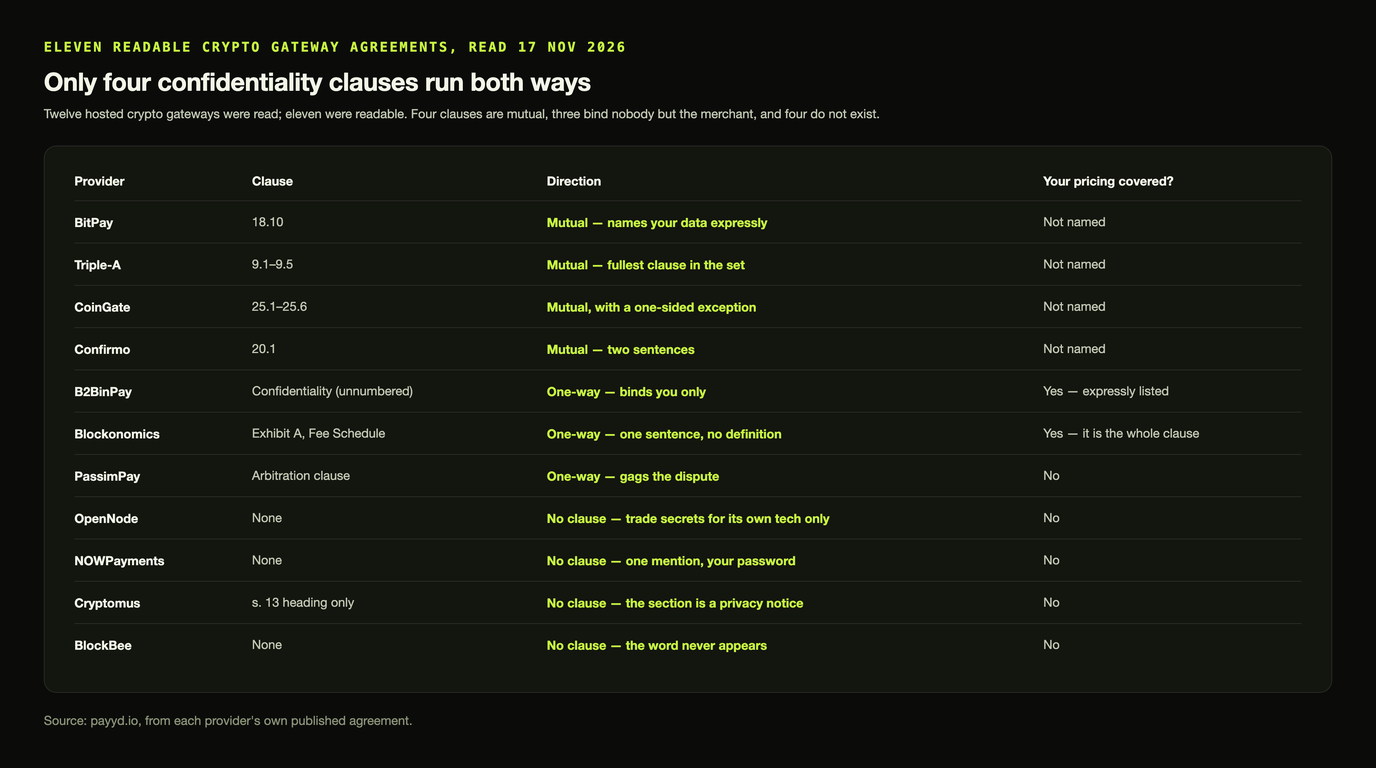
The question is narrow and it has a direction: who promises secrecy to whom? A clause protecting only the provider is not a confidentiality clause in any sense that helps you, and the templates ranking for these searches never raise the possibility — they present a mutual clause as boilerplate. Sorted into mutual, one-way and absent, the eleven fall into an almost even three-way split.
| Provider | Clause | Direction | Your pricing covered? |
|---|---|---|---|
| BitPay | 18.10 | Mutual — names your data expressly | Not named |
| Triple-A | 9.1–9.5 | Mutual — fullest clause in the set | Not named |
| CoinGate | 25.1–25.6 | Mutual, with a one-sided exception | Not named |
| Confirmo | 20.1 | Mutual — two sentences | Not named |
| B2BinPay | Confidentiality (unnumbered) | One-way — binds you only | Yes — expressly listed |
| Blockonomics | Exhibit A, Fee Schedule | One-way — one sentence, no definition | Yes — it is the whole clause |
| PassimPay | Arbitration clause | One-way — gags the dispute | No |
| OpenNode | None | No clause — trade secrets for its own tech only | No |
| NOWPayments | None | No clause — one mention, your password | No |
| Cryptomus | s. 13 heading only | No clause — the section is a privacy notice | No |
| BlockBee | None | No clause — the word never appears | No |
Crypto gateway confidentiality: the four mutual clauses
BitPay cl. 18.10 is the only one written as though a merchant might one day need to enforce it. Confidential Information is defined three ways — marked confidential in tangible form, declared confidential orally or visually, or designated as such in the Terms — and then it does what none of the others do. The definition "shall include without limitation, information accessed via the BitPay API, technical specifications and processes of each party, and all Merchant or Donee, as applicable, data". Your data is named, not left to the general words.
The carve-outs are the standard four: prior knowledge, publicly known through no fault of the recipient, received from a third party without restriction, or independently developed. Compelled disclosure carries a real procedure — prompt notice "upon learning of the existence or likely existence" of the requirement, efforts to avoid the disclosure, and efforts to obtain confidential treatment or a protective order. The obligation then survives until the information becomes public through no fault of the receiving party, which is indefinite rather than timed.
Triple-A s. 9 is the most complete piece of drafting in the crypto set, and reads as though a lawyer wrote it from a precedent rather than from a web page. The definition sits up in s. 2 and catches anything "designated as confidential or which ought reasonably to be treated as confidential". Permitted recipients must be bound by obligations "no less protective"; cl. 9.3 makes you responsible for their compliance; cl. 9.4 lists the three exclusions; cl. 9.5 survives termination, and cll. 3.7 and 17.5 both list confidentiality again in their survival sets.
CoinGate s. 25 is mutual on its face and then grants itself an exception. Clause 25.2 bars disclosure to third parties without written consent, "except to the third party(-ies) engaged/contacted by the Company in order to ensure provision of Services/compliance with applicable legislation as well as to law enforcement", and cl. 25.6 confirms such disclosure "shall not be considered as a breach". Clause 25.5 puts the notify-and-contest duty on you alone — "required by you pursuant to applicable law" — and its carve-outs demand "clear and convincing evidence", a higher bar than anyone else sets.
Where crypto gateway confidentiality does not exist at all
Four contracts have nothing. Not a weak clause, not a one-sided clause — no clause. This is the finding that matters most, because silence here is not a neutral default: it means neither party has promised anything, and the only protections left are whatever general law and the data-protection terms give you.
BlockBee is the cleanest example: the word "confidential" does not appear anywhere in its terms and conditions. Not in a heading, not about your data, not even in the usual place about keeping your own password safe. NOWPayments is almost as bare — the single occurrence in its terms of service makes you "responsible … for maintaining the confidentiality of your account", which is a security obligation on you, not a promise to you.
OpenNode is the interesting absence, because it protects secrecy carefully in one direction and never looks at the other. Section 10 declares its technology to "constitute valuable trade secrets of OpenNode"; s. 11 keeps all intellectual property; s. 12 assigns your feedback to it outright. Meanwhile s. 4.2 takes a perpetual licence to use, process, store, transmit and disclose Your Content, and adds that "you expressly waive any privacy rights you may otherwise have in Your Content in such contexts". The only place the word "confidential" attaches to your information is the indemnity at s. 16.1, where you agree to cover losses from disclosure of confidential information, private keys or credentials held by you.
None of this means these four leak merchant data — data-protection duties bite independently of the contract, and we checked those in the GDPR comparison. It means that if a leak happens, your contract gives you nothing to point at.
Three clauses that bind only you
B2BinPay writes the clearest one-way clause in the set, and the direction is visible in the first line of the definition: Confidential Information is "any non-public information disclosed by or on behalf of B2BINPAY (or its Affiliates) to you". There is no reciprocal definition anywhere in the section. Everything that follows — the use restriction, the protection standard, the permitted recipients, the compelled-disclosure procedure, the return-and-delete duty, the injunctive relief "without posting bond" — runs in one direction only.
It is also the broadest list of protected categories in the set: the platform and services including roadmaps and unreleased products; security, fraud, risk and compliance processes, expressly including "screening logic, thresholds, controls and investigations"; technical information including API keys and test environments; pricing; and "incident details, audit materials and reports". Read it next to the API key comparison and the practical effect is clear: the thresholds that decide whether your payment is held are contractually yours to know and not yours to repeat.
PassimPay's only confidentiality obligation is a litigation gag, and it is tucked inside the arbitration clause rather than given a section of its own. "The arbitration shall be kept confidential and you shall not disclose to any person, other than those necessary to the proceedings, the existence of the arbitration" — nor any information, document, submission, testimony, transcript or award, unless disclosure is required by law or needed for enforcement proceedings. The existence of the dispute is the striking part: a merchant who loses an arbitration may not say that there was one. It sits alongside the venue terms we mapped in the dispute resolution comparison.
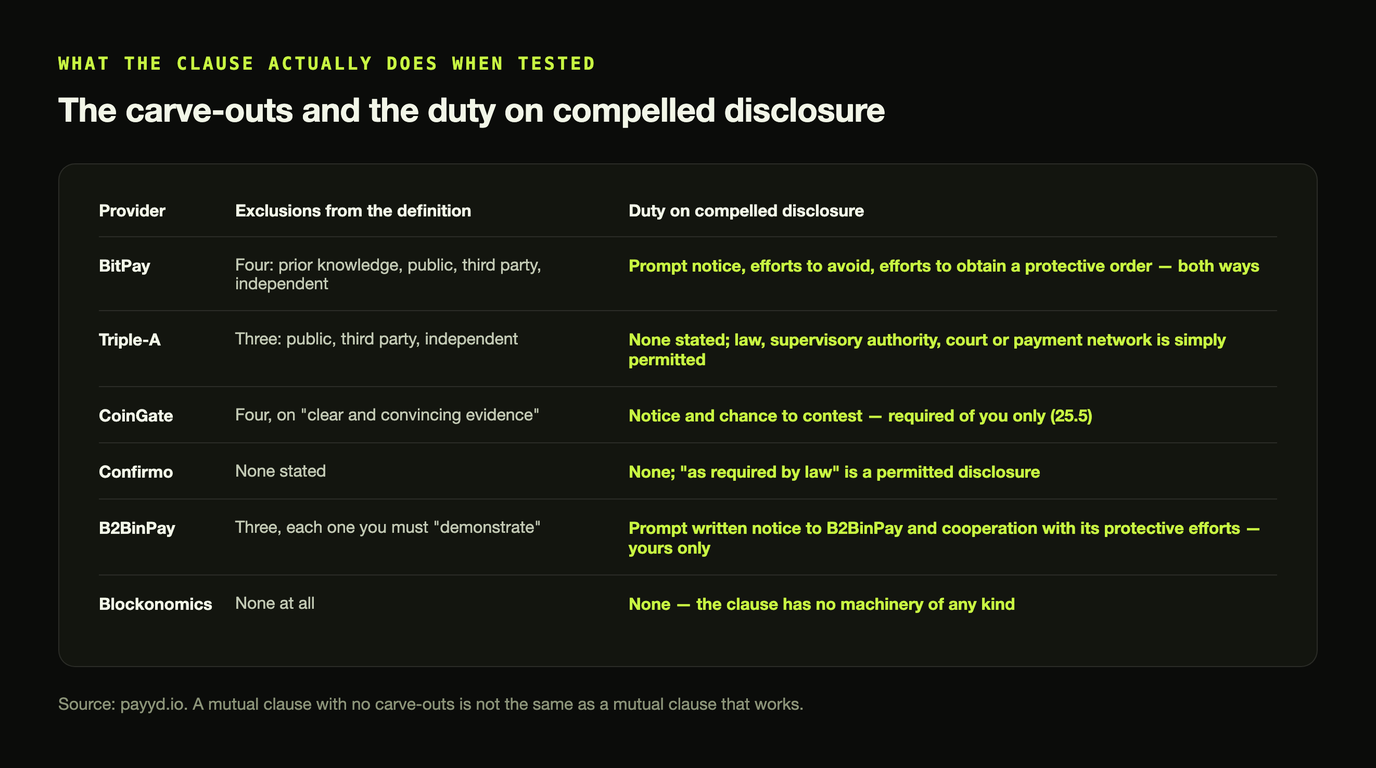
| Provider | Exclusions from the definition | Duty on compelled disclosure |
|---|---|---|
| BitPay | Four: prior knowledge, public, third party, independent | Prompt notice, efforts to avoid, efforts to obtain a protective order — both ways |
| Triple-A | Three: public, third party, independent | None stated; law, supervisory authority, court or payment network is simply permitted |
| CoinGate | Four, on "clear and convincing evidence" | Notice and chance to contest — required of you only (25.5) |
| Confirmo | None stated | None; "as required by law" is a permitted disclosure |
| B2BinPay | Three, each one you must "demonstrate" | Prompt written notice to B2BinPay and cooperation with its protective efforts — yours only |
| Blockonomics | None at all | None — the clause has no machinery of any kind |
The clause that stops you publishing your own fees
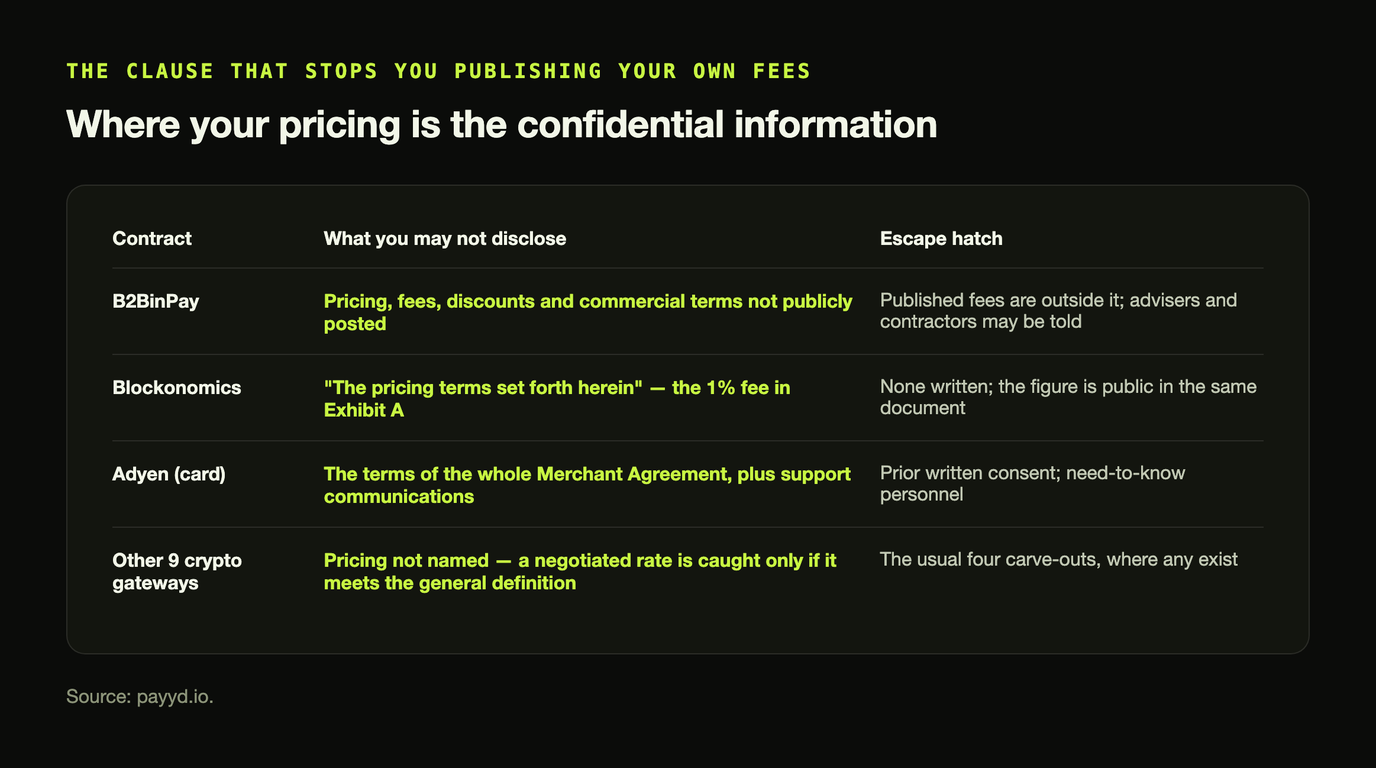
This is the find worth the reading. Two of the eleven contracts make the rate you pay confidential, and in one of them that is the only confidentiality obligation in the entire document.
B2BinPay does it by listing it. Item (d) of its definition is "pricing, fees, discounts and commercial terms not publicly posted" — so a negotiated rate, a volume discount, or anything a salesperson put in an email is Confidential Information you may not pass to a third party. The qualifier does real work: fees published on the website are outside the clause, a bespoke quote is inside it. If you are benchmarking providers against a discount you were offered, that comparison is exactly what the clause covers.
Blockonomics does it in a single sentence with no scaffolding at all. In Exhibit A, the Fee Schedule, immediately after the line setting a one percent transaction fee, the document says: "The pricing terms set forth herein are confidential and shall not be shared with any third parties." There is no definition of confidential information, no carve-out for legal compulsion, no permitted recipients, no survival provision and no mutual duty. It is the only confidentiality obligation in the contract.
And the number it protects is published. Exhibit A sits inside the same public terms document anybody can read without an account, which states the one percent fee in the sentence before the gag. So the clause restricts you from repeating a figure the provider itself publishes — still a term you agreed to, but no real restraint on anyone quoting the public page. Read it next to how notice of a change to that figure works in the fee changes comparison.
| Contract | What you may not disclose | Escape hatch |
|---|---|---|
| B2BinPay | Pricing, fees, discounts and commercial terms not publicly posted | Published fees are outside it; advisers and contractors may be told |
| Blockonomics | "The pricing terms set forth herein" — the 1% fee in Exhibit A | None written; the figure is public in the same document |
| Adyen (card) | The terms of the whole Merchant Agreement, plus support communications | Prior written consent; need-to-know personnel |
| Other 9 crypto gateways | Pricing not named — a negotiated rate is caught only if it meets the general definition | The usual four carve-outs, where any exist |
How long it lasts, and who deletes anything
Generic non-disclosure explainers talk about two-year terms, three-year terms, and indefinite protection for trade secrets. Not one crypto contract in this set states a number of years. Every obligation that survives, survives open-endedly.
BitPay is the only one that defines the end point rather than leaving it blank: the duty runs until the information "becomes public information through no fault of the receiving party", and cl. 18.11 lists s. 18 among the surviving sections. Triple-A says so three times over — cl. 9.5, then the survival lists at cll. 3.7(c) and 17.5. Confirmo names confidentiality in both of its, cll. 17.6(f) and 23.6. CoinGate, which has the longest clause of the four, never addresses survival at all.
Deletion is where the gap with the card rails is widest. Among the crypto gateways only B2BinPay has a return-or-delete obligation, and only against you: on request or at termination you must promptly return or securely delete its Confidential Information, and "We may require written certification of deletion", with a retention carve-out for law, compliance, audit and dispute purposes. Nobody else in crypto has a deletion duty in either direction, and nobody at all has one running against the provider. Authorize.net gives both sides thirty calendar days from termination to destroy everything and certify it by an authorised officer on request — the only clock in all fifteen documents, and it points both ways.
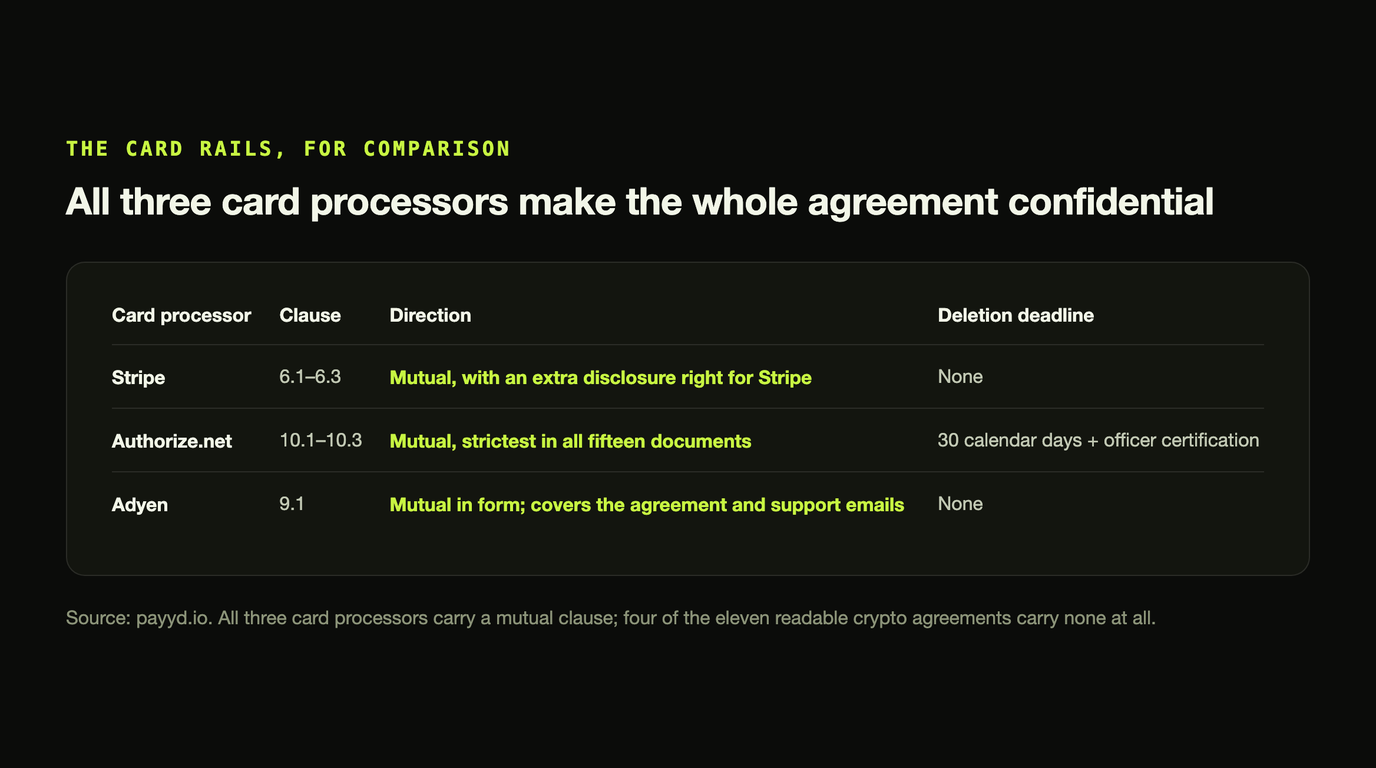
The card rails make the whole agreement confidential
As with marks and audit rights, the benchmark inverts the expectation. The card processors are not looser here; they are tighter, more mutual, and in one case far broader than anything a crypto gateway attempts.
Stripe s. 6 is mutual and short. Each party uses reasonable care and no less than the care it applies to its own confidential information of a similar nature. Permitted recipients need a legitimate need to know and obligations "at least as protective". Two details are worth noting: Stripe adds a one-sided permission to share your Confidential Information with Financial Providers, their affiliates and its own service providers as reasonably necessary to perform the services; and under cl. 6.3, if you want help contesting a compelled disclosure, "Any assistance provided by Recipient to help Discloser contest the disclosure will be at Discloser's sole expense" — your protective order, your legal bill.
Authorize.net s. 10 is the strictest clause in all fifteen documents and it is symmetrical. Both sides hold the other's information in strict confidence, may not divulge it to any third person, may not use it outside the agreement, may not copy or reverse engineer it, and must bind every employee, subcontractor or agent in writing — then destroy and certify within thirty days under cl. 10.2.
Adyen cl. 9.1 is the broadest gag in the set. Confidential Information covers all information relating to either party designated as confidential, plus anything that "should reasonably be deemed confidential by reason of its nature or content". And then the sentence no crypto contract writes: "Merchant acknowledges that the terms of the Merchant Agreement and any information provided by Adyen on its Services (including communications from Adyen's support functions) are Confidential Information." The contract itself is confidential, and so is the reply from the support desk. The bar is then asymmetric in the same breath: no third-party disclosure without prior written consent, "except for Adyen where necessary to perform the Services".
| Card processor | Clause | Direction | Deletion deadline |
|---|---|---|---|
| Stripe | 6.1–6.3 | Mutual, with an extra disclosure right for Stripe | None |
| Authorize.net | 10.1–10.3 | Mutual, strictest in all fifteen documents | 30 calendar days + officer certification |
| Adyen | 9.1 | Mutual in form; covers the agreement and support emails | None |
Five checks before you sign
One: search the document for "confidential" before reading anything else. Zero hits is a real answer and takes ten seconds to get. A heading is not a clause either — Cryptomus proves that, so read the sub-clauses, not the heading.
Two: find the definition and check which way it points. The direction lives in one phrase. "Disclosed by one Party to the other" is mutual; "disclosed by or on behalf of us to you" is not. Everything downstream inherits that phrase, so a long, careful, professional-looking section can still protect only one side.
Three: decide whether you need to talk about your rate. If you negotiate a discount with B2BinPay, that discount is Confidential Information by name. If published pricing is all you rely on, the clause does not reach it — worth settling before a rate goes into a tender or a forum post.
Four: read the deletion and survival terms together. An indefinite obligation with no deletion duty means both sides keep everything forever and stay bound forever. That is the crypto norm here. Authorize.net's thirty days is the model to ask for.
Five: if the contract is silent, ask for a one-page mutual NDA. Four of these eleven have no clause to amend, which makes a standalone agreement easier to get than a contract variation. Do it before you hand over customer records or volume forecasts, not after the breach notification comparison becomes relevant to you.
Four of eleven readable contracts never promise you confidentiality at all.
We read fees, custody, KYC and contract terms for every processor in the directory. BitPay is the only one whose clause names your own data as protected information; Triple-A has the fullest drafting; BTCPay Server is self-hosted, so there is no counterparty to owe you secrecy in the first place.
Compare Crypto Payment Gateways →Affiliate disclosure: Payyd earns a commission if you sign up to some providers linked on this page. It changes none of the clauses or findings reported here, all of which come from the providers' own published documents and are linked below.
FAQ
Does my crypto payment gateway have to keep my business information confidential?
Only if the contract says so, and four of the eleven we read say nothing at all. BitPay, Triple-A, CoinGate and Confirmo have mutual clauses; B2BinPay, Blockonomics and PassimPay bind only you; OpenNode, NOWPayments, Cryptomus and BlockBee have no confidentiality clause in either direction.
Can I tell people what fees I pay my crypto payment gateway?
Under nine of the eleven, pricing is not named and a published rate is plainly repeatable. B2BinPay expressly covers "pricing, fees, discounts and commercial terms not publicly posted", so a negotiated discount is caught. Blockonomics says its pricing terms are confidential, although the 1% figure appears in the same public document.
Is a confidentiality clause the same as a data protection clause?
No, and conflating them is the common mistake. Confidentiality is a contractual promise between you and the provider about non-public business information. Data protection is a statutory regime about personal data. Cryptomus heads a section "Confidentiality and Data Protection" and delivers only the second.
How long do crypto gateway confidentiality obligations last?
Indefinitely, wherever they exist. No contract in this set states a term in years. BitPay runs its obligation until the information becomes public through no fault of the recipient; Triple-A and Confirmo list confidentiality in their survival clauses without an end date; CoinGate never mentions survival.
Do I have to delete the gateway's confidential information when I leave?
Only B2BinPay requires it, on request or at termination, and it may demand written certification of deletion. No crypto gateway in this set owes you the reverse. Authorize.net is the only contract anywhere here with a deadline: thirty calendar days, both ways, with certification by an authorised officer on request.
Can I talk about a dispute with my payment gateway?
Not under PassimPay, whose arbitration clause bars you from disclosing even the existence of the arbitration, along with any document, submission, transcript or award, unless the law requires it or enforcement proceedings need it. It is the only confidentiality obligation in that contract.
Which crypto payment gateway has the best confidentiality terms for merchants?
BitPay, narrowly: its clause is mutual, names "all Merchant or Donee … data" as protected, carries a real compelled-disclosure procedure, and appears again in the survival section. Triple-A is the fullest drafted.
Sources
Confidentiality, non-disclosure, deletion and survival provisions, read 17 November 2026:
- BitPay Merchant and Donee Terms of Use — terms effective on 13 November 2026; cll. 18.10 Confidentiality, 18.11 Survival
- Confirmo Limited Terms and Conditions (PDF) — last updated 2 October 2026; cll. 20.1, 20.5, 17.6(f), 23.6
- Triple-A General Terms and Conditions — version date 20 April 2026; s. 9 (cll. 9.1–9.5), definition in s. 2, survival at cll. 3.7(c) and 17.5
- B2BinPay Terms of Use — last updated 26 June 2026; Confidentiality (unnumbered), all eight sub-headings
- CoinGate Merchant Terms of Service — s. 25 (cll. 25.1–25.6). Clause 25.2 carries a numbering slip, printing "26.3." mid-clause
- OpenNode Terms and Conditions — last update 29 August 2024; no confidentiality clause. ss. 4.2, 10, 11, 12, 16.1
- NOWPayments Terms of Service (PDF) — last updated 19 October 2026 (FD Transfers LLC); no confidentiality clause
- Cryptomus Terms of Use — last updated 17 August 2026; s. 13 (cll. 13.1–13.6) is a privacy notice; cl. 11.10 places its only duty on the user
- PassimPay Terms of Service — last updated 11.05.2026 in the document's own format; arbitration clause
- BlockBee Terms and Conditions — effective 2 October 2026; the word "confidential" does not appear
- Blockonomics Privacy Policy and Terms of Service — undated (OneByZero Tech); Exhibit A Fee Schedule
- plisio.net — not readable on 17 November 2026: no DNS record, no connection. It served a security-incident notice for the five previous readings
- Stripe Services Agreement — last modified 28 September 2026; s. 6 (cll. 6.1–6.3)
- Authorize.net Payment Gateway Merchant Services Agreement — s. 10 Confidential Information (cll. 10.1–10.3)
- Adyen Terms and Conditions — effective from 7 March 2023; cl. 9.1 Confidentiality