
Crypto Gateway Logo Rights 2026: Who May Use Whose
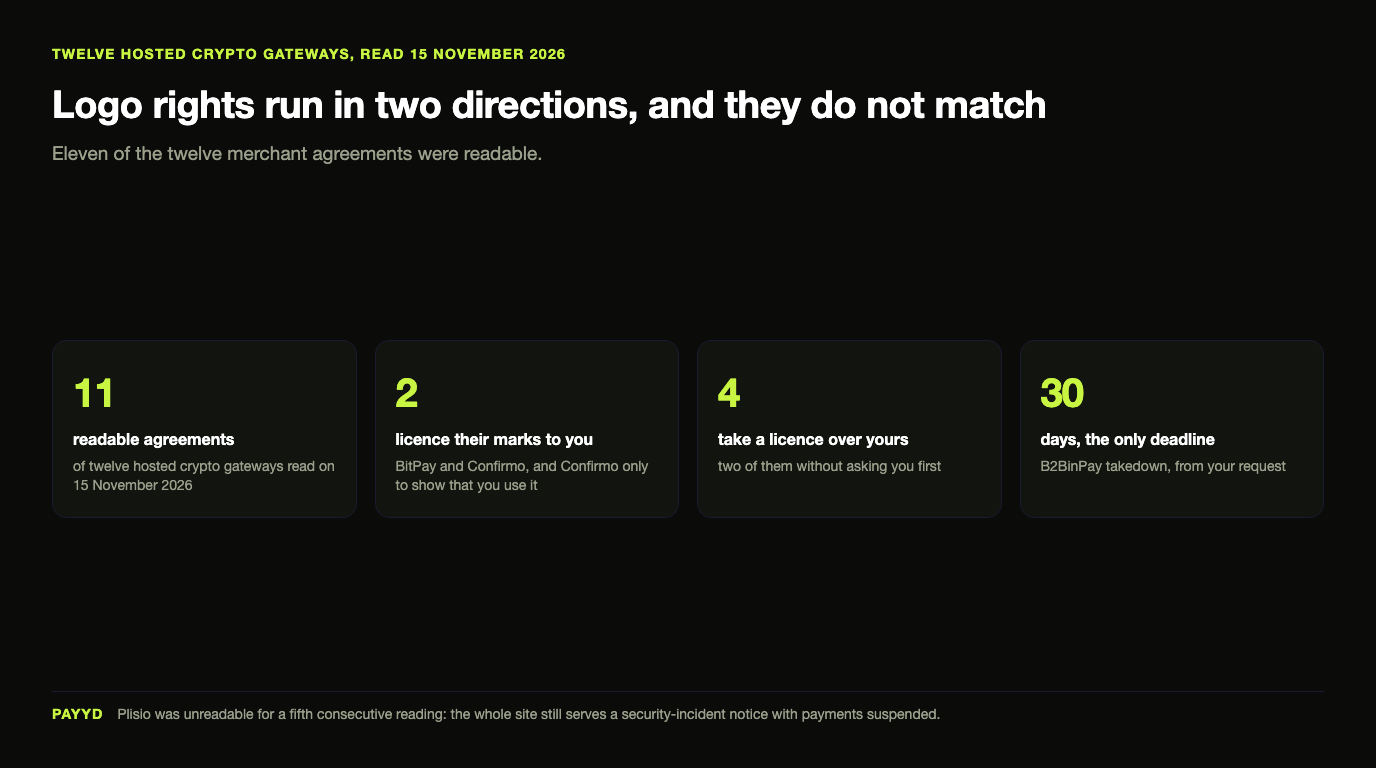
Crypto gateway logo rights, read across 11 merchant contracts in November 2026: only two licence their marks to you, and seven never mention publicity.
 Brian Ormond
Key Takeaways
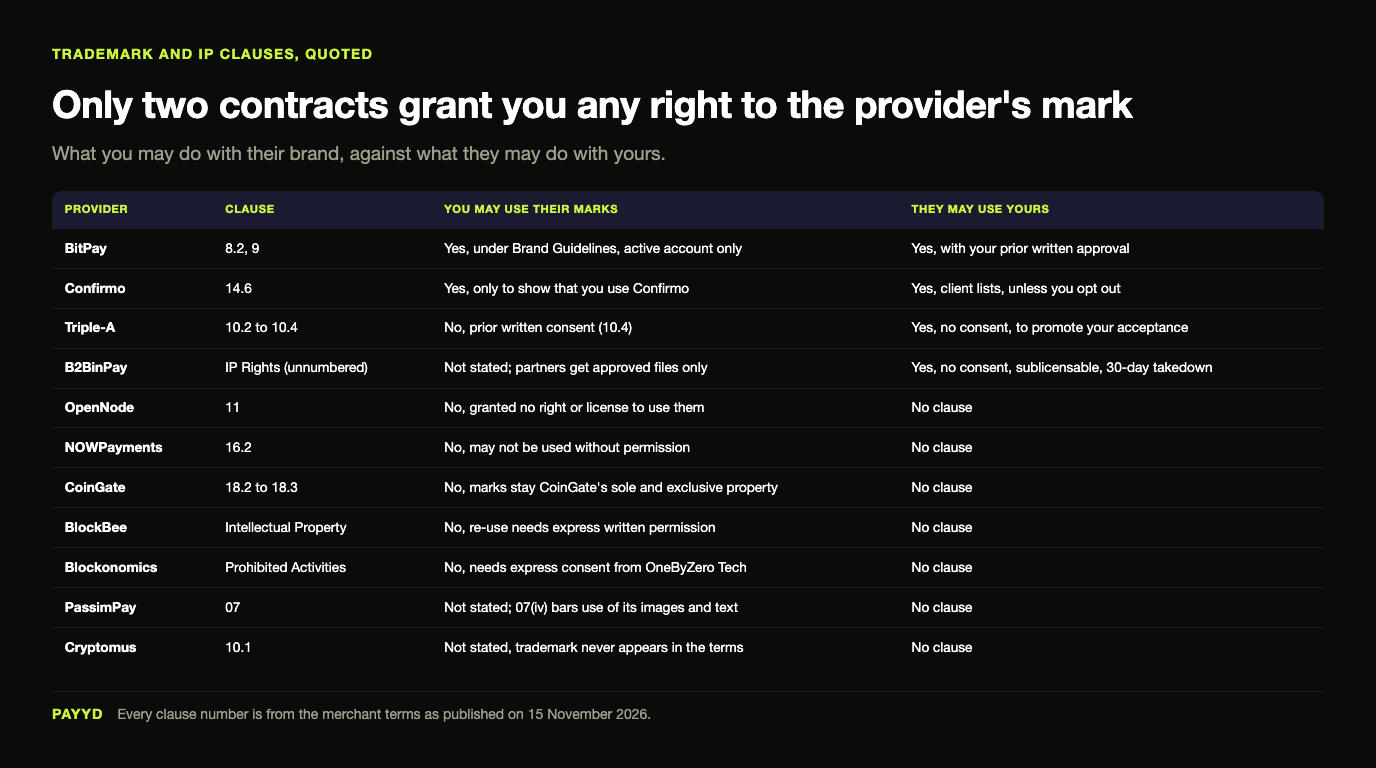
- Only two of eleven readable merchant contracts let you put the gateway's logo on your checkout. BitPay cl. 8.2 permits the BitPay Marks "made available to you by us through our Brand Guidelines" while your account is active; Confirmo cl. 14.6 permits its name and logos "solely to indicate that you use Confirmo for crypto-asset services". Nobody else grants a licence.
- OpenNode writes the flat refusal, and it is the clearest sentence in the set. Section 11: the OpenNode name and logo "are trademarks of OpenNode and its licensors and providers and You are granted no right or license to use them". NOWPayments cl. 16.2 requires permission; BlockBee and Blockonomics require express written consent.
- Four contracts take a licence over your brand, and two need no consent at all. Triple-A cl. 10.2 covers promoting "the Merchant's acceptance of digital payment tokens"; B2BinPay may display your marks "on our websites, in press releases, and in other promotional materials or contexts, at their sole discretion". BitPay asks first; Confirmo lets you opt out.
- Three gateways publish a logo kit their own contract never licensed. CoinGate's brand-assets page restricts the files to "personal or non-commercial purposes, unless written permission is obtained" and adds that "No rights are granted through downloading or copying".
- The only takedown clock in the set is B2BinPay's thirty days. It is also the only contract that stops using your name once that would "objectively be considered to be harmful to your reputation". Seven of eleven say nothing about publicity in either direction.
You add a "Pay with crypto, powered by X" badge to your checkout because it lifts conversion, and six months later a lawyer asks who gave you permission. Crypto gateway logo rights run in two directions at once — what you may do with the provider's brand, and what the provider may do with yours — and the contracts in this directory answer the first question far less often than merchants assume.
The stakes are small until they are not. A badge used outside a licence is trademark infringement rather than a breach of contract, and on the other side of the clause four of these providers can put your name in a press release, two of them without asking. We read the intellectual-property, trademark, publicity and feedback clauses in the merchant terms of twelve hosted crypto gateways on 15 November 2026, then read Stripe, Authorize.net and Adyen against them. Eleven were readable. Two licence their marks to you, four take a licence over yours, and the only deadline in the set is thirty days.
These are the same contracts we read for the audit rights comparison and the assignment comparison. The twelfth, Plisio, has now been unreadable for five consecutive readings: the whole site, legal pages included, still serves a security-incident notice with payments suspended.

Fourteen documents, two questions
Every clause in this article answers one of two questions, and almost no contract answers both. May you display their mark? May they display yours? We put each contract against both, plus the feedback clause that quietly sits in the same section, because a suggestion you email to support is intellectual property too.
The pattern is not the one the contract templates ranking for these searches describe. They present a reciprocal marks licence as standard boilerplate. In the real documents, nine of eleven grant the merchant nothing and seven are silent on publicity in both directions — neither a yes nor a no, and the hardest answer to act on.
| Provider | Clause | You may use their marks | They may use yours |
|---|---|---|---|
| BitPay | 8.2, 9 | Yes — Brand Guidelines, active account only | Yes, with your "prior written approval" |
| Confirmo | 14.6 | Yes — only to show that you use Confirmo | Yes, client lists, unless you opt out |
| Triple-A | 10.2–10.4 | No — prior written consent (10.4) | Yes, no consent — to promote your acceptance |
| B2BinPay | IP Rights (unnumbered) | Not stated; partners get "approved" files only | Yes, no consent — sublicensable, 30-day takedown |
| OpenNode | 11 | No — "granted no right or license to use them" | No clause |
| NOWPayments | 16.2 | No — "may not be used without permission" | No clause |
| CoinGate | 18.2–18.3 | No — marks stay CoinGate's "sole and exclusive property" | No clause |
| BlockBee | Intellectual Property | No — re-use needs "express written permission" | No clause |
| Blockonomics | Prohibited Activities | No — needs "express consent from OneByZero Tech" | No clause |
| PassimPay | 07 | Not stated; 07(iv) bars use of its images and text | No clause |
| Cryptomus | 10.1 | Not stated — "trademark" never appears in the terms | No clause |
Crypto gateway logo rights: only two contracts grant one
BitPay cl. 8.2 is the most complete mark licence any crypto gateway in this directory gives a merchant, and it is worth reading closely because every limit in it is doing work. You may use "those BitPay Marks that are made available to you by us through our Brand Guidelines", and only "while you have an active Account" — so the licence is to a curated set of files, not to the brand at large, and it ends when the account does. Clause 4.8.3(d) says so expressly: on closure you agree "to remove from your website, apps and marketing materials and will discontinue using any BitPay service marks, logos or other branding".
Two further terms are easy to skim past. "Any and all goodwill arising from your use of the BitPay Marks will inure to our sole and exclusive benefit" — standard trademark practice, and still worth knowing you agreed to it. And the guidelines change under you: you are responsible for the current version, with "up to sixty days following an update to make any necessary changes". That is the only grace period in the set.
Confirmo cl. 14.6 gets to a similar place in one sentence and a narrower scope. You may use its name and logos "on your sites and promotional materials solely to indicate that you use Confirmo for crypto-asset services, and subject to any brand guidelines we provide". That is a nominative-use permission rather than a brand licence: it covers the true statement that Confirmo is your processor, and nothing that implies Confirmo endorses you.
What both do that nobody else does is answer the question. The nine remaining contracts leave you reasoning from a default, and the default is restrictive.
Where crypto gateway logo rights are a no, or a silence
OpenNode writes the sentence the rest of the set implies. Section 11: the OpenNode name, logo and product names "are trademarks of OpenNode and its licensors and providers and You are granted no right or license to use them." An unambiguous no is more useful than a silence, because you can plan around it.
Three more require permission without ever framing it as a licence. NOWPayments cl. 16.2: its trademarks and trade names "may not be used without permission in connection with any third-party products or services" — and your checkout is a third-party product. BlockBee's intellectual-property section bars re-using material from its website, logos included, "unless given express written permission to do so by us". Blockonomics goes further and lists it among prohibited activities: "use of our intellectual property, name, or logo, including use of our trade or service marks, without express consent from OneByZero Tech", plus "any action that implies an untrue endorsement by or affiliation with OneByZero Tech".
Then the silences. CoinGate cl. 18.3 keeps its trademarks the "sole and exclusive property" of CoinGate and says you "shall have no rights" in them. PassimPay s. 07(iv) forbids using "any PassimPay content, including images and text, as part of any other software or project of any kind". Cryptomus is the outlier: the word "trademark" does not appear anywhere in its terms. Triple-A is the politest version — cl. 10.4 bars either party from using the other's marks "for publicity, marketing, or other external communications without the prior written consent of the other Party" — and the exception buried in that sentence is the subject of two sections below.
Three logo kits the contract never licensed
Here is where the clause stops being academic. Four of the eleven gateways publish a downloadable brand kit, and only one of them is the gateway whose contract licenses you to use it. The marketing side of the house hands you a logo; the legal side grants you nothing. We checked each page on 15 November 2026.
CoinGate's brand-assets page is the sharpest example, because it answers the question its contract ducked, and the answer is no: the assets "can only be used for personal or non-commercial purposes, unless written permission is obtained from CoinGate", and "No rights are granted through downloading or copying". A logo on a commercial checkout is commercial use, so the obvious thing — download the official file, put it beside the payment button — goes outside both documents at once.
B2BinPay's brand-assets page and Cryptomus's brand-guideline page are style guidance rather than permission: do not recolour, rotate or stretch the logo, use the approved files. Useful if you have a licence; silent on whether you have one. Neither contract grants one.
BitPay is the one place the two halves meet. Clause 8.2 names a URL, and the URL works — the Merchant and Donee Terms point at bitpay.com/brand, the older Send Terms at brand.bitpay.com, and both resolve to one live Brand Guide with a logo set, clear-space rules, a payment mark, a payment button and a downloadable kit. It is the only mark licence in this set pointing at an artefact that exists.
Who may put your name in their marketing
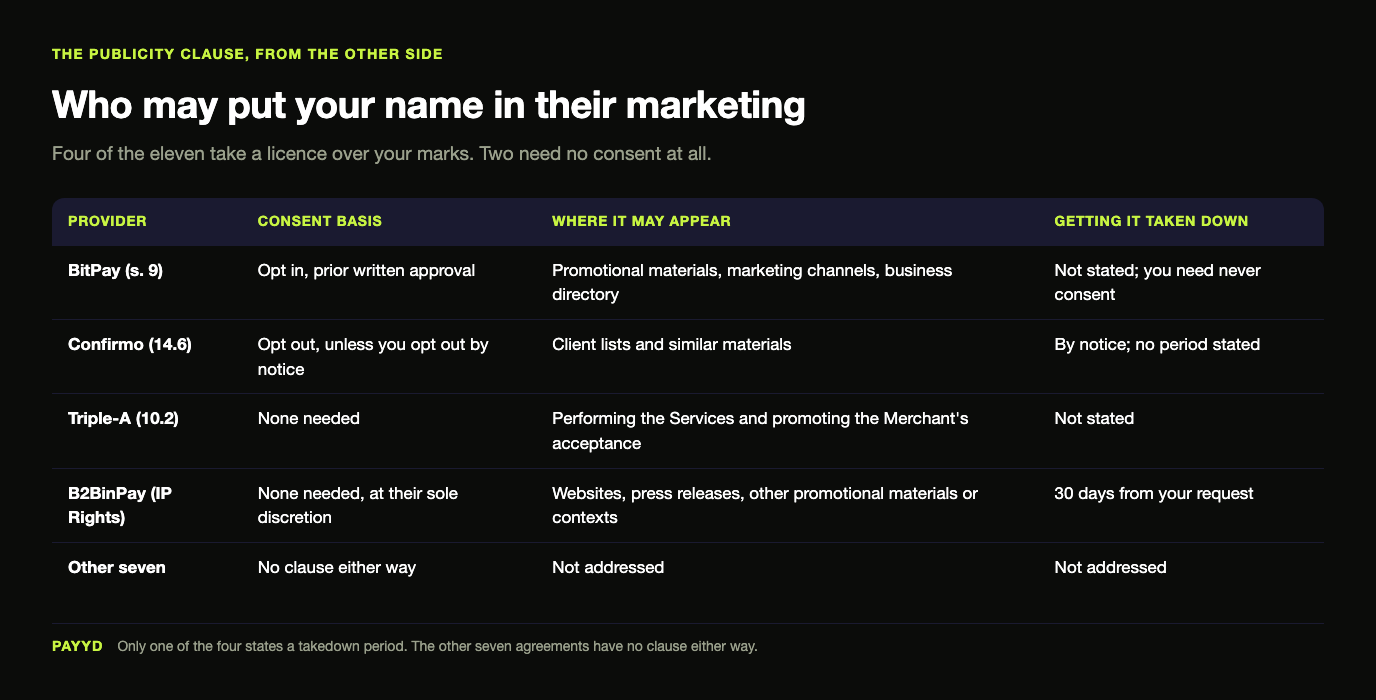
Reverse the question and the contracts get more generous — to themselves. Four of eleven take a licence over the merchant's brand, and the interesting variable is not whether they take one but what they need from you first.
| Provider | Consent basis | Where it may appear | Getting it taken down |
|---|---|---|---|
| BitPay (s. 9) | Opt in — "prior written approval" | Promotional materials, marketing channels, business directory | Not stated; you need never consent |
| Confirmo (14.6) | Opt out — "unless you opt out by notice" | Client lists "and similar materials" | By notice; no period stated |
| Triple-A (10.2) | None needed | Performing the Services and "promoting the Merchant's acceptance" | Not stated |
| B2BinPay (IP Rights) | None needed — "at their sole discretion" | Websites, press releases, "other promotional materials or contexts" | 30 days from your request |
| Other seven | No clause either way | — | — |
Triple-A is the one to read twice, because the exception is hidden inside the restriction. Clause 10.4 bars either party from marketing use without prior written consent — "except as expressly permitted in Clause 10.2". And cl. 10.2 is where you grant Triple-A a licence to use your marks "solely for the purpose of performing the Services and promoting the Merchant's acceptance of digital payment tokens". The mutual-consent rule binds you and carves out Triple-A's own marketing. That is this article's asymmetry in one sentence.
B2BinPay is blunter and, oddly, fairer. The licence it takes is worldwide, royalty-free, sublicensable and transferable — so it travels to whoever buys the business, which is worth reading alongside what we found on assignment. But it is also the only contract in the set with a brake: B2BinPay may use your name only "for as long as it would not objectively be considered to be harmful to your reputation", and on request will remove your marks "within a commercially reasonable period, not to exceed thirty (30) days". Nobody else gives a number.
BitPay is the merchant-friendly end. Section 9 needs your "prior written approval" before publishing your corporate name, URL, artwork, logo or case studies, and adds a sentence no other contract bothers with: "You have no obligation to provide Content, a testimonial, quote or reference."
The clause that turns your suggestion into their property
Four of the eleven contracts carry a feedback clause, in the same section as the marks. It matters because merchants file feature requests constantly — a better refund flow, a webhook, a settlement currency — and the clause decides who owns the idea.
OpenNode is the only one that takes ownership outright rather than a licence. Section 12: feedback "will be the exclusive property of OpenNode", and "To the extent You own any rights in the Feedback, You hereby agree to, and hereby do, assign all right, title and interest" — a present-tense assignment, with a promise to sign whatever is needed to perfect it.
The other three take perpetual licences, which get to the same practical place. Confirmo cl. 14.10 takes a "perpetual, irrevocable, royalty-free licence to use them without restriction and without payment". B2BinPay adds transferable and sublicensable, "without restriction or compensation". Blockonomics takes the widest version: "non-exclusive, worldwide, perpetual, irrevocable, fully-paid, royalty-free, sublicensable and transferable", including the right to "create derivative works".
Cryptomus is the one place where feedback is treated as correspondence rather than property: cl. 17.2 gives a support address and claims nothing. Triple-A, CoinGate, NOWPayments, PassimPay and BlockBee have no feedback clause at all. None of this is unusual or sinister — Stripe cl. 5.2 does the same thing — but it is the reason to put a commercial idea in a priced conversation rather than a support ticket.
The card rails are reciprocal, and Adyen is the hardest line here
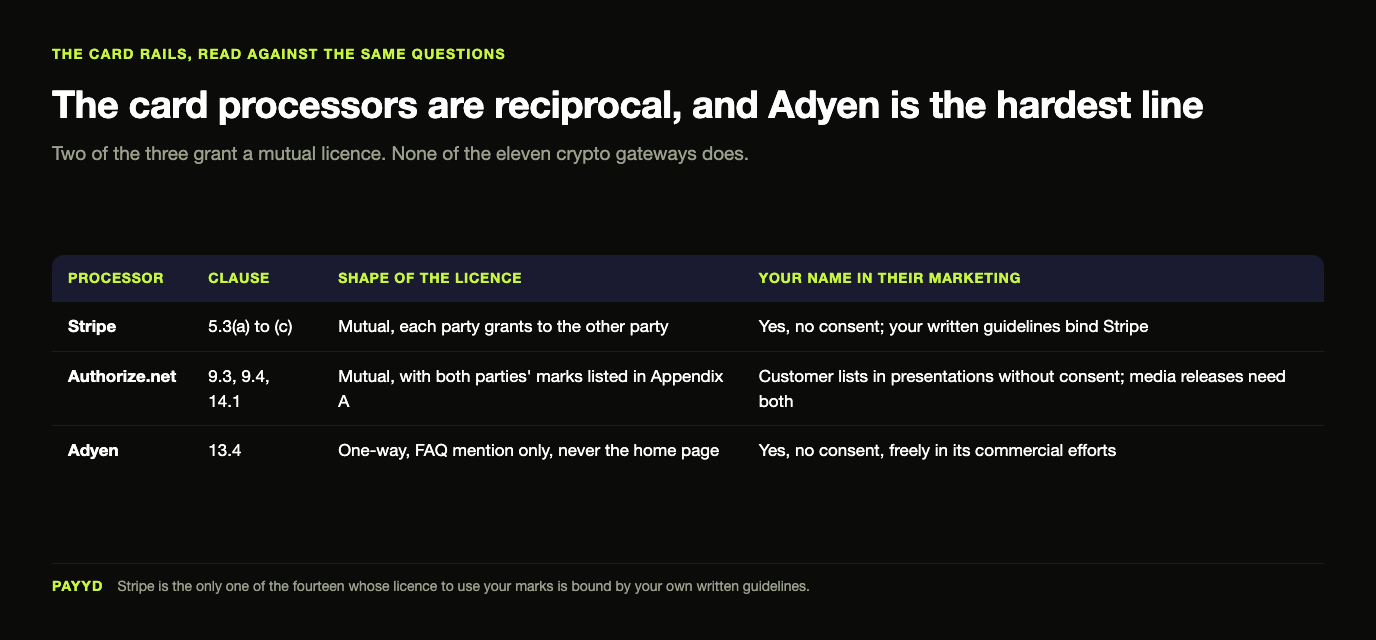
On fees and liability caps, reading the card processors against the crypto gateways usually flatters the cards. On marks it does something more interesting: the card rails are drafted reciprocally, and the single most restrictive clause in all fourteen documents belongs to a card acquirer.
| Processor | Clause | Shape of the licence | Your name in their marketing |
|---|---|---|---|
| Stripe | 5.3(a)–(c) | Mutual — "each party … grants to the other party" | Yes, no consent; your written guidelines bind Stripe |
| Authorize.net | 9.3, 9.4, 14.1 | Mutual, with both parties' marks listed in Appendix A | Customer lists in presentations without consent; media releases need both |
| Adyen | 13.4 | One-way — FAQ mention only, never the home page | Yes, no consent, "freely" in its commercial efforts |
Stripe cl. 5.3(a) grants each party a licence to the other's marks "solely to provide the Services to User and to identify Stripe as User's service provider", and 5.3(c) sends you to a published Mark Usage Terms page, last updated 12 June 2023. Authorize.net goes further than anything in crypto: s. 9.3 licenses its trademarks for your website, s. 9.4 licenses yours back, s. 9.6 requires the ® or ™ symbol at the first and most prominent reference, and Appendix A names the actual marks on both sides — a list no crypto contract here attempts.
Adyen cl. 13.4 is the outlier in the other direction. Your name and standard logo "may be included by Adyen on the Adyen client list on its website and in its sales materials", and Adyen may use that list "freely in its commercial efforts". You may refer to Adyen in a frequently-asked-questions section, "may not mention Adyen on the home page of its website in any situation", and may not use the Adyen logo anywhere without prior express written approval "which Adyen may refuse or withdraw in its discretion". Measured against that, OpenNode's flat no is mild and BitPay's brand kit is generous.
Four checks before a logo goes anywhere
One: find the word "Marks" before you find the logo file. If the only mark language in your contract is a prohibition or an ownership statement, you have no licence, and the brand kit on the website is not one either — CoinGate's says so in two sentences.
Two: if you want the badge and the contract is silent, ask in writing and keep the reply. Every silent contract in this set has a general permission mechanism, and an email granting express consent costs the provider nothing. The providers with the clearest answer, BitPay and Confirmo, have already given it in the terms.
Three: decide now whether you mind being a logo on their website. Nothing to do under BitPay, one notice under Confirmo, a request and up to thirty days under B2BinPay, no stated route at all under Triple-A. Send the notice while the relationship is good, not during a dispute you are reading the dispute resolution clause for.
Four: diarise the badge with the account. The licence dies with the account wherever one is granted, and BitPay cl. 4.8.3(d) makes removal your obligation. A gateway you stopped using two years ago is still in your footer, and that version of this is squarely your problem. The same timing runs through account closure.
- Crypto Gateway Audit Rights 2026: Only Two Can Look
- Crypto Gateway Assignment 2026: None Needs Your Consent
- Crypto Gateway Indemnity 2026: Who Pays for the Claim
- Crypto Gateway Prohibited Businesses 2026: Who Says No
- Crypto Gateway Liability Caps 2026: The One Number
- Crypto Gateway Account Closure 2026: Who Keeps Your Balance
Nine of eleven readable contracts never say whether you may use the badge.
We read fees, custody, KYC and contract terms for every processor in the directory. BitPay is the only one whose mark licence points at a brand guide that exists; Confirmo is the only other that licenses its name to you, and the only one with an opt-out; BTCPay Server is self-hosted, so there is no counterparty with a logo to negotiate over.
Compare Crypto Payment Gateways →Affiliate disclosure: Payyd earns a commission if you sign up to some providers linked on this page. It changes none of the clauses or findings reported here, all of which come from the providers' own published documents and are linked below.
FAQ
Can I put a crypto payment gateway's logo on my checkout page?
On two of the eleven contracts, yes: BitPay cl. 8.2 and Confirmo cl. 14.6 both licence their marks to merchants, within limits. The other nine give an express refusal, a requirement for written permission, or nothing at all — and silence is not permission in trademark law.
Can my crypto payment gateway use my company name and logo without asking?
Triple-A and B2BinPay can, under cl. 10.2 and the unnumbered Intellectual Property Rights section. Confirmo can unless you opt out by notice; BitPay needs your prior written approval. The other seven carry no publicity clause, so there is no contractual permission either way.
Does downloading a gateway's official logo kit give me permission to use it?
No, and CoinGate's brand-assets page says so: the files are for "personal or non-commercial purposes, unless written permission is obtained" and "No rights are granted through downloading or copying". A brand kit is style guidance; the licence, if any, lives in the contract.
What happens to the badge when I close the account?
Both licences end with the account. BitPay cl. 4.8.3(d) makes it your obligation to remove its marks from your website, apps and marketing materials on closure; Confirmo cl. 14.6 permits the statement that you use Confirmo, which stops being true. This is the most commonly breached term here.
Does the gateway licence me the Bitcoin or Tether logos too?
No. Confirmo cl. 14.7 addresses it directly — "We do not grant any licence to third-party protocols, software or marks" — and the position holds across all eleven. Coin and network logos belong to their own projects, each with its own policy.
Who owns a feature request I send to support?
OpenNode owns it outright: s. 12 assigns all right, title and interest in feedback to OpenNode. Confirmo, B2BinPay and Blockonomics take perpetual, royalty-free licences instead, two of them sublicensable. Cryptomus treats feedback as correspondence, and five contracts say nothing.
Which gateway has the clearest terms on this?
BitPay, by a distance: the only one that licences its marks, names the guidelines, publishes them at a working URL, gives sixty days to absorb a change, asks before using your brand and writes down that you may decline. Confirmo is the most concise and the only one offering an opt-out. OpenNode is the clearest no.
Sources
Intellectual-property, trademark, publicity and feedback clauses, read 15 November 2026:
- BitPay Merchant and Donee Terms of Use — effective 13 November 2026; cll. 4.4.1, 4.8.3, s. 8 (8.1–8.2), s. 9; and BitPay Send Terms of Use, effective 1 January 2022, s. 9 (9.1–9.2)
- BitPay Brand Guide — the artefact cl. 8.2 names; brand.bitpay.com resolves to the same page
- Confirmo Limited Terms and Conditions (PDF) — last updated 2 October 2026; s. 14 (cll. 14.1–14.11), esp. 14.5–14.7, 14.10
- Triple-A General Terms and Conditions — version date 20 April 2026; s. 10 (cll. 10.1–10.4), cl. 13(e)
- B2BinPay Terms of Use — last updated 26 June 2026; Intellectual Property Rights and Feedback (unnumbered), Partner Program obligations
- B2BinPay brand assets, Cryptomus brand guidelines — style guidance only
- CoinGate Merchant Terms of Service — last update published 6 February 2024, in force to all merchants 7 May 2024; cll. 16.1.2, 18.2, 18.3
- CoinGate brand assets — non-commercial use only unless written permission is obtained
- OpenNode Terms and Conditions — last update 29 August 2024; s. 10, s. 11 Ownership, s. 12 Feedback
- NOWPayments Terms of Service (PDF) — last updated 19 October 2026 (FD Transfers LLC); cll. 14.1.7, 16.1–16.3
- Cryptomus Terms of Use — last updated 17 August 2026; s. 10 License, cl. 17.2. The word "trademark" does not appear
- PassimPay Terms of Service — last updated 11.05.2026 in the document's own format; s. 07 Limited Intellectual Property License
- BlockBee Terms and Conditions — effective 2 October 2026; Intellectual Property (unnumbered)
- Blockonomics Privacy Policy and Terms of Service — undated; Feedback, Content Ownership, Prohibited Activities (OneByZero Tech)
- plisio.net security-incident notice — the whole site served this notice on 15 November 2026; terms not readable and not reported
- Stripe Services Agreement — last modified 28 September 2026; cll. 5.1(a), 5.2, 5.3(a)–(c) — and Stripe Mark Usage Terms, last updated 12 June 2023
- Authorize.net Payment Gateway Merchant Services Agreement — ss. 9.3–9.8, 14.1, Appendix A
- Adyen Terms and Conditions — effective from 7 March 2023; cl. 13.4 Use of name of the parties